BACB Exam: BCBA, BCaBA, and RBT Format, TCOs, and What to Expect
The phrase BACB exam does not describe one universal test. The Behavior Analyst Certification Board oversees three certification examinations: the BCBA exam, the BCaBA exam, and the RBT exam. They share a computer-based, multiple-choice format and are administered in person through Pearson VUE, but they differ in question count, time limit, eligibility pathway, and test content outline.
This broad guide helps you identify the correct examination before you start studying. It also explains the current content-outline versions and the important 2027 boundary: changes to certification requirements do not automatically mean that a “7th edition” examination outline has replaced the current one. Use the track-specific handbook and current BACB documents for the rule that governs your application.
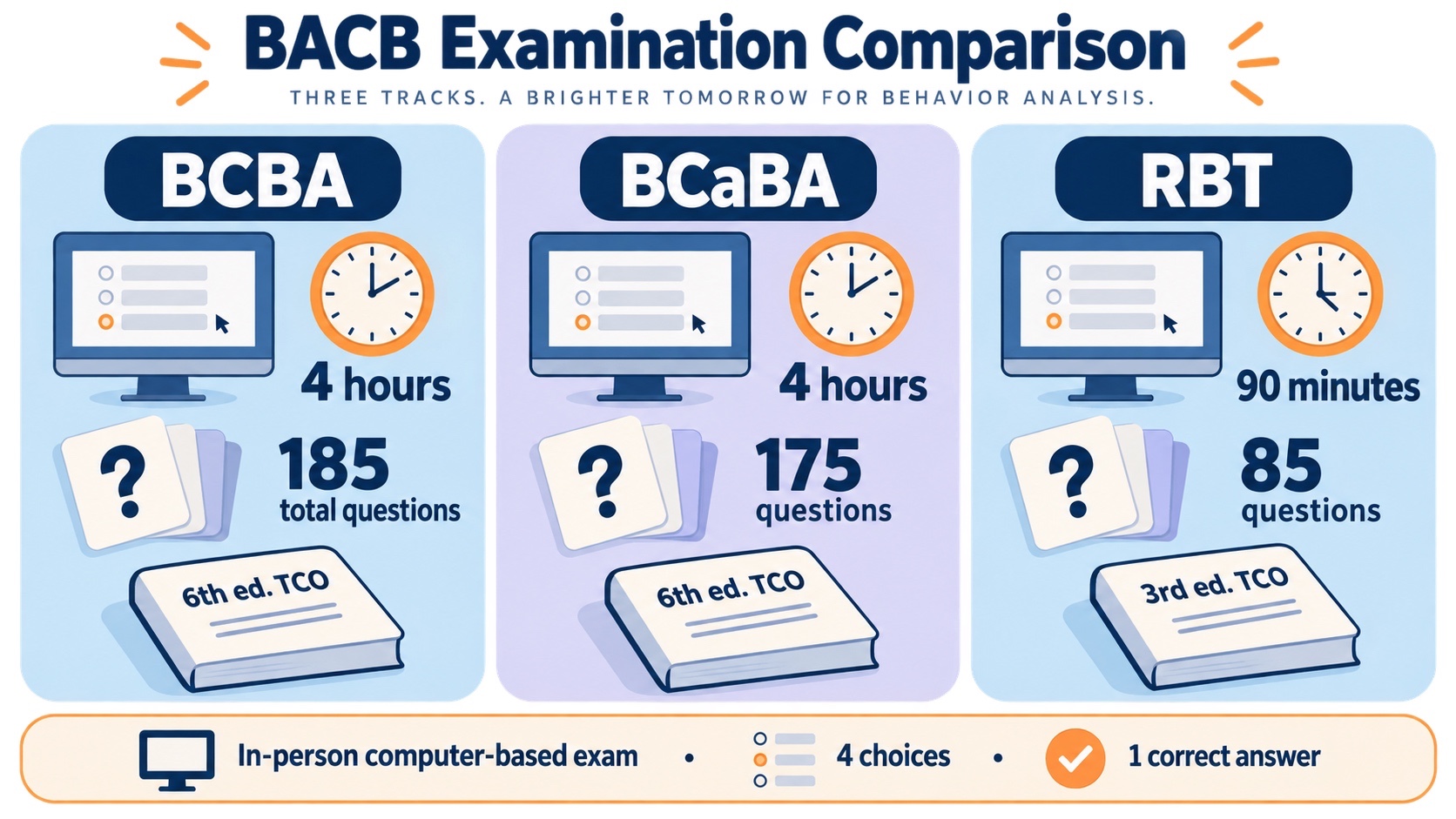
Quick answer: The BACB offers separate BCBA, BCaBA, and RBT certification examinations. The current overview lists 185 total BCBA questions in 4 hours, 175 BCaBA questions in 4 hours, and 85 RBT questions in 90 minutes. All three are in-person computer-based exams with four answer choices per question and one correct answer. You schedule through Pearson VUE after the BACB approves your eligibility and issues an Authorization to Test.
Compare the three BACB examinations
Start by matching the exam to the credential you are pursuing. Do not use a BCBA practice question set as if it were an RBT or BCaBA blueprint simply because all three credentials use behavior-analytic concepts.
| Exam | Time | Total questions | Delivery | Current outline listed by BACB |
|---|---|---|---|---|
| BCBA | 4 hours | 185 total; the handbook describes 175 scored plus 10 unscored | In person, computer-based | BCBA Test Content Outline, 6th ed. |
| BCaBA | 4 hours | 175 | In person, computer-based | BCaBA Test Content Outline, 6th ed. |
| RBT | 90 minutes | 85 | In person, computer-based | RBT Test Content Outline, 3rd ed. |
The “total questions” wording matters for the BCBA exam. The current BACB examination overview reports 185 questions, while the BCBA Handbook explains that 175 are scored and 10 are unscored. Candidates do not need to reverse-engineer the unscored items during the exam; the practical study decision is to prepare for the complete published outline.
When do you schedule the exam?
You do not normally begin by choosing a Pearson VUE appointment and then proving eligibility later. The BACB examination-information page describes a sequence: meet the applicable eligibility requirements, submit the certification application, receive an approved determination, and then take and pass the certification examination.
After approval, Pearson VUE’s BACB page says the candidate receives an Authorization to Test letter by email. Scheduling, rescheduling, and cancellation happen through the Pearson account or Pearson customer service. The BACB does not schedule or change the appointment for you. If you need an accommodation, follow the separate instructions from the BACB because the scheduling process may differ.
The exact eligibility route belongs to the credential-specific handbook. For a BCBA candidate, that can involve degree, coursework, supervised fieldwork, and application documentation. A BCaBA candidate follows a different pathway, and an RBT candidate follows an RBT-specific training and competency process. If you are still deciding which credential fits your situation, begin with the BCBA certification requirements, BCaBA certification, or RBT certification page rather than using an exam article as an eligibility checklist.
Current test content outlines
A test content outline, or TCO, is the exam’s content map. It tells you which tasks or content areas the examination is designed to assess. It is more reliable than a random list of topics from a study group, and it gives a practice-question writer the boundaries for what a question should measure.
The current BACB examination-information page lists the BCBA TCO in its 6th edition, the BCaBA TCO in its 6th edition, and the RBT TCO in its 3rd edition. The BCBA Handbook also says the examination is currently based on the BCBA TCO, 6th edition, and recommends reviewing the applicable TCO, the Ethics Code for Behavior Analysts, and materials from your training.
Use the TCO as a map, not as a promise that every line will receive the same number of questions. For the BCBA exam, the handbook explains that tasks are organized into content areas and that your overall performance determines the result rather than a separate pass/fail score for each content area. The relevant BCaBA and RBT documents control their own outline details.
Does the 2027 change mean a 7th edition?
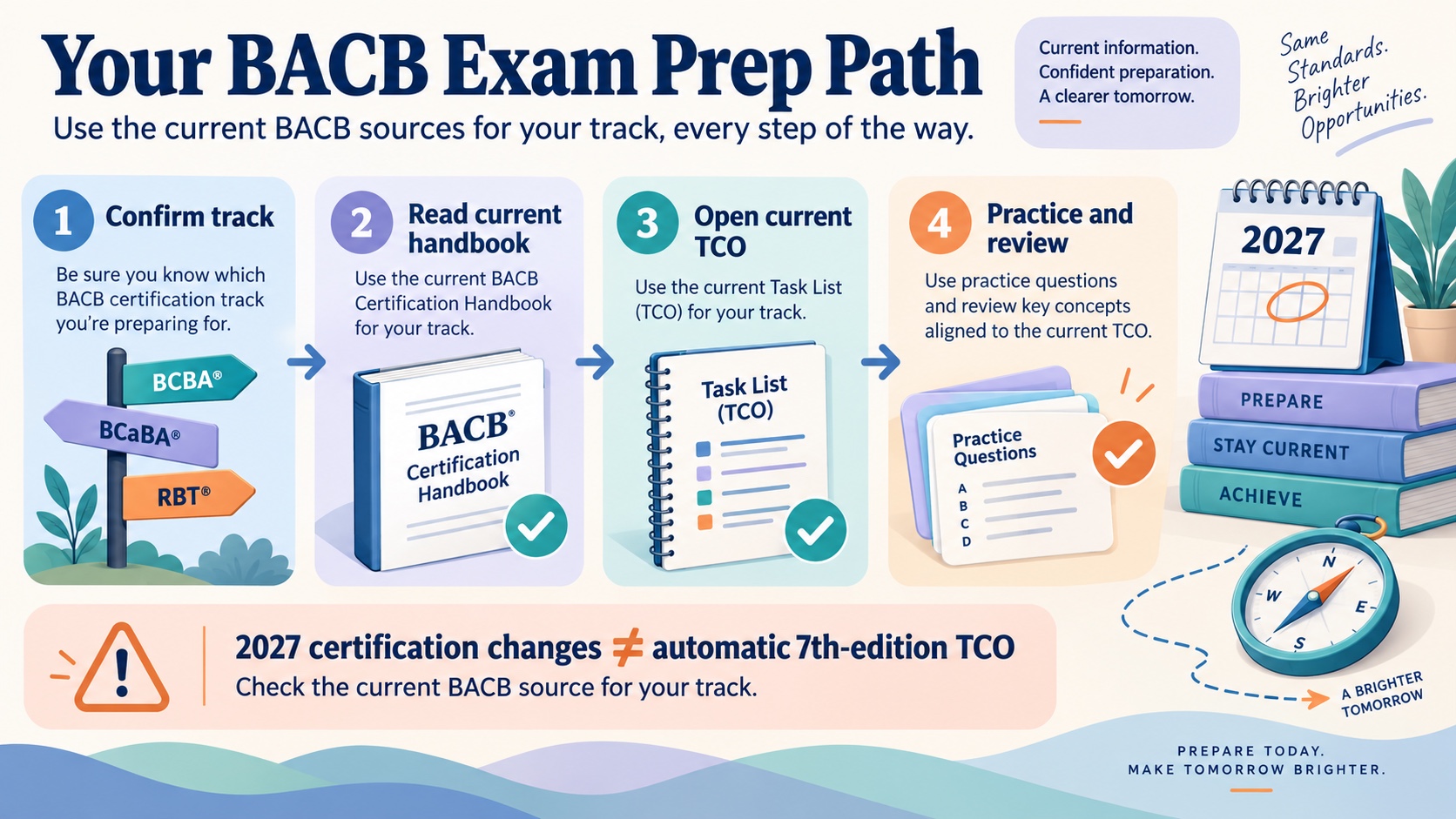
No automatic 7th edition follows from the 2027 certification-requirement transition. The BACB treats eligibility and maintenance requirements separately from examination content. The BCBA transition guidance states that the BCBA examination has been based on the 6th-edition TCO since January 1, 2025 and that there are currently no upcoming changes to the BCBA examination or TCO. It also says that future examination and TCO updates can occur independently of certification-requirement changes.
That distinction is important for your study plan. A new fieldwork form, coursework rule, or application deadline does not by itself change the exam blueprint. Likewise, an eventual new TCO would be a separate official announcement that should be checked against the current handbook and the authorization period. Do not label a practice set “7th edition” unless the official BACB source for that specific track says the 7th edition is in effect.
If you are preparing for BCBA, the BCBA 6th edition task list guide can help you turn the official outline into study blocks. For BCaBA and RBT candidates, choose the matching outline instead of borrowing a neighboring track’s structure.
Pearson VUE and exam-day format
The BACB contracts with Pearson VUE to deliver the examinations in person at authorized testing sites and qualifying U.S. military bases. The BACB examination-information page lists authorized testing in the United States, Canada, Australia, and the United Kingdom and explains that Pearson VUE’s testing page provides the computer-based tutorial, center expectations, and location information.
All three exams use multiple-choice items with four possible answers and one correct answer. That does not mean the questions are simple definition matching. A strong preparation routine should include concept discrimination, scenario application, measurement or decision-making logic when the track requires it, and careful reading of answer choices.
Appointment policies and fees can change. The safest workflow is to verify the current BACB examination-information page and your Pearson VUE account immediately before scheduling or rescheduling. Treat a third-party calendar, screenshot, or old study guide as a lead to verify, not as the governing rule.
How BACB exam scoring works
The BACB uses a modified Angoff method to establish the passing score for each base examination form. A panel of BACB-certified subject-matter experts sets a criterion-referenced standard, and the BACB Board of Directors approves it. Your result is not determined by whether other candidates in your testing window perform better or worse.
The BACB maintains a large question pool and creates multiple forms. Statistical equating accounts for differences in difficulty between forms. That is why there is no universal “you need exactly X percent correct” answer that applies to every form. The BACB does not report the raw number of questions answered correctly. Passing candidates receive a pass notice; failing candidates receive more detailed performance information that can guide further study.
A practice-test percentage is therefore a learning signal, not a guaranteed conversion to the official result. Use missed questions to identify the task, reasoning step, or distractor pattern that needs review. Do not use one unofficial score as a promise that you will pass or fail the BACB examination.
How to prepare without studying blindly
A source-first study loop works across all three tracks:
- Confirm the track: decide whether you are studying for BCBA, BCaBA, or RBT.
- Open the current TCO: turn its tasks or content areas into a checklist.
- Read the governing handbook and ethics material: this supplies definitions, boundaries, and application rules that a keyword list may miss.
- Study concepts before speed: explain why the correct answer fits and why each distractor fails.
- Practice by content area: use a missed-item log that names the task and the reasoning error, not only the percentage.
- Finish with mixed retrieval: combine topics so you practice choosing the right concept under exam-like uncertainty.
ABA Study Online can provide educational explanations and practice resources, but those resources should be treated as study support rather than official BACB examination content. The BACB itself does not endorse specific study guides or guarantee a passing result from purchasing preparation materials.
Common mistakes
- Searching for one “BACB exam”: identify the credential first; BCBA, BCaBA, and RBT are separate exams.
- Using the wrong outline: a BCBA TCO is not a BCaBA or RBT blueprint.
- Assuming 2027 requirements equal a 7th edition: certification-rule changes and TCO updates are separate processes.
- Confusing total and scored questions: the BCBA overview reports 185 total, while the handbook describes 175 scored plus 10 unscored.
- Studying only definitions: multiple-choice exam success also depends on application, distinctions, and distractor analysis.
- Relying on an old appointment policy: confirm scheduling and cancellation information with Pearson VUE before acting.
- Treating a practice score as an official prediction: practice data should guide review, not promise a result.
FAQ
Is the BACB exam online?
The BACB examinations use computer-based testing, but the current official delivery is in person at authorized Pearson VUE testing sites and qualifying military bases. Check the current BACB and Pearson VUE pages for locations and appointment instructions.
How many questions are on the BACB exam?
It depends on the track: 185 total for BCBA, 175 for BCaBA, and 85 for RBT in the current overview. The BCBA Handbook identifies 175 scored and 10 unscored questions within the 185 total.
Is the BCBA exam based on the 7th edition?
Current BACB materials identify the BCBA exam as based on the 6th-edition TCO. The 2027 transition changes certification requirements separately; do not call the exam 7th edition unless the BACB publishes that edition as current for your testing situation.
Can I schedule the exam before my application is approved?
The normal sequence is to meet eligibility requirements, submit the application, receive an approved determination and Authorization to Test, and then schedule through Pearson VUE. Follow the current credential-specific handbook if your situation includes an accommodation or transition issue.
Does BACB publish one passing percentage?
No. The BACB uses criterion-referenced standards and equates multiple forms. The raw number or percentage correct needed can vary by form, and the BACB does not report a universal raw-correct threshold.