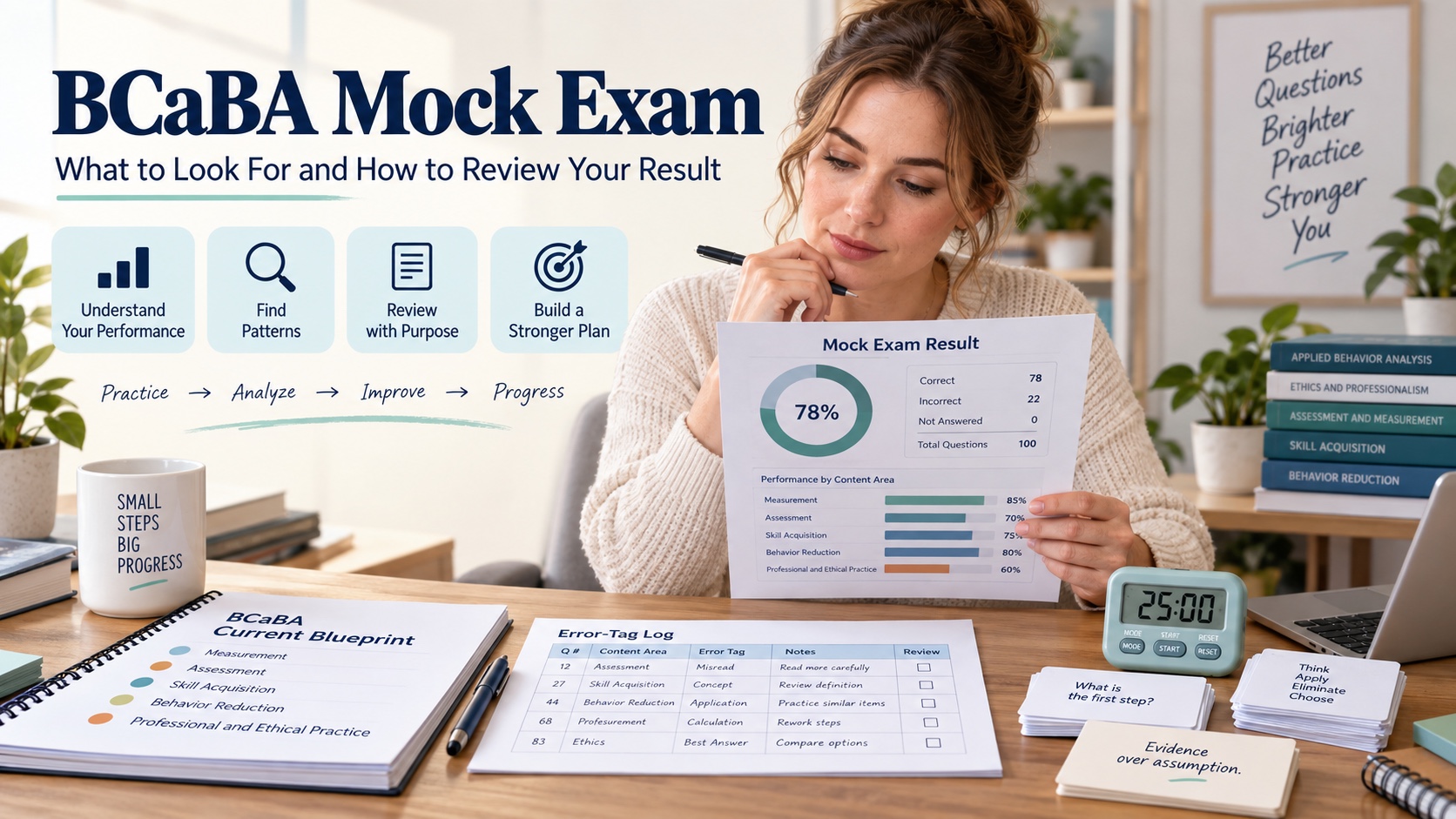
BCaBA Mock Exam: What to Look For and How to Review Your Result
A BCaBA mock exam can be a helpful study tool, but its value is not determined by the word “mock” or by the number at the end. A useful independent practice set should map to the current BCaBA content outline, ask you to make decisions in scenarios, show why an answer fits, and leave you with a practical repair plan.
The current BACB materials describe a BCaBA examination built around the Test Content Outline (6th ed.). An independent mock cannot reproduce the live examination, provide official or recalled questions, decide eligibility, or predict certification. It can give you evidence about coverage, reasoning, pacing, and the kinds of errors you should study next.
This guide shows how to evaluate a mock before you trust its result and how to turn the review into learning. It is independent educational information, not a BACB publication, a pass guarantee, or individualized supervision.
Quick answer: Choose a BCaBA mock exam that names its track, aligns with the current 6th-edition outline, uses original scenario-based questions, gives explanations, and lets you review by domain or error type. Take it under conditions that match your goal, then tag every miss and uncertain answer. Use the score as a study signal, not as an official pass prediction.
What a useful BCaBA mock exam should include
Before you start, look for six quality signals. You do not need a perfect product to learn from a practice set, but you do need to know what the set is actually measuring.
- Clear track: The material should say BCaBA. A generic ABA quiz may contain useful concepts but cannot automatically stand in for a credential-specific mock.
- Current source boundary: The page should identify the current BCaBA TCO and link to the BACB’s live documents. A vague “updated” badge is not the same as a source.
- Application, not only recall: Good questions ask you to distinguish, select, interpret, or apply a concept in a bounded scenario.
- Plausible distractors: The wrong choices should represent understandable reasoning errors, not random jokes or trick wording.
- Explanations: You should be able to see why the best answer fits the evidence and why the strongest distractor does not.
- Review data: A result is more useful when you can see missed topics, uncertain answers, time patterns, or a domain/error log.
The question count alone is not a quality test. A short set with clear explanations can help you identify a measurement misconception. A long set with no feedback can leave you with a percentage and no direction. The right length depends on whether you are diagnosing content, practicing mixed decisions, or rehearsing sustained attention.
How the current blueprint should shape practice
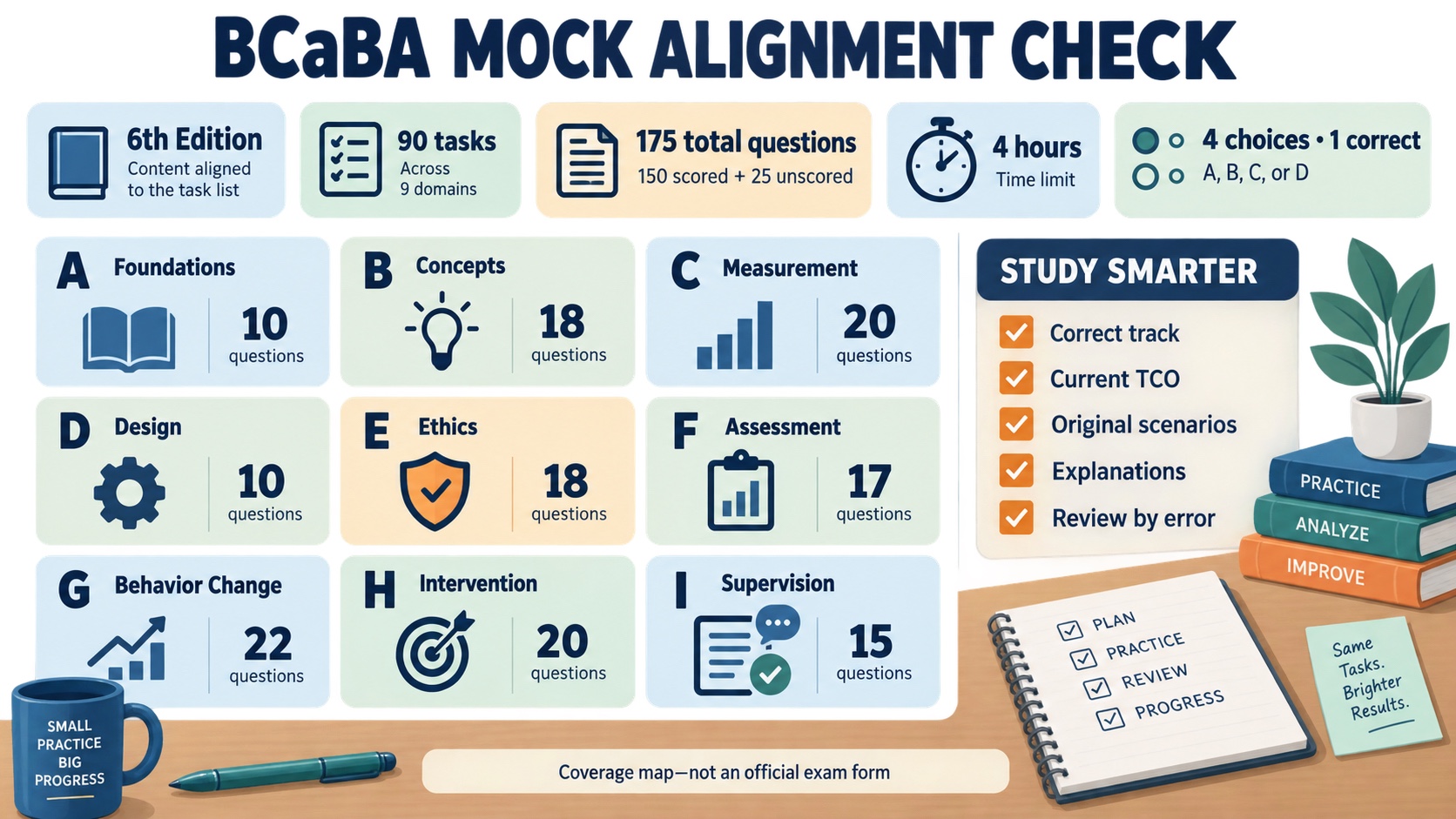
The BCaBA Test Content Outline (6th ed.) describes 90 tasks in nine domains. The current BCaBA Handbook describes 175 multiple-choice questions: 150 scored and 25 unscored pilot questions, four hours, four answer choices, and one correct answer. The handbook also says that results are based on overall performance rather than a separate result for each content area.
| Domain | Questions in the outline | Planning signal |
|---|---|---|
| A. Behaviorism and Philosophical Foundations | 10 | 7% |
| B. Concepts and Principles | 18 | 12% |
| C. Measurement, Data Display, and Interpretation | 20 | 13% |
| D. Experimental Design | 10 | 7% |
| E. Ethical and Professional Issues | 18 | 12% |
| F. Behavior Assessment | 17 | 11% |
| G. Behavior-Change Procedures | 22 | 15% |
| H. Intervention Development and Monitoring | 20 | 13% |
| I. Supervisory Relationships | 15 | 10% |
Use the distribution to notice whether a mock ignores an entire area, not to demand an exact miniature copy of the live examination. The percentages are a coverage map. They do not create nine separate pass thresholds, and they do not tell you which task will appear next.
Also keep track language precise. BCaBA questions may share vocabulary with BCBA or RBT questions, but the credential, role context, and task wording can differ. If a practice set uses a concept from another track, it should explain why the concept is relevant rather than quietly presenting a different blueprint as BCaBA preparation.
Choose practice conditions that answer your question
One mock exam cannot answer every study question. Decide what you want to learn before you start.
- Content diagnosis: Use a manageable mixed set without notes. Mark uncertainty, not just wrong answers.
- Domain repair: Use a focused set after reviewing one area, then compare the new error pattern with your baseline.
- Scenario discrimination: Read the stem, identify the evidence, predict the decision, and only then inspect the options.
- Pacing practice: Use a longer timed session after your content review is stable. Record where attention or time became difficult.
Do not use a timed score to diagnose a content gap if you were also learning the interface, stopping to search definitions, or working while exhausted. The conditions matter because every result is evidence about a particular task under a particular setup. That does not make the result useless; it tells you how carefully to interpret it.
Review errors, not just the score
After a mock, create a review log with the item topic, domain, your answer, the best answer, evidence from the stem, and the next action. Add an error tag such as definition confusion, measurement mismatch, graph interpretation, procedure discrimination, missing scenario evidence, ethics/scope, careless reading, or pacing.
Review uncertain correct answers too. If you selected the right option by guessing, the score may hide a fragile concept. If you selected the wrong option because the question described a different measurement dimension than you expected, the repair should focus on that distinction rather than on rereading an entire textbook.
Consider a fictional learner who misses a question about a preference assessment, one about graph interpretation, and one about supervision. The topics look unrelated. The review may show three different problems: choosing a procedure without identifying its purpose, reading a trend without checking the axes, and selecting an action without checking the role boundary. Each miss needs a different repair, even if the score report places them in a broad “incorrect” column.
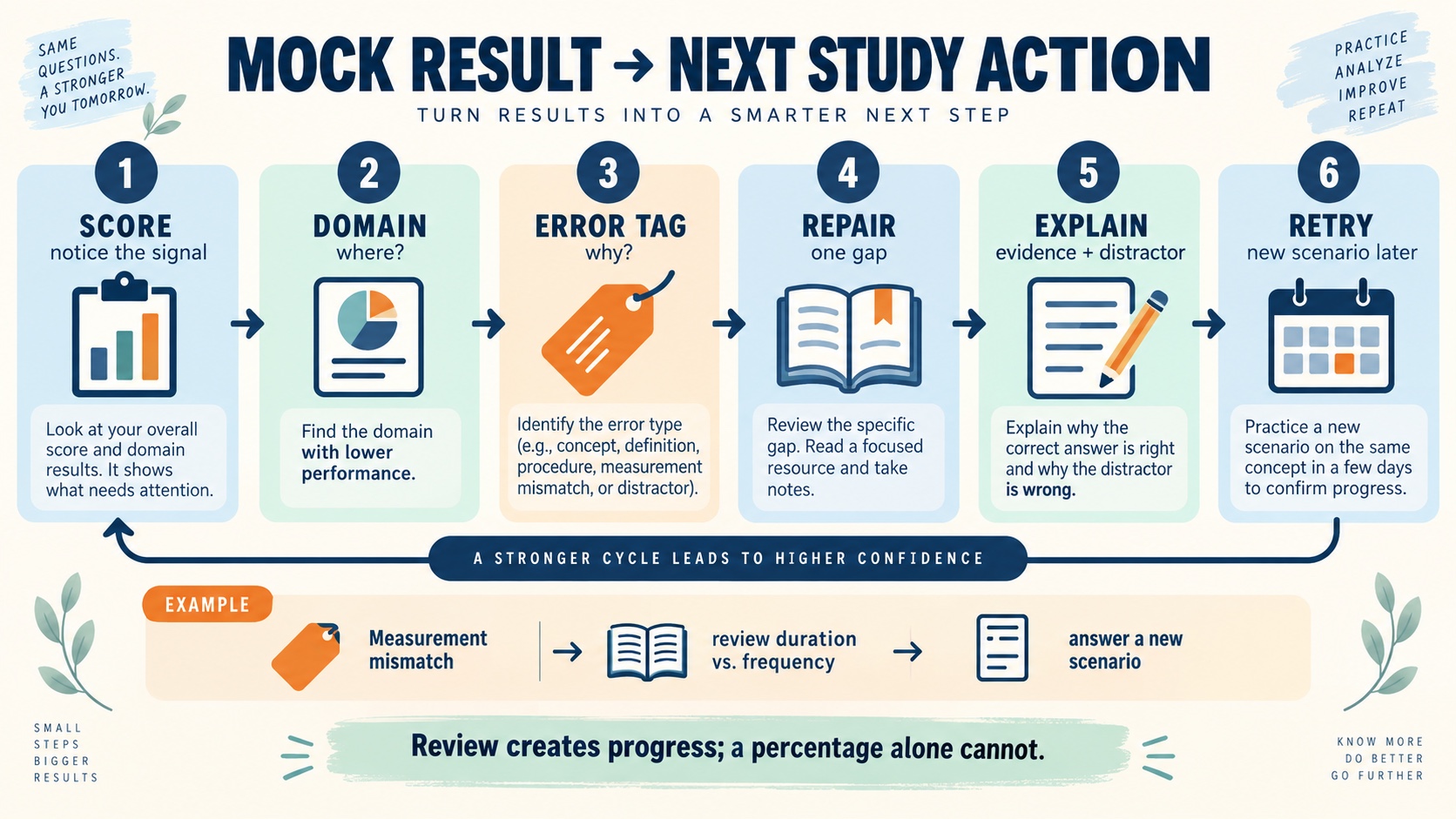
A useful loop is: answer, explain, tag, repair, and retry. Write one sentence explaining why the best answer fits the evidence and why the strongest distractor does not. Review a reliable source or training example. Then answer a new scenario later without copying the original wording. Practice-testing research supports retrieval with feedback and later retrieval; it does not turn one independent score into a prediction of certification.
Give yourself a stopping rule for review. For each repeated error tag, choose one small repair: define the distinction in your own words, work through one new example, or compare two procedures that you keep confusing. Once you can explain the difference without the answer choices in front of you, schedule a mixed retry. This keeps a mock exam from becoming an endless cycle of taking another test without changing the underlying study behavior.
What a mock score cannot tell you
An independent mock score is not an official BACB result, a scaled score, an eligibility decision, or a guarantee. It does not establish competence in client services, and it does not show that you have met coursework, fieldwork, supervision, or application requirements. The BACB recommends using the current TCO, Ethics Code, and training materials, and it says that study-material purchase does not guarantee a pass.
Use your result as one piece of evidence. Ask whether the set was current, whether its questions matched your track, whether you reviewed explanations, and whether the same error tag appears again after repair. A lower score with a clear error map may be more useful than a higher score from a shallow set you cannot evaluate.
When you are ready for a free practice entry point, you can use the ABA Study Online mock-exam area and read the scope notes before starting. For short targeted review after the mock, the ABA Study Online App can support repeated domain/task practice. These are natural study destinations, not official BACB examination tools.
Common mistakes
- Trusting “updated” without a source: Look for the current BCaBA TCO and handbook links.
- Equating question count with realism: Check domain coverage, scenario quality, and feedback too.
- Reviewing only wrong letters: Explain evidence and distractors, then tag the error.
- Using a BCBA or RBT set as a BCaBA blueprint: Shared terms do not erase track boundaries.
- Inventing a pass cutoff: An independent practice percentage is not an official standard.
- Taking full mocks too often: Leave time for repair and later retrieval instead of collecting scores.
BCaBA mock-exam FAQ
How many questions should a BCaBA mock exam have?
There is no universal required length for an independent study set. Short sets can diagnose errors, while longer sets can practice pacing. The official examination format is separate: the current handbook describes 175 multiple-choice questions over four hours.
Should a mock exam use the exact official domain percentages?
A strong mock should be informed by the current TCO and should not ignore domains. A short practice set does not need to reproduce the complete live blueprint question for question. Use the official distribution as a coverage and study-planning reference.
Are online BCaBA mock questions official?
Only if the BACB identifies them as official. Independent educational questions should say that they are original and should not claim access to live, recalled, or leaked examination content.
Does a mock score predict whether I will pass?
No. It is a diagnostic signal about a particular set and a particular day. Review the error pattern and use current official sources for examination and certification information.