BCBA Exam Questions: How to Practice the Current 6th Edition Content
Searching for BCBA exam questions usually means you want more than a list of terms. You want to know whether you can identify the relevant evidence in a scenario, compare plausible answers, and explain why one professional decision fits better than the others. That is the useful job of an independent practice question.
There is an important boundary before you begin: ABA Study Online questions are original educational materials. They are not official BACB examination questions, recalled questions, leaked content, or a promise of certification. The current BACB Handbook and BCBA Test Content Outline (6th ed.) tell you what the examination covers and how it is administered. Practice questions help you rehearse the reasoning those sources describe; they do not reproduce the live examination.
Table of Contents
Quick answer: use BCBA practice questions as diagnostic evidence. Read the stem for the decision, identify the facts that support it, compare the answer choices, explain the best choice in your own words, tag the reason for a miss, and schedule a smaller repair session. A practice percentage is useful only when it changes what you study next.
Start with the current BCBA exam context
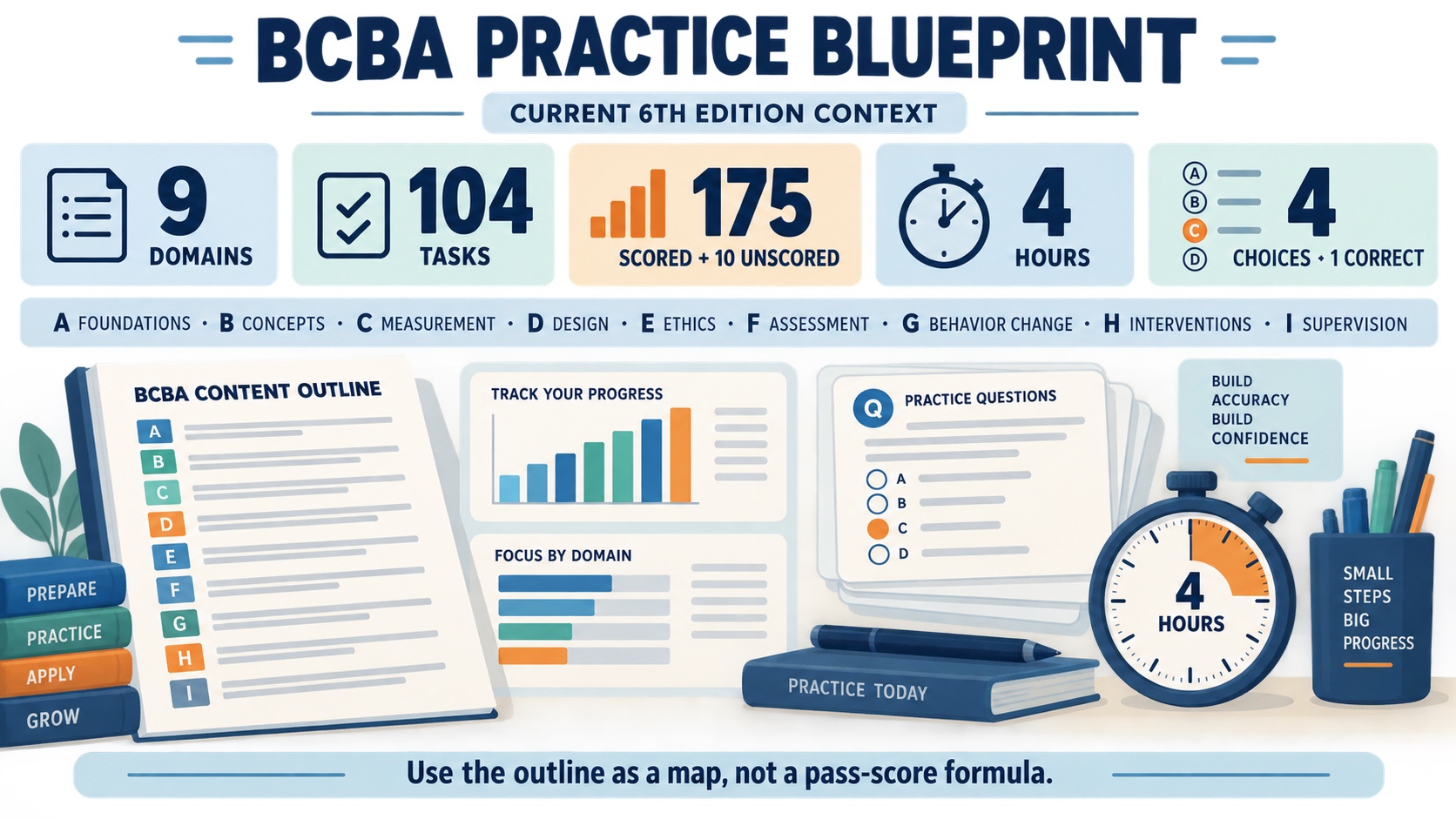
The current BCBA examination is based on the BCBA Test Content Outline (6th ed.). The outline describes 104 tasks organized into nine domains. The examination includes 175 scored questions and 10 unscored pilot questions, for 185 questions presented during a four-hour appointment. Each question has four possible answers and one correct answer.
Those numbers help you understand the assessment, but they do not create a simple “score this many and you will pass” rule. The BACB explains that examination forms are equated and that the passing standard can vary by form. It also does not report a raw correct-answer count as the meaning of your result. A third-party practice score is therefore a study signal, not an official scaled score.
The outline is also a map rather than a complete textbook. It names the content areas and tasks connected to examination preparation, while your coursework, training materials, Ethics Code study, supervised experience, and professional reading provide the depth. Use a question to find the next concept to examine, not to replace the source material.
What a useful BCBA question should test
A strong practice question creates a decision under a defined context. It does not hide the answer behind awkward wording or reward a memorized phrase that has no connection to the scenario. When you write or choose a question, look for five parts.
A clear professional situation
The stem should tell you enough about the learner, setting, target, data, intervention, or professional relationship to make a defensible decision. It should not require you to invent facts. If the question asks about a graph, the axes and measurement should be meaningful. If it asks about an ethical response, the relevant role and risk should be visible.
A decision verb
Notice whether the question asks you to identify, distinguish, interpret, select, implement, evaluate, or recommend. The verb changes the kind of answer that can be defended. “Identify the measurement” is different from “interpret the trend.” “Select the next step” is different from “explain the principle.” Many wrong answers come from answering a familiar question instead of the question that was asked.
Plausible answer choices
Useful distractors represent common reasoning errors. One might use the right procedure for the wrong goal. Another might ignore the data. A third might sound clinically helpful but exceed the professional role described in the stem. Reviewing why those choices fail is more valuable than simply memorizing which letter was correct.
An evidence and boundary check
Before you choose, ask what evidence is available and what boundary applies. Is the decision supported by direct data, a functional assessment, a research design, a written plan, a supervision arrangement, or an ethical requirement? If a question leaves out information that would be necessary for a strong decision, the best answer may be the one that seeks clarification or gathers the appropriate evidence.
Use a five-step review loop
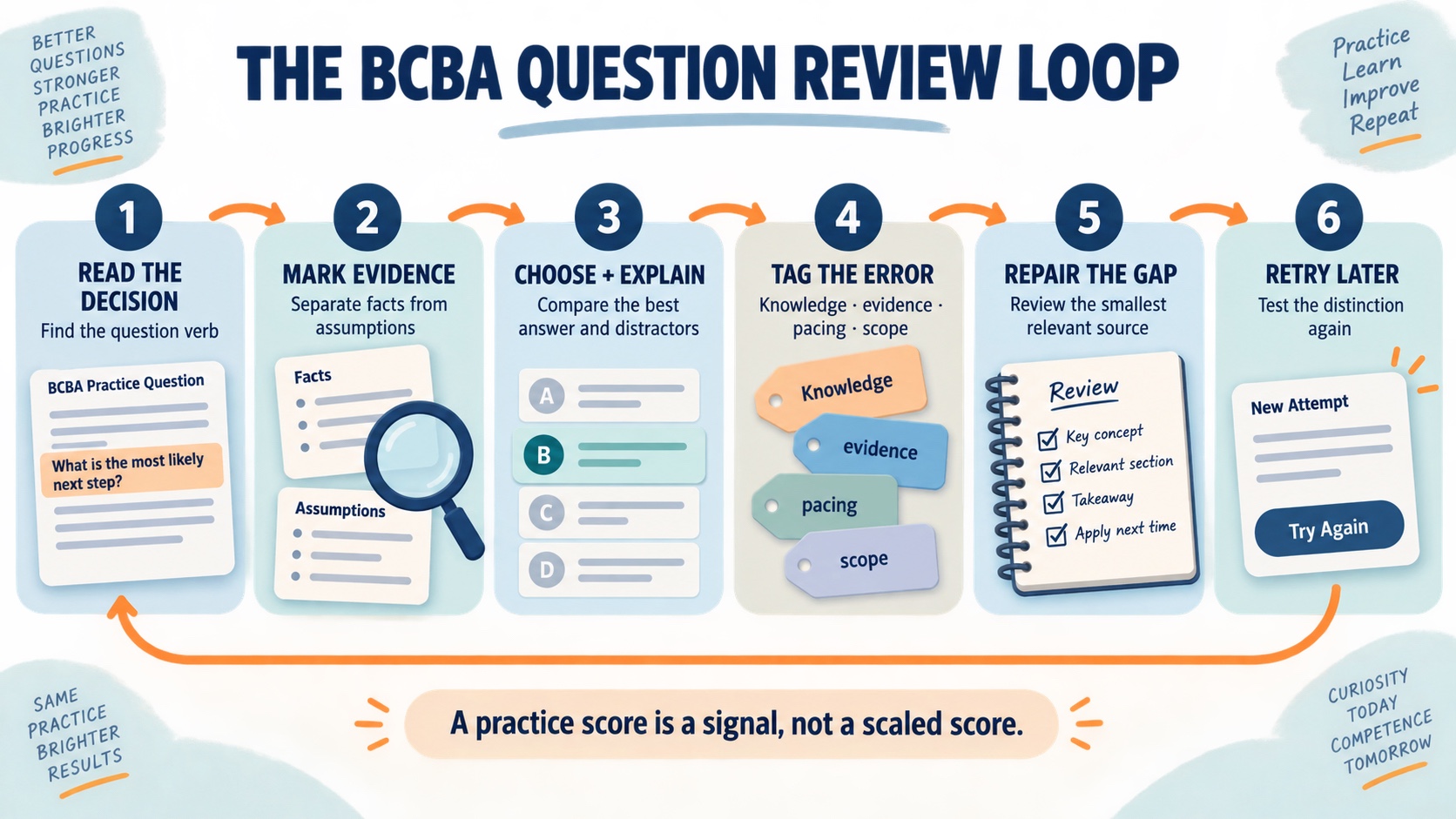
Use the same review process whether you answered correctly or incorrectly. A correct answer chosen for the wrong reason is still a useful warning.
- Name the decision. Write one sentence: “The question is asking me to choose or explain ___.” This prevents a familiar keyword from pulling you toward the wrong concept.
- Mark the evidence. Circle or list the details that support the answer. Separate what the stem says from what you are assuming. If a graph is present, describe the pattern before interpreting it.
- Explain the choice. Complete the sentence: “This answer fits because ___, while the closest distractor fails because ___.” If you cannot explain both, mark the item for review even if it was correct.
- Tag the error. Use a small set of labels such as knowledge gap, discrimination error, evidence-reading error, question-reading error, pacing error, or ethics/scope error. A tag tells you what kind of repair to do.
- Repair and retry. Review the smallest relevant source section, write an original example, and answer a similar but not identical question later. Retrying immediately can measure memory of the explanation; a delayed retry tests whether the distinction is available again.
This loop keeps a practice session from becoming a score-collection exercise. If eight missed questions all carry the “measurement versus interpretation” tag, you have a specific study target. If the misses are scattered but most occurred after rushing, the next intervention may be pacing rather than rereading a textbook.
Match the error to the repair
A knowledge gap calls for a source review and a plain-language explanation. A discrimination error calls for a side-by-side comparison of two related concepts. An evidence-reading error calls for a graph, observation, or data table that you describe before drawing a conclusion. An ethics or scope error calls for the current professional standard and a careful look at who has the authority to act. Different errors need different practice; repeating a mixed quiz without changing the repair rarely solves the pattern.
For pacing errors, reduce the task before increasing the timer. Practice reading the final question sentence first, identify the decision verb, and mark only the evidence that changes the answer. Then return to a timed set. The goal is not to rush faster; it is to make the same evidence-based decisions with less wasted attention.
Build balanced domain coverage
The current BCBA outline organizes questions across nine domains. The rounded planning shares are useful for building a balanced set: Behaviorism and Philosophical Foundations; Concepts and Principles; Measurement, Data Display, and Interpretation; Experimental Design; Ethical and Professional Issues; Behavior Assessment; Behavior-Change Procedures; Selecting and Implementing Interventions; and Personnel Supervision and Management.
Do not turn those domains into nine sealed boxes. A measurement question can change whether an intervention decision is defensible. An assessment scenario can contain an ethics boundary. A supervision question may require you to recognize procedural integrity and performance support. Use the domain label to find the source, then practice the connection to a professional decision.
A balanced weekly practice rhythm might include one mixed set, one domain-focused set, and one review session for previously tagged errors. Keep a simple log with the question topic, domain, error tag, correct reasoning, source checked, and retry date. The log should stay small enough to use. A giant spreadsheet that no longer changes your next action is not a better study system.
A fictional question-review example
Imagine an original question describing a learner whose rate of responding increases after an intervention is introduced. The stem asks what the analyst should examine before concluding that the intervention caused the change. A learner chooses “continue the intervention because the trend is positive.” That answer sounds optimistic, but the review should ask whether the design supports a functional interpretation, whether measurement is reliable, whether other events changed at the same time, and whether the decision is consistent with the current plan.
The error tag might be evidence interpretation rather than behavior-change procedure knowledge. The repair could be a short review of single-case design logic, visual analysis, and threats to interpretation, followed by an original scenario that changes one feature at a time. The point is not to memorize this one example. It is to make the reason for the answer visible.
Common mistakes with BCBA exam questions
- Chasing recalled questions: study from current sources and original practice instead of trusting claims about remembered examination items.
- Using one percentage as a readiness verdict: inspect domain and error patterns, and remember that a practice score is not a BACB scaled score.
- Studying only missed domains: use the report to target review, but continue balanced coverage so a small sample does not define your entire preparation.
- Choosing the most helpful-sounding answer: choose the response supported by the evidence, goal, role, ethics, and available authority.
- Ignoring the question verb: answer the decision requested, not the definition you happen to recognize.
For a broader study plan, use the BCBA exam study guide. For timed practice, review the free BCBA mock-exam guide. You can also return to the BCBA study path and original BCBA practice questions. These links are study routes, not a promise that any particular question set predicts the examination.
BCBA exam questions FAQ
How many questions are on the BCBA exam?
The current examination includes 185 multiple-choice questions: 175 scored questions and 10 unscored pilot questions. Candidates have four hours, and each question has four possible answers with one correct answer. Confirm the current Handbook and examination page before testing.
Are online BCBA practice questions official?
Not unless they are explicitly published by the BACB as an official resource. Independent practice questions should be labeled as original educational content. They should not claim to be recalled or leaked examination questions.
What should I do when I miss a question?
Do not only read the correct letter. Identify the decision, mark the evidence, explain why the distractors fail, tag the error, review the smallest relevant source section, and retry a similar question later.
Can practice questions predict whether I will pass?
No. Practice results can show patterns in knowledge, reasoning, reading, or pacing, but they do not produce an official scaled score or guarantee a certification result.