BCBA Certification Requirements: A Current Checklist
If you are researching BCBA certification requirements, begin with the categories rather than a single number: qualifying degree or program, behavior-analytic coursework where required, supervised fieldwork, application documents, the BCBA examination, and ongoing maintenance. The current BACB BCBA page identifies the BCBA as a graduate-level certification and directs applicants to the current handbook and related official resources.
This checklist helps you organize the right questions and documents. It cannot determine whether your degree, courses, fieldwork, or application will be accepted. The BACB Handbook and the BACB’s formal review process control that decision. Because major BCBA eligibility and maintenance changes are scheduled for 2027, every personal plan also needs an application-date check.
The current BCBA requirement map
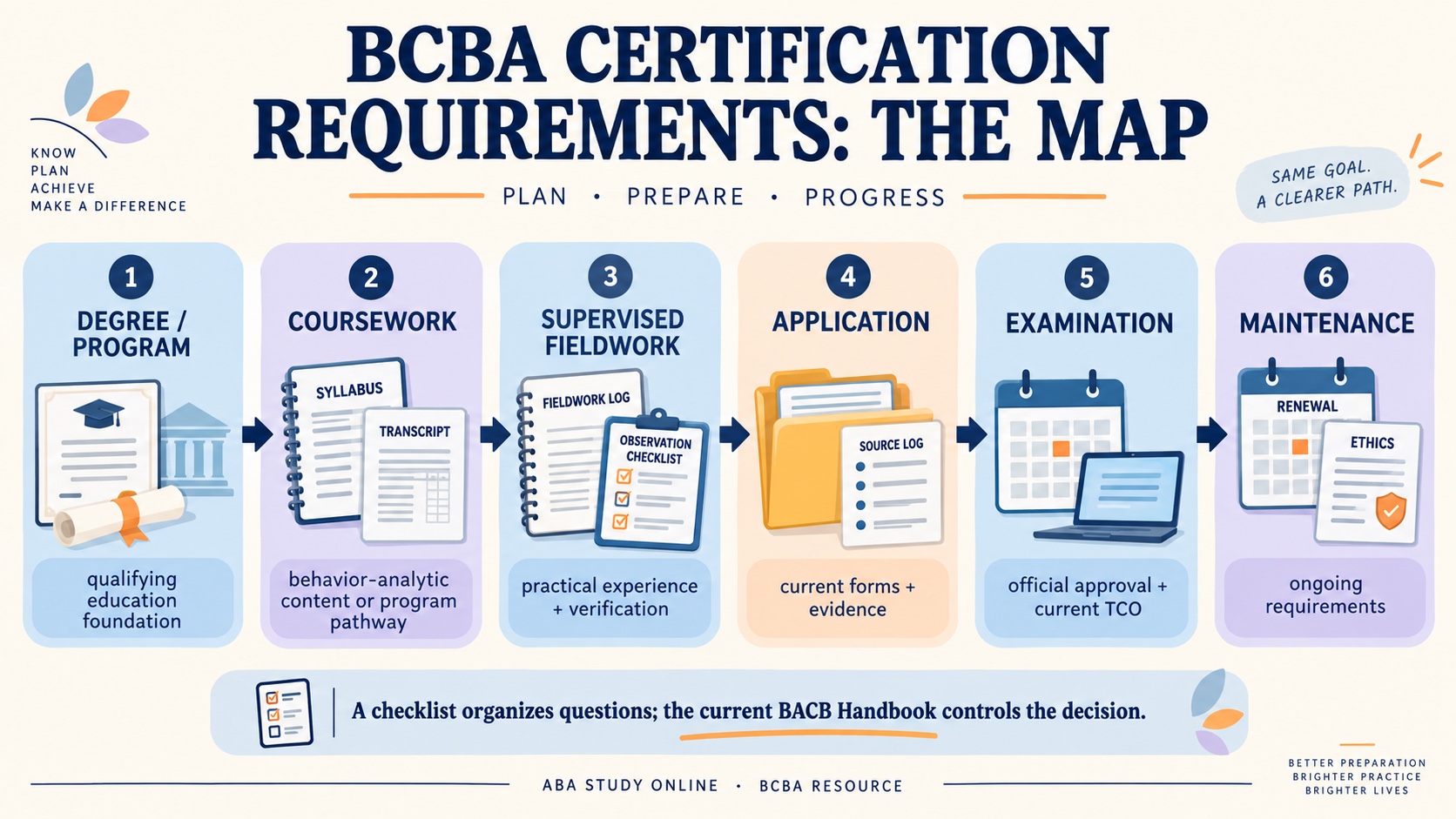
The safest high-level map is:
- Degree or qualifying program: establish the education foundation required by the pathway and application timing.
- Behavior-analytic coursework or qualifying accredited/recognized program: document the content through the pathway’s current verification method.
- Supervised fieldwork: complete qualifying practical experience with the required supervision and records.
- Application: submit the current forms, transcripts, verification documents, and any pathway-specific attestations.
- Examination: receive the applicable approval, schedule through the official process, and prepare from the current Test Content Outline.
- Maintenance: meet ethics, continuing education, supervision, renewal, and other ongoing requirements that apply to the credential.
The order is useful for planning, but real applicants may revisit earlier steps when a transcript, course record, fieldwork form, or application date changes. The current BCBA Handbook is the source to use when a question becomes specific to your pathway.
Degree and qualifying program
The first question is not simply “Do I have a master’s degree?” It is “Does my degree and program meet the current BCBA pathway that applies to my application?” The current handbook describes pathway-specific degree and institution expectations. A graduate degree in any field may not, by itself, establish every other BCBA requirement.
For a degree audit, record the institution, country or jurisdiction, degree title, conferral date, and the official transcript source. If you are evaluating an international degree, check the current BACB instructions about degree equivalency rather than relying on a general university statement. If you are using an accredited or recognized behavior-analysis program, save the program’s status and the dates that matter for your degree.
Do not treat a program’s marketing phrase—“ABA focus,” “behavioral science,” or “BCBA preparation”—as proof that the program satisfies the current pathway. Those descriptions may be useful for comparing programs, but the BACB’s requirements and document verification control the certification decision.
Behavior-analytic coursework
Coursework is another place where a simple checklist can mislead. Depending on the pathway and the date, the relevant evidence may involve an accredited or recognized program, behavior-analytic coursework, official transcripts, a program contact, or a coursework attestation. The required evidence is not determined by the course title alone.
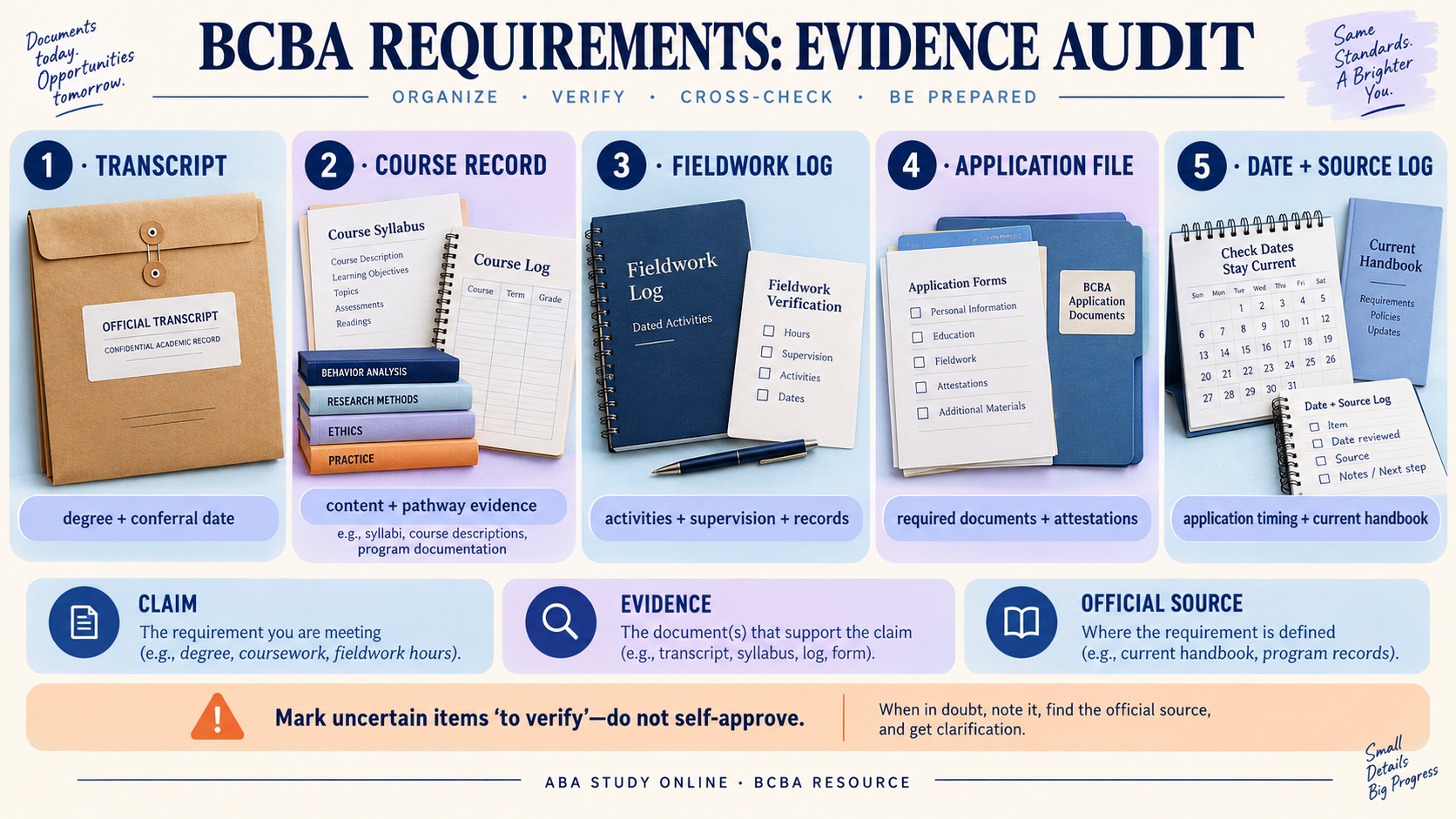
For each course you want to count, save the institution, course title, term, transcript entry, syllabus or official description, and the category you believe it supports. Then label that category as “to verify,” not “approved.” If a single course appears to cover multiple areas, do not count the same hours repeatedly just because the descriptions overlap. Ask the program contact, supervisor, or BACB through the appropriate channel when the pathway instructions leave a question unresolved.
The BACB’s university-training guidance explains that Pathway 2 now uses a BACB-managed coursework attestation system, while future requirements are tied to the 2027 BCBA framework. That is why a saved VCS-era checklist may not be enough for a later application. Use the live university training guidance and current handbook for the exact process.
Supervised fieldwork and verification
Supervised fieldwork is practical experience in applied behavior analysis completed within the current BACB supervision requirements. The important question is not just how many hours appear on a calendar. You also need to know whether the activities, supervisor relationship, observations, contacts, documentation, and verification forms meet the pathway rules in effect for your application.
Keep fieldwork evidence as you go. A useful record system can include dates, activities, supervision contacts, observations, forms, and notes about which requirement each document supports. Do not wait until an application deadline to reconstruct the record from memory. The current handbook and fieldwork resources determine which records are required and how audits may be handled.
Supervision also has a professional boundary. A supervisor’s signature is not a substitute for completing the underlying requirement, and a job title is not proof that every task or hour qualifies. Discuss uncertainty early with a qualified supervisor and compare the answer with the current BACB source. The BACB’s supervision guidance is useful for role orientation, while the BCBA Handbook controls the detailed fieldwork rules.
Application, examination, and maintenance
After the education and fieldwork evidence is ready, the application phase brings the documents together. Depending on the current pathway, this may include an official transcript, fieldwork verification forms, coursework or program attestations, and other forms named in the handbook. Use the current BACB Portal and application instructions rather than a saved screenshot or a checklist from another cohort.
The examination is a separate stage. The BACB Examination Information page explains how eligibility review, application approval, scheduling, and testing logistics fit together. Use the current BCBA Test Content Outline for study scope; it is not a list of protected exam questions and it cannot tell you whether your personal application is complete.
Certification requirements also continue after the examination. The current handbook includes maintenance topics such as ethics, continuing education, renewal, and status changes. Put a maintenance reminder beside your initial-certification checklist so the credential is not treated as a one-time finish line. If a future page, employer, or payer adds a local requirement, record it separately from the BACB requirement rather than blending the two.
How to plan around the 2027 transition
The BACB’s 2027 BCBA Requirements page and its Recent and Upcoming Changes page identify substantial changes to eligibility and maintenance beginning January 1, 2027. The changes include revisions involving degree, coursework, supervised fieldwork, continuing education, and ongoing supervision. The exact pathway and transition rules depend on your timing and record.
Use three dates in your planning file: the date you are gathering evidence, the date you expect to apply, and the update date of the official handbook or requirements page you used. If your application timeline crosses the transition, read the dedicated 2027 page instead of silently mixing the 2022 and 2027 frameworks. This article provides the category map; the live BACB documents provide the rules.
The separate 2027 transition article on ABA Study Online is intended for date-specific planning. It should not replace the official BACB page, and this general requirements article should not repeat every future coursework detail. Keeping the pages distinct helps a reader choose the right depth without assuming that a broad checklist determines eligibility.
A practical audit checklist and FAQ
Before calling your plan “ready for review,” ask:
- Have I identified the application date and the requirement framework likely to apply?
- Do I have the official transcript and the degree/program evidence named by my pathway?
- Have I documented behavior-analytic coursework with official records rather than course titles alone?
- Are my fieldwork activities, supervision, observations, and verification forms organized under the current rules?
- Have I checked the current application and document instructions?
- Am I using the current examination information and Test Content Outline for study?
- Have I added maintenance, ethics, and renewal questions to the plan?
- Have I marked unresolved items as “to verify” instead of assuming they qualify?
Do I need a master’s degree to become a BCBA? The BCBA pathway is graduate level, but the exact degree, institution, coursework, and timing requirements must be checked in the current handbook and pathway that apply to you.
Is any ABA master’s program automatically qualifying? No. Program status, coursework, pathway, dates, transcripts, and fieldwork evidence all matter. A program’s advertising is not a formal BACB determination.
How many fieldwork hours do I need? Do not rely on one number copied from an old guide. Fieldwork type, supervision, dates, documentation, and transition rules matter. Read the current handbook’s fieldwork section for your pathway and application timing.
Does passing the BCBA examination complete every requirement? Passing the examination is one part of the certification process. Eligibility review, application documentation, fieldwork, and maintenance requirements still matter.
Where should I study the concepts? Use the current BACB Test Content Outline for the official exam-content boundary, then use reviewed educational material such as the BCBA Theory Blocks, free BCBA practice questions, and ABA Definition Search to build understanding. These study resources do not determine eligibility or guarantee a score.
The most reliable BCBA requirements checklist is therefore a living source log: current handbook, pathway evidence, fieldwork records, application documents, exam information, maintenance notes, and a date check for 2027. Build the map first, then verify every personal claim with the official BACB source that owns the decision.