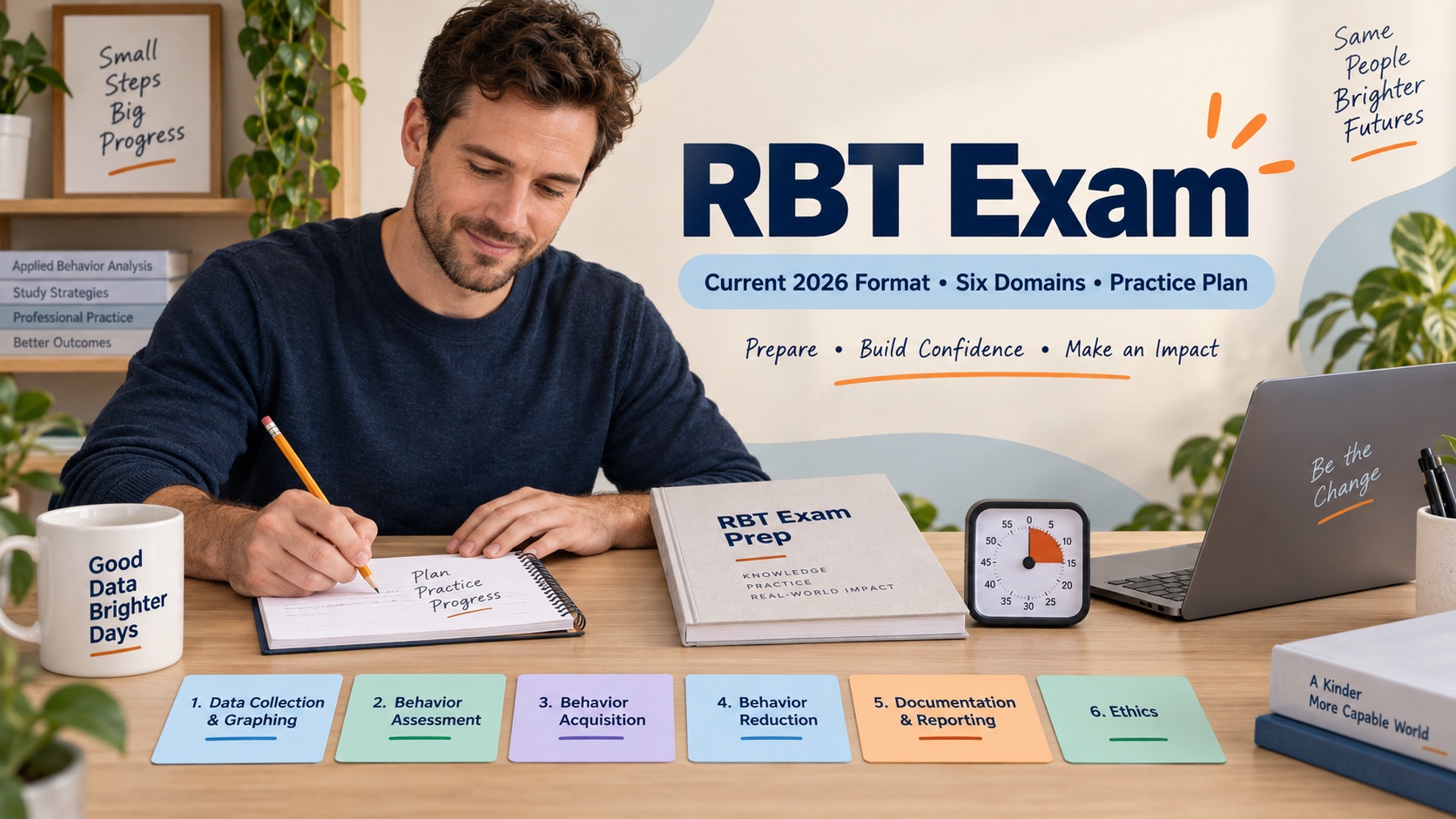
RBT Exam: Current 2026 Format, Six Domains, and a Better Practice Plan
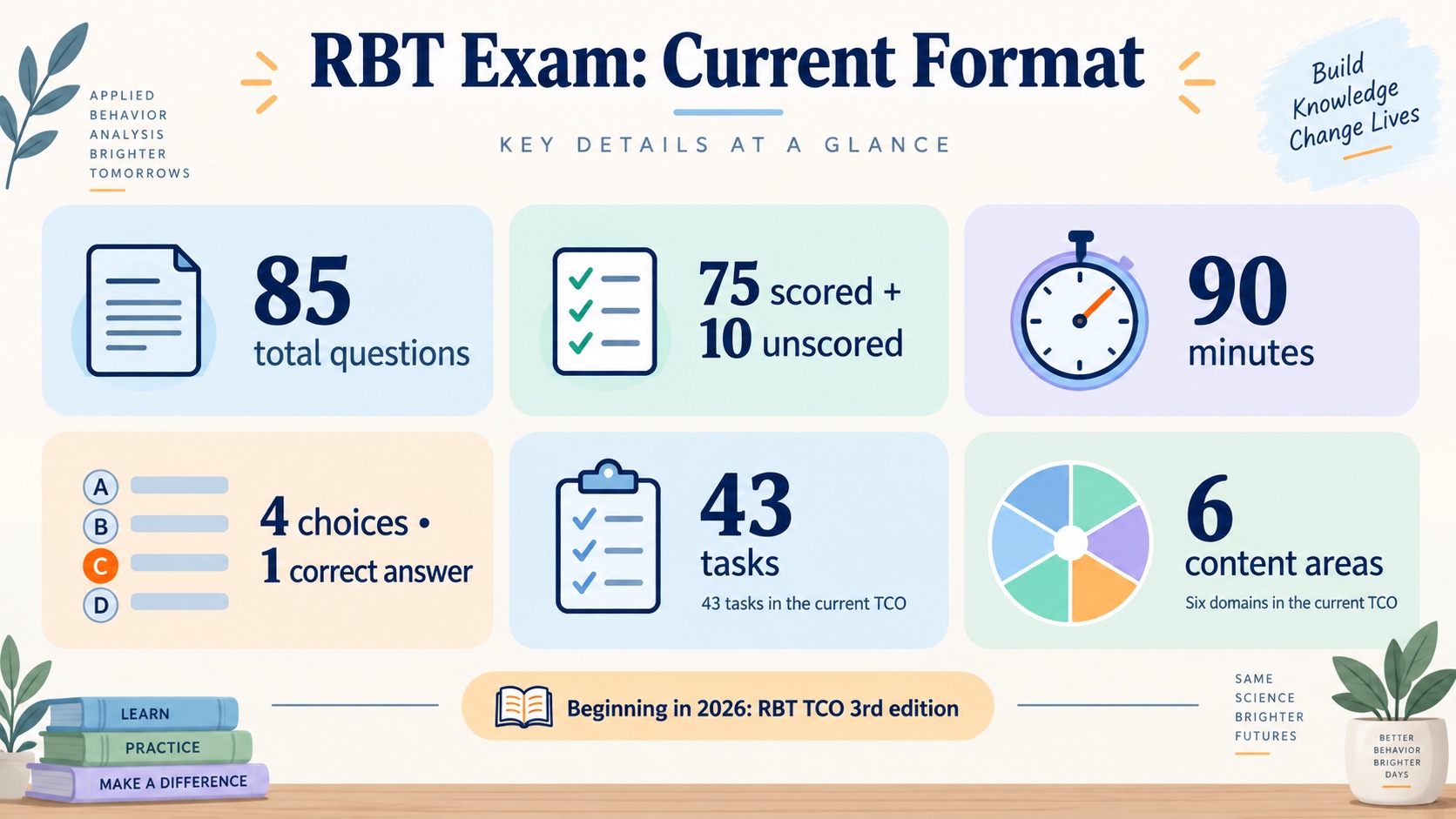
Searching for the RBT exam usually means you need two answers at once: what the current examination looks like, and how to prepare without wasting time on the wrong version of the content outline. Beginning in 2026, the RBT examination is based on the RBT Test Content Outline (TCO), 3rd edition. The current exam has 75 scored questions and 10 unscored questions, 90 minutes, four answer choices per question, and six content areas.
That snapshot is useful, but a number list is not a study plan. You also need to know which domains deserve repeated practice, how to read an applied scenario, and what to do after you miss a question. This guide brings those pieces together. It uses current BACB information for the exam facts and offers an independent practice method for learning the material. ABA Study Online is not the BACB, does not provide official examination questions, and cannot guarantee a certification result.
Table of Contents
What the current RBT exam includes
The current RBT exam is built from the RBT TCO 3rd edition. The outline contains 43 tasks organized into six broad content areas. The examination itself includes 85 multiple-choice questions: 75 scored questions and 10 unscored pilot questions. You cannot identify the unscored questions while taking the exam, so treat every item as worth your full attention.
The current format is:
- Time: 90 minutes.
- Total questions: 85, including 75 scored and 10 unscored questions.
- Response format: four possible answers with one correct answer.
- Scoring orientation: questions are equally weighted, and the result is based on overall examination performance rather than a separate pass score for each content area.
- Delivery: the current RBT Handbook describes delivery through authorized Pearson VUE testing sites.
The phrase “RBT exam 2026” matters because the content blueprint changed. The BACB’s RBT resource page identifies the RBT TCO 3rd edition as the examination content beginning January 1, 2026. Older study material may still contain helpful ABA vocabulary, but you should check the version before using it as your main map. A current practice resource should name the current TCO clearly and keep its questions aligned to the six current areas.
There is another distinction worth keeping straight: the TCO describes the exam content, while the RBT Handbook explains the certification and examination process. The handbook also points candidates toward their 40-hour training materials and Competency Assessment materials. Reading only a practice-test page is not a substitute for reading the current BACB documents.
The six RBT exam content areas
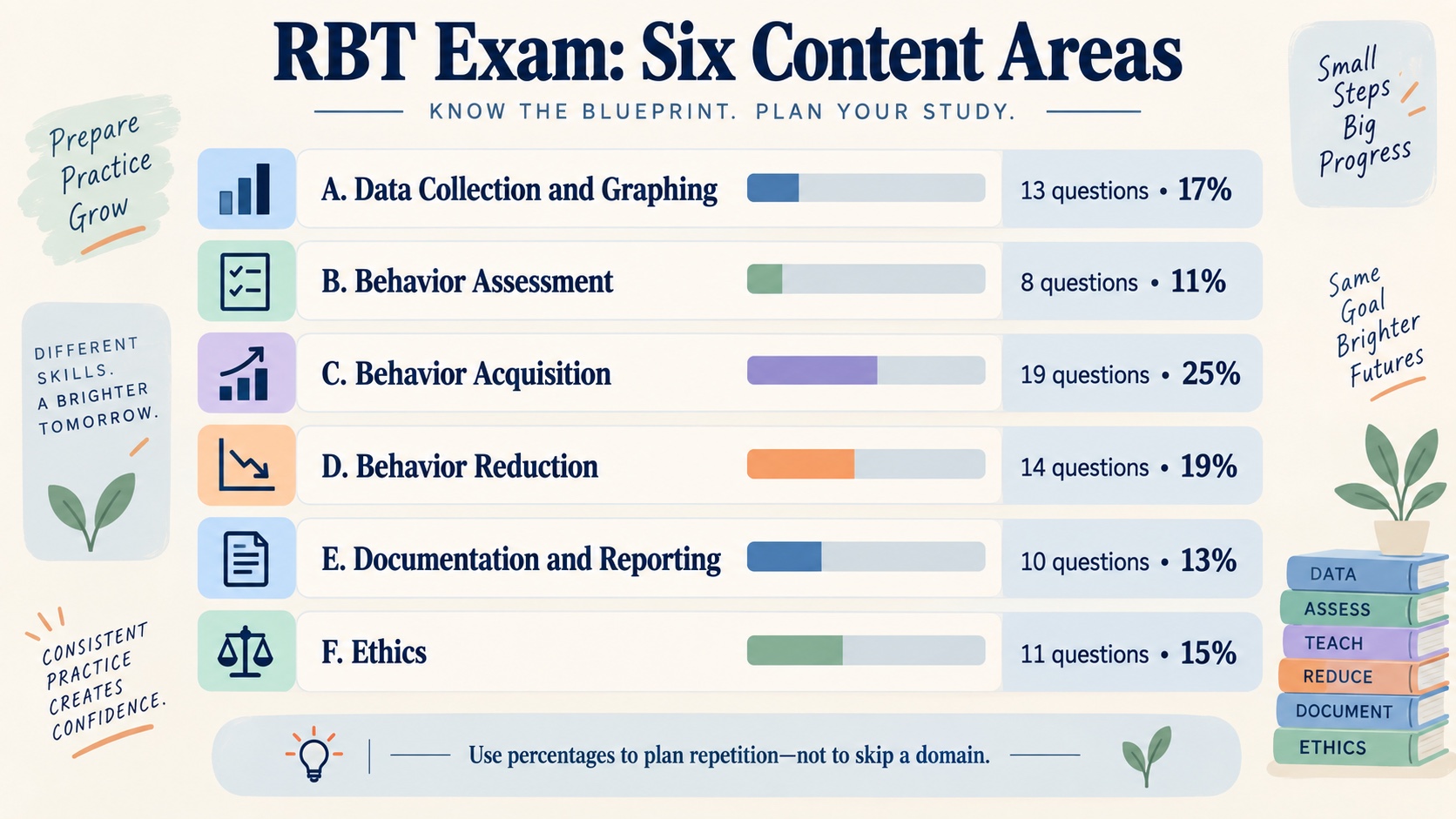
The domain percentages are a planning signal. They are not a pass cutoff, and they do not mean that smaller areas can be ignored. Use them to decide how often a topic returns in your study schedule, then use task-level practice to decide what needs attention.
A. Data Collection and Graphing — 13 questions, 17%
This area covers the practical side of recording and interpreting behavior data. Study continuous measurement such as frequency, duration, latency, and interresponse time, along with discontinuous procedures such as partial-interval, whole-interval, and momentary time sampling. You should also be comfortable with permanent-product recording, data entry, graph updates, observable descriptions, simple summaries such as rate or percentage, and identifying trends. A strong practice item gives you enough context to choose a measurement or interpret a graph—not just recite a definition.
B. Behavior Assessment — 8 questions, 11%
Assessment questions may involve preference assessments, skill-strength or deficit assessments, and components of functional assessment procedures. Keep the RBT role boundary visible. The question may ask what an RBT should participate in, record, or report, rather than asking you to independently design a comprehensive assessment. When practicing, underline who is responsible for the decision, what evidence has actually been collected, and what action is within the technician’s role.
C. Behavior Acquisition — 19 questions, 25%
This is the largest content area in the current outline. It includes reinforcement, conditioned reinforcers, discrete-trial teaching, naturalistic teaching, task-analyzed chaining, discrimination training, prompting and fading, generalization, maintenance versus acquisition, shaping, and token economies. Practice should move beyond matching a word to a definition. Given a short teaching situation, explain what the learner is expected to do, what consequence follows, which prompt is being used, and how the procedure protects independent responding.
D. Behavior Reduction — 14 questions, 19%
Behavior Reduction questions can include antecedent strategies, differential reinforcement, extinction, crisis or emergency procedures, and following a behavior plan. Focus on the function of the procedure rather than the surface appearance of a consequence. Ask what behavior is being strengthened or reduced, whether reinforcement is contingent, what the written plan says, and when the RBT must seek direction. A safe answer usually respects the plan, the client’s dignity, and the RBT’s supervision boundary.
E. Documentation and Reporting — 10 questions, 13%
This area is easy to under-study because it feels less technical than intervention procedures. It is still part of the blueprint. Practice writing objective session notes, separating observation from interpretation, reporting changes or concerns through the correct channel, protecting confidentiality, and documenting what occurred without adding unsupported explanations. A useful error note can say: “I described an inferred feeling instead of the observable event,” or “I reported a concern to the wrong person.”
F. Ethics — 11 questions, 15%
Ethics questions often look like ordinary workplace situations: a request for private information, a boundary problem, a conflict with a caregiver, a social-media post, or pressure to work outside your training. Read the scenario carefully and identify the relevant code, role boundary, confidentiality concern, or supervision step. Do not choose an answer simply because it sounds friendly or decisive. The better answer is usually the one that protects the client, follows the current code and written procedures, and seeks appropriate supervision when needed.
How to use practice questions well
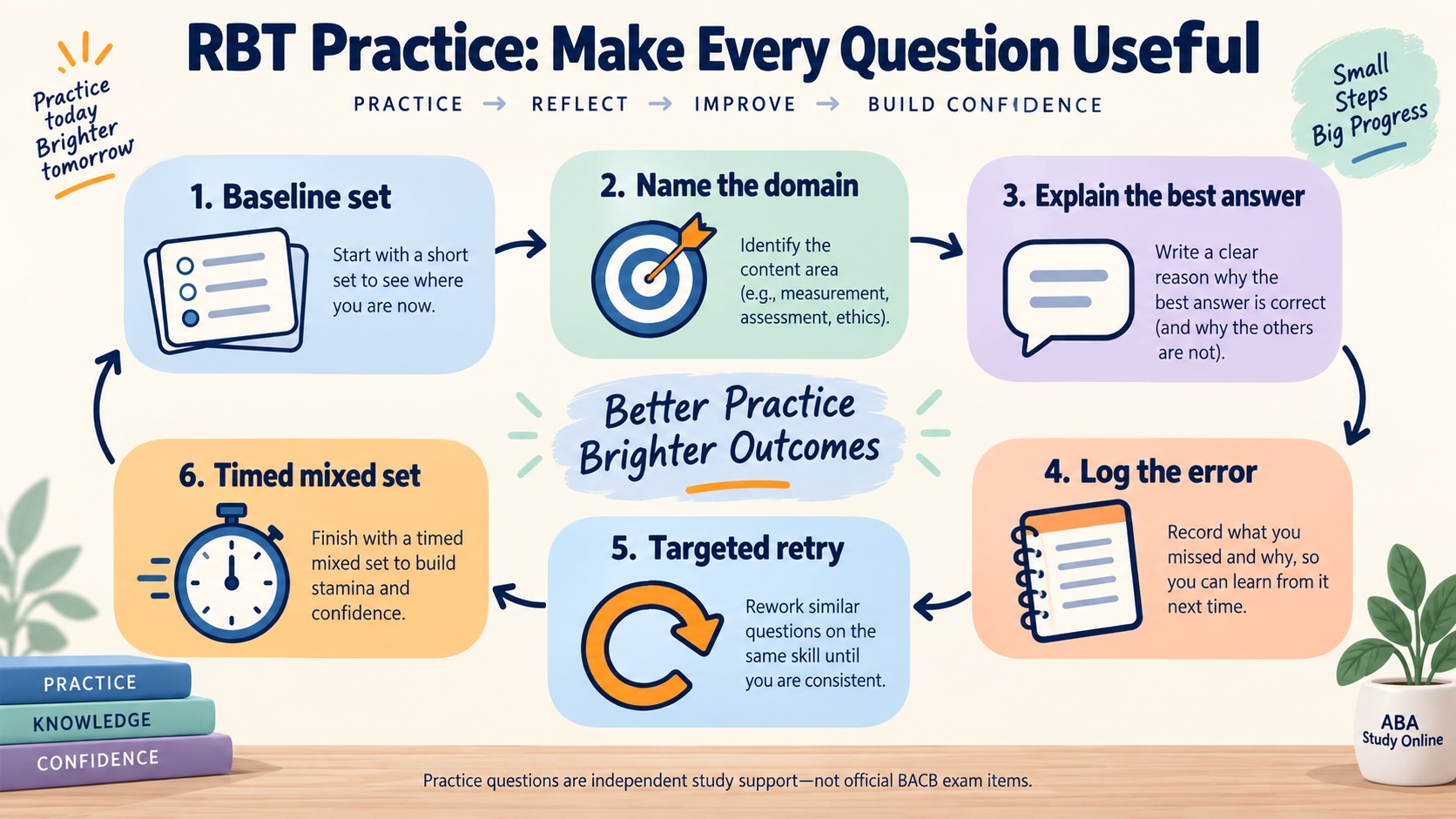
Practice questions are most useful when they show you how you are thinking. A score alone cannot tell you whether you confused duration with latency, missed a role boundary, overlooked the word “best,” or chose a familiar intervention without reading the evidence. Build a short review loop around every set.
- Start with a baseline set. Use a small mixed set first. The goal is not to prove that you are ready; it is to locate the domains and task types that need explanation.
- Answer before checking the rationale. Read the stem twice if it is dense. Identify the target behavior, the relevant evidence, the role, and the question’s action word.
- Explain why the best answer fits. Use one or two sentences. If you cannot explain the answer without repeating the choice, the concept needs another pass.
- Explain why the distractors do not fit. A distractor may be a true statement used in the wrong context. Label the exact clue that rules it out.
- Log the error by task. Record the domain, the concept, the missed clue, and one next action. “Review reinforcement” is too broad; “distinguish continuous from discontinuous measurement in a 20-minute observation” is actionable.
- Retry with a new example. Do not repeat the same item until it feels familiar. Use a different scenario that tests the same reasoning.
- Add timed mixed practice later. Once you have studied the weak tasks, practice switching among domains. The exam is not one long lesson on a single topic.
A simple example: imagine a practice question asks for the best measurement procedure when every occurrence of a brief response must be recorded. A memorization-only approach may hunt for a familiar word. A reasoning approach asks whether the response is observable, whether every occurrence can be captured, what the observation window is, and whether the choice matches the data goal. Then you explain the decision and name one limitation. That is the kind of small reasoning habit that transfers across questions.
What happens before the exam—and what practice cannot promise
The examination is one part of the certification process. The current RBT Handbook describes eligibility requirements, the 40-hour training requirement, the Initial Competency Assessment, the application process, approval, and scheduling. The exact requirement that applies to you depends on the current BACB instructions and your circumstances. This article can explain the sequence, but it cannot decide whether your training, assessment, documentation, or application meets the requirements.
After an application is approved, the handbook directs candidates to schedule through Pearson VUE. The exam is delivered at authorized testing sites, and testing-center rules matter. Read your approval and scheduling instructions carefully, bring acceptable identification, and check the current handbook for test-day restrictions. Do not rely on a social-media post or an old study page for a current scheduling rule.
Independent practice questions have a different boundary. They can help you retrieve concepts, read scenarios, manage time, and find weak areas. They are not official BACB questions and cannot reveal the exact questions you will receive. The BACB specifically states that it cannot endorse specific study guides or other preparation materials, and purchasing study materials does not guarantee a pass.
A repeatable seven-day RBT study routine
You can adapt the routine to a longer plan, but keeping the sequence visible helps prevent “study” from becoming endless rereading.
- Day 1 — Baseline: take a short mixed set and classify every miss by domain and reason.
- Day 2 — Measurement: review data collection and graphing; complete examples for continuous, discontinuous, and permanent-product recording.
- Day 3 — Assessment and acquisition: separate the RBT’s participation role from independent assessment decisions, then practice teaching procedures.
- Day 4 — Behavior reduction: compare antecedent strategies, differential reinforcement, extinction, and safety steps using written-plan scenarios.
- Day 5 — Documentation and ethics: practice objective notes, confidentiality, supervision, scope, and professional conduct.
- Day 6 — Targeted retry: revisit the three most common error types with new questions and short written rationales.
- Day 7 — Timed mixed set: practice switching domains under a clock, then review errors rather than chasing a single percentage.
Repeat the cycle with different examples. If your study session is short, keep the smallest complete loop: one target, a few applied questions, one explanation, and one error note. Consistency gives you better information than a single exhausting cram session.
RBT exam FAQ
How many questions are on the RBT exam?
The current examination has 85 multiple-choice questions: 75 scored questions and 10 unscored questions.
How long is the RBT exam?
The current handbook states that candidates have 90 minutes. The allocated time includes the examination process and review time described in the handbook, so check the current instructions before test day.
What is the current RBT task list edition?
For examination content beginning in 2026, the current blueprint is the RBT Test Content Outline, 3rd edition. Older references to the RBT Task List 2nd edition may describe the previous boundary.
Which RBT domain is the biggest?
Behavior Acquisition is the largest current area at 19 questions, or 25% of the scored blueprint. Behavior Reduction follows at 14 questions, or 19%. Use that information to plan repetition, not to skip the other domains.
Are online RBT practice tests official?
Independent practice tests are not official BACB examinations or a source of secure exam questions. They can be useful study tools when they are clearly labeled, aligned to the current TCO, and accompanied by explanations.
Can ABA Study Online guarantee that I will pass?
No. ABA Study Online provides independent study support. Use current BACB sources for certification and examination rules, and use practice to improve your reasoning rather than to claim a guaranteed result.
Choose your next practice step
If you already know the current RBT format, the most useful next step is a short set of original practice questions. Start with the free RBT practice questions, classify your misses by the six current content areas, and return to the TCO when a task needs clarification. If you prefer short retrieval sessions, the ABA Study Online app can support flashcards, section practice, progress review, and teaching tools as part of a repeatable study loop.