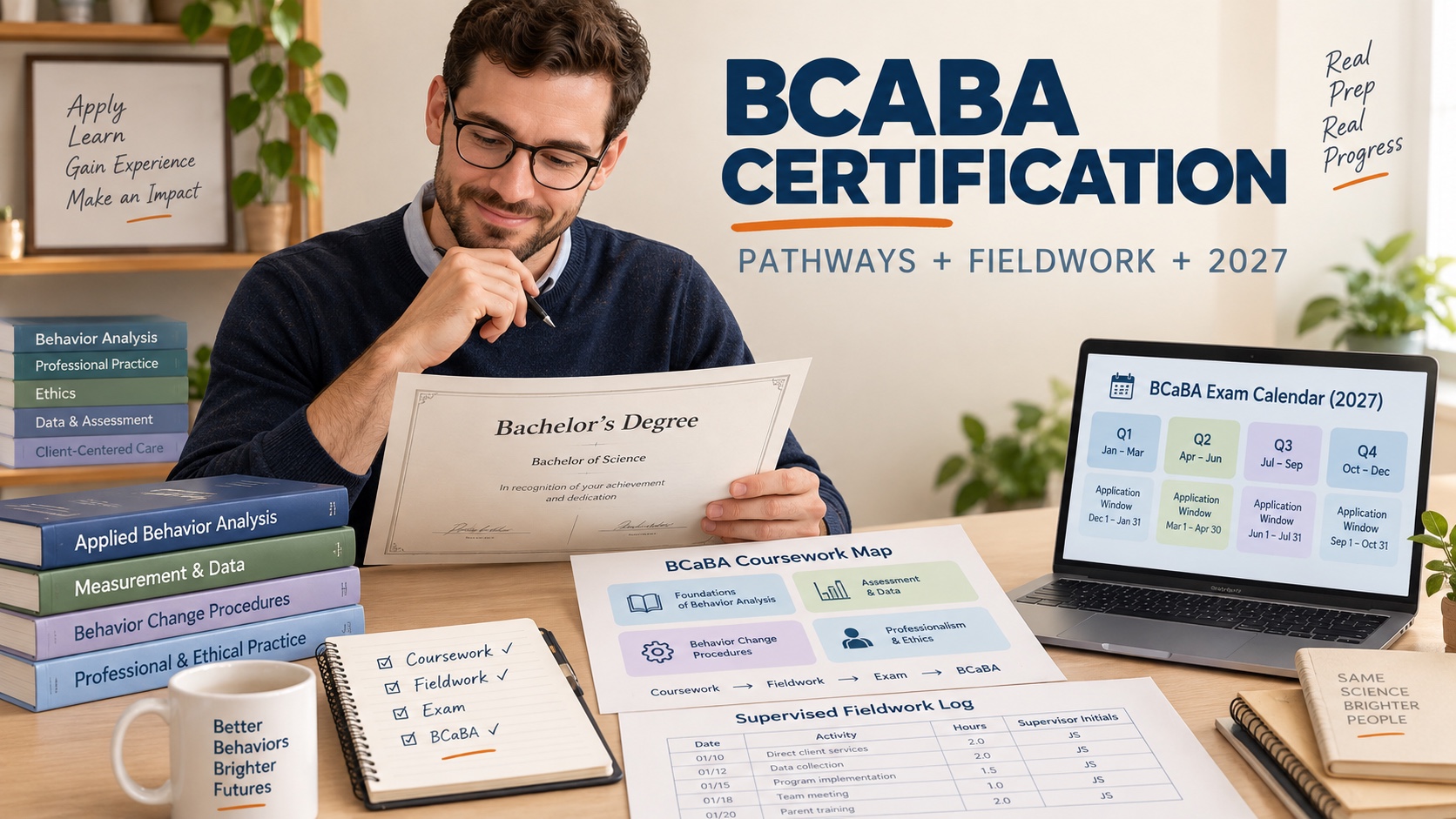
BCaBA Certification: Current Pathways, Steps, and 2027 Planning
BCaBA certification is the Board Certified Assistant Behavior Analyst credential offered by the Behavior Analyst Certification Board. The BACB describes it as an undergraduate-level certification in behavior analysis. BCaBAs provide behavior-analytic services under the supervision of a BCBA, and they may supervise the work of RBT certificants within the applicable rules.
If you are exploring this path, the most important question is not simply “How do I become a BCaBA?” It is “Which current BACB requirements apply to my planned application, and which official document should I verify next?” The handbook, eligibility pathway, supervised fieldwork, examination, maintenance rules, and the announced 2027 changes all need to be read as part of one time-sensitive process.
What BCaBA certification means
BCaBA certification recognizes a defined level of education, behavior-analytic preparation, supervised experience, examination performance, and ongoing maintenance under the BACB’s certification system. It is not a general “ABA certificate,” a university degree by itself, or a promise that every person with a bachelor’s degree is eligible.
The current BCaBA overview places the role between entry-level technician work and independent BCBA practice. A BCaBA may provide behavior-analytic services, but the current BACB description states that those services are provided under BCBA supervision. A BCaBA may also supervise RBT work when the applicable qualification and supervision requirements are met.
Those boundaries matter when you read a job description or a course advertisement. A program may teach useful ABA content without being a BACB certification pathway. An employer may use a title that sounds similar to BCaBA without the person holding the credential. A state, payer, or organization may impose additional rules. Confirm the credential status and local requirements instead of treating the acronym as a complete scope-of-practice answer.
The current eligibility pathway map
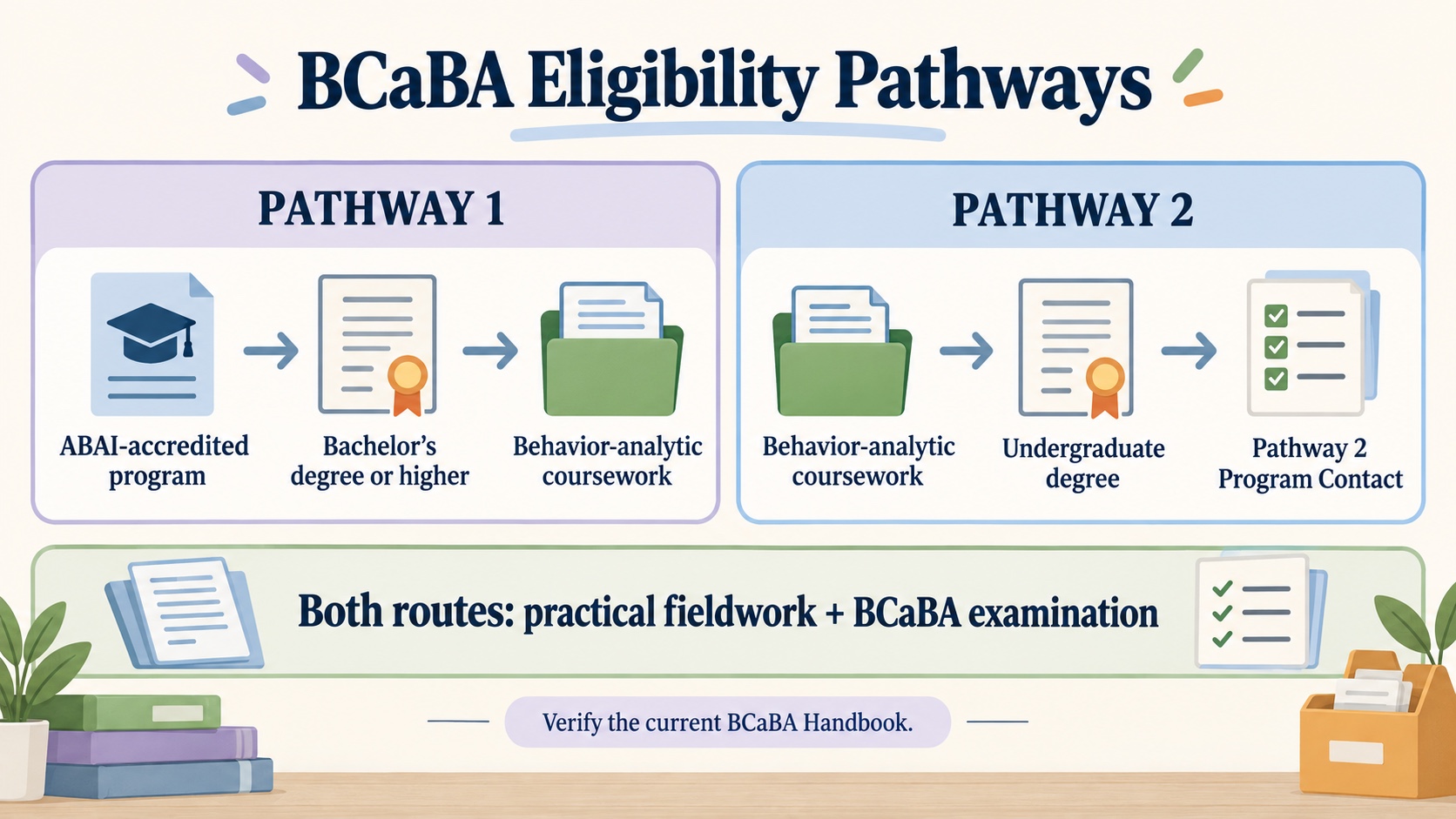
The June 2026 BCaBA Handbook presents two current eligibility pathways. The pathway names are useful for orientation, but the handbook’s detailed requirements control.
Pathway 1: degree from an ABAI-accredited program
Under the handbook’s Pathway 1 overview, the applicant earns a bachelor’s degree or higher from an ABAI-accredited program. The accredited program is designed to satisfy the relevant degree and behavior-analytic coursework expectations described by the BACB. “I took several ABA classes” is not the same claim as “my program satisfies the current Pathway 1 requirements,” so verify the program and the exact application rules.
Pathway 2: behavior-analytic coursework
Under Pathway 2, the applicant completes an undergraduate degree and qualifying behavior-analytic coursework through a program with the required structure and contact process. The current handbook describes how coursework, a Pathway 2 Program Contact, and supporting documentation fit together. Do not assume that a course title, online format, or informal certificate automatically satisfies the pathway.
Both pathways connect to practical fieldwork in applied behavior analysis and the BCaBA certification examination. The pathway determines how education and coursework are documented; it does not remove the need to read the fieldwork, examination, ethics, and application sections of the current handbook.
Before committing to a program, compare the program’s claims against the official handbook and ask the institution how it documents the relevant requirements. If a program cannot explain which current pathway it supports, pause before assuming that its credits or certificate will qualify.
Application, examination, and maintenance
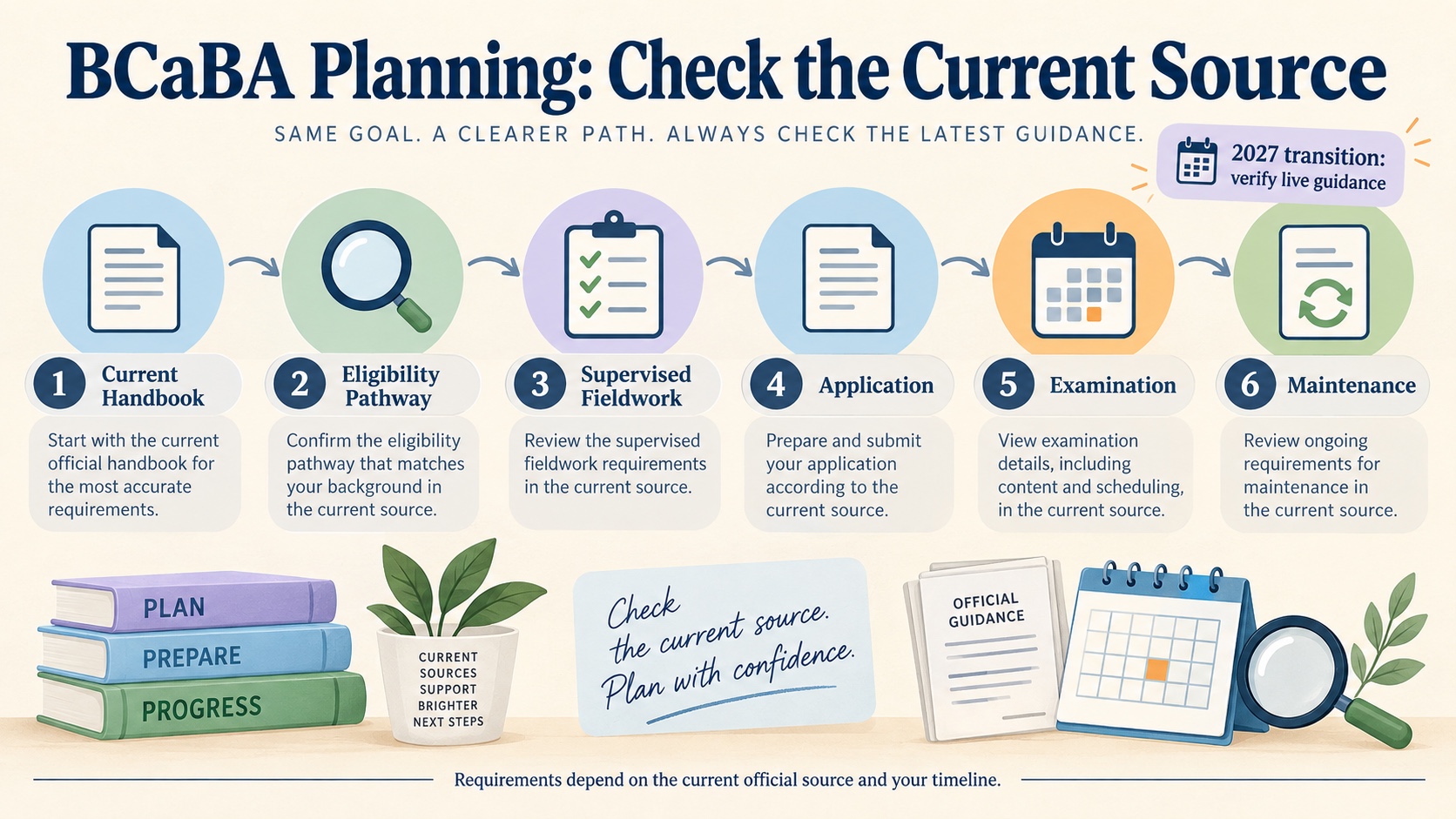
A helpful way to study the process is to separate it into stages:
- Read the current handbook. Start with the version linked from the BACB BCaBA page. Record the update date and the requirements that apply to your intended application timing.
- Choose the eligibility pathway. Determine whether your education is being evaluated through the accredited-program route or the behavior-analytic-coursework route. Keep official transcripts and pathway documentation in view.
- Complete the applicable fieldwork. Fieldwork must meet the current BACB requirements and be supervised and documented according to those rules. A job title or a large number of work hours does not automatically prove that every hour qualifies.
- Apply through the BACB process. Submit the application and required documents as the official instructions specify. The BACB reviews the materials; a course provider or study website cannot guarantee approval.
- Prepare for and schedule the examination. Use the current BCaBA Test Content Outline, handbook, and examination information. A practice quiz can support learning, but it is not the official exam and cannot promise a passing result.
- Maintain the certification. The current handbook includes continuing education, ethics and self-reporting, ongoing supervision, recertification, and inactive-status information. Maintenance is part of the credential, not an optional afterthought.
The BACB also states that handbooks may be updated as needed and that applicants completing requirements in a future year should pay attention to implementation dates. This is why a saved checklist from a previous cohort can be a useful historical note but a poor final authority.
What to verify before you rely on a checklist
When a handbook feels dense, divide the reading task instead of copying every heading into a study document. First, locate the eligibility section and mark the requirements that belong to your pathway. Next, locate the fieldwork section and identify who may supervise, what must be documented, and what records you will need to retain. Finally, review the application and examination sections so that your timeline includes document submission, approval, scheduling, and any retake or appeal rules that may apply.
This reading strategy also helps you distinguish a requirement from a recommendation. The handbook may tell you what must be submitted, while an advisor or supervisor may suggest how to organize your semester or choose a fieldwork setting. Both can be useful, but they are not the same kind of authority. Label your notes “official requirement,” “program-specific process,” or “personal planning idea” so a convenient suggestion does not quietly become a rule in your study system.
Keep a source log with the document title, update date, page or section, and the question it answers. If two pages appear to conflict, use the most current official guidance and contact BACB through its stated channel rather than solving the conflict through a search snippet.
Why the 2027 transition matters
The BACB’s Recent and Upcoming Changes page identifies significant BCaBA eligibility and maintenance changes taking effect January 1, 2027. The BCaBA page directs prospective certificants to the 2027 requirements, transition guidance, and updated handbook.
For a learner, the practical implication is simple: do not plan a multi-year pathway from a social-media summary or an old study guide. Record your expected application date, check whether the requirements in place at that time apply to you, and revisit the official handbook and transition guidance as your timeline changes. The details of a future rule should be read from the current BACB document rather than guessed from a headline.
The transition also makes vocabulary important. “Current requirements,” “requirements in effect on the application date,” “maintenance requirements,” and “examination version” are related but not identical ideas. A good plan records each one separately so you know which question you are actually checking.
A practical planning scenario
Imagine Maya, an undergraduate student who wants to pursue BCaBA certification. She has completed several courses labeled ABA and works in a clinic. Instead of assuming that the courses and work hours qualify, she opens the current BCaBA Handbook and writes four questions:
- Does her degree and program fit Pathway 1, or should she evaluate Pathway 2?
- Who is the current Pathway 2 Program Contact, if that route applies?
- How will her fieldwork be supervised and documented under the current rules?
- What application date is realistic, and which 2027 transition resources must she review?
She then discusses the unanswered questions with her program contact, advisor, and qualified supervisor. Her notes separate official requirements from personal planning decisions. That is a safer study habit than copying a checklist from a course page and assuming it will remain correct.
Common mistakes and a checklist
- Confusing BCaBA with BCBA: the credentials have different education, practice, and supervision expectations.
- Assuming a bachelor’s degree is enough: the current pathway includes behavior-analytic content, fieldwork, examination, and documentation requirements.
- Counting every work hour as fieldwork: qualifying fieldwork must fit the current BACB rules and supervision structure.
- Treating a prep course as the official source: use the handbook and current BACB pages to verify the course’s claims.
- Ignoring the 2027 transition: a multi-year plan should include a date check and the current transition guidance.
- Promising approval or a pass: no study resource can guarantee application approval or examination performance.
Before you call your plan “ready,” verify:
- I have the current BCaBA Handbook and noted its update date.
- I know which eligibility pathway I am investigating.
- I have a documented conversation about coursework and fieldwork, not just a job title.
- I have checked the current examination outline and application instructions.
- I have reviewed the 2027 transition page if my timeline reaches 2027 or later.
- I know which local licensing or employer rules may apply in addition to certification.
For related BCaBA study, explore BCaBA Theory Blocks, practice with free ABA questions, or browse the ABA Definition Search. These are natural study links; this orientation page does not add a conversion CTA.
FAQ and official sources
What is BCaBA certification? It is an undergraduate-level behavior-analysis certification operated by the BACB. BCaBAs provide services under BCBA supervision and may supervise RBT work when the applicable requirements are met.
Can a BCaBA practice independently? The current BACB description states that BCaBAs may not provide behavior-analytic services without BCBA supervision. Local laws, employers, and payers may add requirements, so check the current official and local sources.
What are the BCaBA eligibility pathways? The current handbook presents Pathway 1 through an ABAI-accredited program and Pathway 2 through behavior-analytic coursework. Both pathways also involve applicable fieldwork and examination requirements.
What changes in 2027? The BACB has announced significant BCaBA eligibility and maintenance changes effective January 1, 2027. Use the live BACB transition page and the updated handbook for the exact requirements that apply to your timeline.