BCBA 6th Edition Task List: How to Use the Current Test Content Outline
If you search for the BCBA 6th edition task list, you are probably looking for the document that tells you what to study for the BCBA examination. The current BACB document is called the BCBA Test Content Outline (TCO), 6th edition. “Task list” remains a common search phrase because older materials used that wording, but current study notes should point to the TCO.
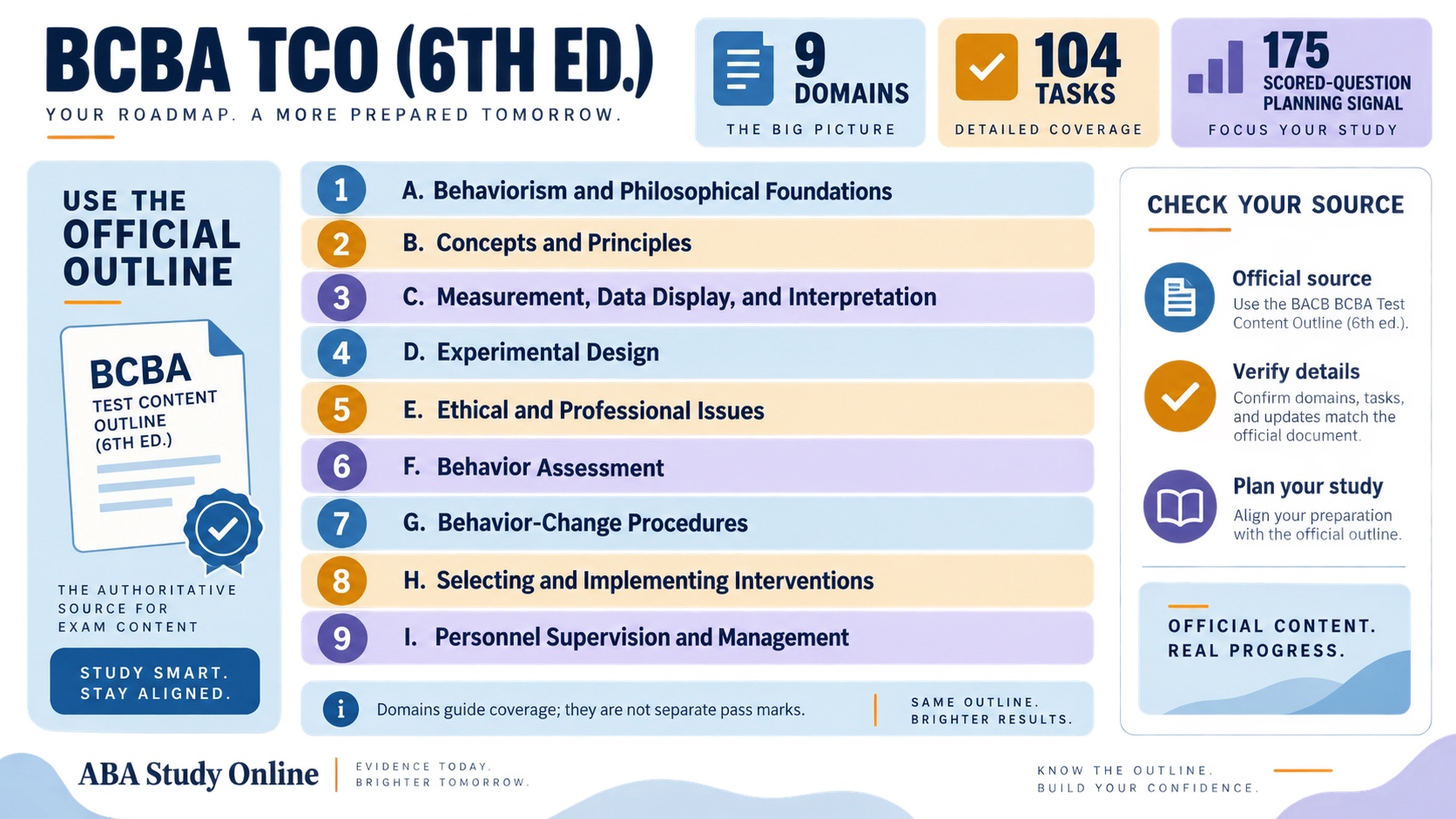
The TCO is more useful when you treat it as a map rather than a stack of sentences to memorize. It names 104 tasks across nine domains. Your job is to turn each relevant task into an explanation, an example, a contrast with a plausible distractor, and applied practice that matches the task verb.
This guide focuses on the BCBA outline itself. It does not replace the BCBA Handbook, decide eligibility, provide official questions, or promise a passing result.
Quick answer: The current BCBA 6th-edition “task list” is the BACB’s BCBA Test Content Outline (6th ed.). It describes 104 tasks arranged in nine domains and represents examination content beginning in 2025. Use the official TCO to check coverage and task wording, then use training materials and original practice to learn and apply the content. Do not treat it as a question bank, an eligibility checklist, or a set of separate domain pass marks.
The BCBA 6th-edition domain map
The current BCBA TCO organizes the 104 tasks into nine domains. The question counts below are the outline’s scored-question planning signals. They help you notice the relative weight of a domain; they do not mean that the examination has nine separate pass thresholds.
| Domain | Tasks in the TCO | Scored-question signal | Study emphasis |
|---|---|---|---|
| A. Behaviorism and Philosophical Foundations | 5 | 8 / 175 | Assumptions, goals, radical behaviorism, and ABA dimensions |
| B. Concepts and Principles | 24 | 24 / 175 | Definitions, contingencies, schedules, verbal behavior, and behavioral processes |
| C. Measurement, Data Display, and Interpretation | 12 | 21 / 175 | Measurement choices, displays, data quality, and interpretation |
| D. Experimental Design | 10 | 13 / 175 | Design logic, threats, and conclusions |
| E. Ethical and Professional Issues | 13 | 22 / 175 | Ethical decisions, professional responsibilities, and boundaries |
| F. Behavior Assessment | 11 | 23 / 175 | Assessment questions, data, and functional decision-making |
| G. Behavior-Change Procedures | 19 | 25 / 175 | Teaching, decreasing, increasing, maintaining, and generalizing behavior |
| H. Selecting and Implementing Interventions | 5 | 20 / 175 | Intervention selection, implementation, monitoring, and adjustment |
| I. Personnel Supervision and Management | 5 | 19 / 175 | Training, supervision, performance, and management systems |
The task counts above are a way to orient your notes, not a reason to ignore Domain A or to study only the largest-looking numbers. The TCO’s exact task statements matter more than a homemade summary. Use the table to plan your first pass, then return to the official wording when you build practice.
Read the task verbs before you study
One reason a TCO can feel vague is that its tasks use action verbs. “Identify,” “distinguish,” “explain,” “select,” “interpret,” and “evaluate” do not ask you to study in the same way. A learner who memorizes a definition may still be unprepared for a task that asks them to discriminate between two procedures in a scenario.
- Identify: recognize the correct concept, feature, or example from relevant evidence.
- Distinguish: state the feature that separates two terms, procedures, or contingencies.
- Explain: connect the concept to the conditions or process that make it true.
- Select: choose a procedure or decision that fits the goal, evidence, and role boundary.
- Interpret: draw a bounded conclusion from data, a graph, or a scenario without adding unsupported assumptions.
- Evaluate: judge quality, fit, risk, or effectiveness using stated criteria.
These are study prompts, not a promise that every live item will use the same wording. If a task says “distinguish,” put two similar options side by side. If it says “interpret,” practice with a display and explain what the data do and do not support. If it says “select,” add the client goal, context, and ethical or professional boundary before choosing.
Turn one task into applied practice
Choose one task statement and make a compact four-part study card:
- Plain-language meaning: rewrite the task without removing its technical boundary.
- Concrete example: create a fictional, observable situation that shows the concept.
- Closest contrast: name the option that would be easy to confuse with your answer and explain the difference.
- Evidence check: write what information you would need before selecting or evaluating a procedure.
Take a measurement example. Do not stop at “frequency is how often behavior occurs.” Ask what behavior is being counted, what observation period is used, whether the question is about rate or total count, and what feature of the scenario would make a different measurement better. The extra questions turn a dictionary definition into a decision routine.
For an ethics task, the evidence check might include consent, confidentiality, competence, supervision, scope, or the effect of a proposed action on the client. For an intervention task, it might include the target definition, baseline pattern, function or assessment evidence, reinforcement plan, procedural integrity, and monitoring. The TCO tells you the task boundary; professional judgment still requires the facts of the scenario.
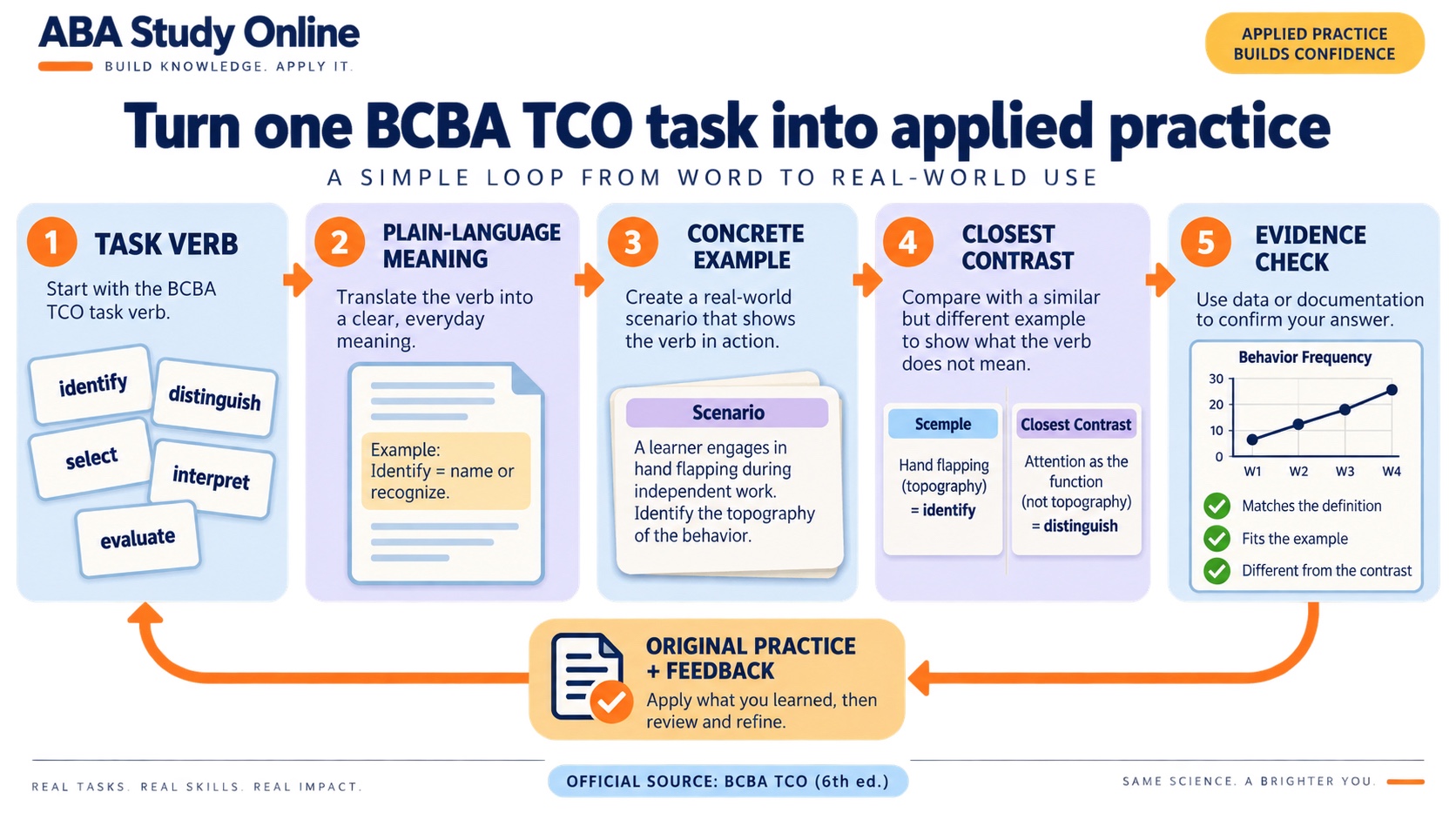
Use retrieval practice with feedback: answer before rereading the explanation, mark uncertain correct answers, and revisit the task later with a new scenario. Learning-science reviews support retrieval and feedback as useful techniques, but they do not turn an independent practice percentage into an official BACB result.
Build a coverage and error map
Make a simple spreadsheet or notebook with one row per TCO task. Useful columns include domain, task number, task verb, confidence, example completed, contrast completed, practice result, error tag, and next review date. You do not need a complicated dashboard. The purpose is to see whether you can apply a task, not merely whether you have highlighted it.
Tag errors precisely. “Wrong” is not a useful repair plan. Try tags such as definition confusion, missed scenario evidence, measurement mismatch, graph interpretation, procedure discrimination, ethics or scope boundary, data-to-conclusion leap, or careless reading. Then choose a small repair: explain the distinction aloud, compare two examples, draw the contingency, interpret a new graph, or answer a fresh scenario.
Keep the outline and the requirements documents separate in your notes. The TCO tells you about examination content. The BCBA certification requirements guide and current BACB Handbook answer different questions about eligibility, application, fieldwork, and maintenance. The BCBA test guide owns the full examination format and test-day snapshot, while the BCBA exam-prep guide owns the broader preparation routine.
The 2027 and version boundary
The BACB currently lists the BCBA TCO (6th ed.) under the sixth-edition content outlines effective January 1, 2025. A 2027 requirements or transition notice may change an eligibility, coursework, fieldwork, or maintenance process, but that does not automatically establish a 7th-edition BCBA TCO.
When you see a future date, check three things: the exact document name, the effective date, and whether the notice is about examination content or a certification requirement. Use the live BACB TCO index as the version source. Until the BACB names a new BCBA examination outline, keep the current 6th-edition TCO label and record the date you checked it.
Common mistakes
- Downloading a generic “BACB 6th edition” file: Confirm that the document title says BCBA TCO.
- Calling the current document only a task list: Keep the search phrase for discovery, but use Test Content Outline in current notes.
- Studying domain percentages as pass thresholds: They are planning signals, not nine separate score requirements.
- Memorizing task sentences without applying them: Let the task verb determine the practice activity.
- Using a TCO as an eligibility checklist: Open the current handbook or requirements page for application questions.
- Assuming a 2027 change equals a 7th edition: Wait for an exact official examination-outline statement.
- Treating a practice question bank as official: Independent questions should be labeled original and should not claim access to live items.
FAQ
Is the BCBA 6th edition task list still called a task list?
“Task list” remains a common search phrase, but current BACB examination blueprints are referred to as Test Content Outlines. The BCBA document is the BCBA TCO (6th ed.).
How many tasks are in the BCBA 6th-edition TCO?
The official BCBA TCO includes 104 tasks organized into nine domains. Use the official PDF for the exact task statements and numbering.
Can I use the TCO as my complete BCBA study guide?
It is an important content map, but not a complete teaching resource or question bank. Pair it with instruction, examples, original practice, feedback, and current ethics and certification documents.
Does the 6th edition tell me whether I am eligible for the BCBA exam?
No. The TCO describes examination content. Eligibility and application questions belong to the current BACB requirements and handbook materials.
Will a 2027 BCBA requirement automatically create a 7th-edition TCO?
Not automatically. Verify the exact examination-outline announcement and effective date on the BACB’s live pages before changing the edition label in your study plan.