
BCaBA CEU Requirements: The Current 20-CEU Cycle and the 2027 Update
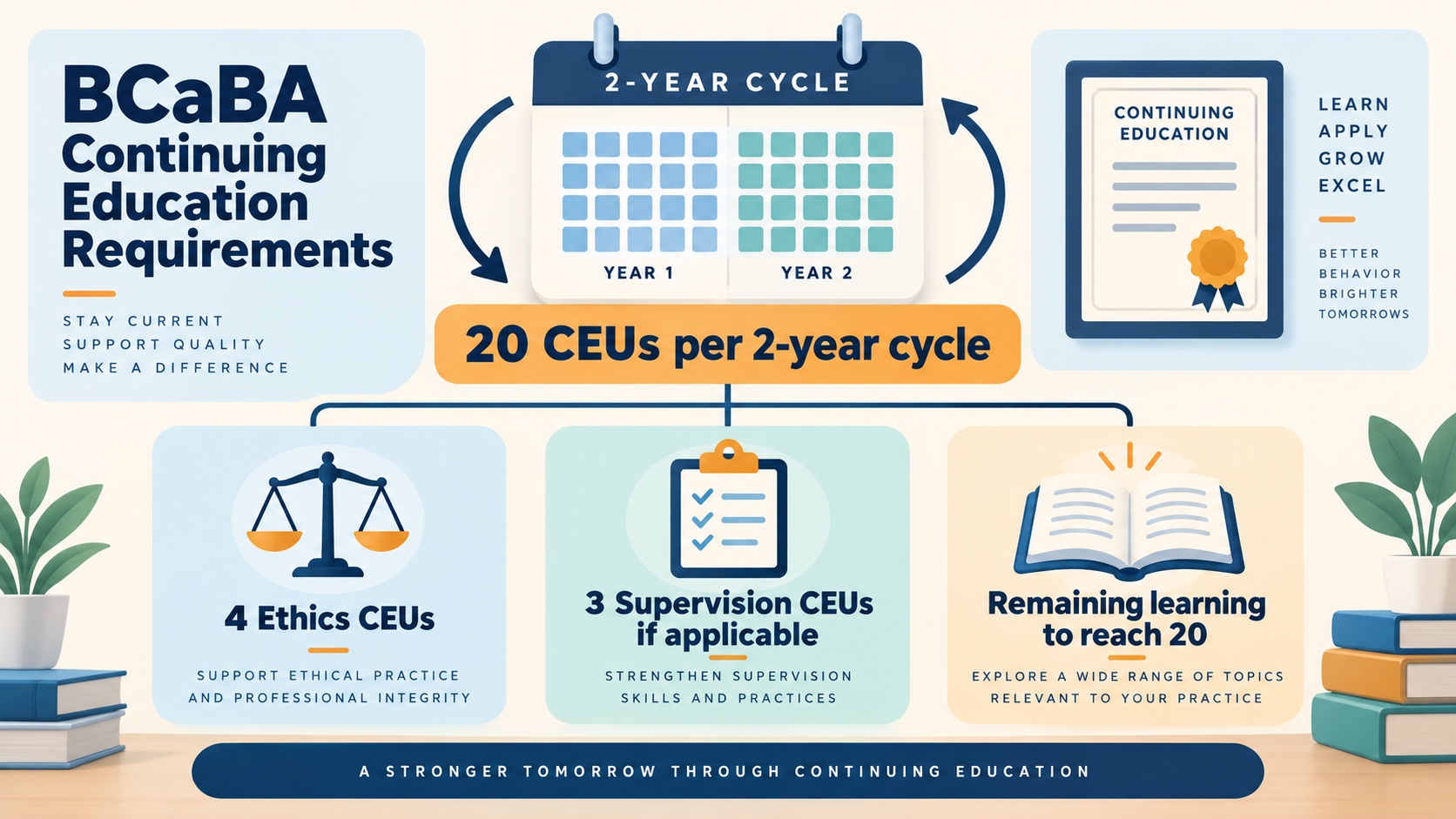
If you are searching for BCaBA CEU requirements, the short answer is straightforward: the current BACB handbook requires 20 continuing education units in each two-year recertification cycle. That total includes 4 ethics CEUs, plus 3 supervision CEUs if you supervise others. The number alone, however, is not the whole maintenance rule. You also have to earn the units in the correct cycle, keep supporting documentation, meet ongoing supervision requirements, and submit recertification materials on time.
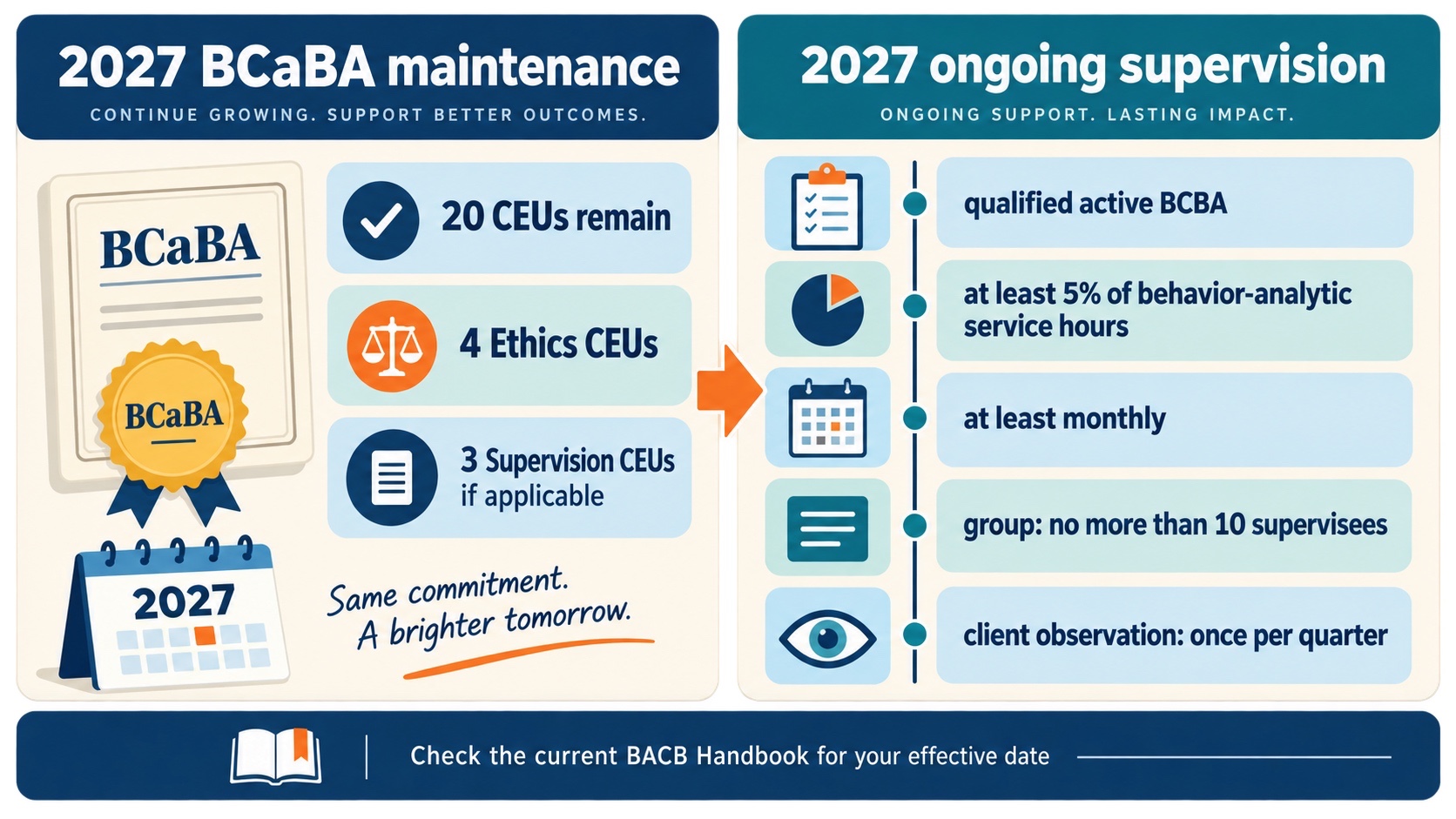
The 2027 update does not replace the 20/4/3 CEU structure. The BACB’s 2027 BCaBA requirements say those CEU numbers remain unchanged from the 2022 requirements, while clarifying the ethics category and setting out dated ongoing-supervision requirements. This guide separates the stable CEU total from the parts that depend on your role, recertification date, and applicable version of the BACB rules.
Quick answer: A BCaBA needs 20 CEUs during each two-year recertification cycle. At least 4 must be ethics CEUs. The 3-CEU supervision category applies if the BCaBA supervises others. These CEU requirements are separate from the ongoing supervision relationship that a BCaBA may need in order to practice. The current BCaBA Handbook and the BACB’s dated 2027 requirements document control if a general explanation conflicts with your cycle-specific instructions.
The 20-CEU breakdown
Think of the requirement as one total with category minimums inside it, rather than as three unrelated quotas:
| Category | Amount in each 2-year cycle | Who needs it? |
|---|---|---|
| Total continuing education | 20 CEUs | Every BCaBA maintaining certification |
| Ethics | 4 CEUs | Every BCaBA maintaining certification |
| Supervision | 3 CEUs | BCaBAs who supervise others, when the supervision category applies |
| Other learning | The remaining amount needed to reach 20 | Choose activities that fit the current BACB rules and your professional learning needs |
The table is a planning model, not permission to label any course however you want. A course’s title may contain the word “ethics” without meeting the BACB’s ethics-CE definition. Similarly, the fact that a BCaBA attends a supervision meeting does not automatically mean the meeting is a supervision CE activity. Check the activity description, provider information, category, date, and certificate before counting it.
How the two-year cycle works
Your CEU plan follows your individual recertification cycle, not a calendar-year reset. The BACB handbook says that all CEUs must be earned within the recertification cycle to which they are applied. For example, if a cycle runs from September 30, 2025, through September 29, 2027, a CEU earned before September 30, 2027 belongs to that cycle; a CEU for the next cycle cannot be started early just because the recertification application was submitted in September.
The handbook also warns against two common assumptions. Missed CEUs cannot simply be made up after the recertification date, and extra CEUs do not transfer to the next cycle. That makes a simple running record more useful than a last-minute search for courses. At the start of each cycle, write down the end date, the 4-CEU ethics minimum, whether the 3-CEU supervision category applies, and the documentation you will need to enter in your BACB account.
Recertification is a separate action from attending a course. The current handbook describes ongoing continuing education, ethics and self-reporting compliance, ongoing supervision, and a recertification application with associated fees every two years before the recertification date. Meeting one part does not erase the others.
What counts toward ethics CEUs?
The BACB’s 2027 BCaBA Requirements document gives a specific definition for ethics continuing education. A qualifying event may relate to BACB ethics requirements and/or cultural or contextual responsiveness. Its content must relate to behavior-analytic practice or applied research and must be directly linked to behavior-analytic literature and/or established practice. Most of the event must focus on ethics or cultural/contextual responsiveness.
That last boundary matters. A general ABA course that mentions the Ethics Code for five minutes should not automatically be marketed or counted as an ethics CEU. The main learning activity needs to be about the ethics or cultural/contextual-responsiveness topic, not merely decorated with an ethics reference. When you review a course, ask whether the description makes the category focus clear and whether the learning material supports the connection to behavior-analytic practice.
The Ethics Code for Behavior Analysts is a professional standard for BCaBA and BCBA certificants and applicants, but reading the code by itself does not answer whether a particular event qualifies as a CEU. The activity still needs an appropriate format, provider, date, record, and category under the rules that govern your cycle.
CEUs versus ongoing supervision
Supervision CEUs and ongoing supervision are related words with different jobs. Supervision CEUs are a continuing-education category that can apply to a BCaBA who supervises others. Ongoing supervision is the professional oversight a BCaBA may need while practicing. It can involve a qualified supervisor, regular contact, observation, feedback, and records. Completing 3 supervision CEUs does not replace ongoing supervision, and being supervised does not automatically give you 3 qualifying CEUs.
This distinction prevents a common paperwork error: placing a supervision meeting or fieldwork activity in the CEU total without checking what requirement it was designed to satisfy. Keep the activity label tied to its source document. A learning event, a supervision meeting, a fieldwork observation, and an employer training can all be useful while serving different compliance purposes.
If you are building a broader study plan, the BCaBA supervision hours guide can help you separate supervised practice from continuing education. For a cross-credential view, see the BACB CEUs overview, then return to the BCaBA handbook for the rules that apply to your credential.
What changes for BCaBA maintenance in 2027?
The BACB says the key 2027 BCaBA maintenance changes take effect for people recertifying on or after January 1, 2027. The continuing-education numbers remain 20 CEUs per two-year cycle, 4 ethics CEUs, and 3 supervision CEUs for supervisors. The meaningful update is the clarified definition of ethics CE and the dated ongoing-supervision overview.
Under the 2027 overview, a BCaBA must practice under a qualified supervisor. The document says the supervisor must be an active BCBA with no current disciplinary sanctions and must meet the ongoing supervision CEU requirement. It lists at least 5% of behavior-analytic service hours supervised, supervision at least once a month, and a combination of individual and group supervision when the group has no more than 10 supervisees. It also calls for observation of the BCaBA supervisee with a client once each quarter.
The BACB states that a BCaBA without a qualified supervisor is considered inactive and may not practice or use the BCaBA certification until a supervisor is on record. These are supervision rules, not additional CEUs to add to the 20. They should be read with the full BCaBA Handbook and your actual effective date, because a transition document is a dated overview rather than a replacement for every handbook section.
A practical verification checklist
Before you count an activity, run it through a short source-first check:
- Identify the cycle: record the start and recertification dates that govern the activity.
- Identify the category: decide whether the event is general learning, ethics, or supervision before adding it to a total.
- Check the provider: when the activity is offered through an ACE Provider, use the BACB registry to verify the provider status; do not confuse a provider listing with automatic approval of every event.
- Read the event description: for ethics CE, most of the event should focus on ethics or cultural/contextual responsiveness and connect to behavior-analytic practice or applied research.
- Save the evidence: keep the certificate or other supporting record, including the activity title, date, category, provider, and number of units.
- Enter and review: add the activity to the BACB account according to current portal instructions and check that the category minimums are still met.
This checklist is deliberately conservative. If the provider, category, date, or documentation is unclear, pause before counting the activity and consult the current BACB source. It is much easier to clarify one uncertain event than to discover a category gap immediately before recertification.
Common mistakes
- Counting 20 hours without checking categories: the total alone does not prove that the 4 ethics minimum is met.
- Assuming every BCaBA needs 3 supervision CEUs: the handbook identifies this category for supervisors when applicable.
- Using a calendar-year spreadsheet: the governing unit is your individual two-year recertification cycle.
- Carrying extra units forward: the handbook says excess CEUs do not transfer to the next cycle.
- Calling a brief ethics mention an ethics event: the 2027 guidance requires the main focus to be ethics or cultural/contextual responsiveness.
- Confusing supervision with supervision CEUs: professional oversight and continuing-education categories must be documented separately.
- Relying on an old blog post: use the current BCaBA Handbook and dated BACB transition documents when rules change.
FAQ
How many CEUs does a BCaBA need every two years?
The current BACB requirement is 20 CEUs in each two-year recertification cycle. Four must be ethics CEUs, and three supervision CEUs apply when the BCaBA supervises others.
Are BCaBA supervision CEUs required for everyone?
No. The handbook describes 3 supervision CEUs for supervisors. Whether that category applies depends on the supervision role and the rules governing your cycle.
Do BCaBA CEUs carry over?
No. The current handbook says CEUs must be earned in the cycle to which they are applied, missed CEUs cannot be made up after the recertification date, and excess CEUs cannot be applied to the next cycle.
Did the 2027 update increase the BCaBA CEU total?
No. The BACB’s 2027 BCaBA requirements document says the 20 total, 4 ethics, and 3 supervision CEU structure remains unchanged from the 2022 requirements. The document clarifies ethics content and provides dated ongoing-supervision requirements.
Can ABA Study Online CEUs be used for BCaBA recertification?
Do not assume that because a resource is educational it is an accepted CEU. Verify the provider and activity against the BACB’s current requirements and documentation rules. ABA Study Online should not be presented as BACB-authorized unless that status is separately established and current.