
BCaBA Supervision Hours: What Counts?
When someone searches for BCaBA supervision hours, they may be asking about the fieldwork hours needed before certification, the amount of supervision required each month, or the ongoing supervision a certified BCaBA receives after certification. Those are related questions, but they are not the same requirement. This guide focuses first on supervised fieldwork for BCaBA certification, then separates it from post-certification ongoing supervision.
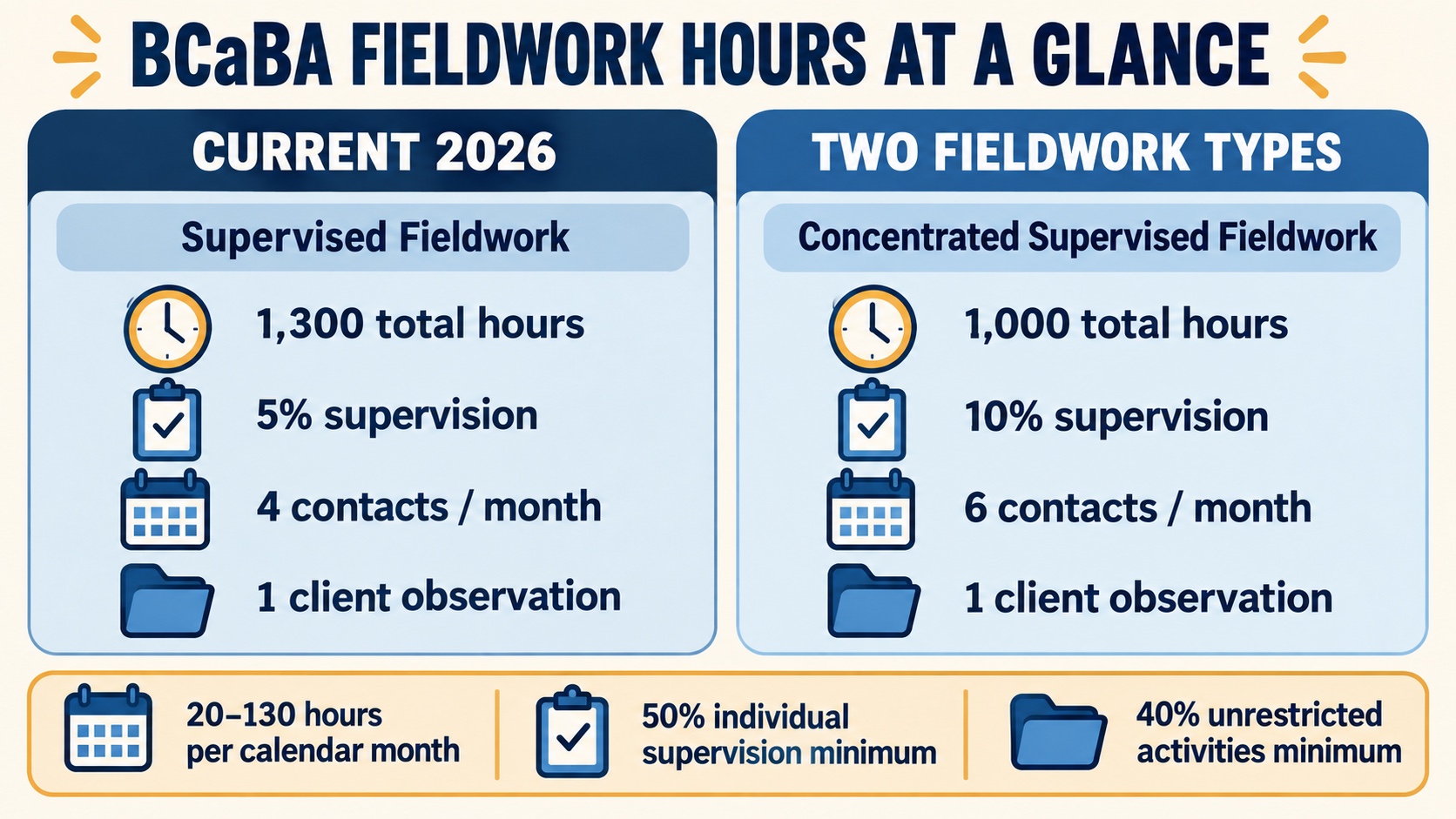
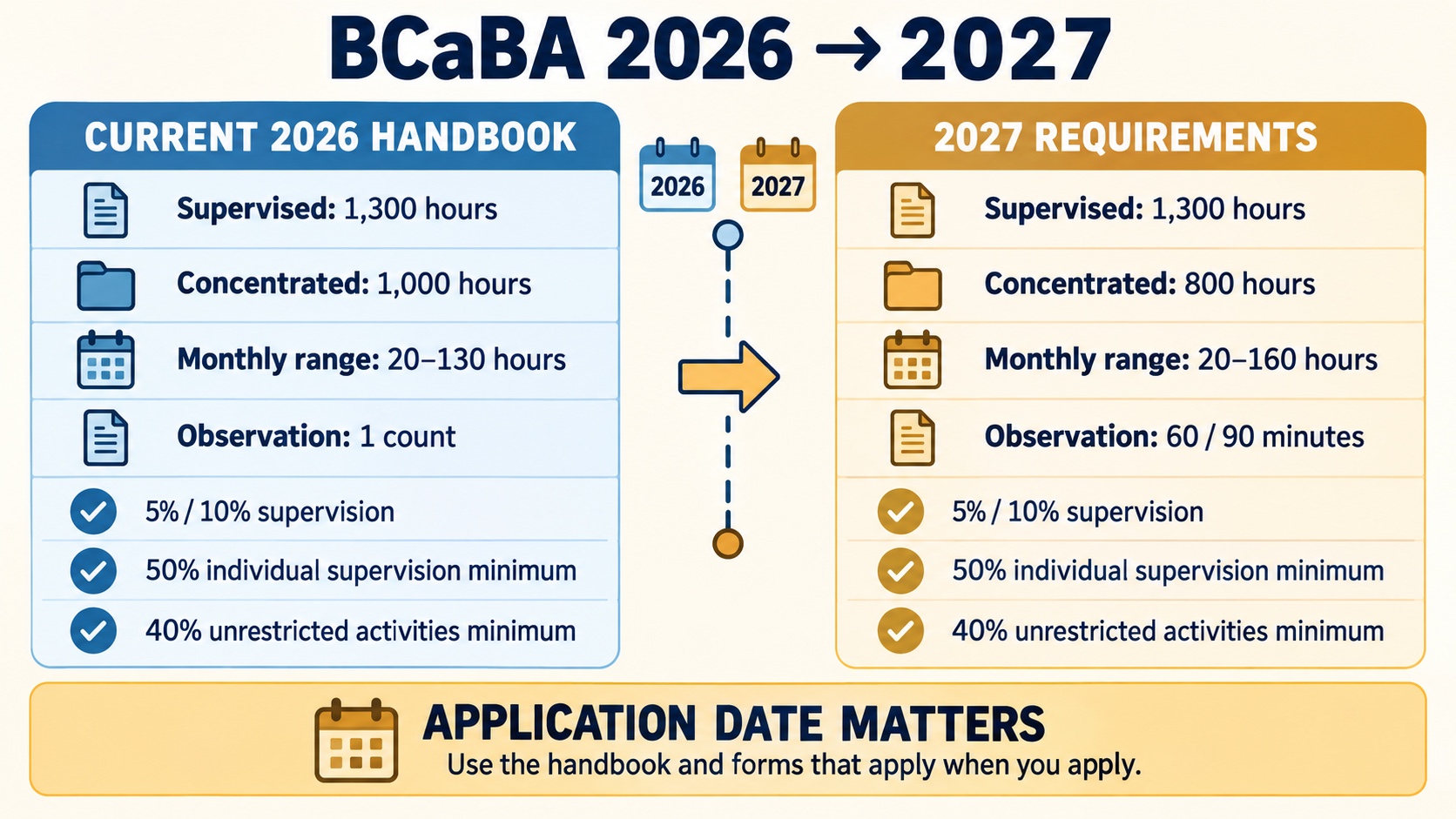
Under the current June 2026 BCaBA Handbook, the fieldwork route is either 1,300 Supervised Fieldwork hours, 1,000 Concentrated Supervised Fieldwork hours, or a permitted combination. The monthly supervision percentage is 5% for Supervised Fieldwork and 10% for Concentrated Supervised Fieldwork. The official 2027 requirements keep 1,300 standard hours but list 800 concentrated hours and change several monthly details, so the application date matters.
Table of Contents
What BCaBA supervision hours can mean
The phrase “supervision hours” hides two different clocks:
- Certification fieldwork: supervised practical experience accumulated before applying for BCaBA certification. This is the main subject of this article. It has a fieldwork total, a monthly supervisory period, supervision percentages, contact and observation rules, and documentation forms.
- Ongoing supervision after certification: supervision connected to a certified BCaBA’s behavior-analytic service delivery. It is a maintenance and practice requirement, not a way to relabel pre-certification fieldwork.
A third number can cause confusion: the 3 supervision CEUs required for applicable BCaBA supervisors during a recertification cycle. Those are continuing-education units, not the fieldwork hours a trainee needs to qualify. A good tracker labels each row as fieldwork, ongoing supervision, or continuing education before any number is added.
For fieldwork, “hours” does not mean that every hour spent at an ABA workplace automatically qualifies. The current handbook says fieldwork must be client-related and meet the applicable supervision structure. The supervisor determines whether activities fit the requirements, and the trainee needs a documentation system that can support the claim if the BACB audits the experience.
Current 2026 fieldwork requirements
The current June 2026 handbook gives two fieldwork types. They are not simply two labels for the same schedule; the concentrated route uses more supervision within each month and therefore has a lower required total.
| Requirement | Supervised Fieldwork | Concentrated Supervised Fieldwork |
|---|---|---|
| Total hours to qualify | 1,300 | 1,000 |
| Supervisory period | 1 calendar month | 1 calendar month |
| Fieldwork hours per month | 20–130 | 20–130 |
| Supervision per period | 5% of hours | 10% of hours |
| Supervisor contacts per period | 4 | 6 |
| Client observation | 1 observation | 1 observation |
| Individual supervision | At least 50% of supervised hours must be individual; group supervision may not exceed 50%. | |
| Unrestricted activities | At least 40% of overall supervised fieldwork hours. | |
The word “per month” matters. A trainee cannot normally log 10 hours in one month, 150 in the next, and average the numbers across the two periods. The current range is measured by calendar month, and the requirements for the chosen fieldwork type must be met in the period in which the hours are claimed. Fieldwork must also be completed within five continuous years.
What must happen before hours begin
Starting a job is not the same as starting qualifying BCaBA fieldwork. The current handbook requires three foundations before a trainee begins accumulating hours:
- A qualified supervisor: the supervisor must meet the applicable BACB qualifications and be able to oversee the fieldwork structure.
- A signed supervision contract: the relationship and responsibilities need to be defined before the hours are treated as fieldwork.
- Qualifying behavior-analytic coursework: the trainee must have started the relevant coursework. Hours may begin after attending the first class meeting, but the initial graded course must ultimately receive at least a C, or a pass in a pass/fail system, for the fieldwork hours to count.
This order protects both sides. It stops a trainee from retroactively labeling ordinary employment as fieldwork, and it gives the supervisor a chance to establish the documentation system before the first monthly period closes. If one of the foundations is missing, pause and resolve it with the supervisor and the current handbook instead of quietly adding the hours to a spreadsheet.
The BACB also recommends reviewing a fieldwork checklist with the supervisor before starting at each setting. The supervisor’s status, training, contract, and record-keeping process are not minor administrative details; they are part of the conditions that make an audit trail usable.
Supervised versus Concentrated Supervised Fieldwork
Supervised Fieldwork is the standard route at 1,300 hours. Concentrated Supervised Fieldwork is the more intensive route at 1,000 hours under the current handbook. Concentrated fieldwork requires 10% supervision rather than 5% and six contacts rather than four during the monthly period. Both types still require the individual/group, observation, client-related, and unrestricted-activity rules that apply to the fieldwork structure.
A simple planning example shows the percentage without turning it into a personal approval. If a trainee logs 80 eligible fieldwork hours in one current standard month, 5% is 4 hours of supervision. If the trainee is in the concentrated structure for that month, 10% is 8 hours. The supervisor must still verify the actual contacts, observation, individual supervision, activity quality, and documentation. The arithmetic alone does not make a month compliant.
The current handbook allows a permitted combination of fieldwork types. For planning the combined total, multiply concentrated hours by 1.3 and add the supervised-fieldwork hours; the adjusted planning total must reach 1,300. This multiplier is only for the mixed-total calculation. On the Monthly Fieldwork Verification Form, Final Fieldwork Verification Form, and application, record the actual hours accrued, not the adjusted number.
Do not use the multiplier to inflate a monthly form, and do not assume that a software tracker’s adjusted total is the number you should submit. Keep two columns if needed: actual hours and planning-equivalent hours. Label the second one clearly so it cannot be mistaken for the official record.
How to plan a compliant month
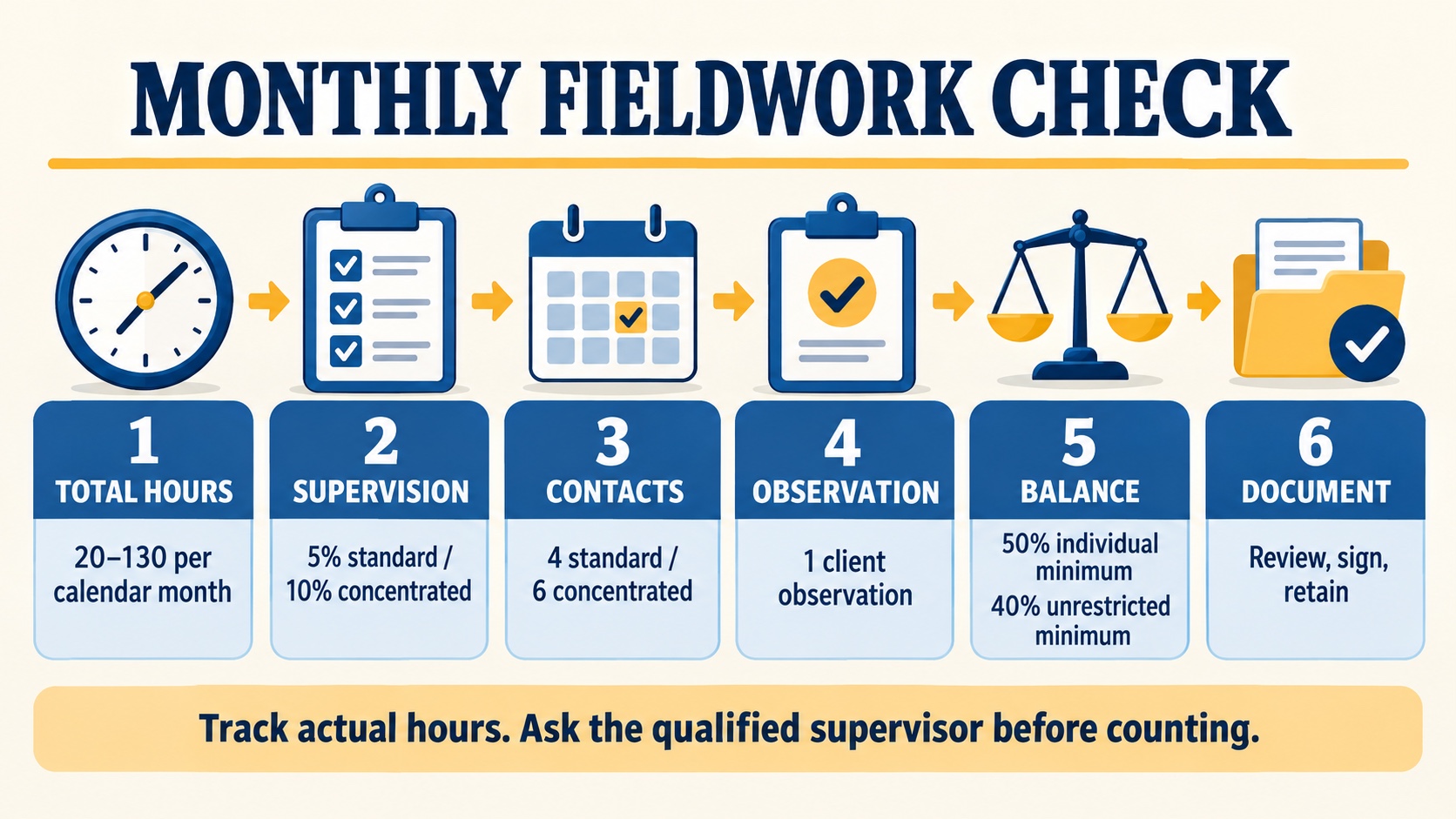
At the beginning of each calendar month, write down the fieldwork type, the setting, the responsible supervisor, and the expected range of hours. During the month, track the following items separately:
- Total fieldwork hours: stay within the current 20–130-hour monthly range.
- Supervised time: calculate the applicable 5% or 10% percentage for the period rather than averaging it later.
- Contacts: current standard fieldwork uses at least four contacts and current concentrated fieldwork uses at least six.
- Client observation: document the required observation in the natural environment or the permitted synchronous/asynchronous format described by the handbook.
- Individual and group balance: at least half of supervised hours must be individual; group supervision cannot replace the individual component.
- Unrestricted work: keep a separate running total so at least 40% of overall supervised fieldwork is devoted to unrestricted activities.
- Evidence: save dates, activity descriptions, supervisor notes, forms, signatures, and corrections in one durable location.
For example, a month with 60 total hours may include direct service work, data analysis, program development, caregiver or staff training, and observation. The label “ABA work” is not enough. Your documentation should make it possible to see which activities were client-related, which were restricted or unrestricted, when supervision occurred, and how the supervisor reviewed the work.
What fieldwork activities can include
The current handbook describes fieldwork as practical behavior-analytic experience connected to specific client programming. Examples of unrestricted work can include observing clients and analyzing data, developing programs, training staff or caregivers on behavior-analytic procedures, and meeting with clients about behavior-analytic services. Restricted work may include directly implementing existing assessments or interventions with clients.
Restricted does not mean useless, and unrestricted does not mean “anything done away from a client.” The distinction is about the nature of the activity and how it represents the work of a BCaBA. Some activities can be valuable in practice but still fail to meet the fieldwork definition or the monthly ratio. That is why the supervisor, not a generic internet checklist, must determine whether a particular activity qualifies.
Holding an RBT certification does not automatically convert RBT duties or RBT supervision tasks into BCaBA fieldwork. The BACB specifically warns that many activities completed for RBT requirements may not count toward fieldwork. Keep the two credential pathways labeled separately in your tracker.
How to document and protect the hours
For supervised fieldwork, the Monthly Fieldwork Verification Form and Final Fieldwork Verification Form are central records. At the end of each monthly period, compare your tracker with the form before asking the supervisor to sign. Confirm the actual hours, fieldwork type, supervision percentage, contacts, observation, individual/group split, unrestricted work, setting, and dates.
BACB’s documentation guidance says the monthly form must be signed by the last day of the calendar month following the month of supervision, and the trainee and supervisor should retain copies for at least seven years. If a form is missing, the BACB FAQ warns that the associated hours should not simply be counted as if the documentation still existed. Corrections need to be supported and initialed according to the applicable guidance.
Multiple supervisors or settings add another layer. The requirements for each organized fieldwork experience must be met and documented for each setting. A single combined spreadsheet is useful for planning, but it cannot erase the need for the correct form, responsible supervisor, contract, and monthly evidence for each structure.
Build the record while the month is fresh. Keep a folder for the contract, monthly forms, final forms, supervisor credentials or registry checks, activity logs, and any audit material. This is not a promise that the BACB will accept a particular record; it is a practical way to make missing evidence visible before an application or audit.
What changes for 2027
The official 2027 BCaBA Requirements create a clear date boundary. For the 2027 eligibility framework, the fieldwork overview lists:
- 1,300 Supervised Fieldwork hours.
- 800 Concentrated Supervised Fieldwork hours.
- 20–160 fieldwork hours per supervisory period.
- 5% / 10% supervision for the two fieldwork types.
- 60 / 90 cumulative minutes of client observation for the two fieldwork types.
- At least 50% individual supervision and at least 40% unrestricted activities.
The 2027 document also says that applicants after January 1, 2027 will use the 2027 Monthly and Final Fieldwork Verification Forms. The current handbook explains that applicants must meet the requirements in place at the time they apply, regardless of when the hours were earned. That is why someone crossing the transition should track the application date, the version of the handbook, and the form version—not only the number in a cumulative hour column.
Do not treat 2027 as a reason to rewrite old records or to assume that every current monthly detail remains unchanged. The official 2027 page is a summary, and the 2027 handbook/forms control the complete documentation process. Before relying on a transition plan, compare the live source documents with your supervisor.
Fieldwork supervision versus ongoing supervision
After certification, a BCaBA still practices under ongoing supervision, but that is a different requirement from pre-certification fieldwork. Under the current handbook, the first 1,000 hours of post-certification practice require at least 5% supervision of monthly behavior-analytic service hours, with no less than 1 hour every two weeks. After the first 1,000 hours, the ongoing minimum is 2% of monthly behavior-analytic service hours. A certified BCaBA who provides behavior-analytic services must meet with the supervisor at least once each month.
Do not put those post-certification service hours in the same “fieldwork total” column. Also keep ongoing supervision separate from the 3 supervision CEUs that may apply during recertification. The numbers can appear in the same search result, but they answer different administrative questions.
Common mistakes and questions
How many supervision hours does a BCaBA trainee need?
For current fieldwork, supervision is calculated within each calendar month: 5% of fieldwork hours for Supervised Fieldwork and 10% for Concentrated Supervised Fieldwork. The month also has contact, observation, individual/group, unrestricted, and documentation requirements.
Are BCaBA supervision hours the same as BCBA supervision hours?
No. The credentials have different fieldwork totals and requirements. Use the BCaBA Handbook and BCaBA transition documents for a BCaBA plan; do not copy a BCBA table.
Can I count every hour I work at an ABA clinic?
No. Fieldwork must be client-related and meet the applicable structure. Some job duties, RBT duties, meetings, or informal learning may not qualify. Ask the qualified supervisor and document the decision.
Can I use the 1.3 multiplier on my fieldwork form?
No. Under the current handbook, the multiplier helps estimate a combined total when fieldwork types are mixed. Record actual hours on the Monthly and Final Fieldwork Verification Forms and application.
What if I apply after January 1, 2027?
Use the official 2027 requirements, the current handbook section that applies to your application, and the 2027 forms. The application date matters, and the 2027 page changes the concentrated total, monthly range, observation measure, and form set.
Does ABA Study Online approve my fieldwork hours?
No. ABA Study Online can provide explanations, practice questions, glossary material, and app-based review, but it does not approve individual fieldwork activities or replace a qualified supervisor, the BACB Handbook, or BACB forms.
For study support, review the BCaBA Theory Blocks, practice with BCaBA questions, check the ABA Definition Search, browse free ABA resources, or use the ABA Study Online app. These destinations support learning; they are not a fieldwork or supervision approval service.