BCaBA Study Guide: How to Use the Current 6th Edition Outline
A good BCaBA study guide should do more than collect definitions. It should help you decide what to study first, how to practice an applied question, and what to do after you miss one. Start with the current BACB BCaBA Test Content Outline (6th ed.), then build a routine that connects concepts to measurement, assessment, intervention, supervision, and ethics.
This guide is for independent study. It explains the current examination map and gives you a practical review system, but it is not official BACB examination content, a certification checklist, or a promise of a passing result.
Quick answer: Use the current BCaBA Test Content Outline (6th ed.) as your content map, the BCaBA Handbook for examination and certification boundaries, the Ethics Code for professional responsibilities, and your training materials for depth. Then combine short retrieval practice, spaced review, applied scenarios, and an error log. A study guide is most useful when every missed question produces a specific next action.
Keep the documents separate: the Test Content Outline describes examination content. The Handbook covers eligibility, application, testing procedures, and maintenance. A study resource can help you learn, but it does not replace either official document.
The current BCaBA exam map
The current BCaBA Test Content Outline is the 6th edition. It contains 90 tasks organized into nine domains and describes an examination with 150 scored questions plus 25 unscored pilot questions. The current BCaBA Handbook also states that the examination uses four answer choices with one correct answer and gives candidates four hours to complete it.
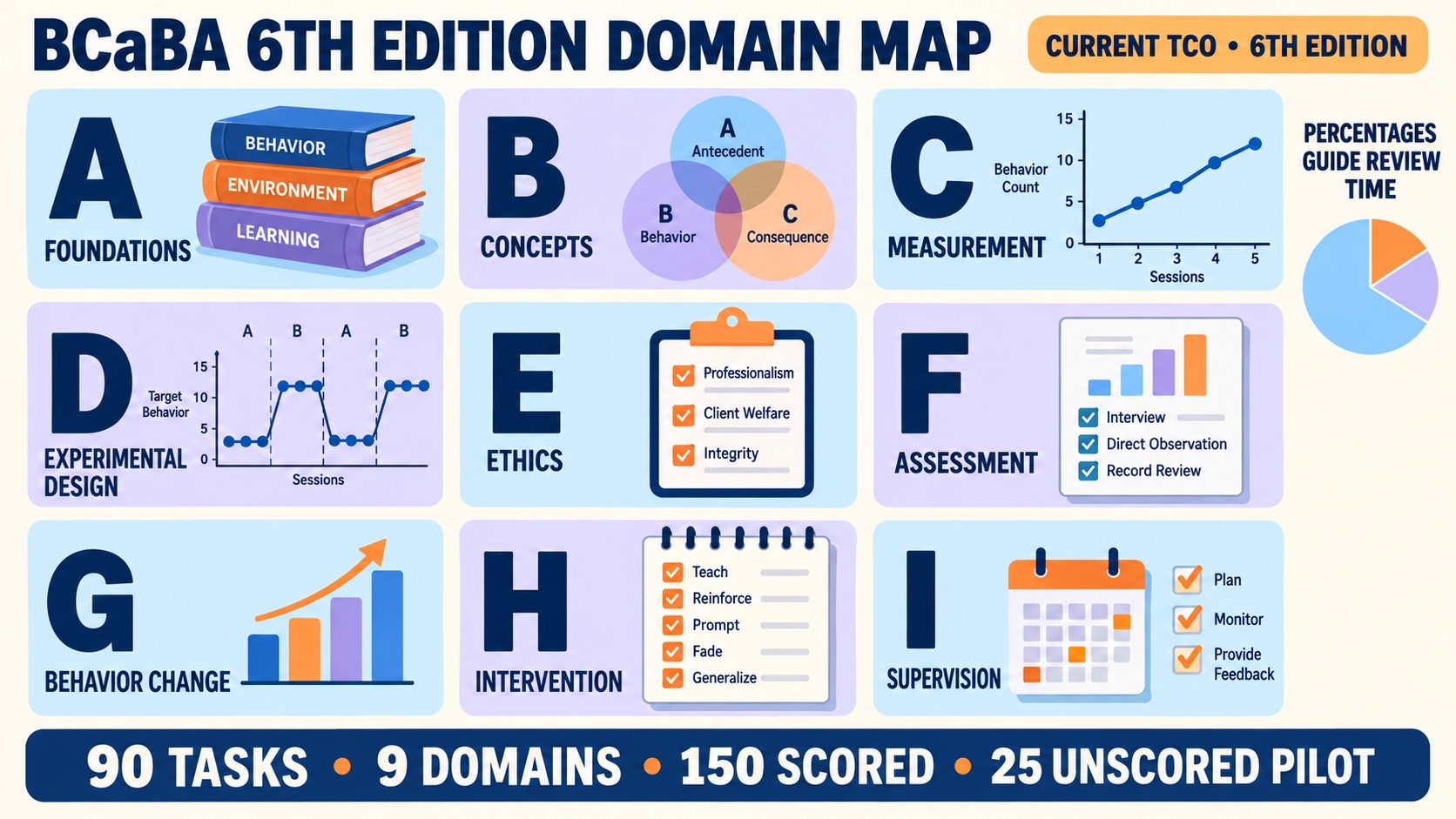
The official distribution is: A Behaviorism and Philosophical Foundations, 7%; B Concepts and Principles, 12%; C Measurement, Data Display, and Interpretation, 13%; D Experimental Design, 7%; E Ethical and Professional Issues, 12%; F Behavior Assessment, 11%; G Behavior-Change Procedures, 15%; H Intervention Development and Monitoring, 13%; and I Supervisory Relationships, 10%.
Use those numbers as a planning signal. They suggest that behavior-change procedures, measurement, intervention development, concepts, ethics, and assessment deserve substantial attention. They do not mean that a smaller domain can be skipped or that you will receive a predictable number of questions in a particular order.
How to study the nine domains
Do not make nine isolated vocabulary lists. Give each domain a question it should help you answer in a real case.
A and B: foundations, concepts, and principles
For foundations, explain what behavior analysis is trying to describe, predict, and influence, and how philosophical assumptions shape observation. For concepts and principles, build comparison cards for close alternatives such as reinforcement and punishment, motivating operations and stimulus control, or response and stimulus classes. Add a brief example and one feature that would make the example different.
C and D: measurement and experimental design
Pair every measurement term with the behavior dimension it captures and the decision it can support. Practice reading level, trend, variability, and changes in data collection before choosing an explanation. For experimental design, ask what changes, what is held comparable, what is replicated, and which alternative explanation the design helps address.
E and F: ethics and assessment
Keep the current Ethics Code next to your case notes. Practice identifying consent, confidentiality, competence, documentation, scope, cultural responsiveness, and supervision boundaries inside an applied scenario. For assessment, separate what was observed from the hypothesis drawn from it. Descriptive information may suggest a relation; it does not automatically demonstrate a functional relation.
G and H: behavior change and intervention monitoring
For behavior-change procedures, describe the contingency, target response, learner experience, prompting or fading plan, generalization arrangement, and maintenance check. For intervention development and monitoring, connect the choice to assessment data, meaningful goals, contextual fit, treatment integrity, and outcome review. A familiar procedure is not automatically the best decision for a particular case.
I: supervisory relationships
Study feedback, training, performance support, communication, role boundaries, and monitoring. A BCaBA study scenario may include what a supervisor should do next, not only what the learner should do. Keep the supervision relationship visible when you explain a decision; BCaBA practice is not a license to work outside required oversight.
An eight-week BCaBA study routine
An eight-week plan is a template, not a requirement. Shorten or extend it according to your training, available time, and examination date.
- Week 1 — Map the source: read the current TCO once, create nine domain headings, and note which task verbs appear repeatedly.
- Weeks 2–3 — Build the base: study foundations, concepts, measurement, and design. Use short recall prompts instead of rereading the same page.
- Weeks 4–5 — Connect decisions: study ethics, assessment, behavior change, and intervention monitoring through short scenarios.
- Week 6 — Add supervision: review supervisory relationships and revisit the domains where your error log shows uncertainty.
- Week 7 — Interleave: mix domains in one practice session so you must identify the relevant concept before choosing an answer.
- Week 8 — Simulate and repair: use timed mixed practice, review the rationale for every uncertain item, and create a final list of source checks and high-value comparisons.
Within each week, use a small repeatable session: five minutes to recall yesterday’s ideas, twenty minutes to learn or clarify one target, fifteen minutes to answer applied questions, and ten minutes to classify mistakes. The BCaBA study path can hold the theory step; free BCaBA questions can hold the practice step. If you prefer short sessions, the ABA Study Online app is designed for flashcards, section practice, audio review, progress, and tools rather than one long reading block.
How to practice and review mistakes
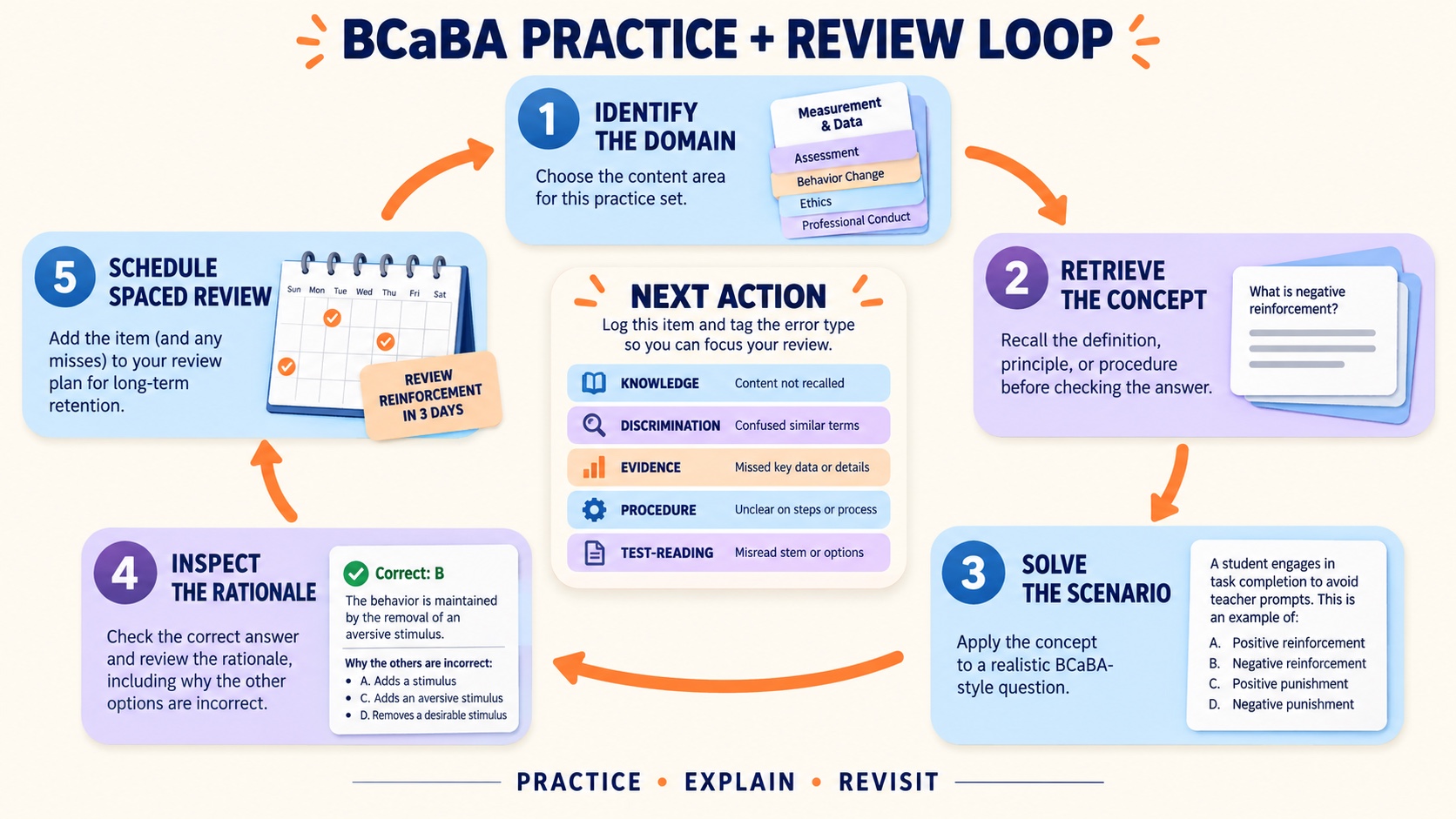
When you answer a question, pause before reading the explanation. Name the domain, task verb, relevant evidence, and reason for your choice. Then compare your reasoning with the rationale. If you were wrong, do not only write the correct letter. Record the error type:
- Knowledge error: you did not know the term or relation.
- Discrimination error: you knew both concepts but missed the feature that separates them.
- Evidence error: you made a stronger conclusion than the data support.
- Procedure error: you selected a familiar intervention without checking goal, context, integrity, or ethics.
- Test-reading error: you missed a qualifier such as “best,” “first,” “most appropriate,” or “based on the data.”
Turn the log into a next action. A knowledge error becomes a short definition-and-example card. A discrimination error becomes a two-column comparison. An evidence error becomes a graph or scenario interpretation. A procedure error becomes a decision checklist. Revisit the item after a delay, then mix it with a different domain. Retrieval practice and spaced review are learning methods supported by educational research; they are not BACB requirements or a guarantee of examination performance.
Common study-guide mistakes
- Using an old task list without checking the edition: confirm the current TCO and effective examination period.
- Studying only the largest domain: use the distribution to allocate time, not to eliminate content.
- Rereading instead of retrieving: close the notes and explain the idea before checking the page.
- Counting a score without studying the errors: accuracy is useful only when it changes the next session.
- Mixing BCaBA and BCBA materials casually: shared ABA language does not make the examination tracks interchangeable.
- Expecting a guide to replace official sources: return to the current Handbook, TCO, and Ethics Code when an edition, application, testing, or professional-boundary question matters.
BCaBA study guide FAQ
What should a BCaBA study guide include?
It should include the current TCO, all nine domains, applied examples, practice questions, rationales, an error-review system, and a clear boundary between independent study material and official BACB information.
How many questions are on the BCaBA exam?
The current structure includes 150 scored questions and 25 unscored pilot questions. The current BCaBA Handbook says candidates have four hours and that each question has four answer choices with one correct answer.
Is the BCaBA study guide official?
Third-party study guides are independent resources. The BACB recommends reviewing the current TCO, Ethics Code, and training materials, but it does not endorse specific study guides or guarantee that buying one will produce a passing result.
How do I know what to study next?
Use your error log, not only your overall percentage. The next target should be the domain, task verb, concept distinction, evidence interpretation, or procedure boundary that is producing repeated uncertainty.