BACB CEUs: How to Understand Requirements, Records, and 2027 Changes
Searching for BACB CEUs often begins with a simple question: “Does this activity count?” The answer depends on more than whether a course mentions applied behavior analysis or provides a certificate. Your credential, the activity category, the provider, the date, the documentation, and your recertification cycle all matter. A BCBA and a BCaBA use continuing education units, while an RBT who becomes certified or recertifies in 2026 follows a professional-development-unit process.
This guide gives you a practical map for separating those requirements. It uses the current BACB handbooks and official provider guidance as the starting point, then labels the 2027 changes as future or dated requirements. It is educational information, not an individualized recertification decision. When your account, cycle, or documentation is unusual, check the current BACB Portal instructions and contact the BACB rather than relying on a general article.
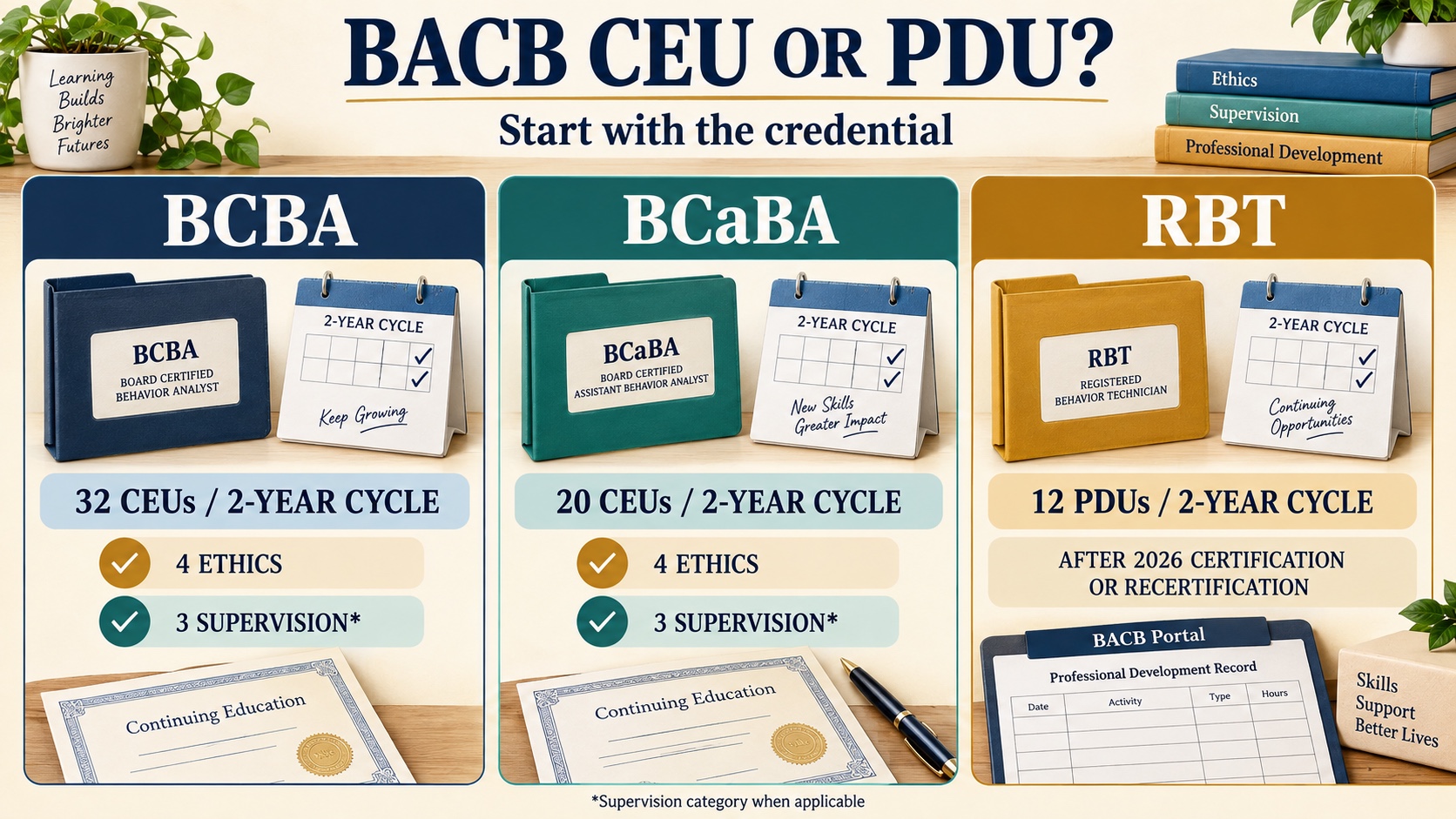
Quick answer: BACB continuing education is credential-specific. Under the current handbooks, BCBAs need 32 CEUs in each two-year cycle, including 4 ethics CEUs and 3 supervision CEUs for supervisors. BCaBAs need 20 CEUs, including 4 ethics CEUs and 3 supervision CEUs for supervisors. RBTs who become certified or recertify in 2026 need 12 professional development units, or PDUs, in each two-year cycle. Those totals are not interchangeable.
BCBA, BCaBA, and RBT maintenance at a glance
The fastest way to avoid a CEU mistake is to identify the credential before you search for an event. “BACB-approved,” “ABA training,” and “certificate included” are not enough information to tell you how an activity will be handled. Start with the maintenance category that applies to you.
| Credential | Current maintenance snapshot | Important boundary |
|---|---|---|
| BCBA | 32 CEUs per 2-year recertification cycle; 4 ethics CEUs; 3 supervision CEUs for supervisors. | Use the current BCBA Handbook and your cycle dates. The 2027 framework lists 4 supervision CEUs for supervisors. |
| BCaBA | 20 CEUs per 2-year recertification cycle; 4 ethics CEUs; 3 supervision CEUs for supervisors. | The 2027 BCaBA maintenance section keeps these CEU numbers, even though other requirements change. |
| RBT | 12 PDUs per 2-year cycle after becoming certified or recertifying in 2026. | RBT PDUs are professional development, not BCBA or BCaBA CEUs. Supervision and client-specific training do not automatically count. |
These numbers are a planning snapshot, not a substitute for the applicable handbook. Your own recertification date controls the cycle. A course completed in the wrong cycle may not be usable for the purpose you had in mind, even if the content is excellent.
Current BCBA CEU requirements
The current BCBA Handbook, updated in June 2026, requires a BCBA to obtain 32 continuing education units within each two-year recertification cycle. That total includes 4 ethics CEUs and 3 supervision CEUs for supervisors. The supervision requirement applies when the certificant has the supervisory responsibility described by the BACB.
All CEUs must be earned within the recertification cycle to which they are applied. The handbook also explains that missed CEUs cannot be made up after the recertification date and that extra CEUs cannot simply be moved to the next cycle. That makes a calendar and a record system useful long before the renewal deadline.
What makes an ethics CEU different?
An event does not become an ethics CEU merely because the title contains the word “ethics.” The current BACB definition includes events related to the BACB’s ethics requirements and/or cultural or contextual responsiveness. The content must connect to behavior-analytic practice or applied research and be directly linked to behavior-analytic literature or established practice. Most of the event must focus on ethics or cultural/contextual responsiveness.
When you review an event description, look for the substance of the session. Does it explain ethical decision-making, professional responsibilities, cultural or contextual responsiveness, and behavior-analytic applications? Or does it mention an ethics code for five minutes before moving to an unrelated topic? A category label is helpful, but the description and supporting record still need to match the current rules.
What about supervision CEUs?
Supervision CEUs are another category-specific requirement. A general webinar that includes one slide about supervision is not automatically a supervision CEU. The current BCBA Handbook says supervision CEUs must be behavior-analytic in nature and cover effective supervision practices described in the relevant BACB supervision materials.
Keep supervision CEUs separate from the supervision you provide, the fieldwork supervision a trainee receives, and the 8-hour supervision training that may apply to a supervisor’s eligibility. Related words do not make these activities interchangeable. Your record should identify the exact activity and category you are reporting.
Current BCaBA CEU requirements
The current BCaBA Handbook, also updated in June 2026, requires 20 CEUs within each two-year recertification cycle. The total includes 4 ethics CEUs and 3 supervision CEUs for supervisors. As with BCBA maintenance, the activity must fit the cycle in which you intend to count it.
The handbook describes several activity routes, including Learning, Teaching, and Scholarship. Learning may include qualifying behavior-analytic events offered by Authorized Continuing Education Providers, certain behavior-analytic university coursework, and other activities described in the handbook. Teaching and Scholarship have their own eligibility and documentation expectations. Do not turn informal mentoring, ordinary blog writing, or reading a general article into a CEU category without checking the applicable definition.
For a BCaBA, the supervision label needs extra care because ongoing supervision is also part of practicing as an assistant behavior analyst. A supervision meeting, fieldwork supervision, and a supervision CEU can all be educational, but they answer different maintenance or practice questions. Use the BCaBA Handbook section that matches the activity instead of adding every supervision-related hour to the CEU total.
The 2027 BCaBA maintenance section says the CEU requirements remain unchanged from the 2022 requirements: 20 total CEUs, 4 ethics CEUs, and 3 supervision CEUs when applicable. That does not mean every 2027 BCaBA rule stays the same. The safest planning note is “CEU numbers unchanged; review the new supervision and other maintenance rules separately.”
RBT PDUs are not BCBA or BCaBA CEUs
RBT maintenance uses a different vocabulary and a different transition. The BACB’s current RBT guidance says that an RBT who becomes certified or recertifies in 2026 must earn 12 professional development units during each two-year recertification cycle. The RBT Handbook and the BACB’s RBT professional-development page describe three broad routes:
- Qualifying in-service training from the RBT’s service organization, related to behavior-analytic service delivery and not limited to one client’s program.
- Professional-development events offered by an ACE Provider for RBTs.
- Qualifying didactic behavior-analytic university coursework with the required passing grade and documentation.
The RBT boundary is important. Ongoing RBT supervision, client-specific training, and supervised fieldwork toward BCaBA or BCBA certification do not count toward the RBT PDU requirement. Repeating the same professional-development activity also does not create new credit. RBTs should retain the form, certificate, syllabus, transcript, or other record required for the route they used and upload the documentation through the BACB Portal as instructed.
Because the units have different names, do not search for “RBT CEUs” and assume the result is a BCBA or BCaBA learning event. It may be useful education, but the credential and maintenance rule still control how it can be reported.
How to verify an activity before counting it
The BACB’s Authorized Continuing Education Providers page explains that ACE Providers can provide Learning CE to BCBA and BCaBA certificants and professional development to RBT certificants. It also points to the ACE Provider Verification Registry. Use that registry as the first check, not as the last one.
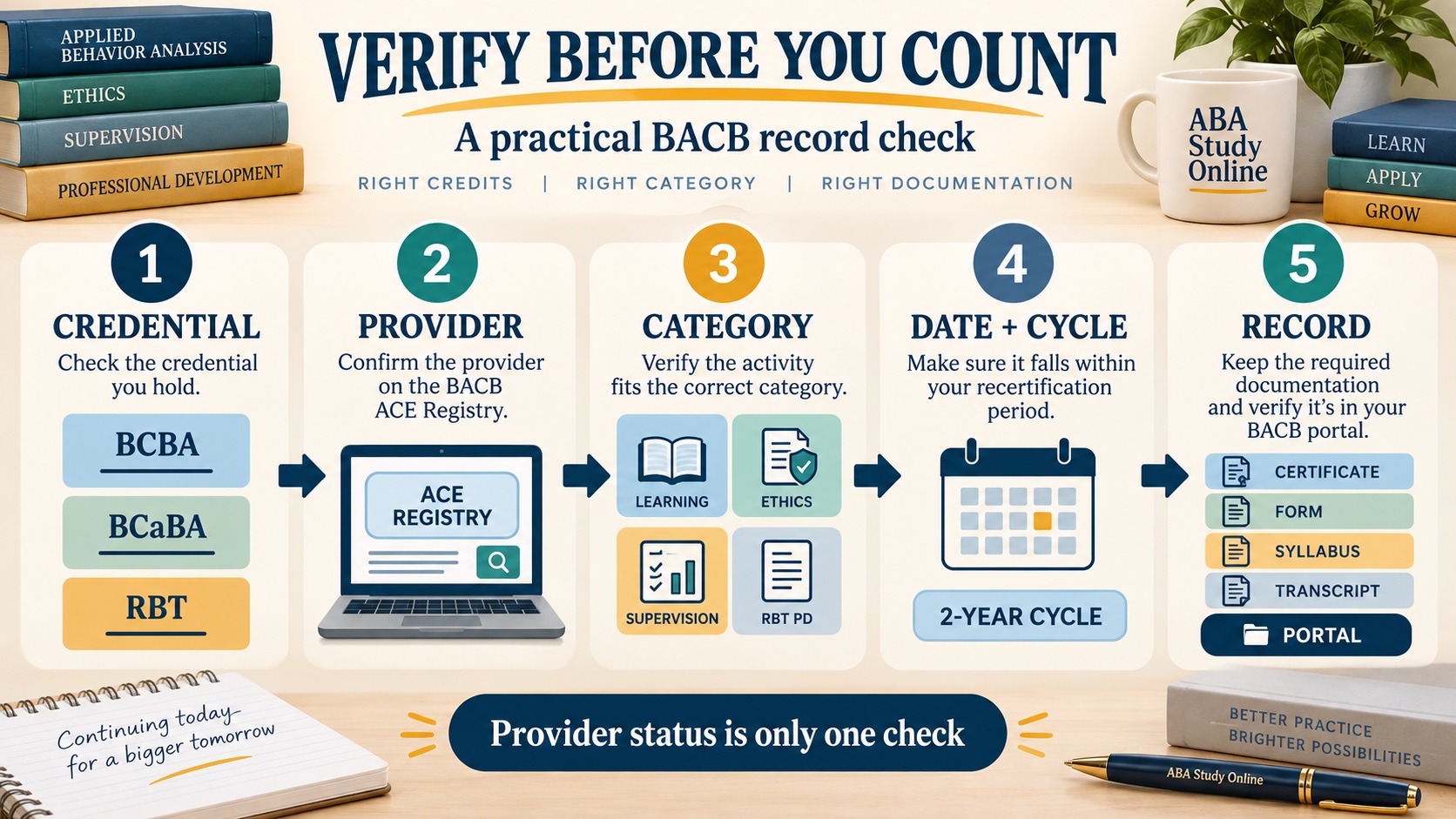
Before counting an activity, run this short audit:
- Identify the credential. Decide whether you need BCBA CEUs, BCaBA CEUs, or RBT PDUs.
- Verify the provider. Check the current ACE Provider Verification Registry or the official BACB route. Do not rely only on a third-party badge.
- Read the event description. Confirm the audience, subject, learning level, and the category being offered.
- Check the amount and date. Make sure the number of units and event date are clear and fit your recertification cycle.
- Confirm the record. Ask what certificate, form, syllabus, transcript, or completion evidence you will receive and where it should be uploaded or stored.
- Enter it carefully. Use the information exactly as it appears on the supporting document. If a category is uncertain, mark the row for verification instead of counting it prematurely.
A certificate is evidence of participation or completion; it is not a universal promise that every credential can use the activity in the same way. The provider’s audience, category, and documentation still have to match the BACB rules that apply to you.
How to plan around the 2027 changes
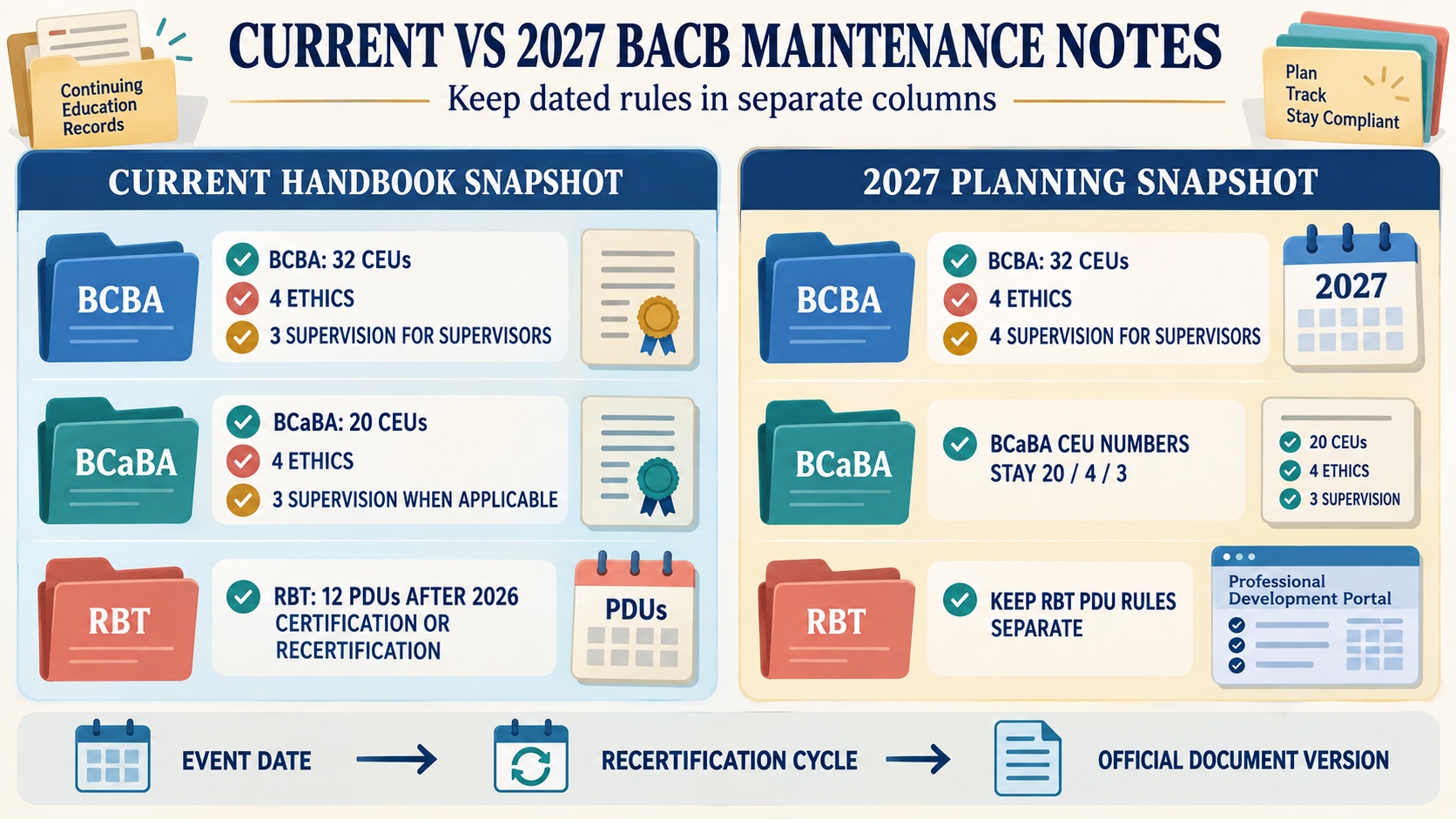
Future requirements are easiest to understand when you keep them in a separate dated column. The BACB’s 2027 BCBA Requirements page lists 32 CEUs per two-year cycle, 4 ethics CEUs, and 4 supervision CEUs for supervisors. That is a change from the current BCBA Handbook’s 3 supervision CEUs for supervisors.
For BCaBA maintenance, the 2027 handbook section keeps the 20 total, 4 ethics, and 3 supervision-if-applicable CEU numbers. Other ongoing-supervision and maintenance details still need a separate review. For RBTs, the 2026 PDU transition controls the relevant cycle after certification or recertification; it is not a reason to relabel RBT PDUs as BCBA or BCaBA CEUs.
Write down three dates for every planned activity: the event date, the beginning and end of your certification cycle, and the official document version you used. If the activity or recertification crosses the 2027 boundary, read the live BACB guidance for your credential and timing. A general comparison article can show the issue, but it cannot determine an individual transition case.
A practical tracking workflow
A small tracker is usually more useful than a long list of event links. Create one row for each activity and include:
- Credential: BCBA, BCaBA, or RBT.
- Unit type: CEU or PDU.
- Activity title and provider.
- ACE status or other provider route checked.
- Activity date and recertification cycle.
- Amount and category: general learning, ethics, supervision, in-service, ACE PD, or university coursework.
- Certificate, form, syllabus, transcript, or other document location.
- Verification status: confirmed, needs clarification, or not counted.
Review the tracker monthly rather than waiting for the final month. First check the total, then check the category requirements, then check the files. A person can have enough general learning units but still be missing ethics or supervision documentation. The tracker should make that visible while there is still time to find a qualifying activity or ask the provider a precise question.
ABA Study Online can support concept review between verified professional-development events through its BCBA learning resources, BCaBA learning resources, free ABA materials, and app review tools. Those resources are for learning and practice. They do not automatically issue BACB CEUs, ACE certificates, or RBT PDU documentation.
Common mistakes and FAQ
Can any ABA webinar count as a BACB CEU?
No. Check the credential, provider route, event content, category, date, completion evidence, and documentation. A useful webinar may still be informal learning even when it is not reportable as the category you need.
Are BCBA CEUs and BCaBA CEUs the same?
They use the same general unit name, but the total requirements, handbook language, and individual activity rules must be checked for the credential and cycle involved. Do not assume that an event marketed to one audience automatically satisfies another credential’s requirement.
Can RBT PDUs be used as CEUs?
Do not substitute them. RBT professional development units are a separate maintenance system. Follow the RBT handbook and PDU documentation route that applies after your 2026 certification or recertification.
Does “free” mean the activity is not valid?
No. Price is not the deciding factor. A free event may qualify if it meets the applicable rules and produces the required documentation; a paid event still needs to be verified.
Can I use this article as proof that my activity counts?
No. Use it as a planning map. The current BACB handbook, official provider information, your documentation, and your BACB Portal record control the decision for your situation.