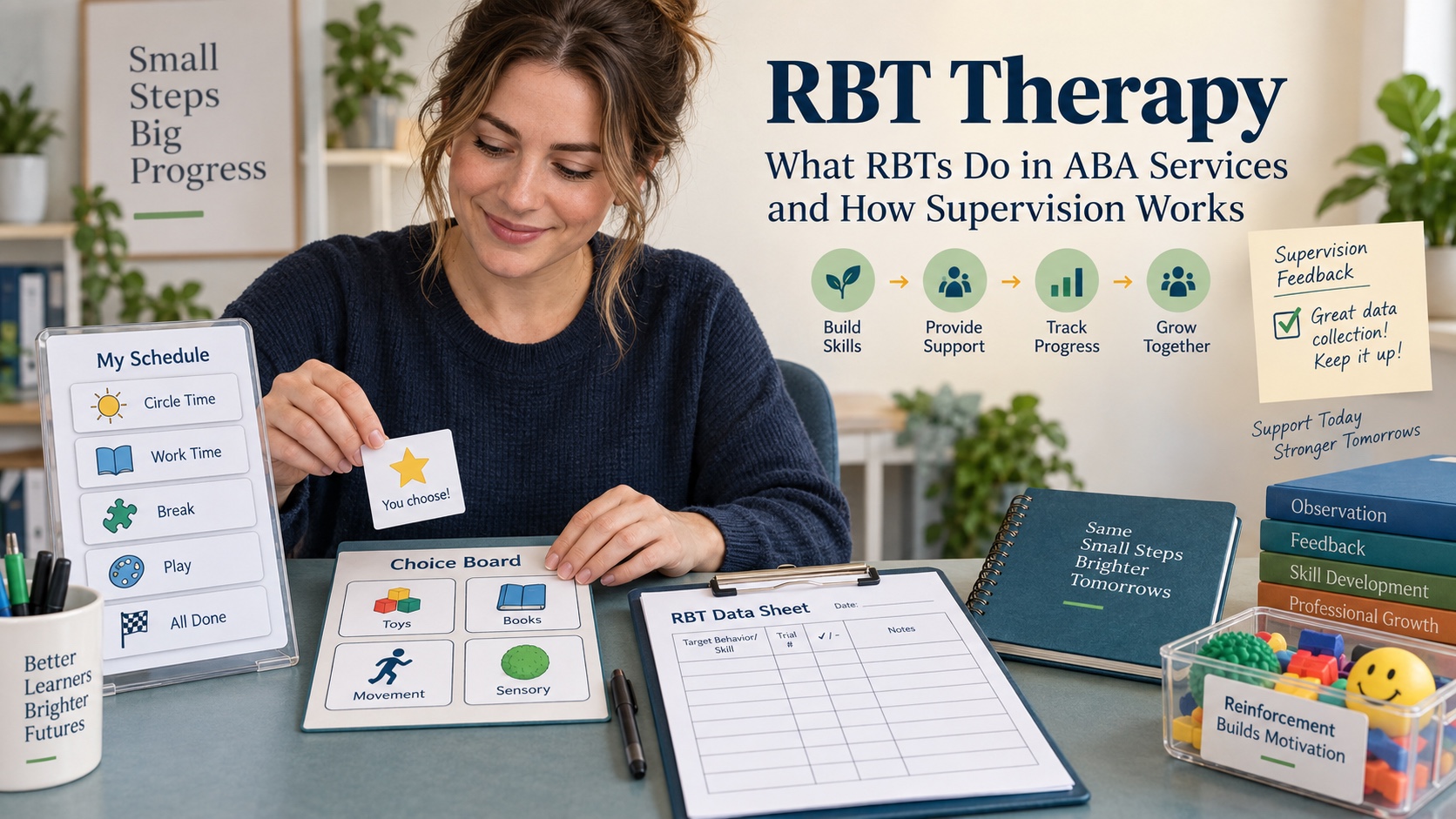
RBT Therapy: What RBTs Do in ABA Services and How Supervision Works
People often search for RBT therapy when they want to understand the person working directly with a child, teenager, or adult during an ABA session. The phrase is understandable, but it combines two different things: RBT is a paraprofessional certification in behavior analysis, while ABA therapy describes a service that uses applied behavior analysis. An RBT may assist in delivering that service, but an RBT is not the person who independently diagnoses a client or writes a treatment plan.
The BACB describes RBTs as assisting with behavior-analytic services under the direction and close supervision of an RBT Supervisor and/or RBT Requirements Coordinator who is responsible for their work. This guide explains what an RBT session may look like, how responsibilities are shared, and what families or learners can ask about quality and communication. It is educational information, not a diagnosis, treatment recommendation, or individual provider evaluation.
Table of Contents
Quick answer: what RBT therapy means
In everyday language, “RBT therapy” usually refers to ABA services in which an RBT works directly with a client while following an individualized program and receiving close supervision. The RBT may help the client practice communication, play, learning, social, self-care, safety, or daily-living skills. The RBT may also help reduce behaviors that interfere with learning or participation when the supervising clinician has assessed the situation and authorized the procedures.
The exact service is not defined by the job title alone. A responsible explanation includes:
- the client’s goals and preferences;
- the assessment and behavior-change plan created or overseen by the qualified clinician;
- the RBT’s training and demonstrated competence with the assigned tasks;
- ongoing observation, feedback, data review, and supervision; and
- the laws, funding rules, organizational policies, and professional standards that apply in the location.
This is why two RBT sessions can look different. One may involve structured teaching at a clinic table; another may involve practicing a communication request during a home routine or supporting a skill in a community setting. The goal is not to make every session look the same. The goal is to deliver the authorized plan safely, respectfully, and with enough information for the team to evaluate whether it is helping.
What an RBT may do during a session
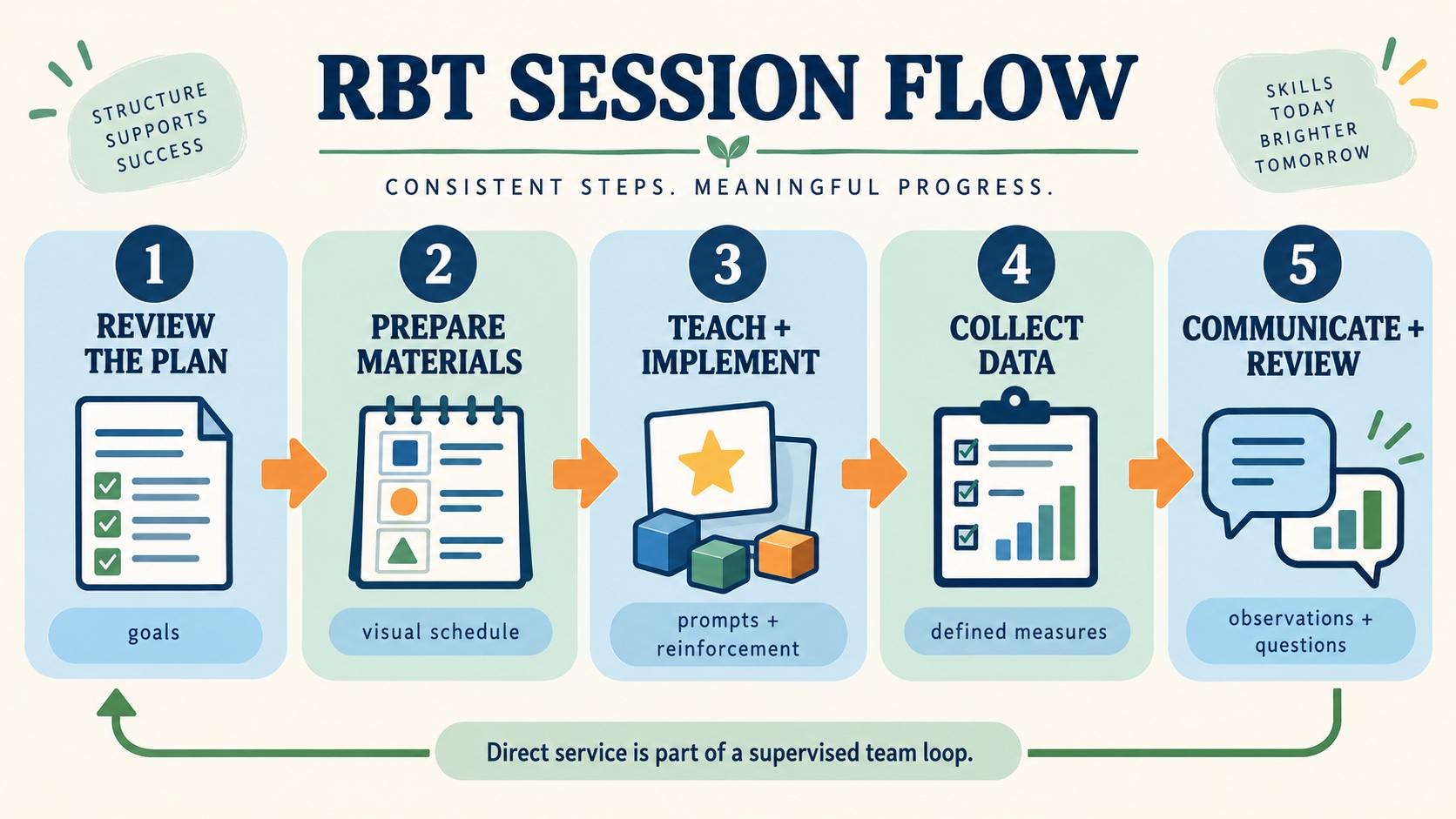
An RBT’s work is practical and observable. Depending on the client’s plan and the RBT’s training, a session may include several of the following activities:
- Review the plan and prepare materials. The RBT checks the current instructions, gathers teaching materials, arranges the environment, and confirms any safety or communication supports.
- Build instructional opportunities. The RBT creates chances for the client to practice a target skill during a planned activity or a natural routine.
- Use specified teaching procedures. The RBT may use prompts, modeling, reinforcement, error-correction steps, visual supports, or task-analysis procedures as trained and written in the program.
- Collect data. The RBT records what the client did, what support was provided, and what happened afterward using the team’s measurement system. Data may include skill responses, independence, latency, duration, or other defined measures.
- Support generalization and participation. When the plan calls for it, the RBT practices the skill across materials, people, routines, or settings so the client is not limited to one exact teaching arrangement.
- Communicate observations. The RBT reports relevant changes, questions, barriers, safety concerns, and client preferences to the supervising team. A session note should describe what occurred rather than exaggerate progress.
Good implementation is more than “getting the client to comply.” It includes protecting dignity, offering meaningful choices when appropriate, noticing assent or withdrawal, using the least intrusive effective support, and following the plan’s safety and consent procedures. If a procedure is unclear, unsafe, or no longer fits the situation, the RBT should pause as directed by the organization and contact the supervisor rather than improvise a new treatment.
How the RBT fits into the team
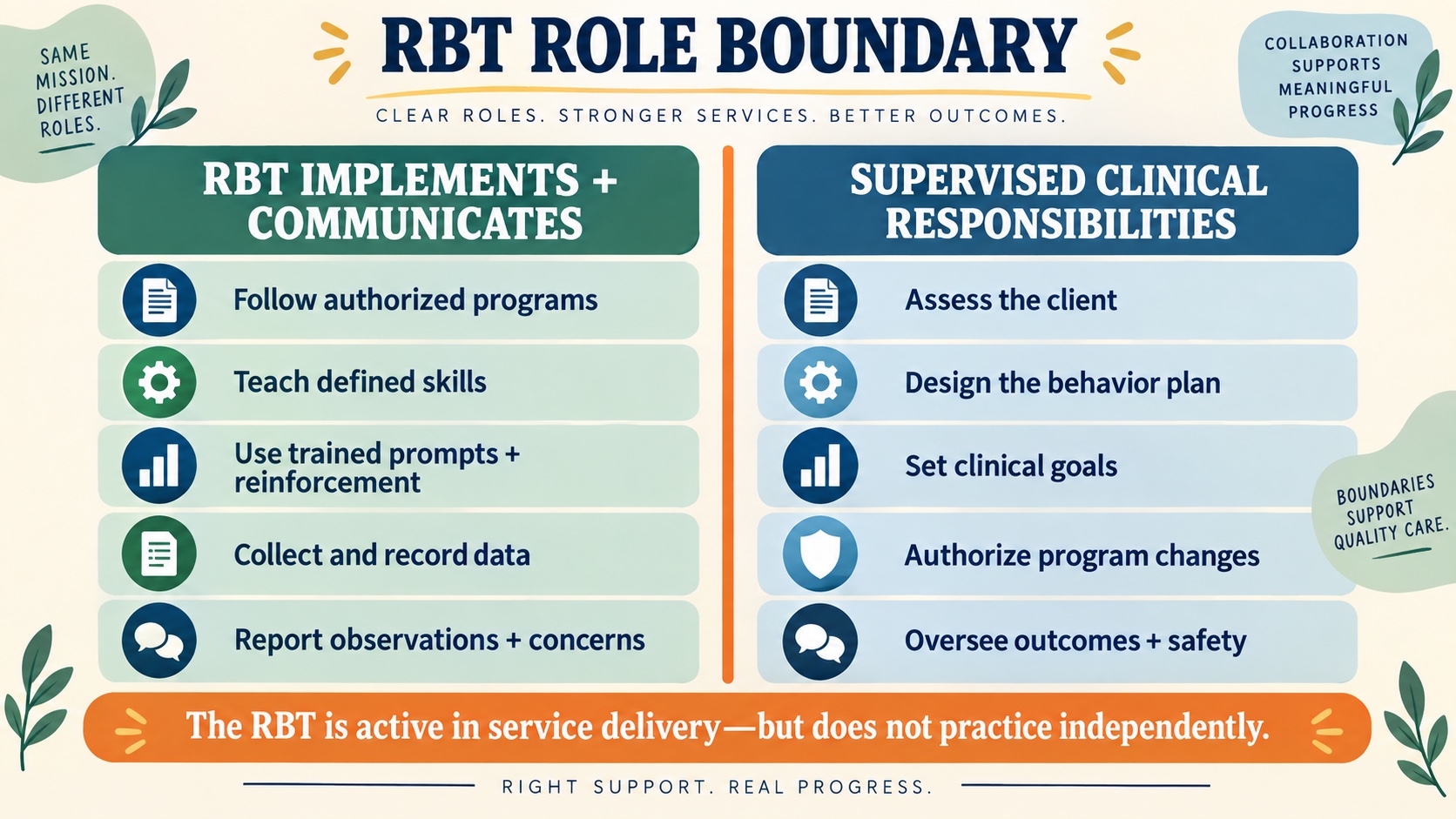
The RBT is usually the team member with frequent direct contact, but frequent contact does not mean independent clinical authority. A qualified supervisor or requirements coordinator is responsible for the applicable supervision structure and has enough client-specific knowledge to inform the RBT’s clinical direction.
In a typical team, the supervising clinician may assess behavior, identify meaningful goals, select and monitor interventions, interpret data, train caregivers or staff, and modify the program within their role and competence. The RBT may then implement the written procedures, collect data, describe what happened, and receive coaching. Families, caregivers, teachers, and other professionals may contribute important information and preferences. The exact organization varies, but the responsibility chain should be understandable to the people receiving services.
This division protects the client and the RBT. An RBT should have a way to ask questions, report a change, request more training, and receive feedback. A supervisor needs enough observation and information to know whether the program is being implemented as intended and whether the plan itself should be reconsidered.
What an RBT does not decide independently
An RBT does not independently diagnose a condition, determine whether ABA is appropriate, create a behavior assessment, write a treatment plan, set clinical goals, or change an intervention because a different idea seems interesting. An RBT should not promise a result, conceal difficult data, or represent the credential as an independent clinical license.
That boundary does not make the RBT a passive person. RBTs use active teaching skills, make moment-to-moment implementation decisions that are already covered by training and the plan, and communicate observations that may change the team’s understanding. The boundary is about who has authority to assess, authorize, revise, and take responsibility for clinical decisions.
For example, if a client begins showing a new dangerous behavior, the RBT should follow the current safety response, protect the client and others, document what was observed, and contact the supervisor or emergency resource required by the plan. The RBT should not invent a punishment procedure or quietly change the client’s goals. The correct next step depends on the written plan, the risk, the setting, and applicable law.
How RBT supervision works
The current RBT Handbook, updated in June 2026, says supervision must include at least two face-to-face, real-time contacts each month. The supervisor must observe the RBT providing services in at least one monthly meeting. One contact must be individual; the other may be a small-group meeting with 2–10 RBTs who share similar experiences. Video conferencing may be used instead of physical presence when it meets applicable requirements, but passive video monitoring without real-time interaction or feedback may not count as supervision.
Supervision may include observing service delivery, behavioral skills training, performance feedback, modeling professional and ethical behavior, reviewing data sheets or notes, guiding problem solving, and evaluating the effects of the services and the supervision. This is more meaningful than a supervisor signing a form without knowing what happened during sessions.
Ongoing supervision is also separate from professional development. The Handbook says one event cannot automatically satisfy both requirements, and client-focused ongoing supervision may not count as professional development. Because supervision rules and forms can change, RBTs and organizations should use the current handbook rather than a remembered percentage or an old training slide.
Questions families and clients can ask
A family or client does not need to memorize the RBT Handbook to ask useful questions. Consider asking:
- What are the current goals, and how were they chosen with the client and relevant stakeholders?
- What will the RBT do during a typical session, and what data will be collected?
- Who is the supervising clinician, and how can we contact them with a concern?
- How often will the supervisor observe and give feedback to the RBT?
- How will the team respect communication, privacy, assent, dignity, and cultural or family preferences?
- What happens if the client refuses, becomes distressed, or shows a new safety risk?
- How will progress and nonprogress be shared, and when will the plan be reviewed?
- What should we do if the service looks different from the written plan or a procedure is unclear?
These questions are not a demand for one therapy style. They are a way to make the service understandable, observable, and responsive to the person receiving it.
Settings, populations, and the 2026 rule boundary
RBT services may occur in homes, clinics, schools, community settings, or other locations approved by the service team and applicable rules. The BACB credential is population-neutral, so “RBT” does not by itself mean that the person works only with young autistic children. The client’s needs, goals, consent, plan, funding, and local requirements shape the service.
The BACB is currently highlighting 2026 RBT requirements changes, including the updated handbook and examination-related resources. Keep certification requirements separate from the question “what happens in a session.” For the credential path, use the site’s RBT certification guide. For broader study, the RBT learning path and RBT practice questions are separate from clinical service delivery.
A practical service checklist
- Can the team explain the client’s goals in plain language?
- Is there a current written plan that matches what the RBT is being asked to do?
- Does the RBT know how to record data and report concerns?
- Is supervision interactive, observable, and frequent enough for the assigned work?
- Are dignity, communication, privacy, assent, and cultural context addressed?
- Does the family or client know who can authorize a program change?
- Are setbacks and safety concerns communicated honestly rather than hidden?
- Does the service team review whether the plan is helping and revise it through the appropriate supervisor?
For a deeper role and certification overview, read the RBT Handbook explainer. The goal of an RBT session is not a perfect performance by the technician; it is a safe, respectful, well-supported service process that helps the team learn what the client needs next.
RBT therapy FAQ
Is RBT therapy the same as ABA therapy?
No. ABA therapy describes a behavior-analytic service. RBT is a paraprofessional credential held by someone who may assist in delivering that service under close supervision.
Is an RBT a therapist?
People sometimes use “therapist” informally to describe direct service staff, but the BACB credential is Registered Behavior Technician. An RBT works under the direction and close supervision of the responsible team; the credential does not authorize independent diagnosis or treatment-plan authorship.
Does an RBT create the treatment plan?
An RBT may provide important observations and data, but an RBT does not independently assess the client or write and authorize a treatment plan. Program design and changes belong to the appropriately qualified and supervising clinician or team structure.
How often should an RBT be supervised?
The current RBT Handbook describes at least two face-to-face, real-time supervision contacts per month, with observation of service delivery in at least one contact. Check the current handbook and applicable laws because requirements and implementation details can change.
Can RBT services happen outside a clinic?
They can occur in homes, schools, community settings, and other approved environments when the service plan, organization, funder, and applicable rules allow it. The setting does not remove the need for close supervision and clear responsibility.
Sources
- BACB Registered Behavior Technician overview
- BACB RBT Handbook, updated June 2026
- BACB Supervision, Assessment, Training, and Oversight
- County Variation in the Supervision of Registered Behavior Technicians for the Provision of ABA Services
- A Survey of Staff Training and Performance Management Practices