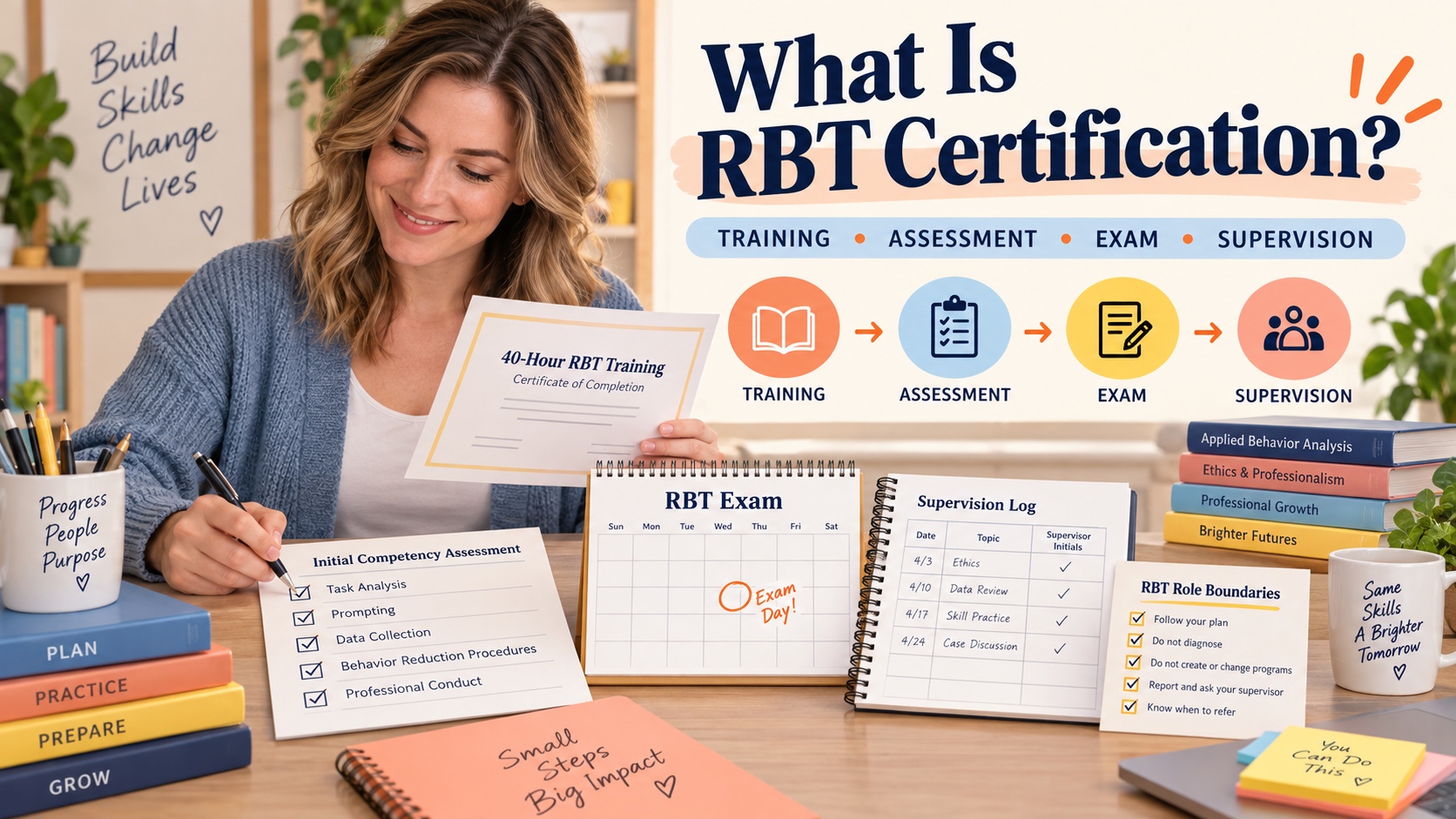
What Is RBT Certification? Training, Assessment, Exam, and Supervision
RBT certification is a paraprofessional certification in behavior analysis issued by the Behavior Analyst Certification Board. Registered Behavior Technicians help deliver behavior-analytic services under the direction and close supervision of an RBT Supervisor and/or RBT Requirements Coordinator who is responsible for their work. The credential describes a supervised role; it does not mean that an RBT independently diagnoses, writes treatment plans, or makes unsupervised clinical decisions.
People often use “RBT certification” to mean several different things: a 40-hour training course, a competency assessment, an application, an examination, or a job at an ABA provider. Those are connected, but they are not interchangeable. This guide separates the steps and explains the current 2026 exam boundary so you can read the BACB RBT resources with a clearer map.
Table of Contents
What RBT certification means
The RBT credential is designed for an entry-level behavior technician who implements behavior-analytic services within a defined supervisory structure. It gives employers, supervisors, families, and other stakeholders a way to verify that the certificant has met the BACB’s eligibility, examination, ethics, and maintenance requirements. It is not a graduate credential and it is not the same certification as BCaBA or BCBA.
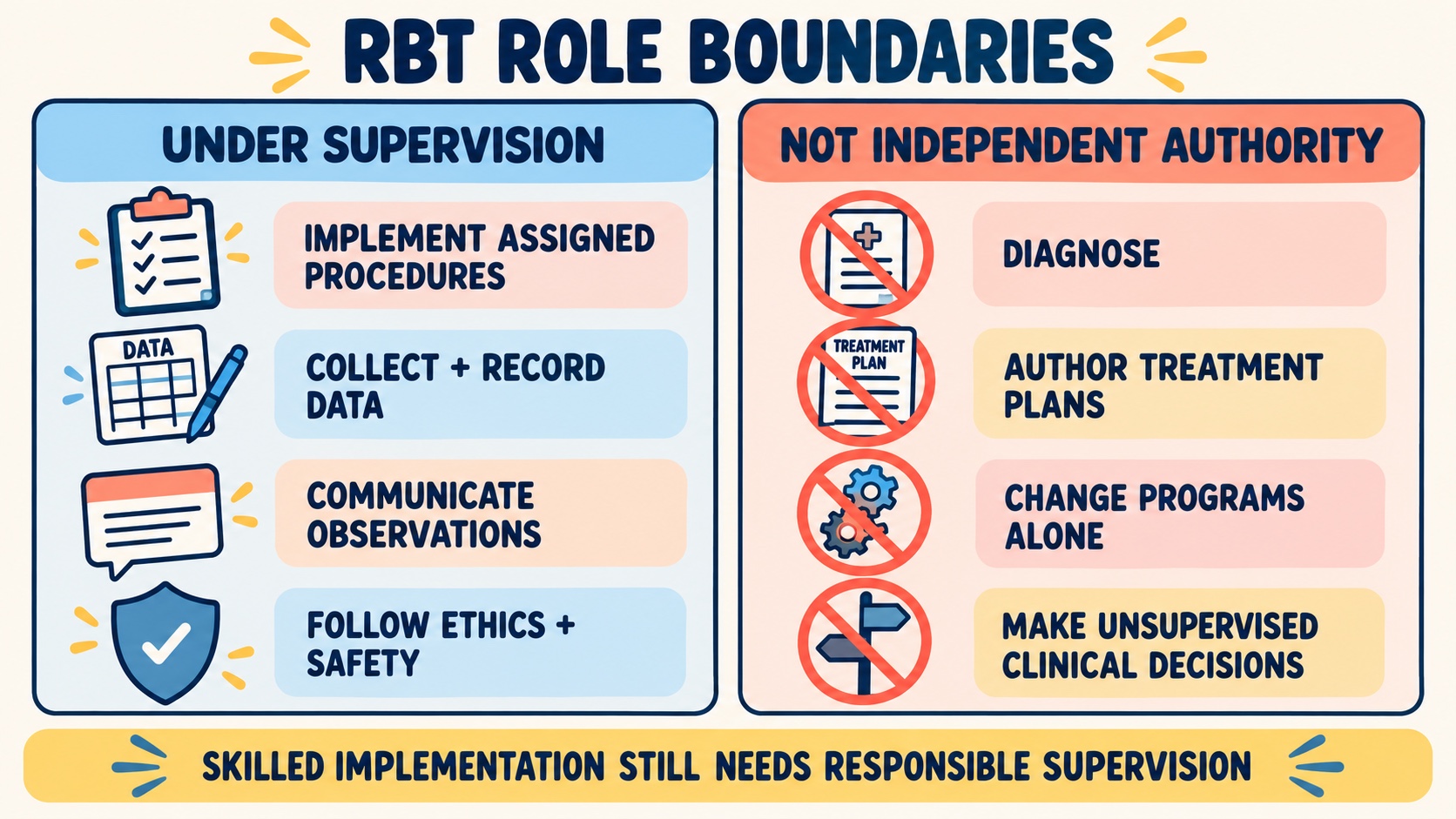
The role boundary matters in everyday work. An RBT may collect data, prepare materials, implement teaching or behavior-reduction procedures that have been assigned, document what occurred, and communicate observations through the appropriate team process. The RBT does not turn a short observation into a diagnosis, independently select a treatment plan, or change a behavior plan outside the authority and supervision structure that applies to the case.
RBT certification also should not be treated as a universal state license. A state, payer, employer, school, or health-care setting may have additional requirements. The BACB handbook explains the certification rules; local law and the employer’s policies may add obligations that are not answered by the credential alone.
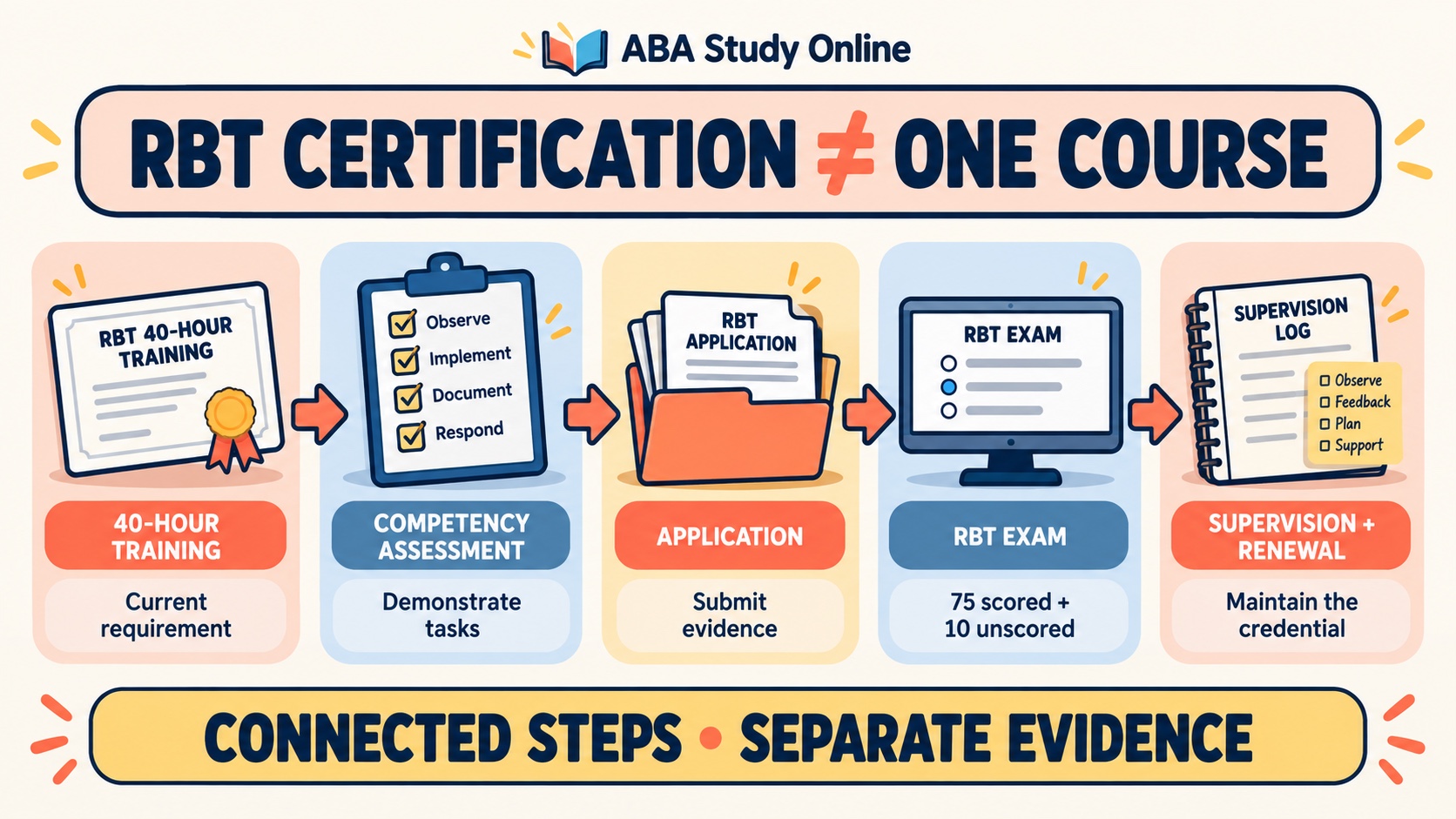
The RBT certification sequence
The exact documents and timing rules belong to the current RBT Handbook, but the overall sequence is easier to understand when you keep the steps separate.
1. Meet the basic eligibility requirements
For applications under the current 2026 requirements, the handbook identifies an age requirement of at least 18, a high school-level education or equivalent, and criminal-background and abuse-registry checks. The checks have timing and attestation rules. Do not copy an old checklist if your application date falls under a different handbook version, and remember that fingerprinting or additional employer checks may vary by state or organization.
2. Complete the required 40-hour training
The 2026 RBT training requirement is a 40-hour program that follows the BACB’s current training requirements and curriculum outline. The current handbook describes a completion window of no fewer than 5 days and no more than 180 days, counting the start and end dates. Training may be provided by an employer, university, or online program, but online delivery does not automatically make a course compliant. Ask which requirement version the provider used and keep the certificate and supporting records.
3. Complete the initial competency assessment
After the required training, you must demonstrate competency on the current initial assessment with a qualified assessor. The assessment is not the same as watching modules or passing a course quiz. It is a separate demonstration of the tasks described in the current assessment packet. Timing matters: under the current handbook, the assessment is completed after training and within the applicable window before the application.
4. Submit the application and required attestations
The application brings the evidence together. Depending on the requirement, this may include education confirmation, background and registry information, training certificate, competency assessment, and the appropriate attestation. Read the current application instructions carefully because a document can be valid in general but outside the allowed date window for the application.
5. Receive authorization and take the examination
Meeting a training or assessment requirement does not automatically authorize the examination. Once the BACB reviews the applicable application and provides an approved determination, the candidate schedules the examination through the authorized testing process. Use the official account and handbook instructions for fees, appointments, identification, accommodations, and rescheduling.
6. Maintain the certification
Certification is not the end of the supervision relationship. The current RBT materials describe ongoing supervision, adherence to the Ethics Code, recertification, and professional-development requirements for the applicable certification or recertification period. Maintenance rules can change, so use the current handbook rather than an employer’s old orientation slide.
Training is not the certification
The phrase “RBT certification course” is common in marketing, but it can hide an important distinction. A provider can offer a course designed to meet the 40-hour training requirement. That provider does not, simply by issuing a certificate, become the BACB, approve your application, complete your competency assessment, or guarantee that you will pass the examination.
Before enrolling, ask five practical questions:
- Does the course explicitly follow the current RBT 2026 training requirements?
- Does it meet the required time window and provide a certificate that identifies the training?
- Who will conduct the separate initial competency assessment?
- Which application documents and attestation steps remain my responsibility?
- Does the provider clearly distinguish independent study support from BACB certification authority?
A free video series or study app can be useful for learning terminology and practicing decisions. It should not be described as the certification itself unless it is actually the required training program and the current evidence supports that claim. Keep your records organized by step so a training completion date does not get confused with the assessment date or application date.
What the current RBT examination covers
Beginning in 2026, the RBT examination is based on the RBT Test Content Outline (3rd ed.). The current handbook describes 75 scored questions and 10 unscored pilot questions, four answer choices with one correct answer, and 90 minutes. The outline contains 43 tasks organized into six content areas:
- Data Collection and Graphing
- Behavior Assessment
- Behavior Acquisition
- Behavior Reduction
- Documentation and Reporting
- Ethics
The outline is an exam-content map, not a promise that each candidate will see a particular question. The official handbook also warns that the BACB does not endorse specific study guides and that purchasing study materials does not guarantee a passing result. Use the outline to organize study, then practice explaining why an answer fits the role, the data, and the ethical boundary.
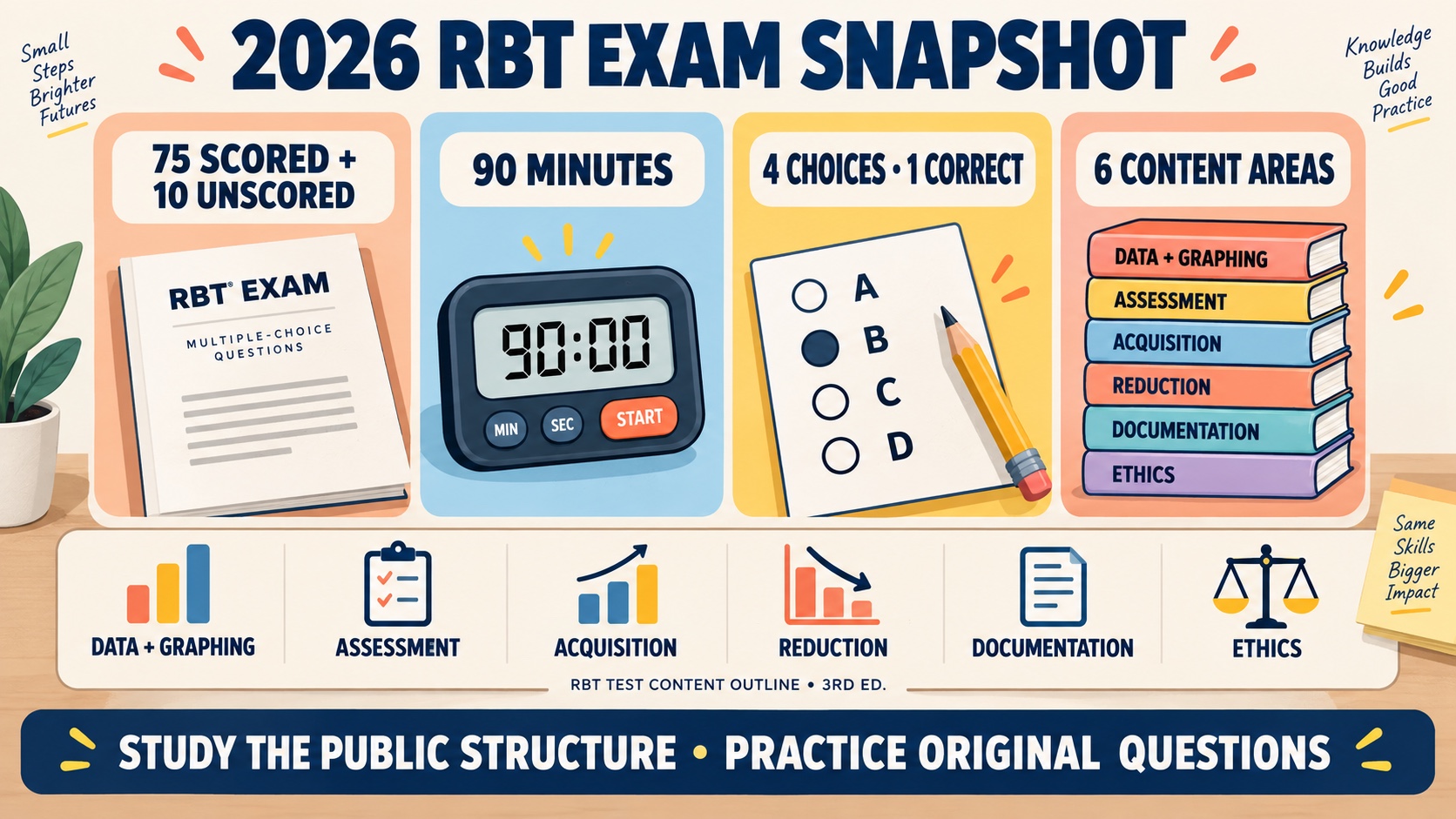
Use the outline as a study map
When you study for the RBT examination, begin with the six public content areas and then move to the individual tasks. A useful question set should make you decide what to measure, which teaching or reduction procedure is being described, what the documentation should include, and when to contact the supervisor. Do not study the headings as isolated vocabulary. For example, a prompt-fading question can involve skill acquisition, data collection, generalization, and professional communication at the same time.
After a practice set, record the content area, confidence, and error type. A missed item about graphing may be a calculation problem, a definition problem, or a failure to notice the question’s measurement dimension. Those require different review actions. Use original, clearly labeled practice material and read the rationale before moving on. A practice score can show where to look next, but it cannot authorize an application or predict the official result.
What an RBT does under supervision
Understanding the role is more useful than memorizing a job-title definition. In a supervised session, an RBT may be asked to implement a skill-acquisition program, use a prompt and a planned fading procedure, collect data, prepare materials, support generalization, or record what happened. The exact task comes from the client’s plan, the supervisor’s direction, and the organization’s policies.
An RBT should communicate changes, barriers, safety concerns, and unexpected events through the required chain of supervision. If the data look different from the expected pattern, the responsible response is to document and report—not quietly rewrite the goal, invent a new intervention, or decide that the client has a diagnosis. The supervisor is responsible for the clinical decisions that fall outside the RBT role.
Ethics is part of the job, not an exam-only chapter. Protect privacy, follow the applicable code and workplace procedures, maintain professional boundaries, use respectful language, and seek help when a request is outside your training or authority. The current RBT Ethics Code and handbook should be read together with the organization’s policies and any applicable law.
Maintaining RBT certification
Maintenance is easy to overlook when someone is focused on passing the first examination. Read the current handbook for the period that applies to your certification or recertification. The RBT materials describe ongoing supervision, ethics requirements, timely recertification, and professional development under the current rules. A certificate that is not maintained under the applicable requirements may not remain active.
Keep a simple record of supervision contacts, professional-development documentation, deadlines, and any required competency assessment. Do not assume that an employer’s training calendar is the same as your BACB recertification calendar. If your work setting changes, verify who is responsible for supervision and which records you need to retain.
A first-time applicant checklist
Use this as a conversation starter with the current RBT Handbook and the people responsible for your training and assessment:
- Confirm that you meet the current age and education requirements.
- Check the timing and attestation requirements for background and abuse-registry checks.
- Select a 40-hour training that identifies the current requirement version.
- Record the training start and end dates and keep the certificate.
- Arrange the separate initial competency assessment with an appropriate assessor.
- Collect the application documents and check every date window.
- Read the current RBT TCO and Handbook for exam preparation and testing rules.
- Plan how supervision, ethics, recertification, and professional development will be maintained after certification.
For independent study, the RBT learning path, free RBT practice questions, free ABA resources, and ABA Study Online app can help organize concepts and review. They are study supports, not the BACB application, an official training certificate, a competency assessment, or a certification decision.
RBT certification FAQ
Is the 40-hour RBT course the same as certification?
No. The 40-hour training is one eligibility component. You still need the applicable eligibility checks, initial competency assessment, application evidence, authorization, examination, and maintenance requirements.
Can RBT training be completed online?
The current handbook allows the 40-hour training to be offered through settings such as an employer, university, or online training program, provided it meets the current requirements. Online delivery alone does not establish compliance; verify the course design, timing, certificate, and the separate assessment step.
Can an RBT work independently?
RBTs provide services under the direction and close supervision of the responsible supervisor or requirements coordinator. They may implement and document assigned procedures, but certification does not authorize independent diagnosis, treatment-plan authorship, or unsupervised clinical decisions.
What changed for the RBT exam in 2026?
The examination is based on the RBT Test Content Outline (3rd ed.) beginning in 2026. The current public structure is 75 scored questions plus 10 unscored questions, 90 minutes, and six content areas. Use the current handbook and outline for the complete rules.
Does RBT certification guarantee a job?
No. Certification can be one qualification an employer considers, but job duties, pay, state rules, payer requirements, and employer onboarding vary. Review the specific position and local requirements separately from the BACB credential.