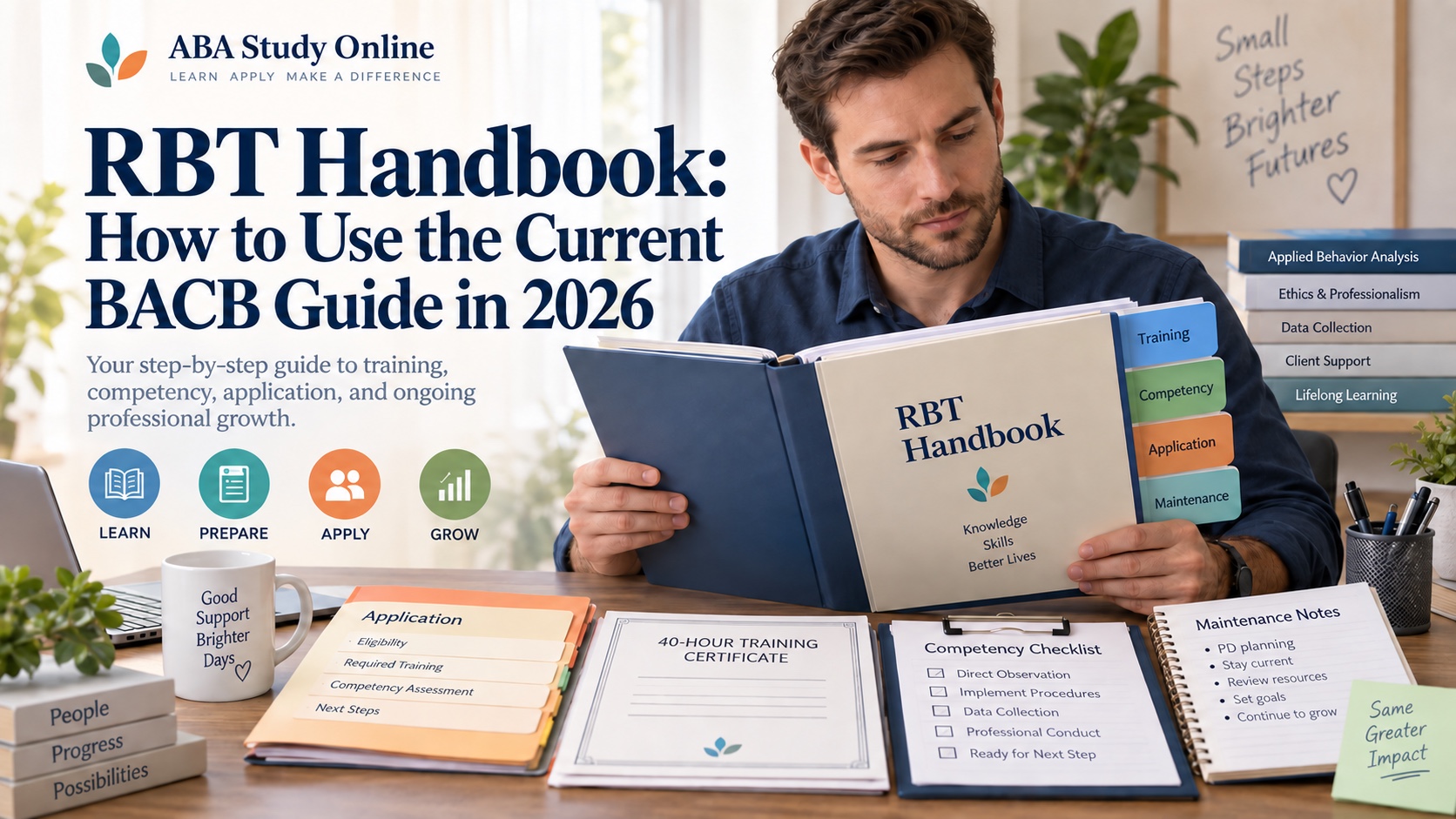
RBT Handbook: How to Use the Current BACB Guide in 2026
If you search for the RBT Handbook, you probably need more than a download link. You need to know whether the document is current, which section applies to you, and whether you are applying for certification or maintaining a credential you already hold.
The safest approach is to begin at the current BACB RBT page or RBT Handbook page, not an archived copy or a third-party checklist. For applicants applying on or after January 1, 2026, the current materials describe 2026 eligibility requirements and use the RBT Test Content Outline (3rd ed.). This guide shows how to navigate those materials without copying official examination content or treating a study resource as the Handbook.
Quick answer: where to find the RBT Handbook
Start at the BACB’s RBT resource page or the dedicated RBT Handbook page. Those pages connect the Handbook to the current training requirements, competency-assessment packet, examination outline, ethics materials, supervision forms, and recertification resources.
Before using a PDF you saved earlier, compare its version information and linked documents with the live BACB page. The cover date is not the only thing that matters. A Handbook can point to a newer form, assessment packet, or curriculum outline. A checklist is only as current as its least-current linked document.
Use the Handbook for requirements and official forms. Use a study guide or practice resource to learn concepts and rehearse decisions. Keep those roles separate.
What the Handbook contains
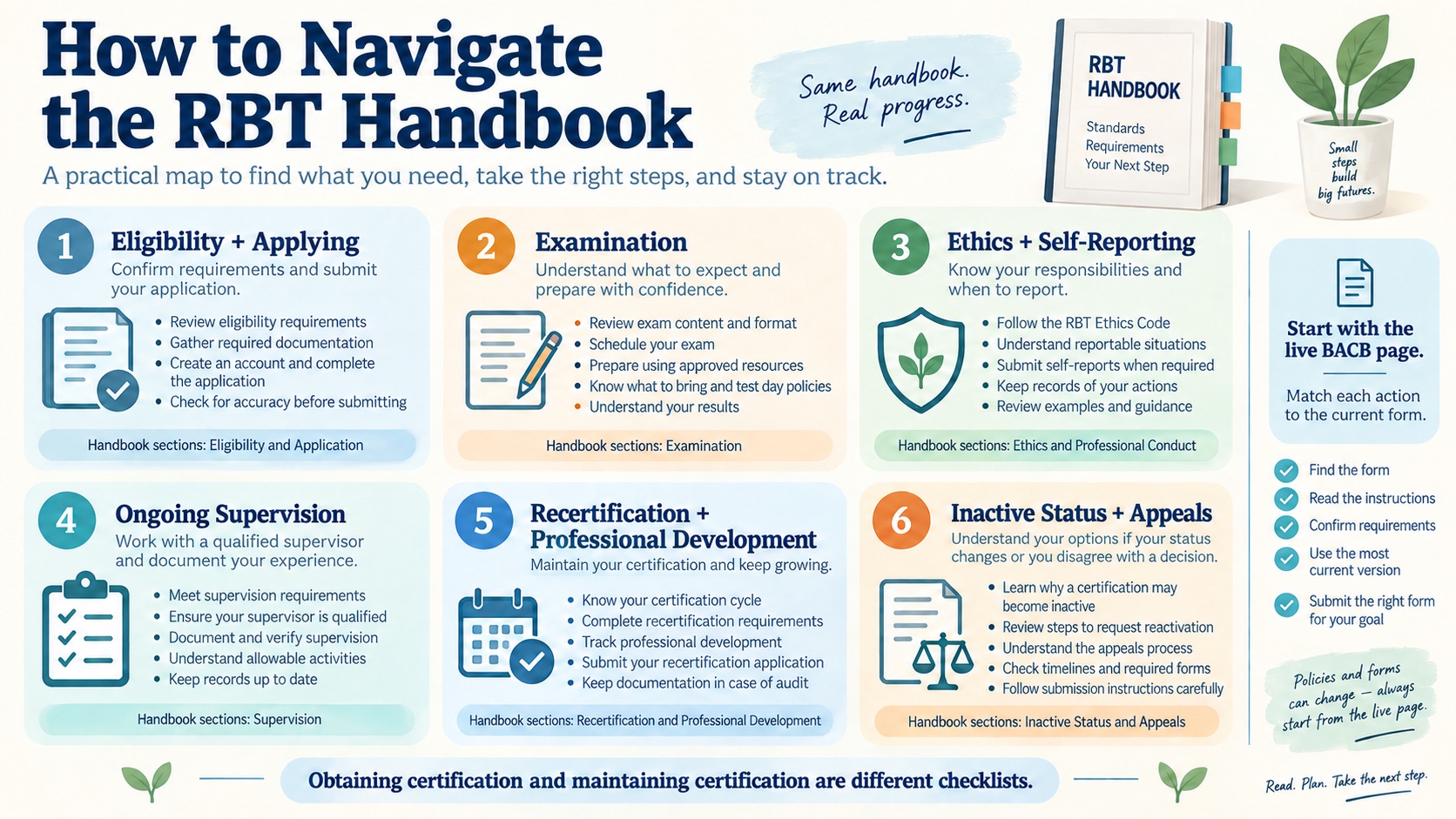
The Handbook is easier to use when you treat it as a small document system rather than one long reading assignment.
| Section or resource area | What it helps you answer |
|---|---|
| Eligibility and applying | What you must demonstrate before submitting the certification application and which documents support it. |
| Examination | Which content outline, testing instructions, authorization steps, and policies apply. |
| Ethics and self-reporting | How the RBT ethics requirements and reporting responsibilities affect practice. |
| Ongoing supervision | How direction, close supervision, and the supervisor relationship are maintained. |
| Recertification and professional development | What to do after initial certification and which current forms or training rules apply. |
| Voluntary inactive status and appeals | What official routes exist when practice pauses or a decision needs review. |
Use version control before you act
When a requirement changes, the change may appear in several places: the Handbook, a curriculum outline, a form, an application tutorial, and the testing page. That is why copying one bullet list from a blog can create a hidden mismatch. The list may describe the right idea but point to an old packet or an old examination outline.
For every action you plan to take, record four items: the requirement, the current BACB source, the document or proof you will submit, and the date you checked it. If two official pages appear to use different labels, follow the page that owns the action and contact BACB or your supervisor before submitting. Do not solve an ambiguity by combining the most convenient parts of two versions.
This is also useful when a training provider says that a course “meets the RBT Handbook.” Ask which 2026 curriculum document it uses, when the course started and ended, and what certificate it provides. A provider’s description is helpful evidence, but the applicant remains responsible for comparing the record with the current BACB requirement.
The 2026 eligibility timeline
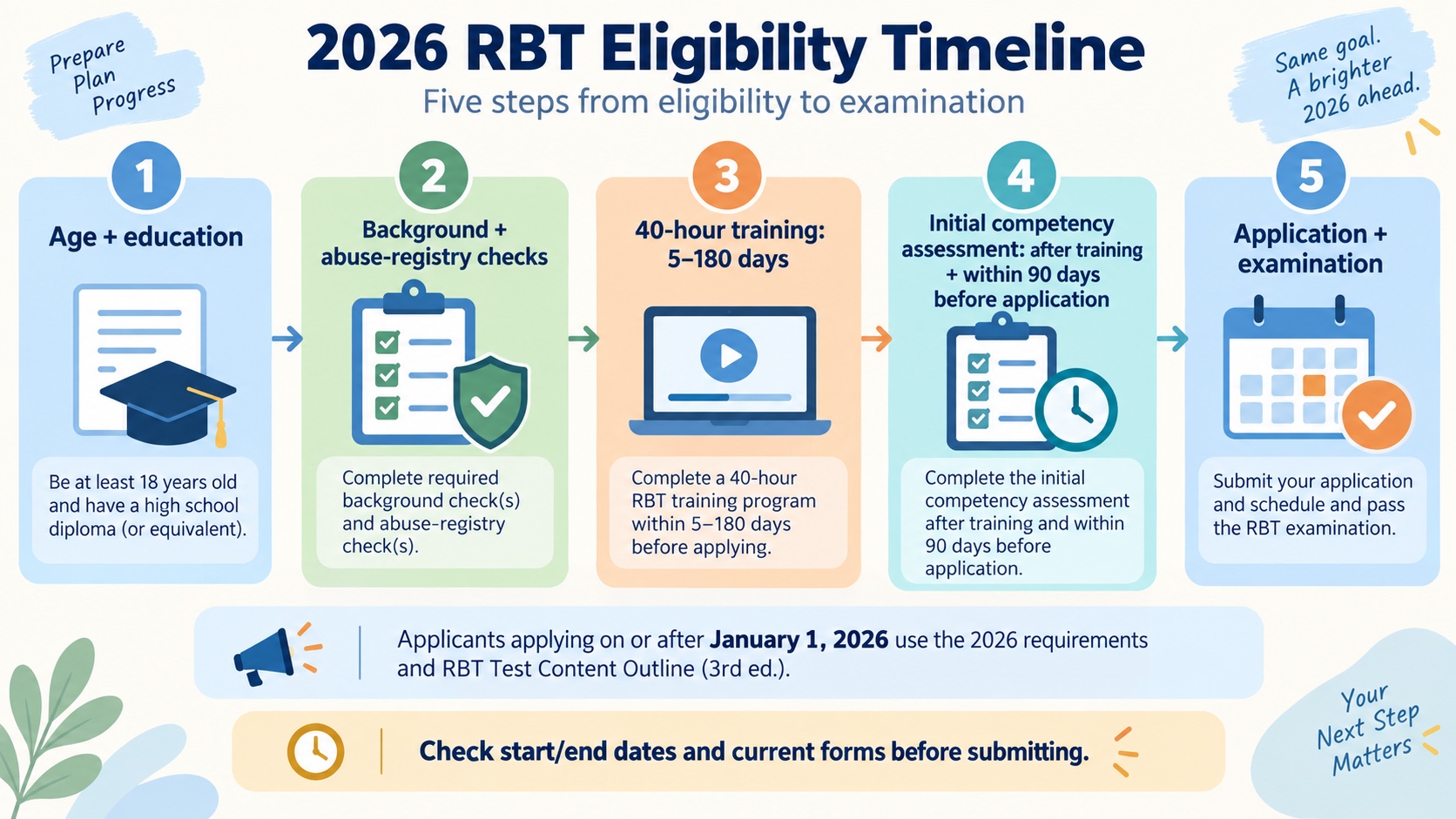
The current 2026 eligibility table gives applicants a sequence of checkpoints. The exact application instructions and forms remain controlling, but this order makes the date windows easier to see.
- Age and education: be at least 18 when submitting the RBT certification application and have at least a high-school-level education or equivalent.
- Background and abuse-registry checks: complete the required checks within the time windows and use the current attestation instructions. Fingerprinting may be required by a state or organization even when it is not required by the BACB itself.
- 40-hour training: complete training that meets the 2026 curriculum requirements in no fewer than 5 days and no more than 180 days, counting the start and end dates.
- Initial competency assessment: complete the current assessment after the 40-hour training and no more than 90 days before submitting the certification application.
- Application and examination: upload the required documentation, follow the current application route, receive authorization, and use the current RBT examination instructions.
Each checkpoint has a different proof. A training certificate does not prove competency assessment, and a completed assessment does not replace a background check. Use a private folder or tracker that names the requirement, document, completion date, expiration/date window, and source version.
Date windows and document versions
Most RBT application problems are not caused by a learner refusing to complete a requirement. They happen when a correct document is outside its allowed window or an old form is uploaded for a new requirement.
Keep these questions next to your tracker:
- Did I apply under the 2026 requirements or an earlier set of requirements?
- Did my 40-hour training start and finish inside the current 5-to-180-day window?
- Was the initial competency assessment completed after training and within 90 days of the application?
- Are the background and abuse-registry checks current under the Handbook’s applicable window?
- Did I download the current attestation and competency-assessment packet from the BACB page?
- Does my supervisor or assessor meet the independence and role requirements described by the current documents?
If an employer has a stricter check, follow the employer or state requirement as well. The BACB Handbook is the source for BACB certification, not a replacement for every local employment, payer, or state rule. For Texas-specific questions, use the separate state overlay rather than assuming the national Handbook answers it.
Obtaining versus maintaining RBT certification
Applicants often stop reading after the application and exam. The Handbook also explains maintenance. RBTs must continue to work under the required direction and close supervision, follow the current ethics requirements, and use the current recertification and professional-development materials.
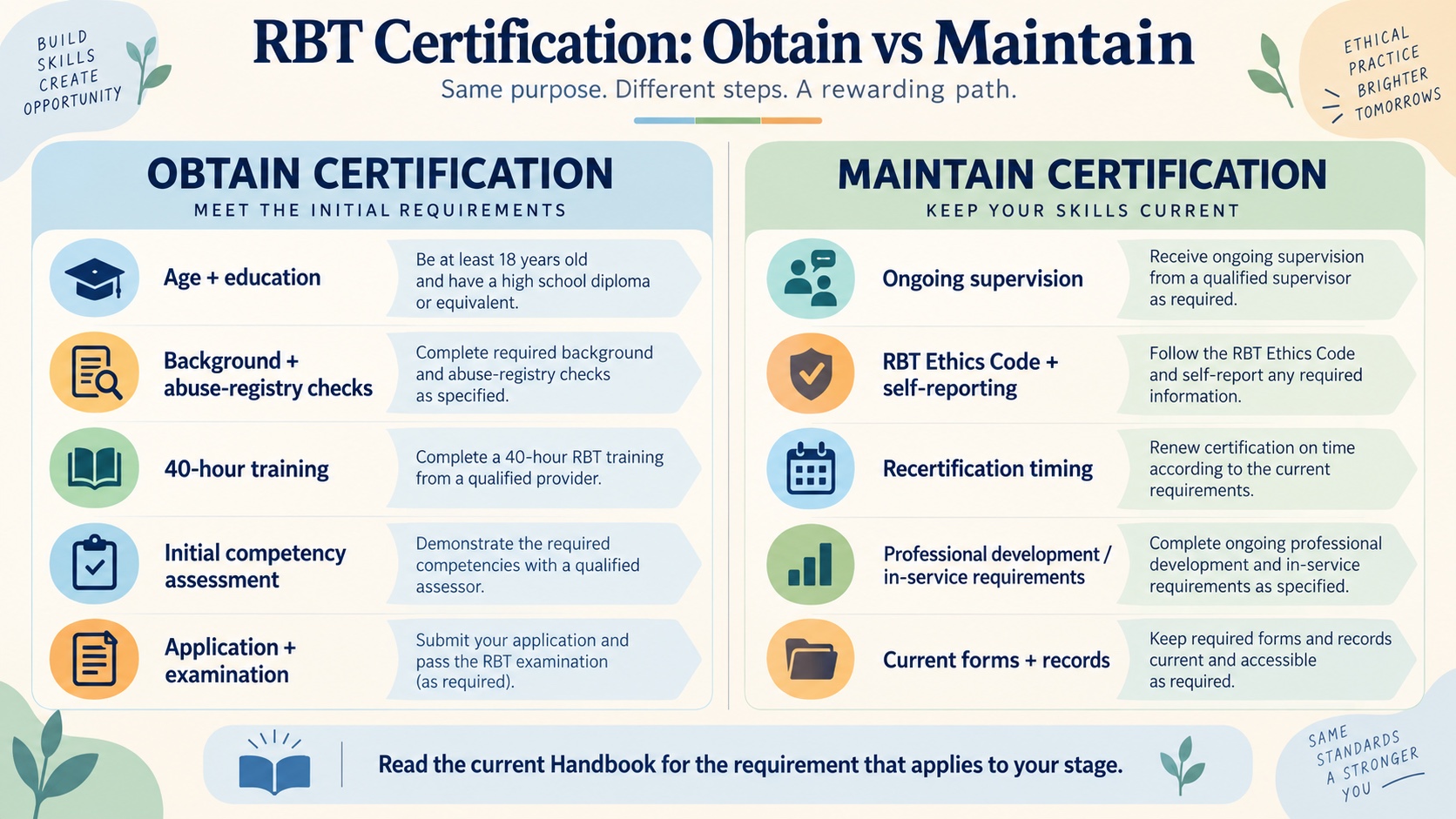
Make two checklists:
- Obtain: age, education, background and abuse-registry checks, 40-hour training, initial competency assessment, application, authorization, and examination.
- Maintain: supervisor relationship, ongoing supervision, ethics and self-reporting responsibilities, recertification timing, professional development or in-service requirements, and current forms.
This split helps prevent a common error: assuming the one-time 40-hour training is the entire RBT professional-development obligation. Training to qualify for the initial application and training or professional development to maintain certification are separate questions.
Know when a question needs an official answer
A study resource can explain the difference between a training certificate and an assessment, but it cannot decide a disputed application for you. Use the official BACB support route when your account shows an action item, a form appears inconsistent with the current Handbook, or your individual education, background, or training history does not fit a simple example.
Before contacting support, prepare a short timeline: the date you completed training, the assessment date, the background-check date, the application date, and the document versions you used. Describe the exact field or instruction that is unclear. Remove passwords, private account identifiers, and unnecessary client information. A precise question is easier to review than a collection of screenshots with no dates.
Your supervisor, assessor, employer, or state regulator may also be the right source for a role-specific question. The Handbook tells you how BACB certification works; it does not create a universal answer for every workplace or jurisdiction.
Keep the final answer with your private records, especially when it changes a submission date or document choice. That record will help you explain your process if the application is reviewed later and make future renewals easier.
Clear records reduce avoidable delays and prevent repeated searches through old emails later.
How to study from the Handbook
Do not try to memorize the entire document in one sitting. Use a source-first routine:
- Read the overview: identify whether you are obtaining, maintaining, returning from inactive status, or appealing.
- Mark action verbs: complete, pass, upload, attest, receive, maintain, report, and recertify each imply a different next step.
- Build a document map: connect each requirement to the official form, certificate, assessment, or account action.
- Study concepts separately: use practice questions to learn RBT content and reasoning, but do not treat them as official exam items.
- Recheck before submitting: compare your saved checklist with the live BACB page and current application-processing updates.
This routine is especially useful when a resource uses “RBT requirements” without showing a version. If you cannot identify the source date or linked form, treat it as an orientation resource and return to the current Handbook.
For study notes, summarize each section in your own words and attach the official link beside the summary. Mark examples as examples, not as BACB requirements. If you make a flashcard for a number or date window, include the source title and version on the back. That small habit makes it much easier to retire an old card when the Handbook changes.
It also keeps your notes useful when a supervisor, assessor, or employer asks which instruction you followed.
Good source control is part of professional preparation, not busywork. It protects your application record and helps you ask a precise question when a requirement is unclear.
Common Handbook mistakes
Downloading the first PDF in search results. Open the live BACB page first and follow its current links.
Using a 2025 checklist for a 2026 application. The 2026 eligibility requirements and RBT exam outline changed the source set.
Counting the training certificate as the competency assessment. They are separate requirements with separate proof.
Ignoring the 90-day assessment window. A valid assessment can still be outside the application window.
Stopping after the exam. Ongoing supervision, ethics, recertification, and professional-development requirements continue after certification.
Assuming national certification answers every state question. Employer, payer, and state rules may add requirements. Read the applicable local source too.
FAQ
Where can I download the current RBT Handbook?
Start at the BACB RBT page or the current RBT Handbook page, then use the linked PDF and supporting forms. Avoid relying on a third-party upload without checking its version against the live BACB page.
What changed for RBT applicants in 2026?
Applicants applying on or after January 1, 2026 use the 2026 eligibility requirements and RBT Test Content Outline (3rd ed.). The current table includes age, education, background and abuse-registry checks, 40-hour training, and an initial competency assessment with specific date windows.
How long is the RBT 40-hour training window?
The current 2026 requirement says the 40-hour training must be completed in no fewer than 5 days and no more than 180 days, counting the start and end dates. Check the live curriculum document before starting a course.
How long is an RBT competency assessment valid for the application?
For the 2026 initial application, the assessment must be completed after the required training and no more than 90 days before submitting the application. Use the current packet and instructions for the exact documentation.
Does the RBT Handbook cover Texas rules?
It explains BACB certification requirements. It does not replace every state, employer, payer, or setting rule. If you are asking about Texas, read the current Texas sources in addition to the national Handbook.