RBT Certification: A 2026 Step-by-Step Guide
If you are searching for RBT certification, you are probably trying to turn a general interest in applied behavior analysis into a clear next step. The process is easier to manage when you separate three questions: whether you meet the eligibility requirements, what documents you need to apply, and what certification maintenance will look like after you pass the exam.
This guide follows the BACB’s current 2026 RBT materials. It explains the sequence in plain language, points out places where an employer or assessor has a role, and gives you a planning checklist you can use before paying for an application. It is independent educational material, not an official BACB application, training recommendation, or guarantee of certification.
What RBT certification means
The Registered Behavior Technician® certification is a paraprofessional certification in behavior analysis. RBTs assist with behavior-analytic services under the direction and close supervision of an RBT Supervisor and/or an RBT Requirements Coordinator. That boundary matters: RBT certification does not make someone an independent behavior analyst, and an RBT does not replace the supervisor responsible for the service.
Think of certification as a chain rather than a single test. The chain includes eligibility, required preparation, an initial competency assessment, an application, an examination, and ongoing responsibilities. A strong plan keeps evidence for each link instead of treating exam preparation as the entire process.
- Eligibility: confirm age, education, background checks, and the current application requirements.
- Preparation: complete the required training within the current time window and keep the completion certificate.
- Competency: demonstrate the listed skills with a qualified assessor before submitting the application.
- Application: create your own BACB Portal account, upload accurate documents, and allow time for processing.
- Examination: schedule and take the version of the exam that applies when you schedule your appointment.
- Maintenance: follow supervision, ethics, professional-development, and recertification requirements after certification.
Eligibility requirements to check first
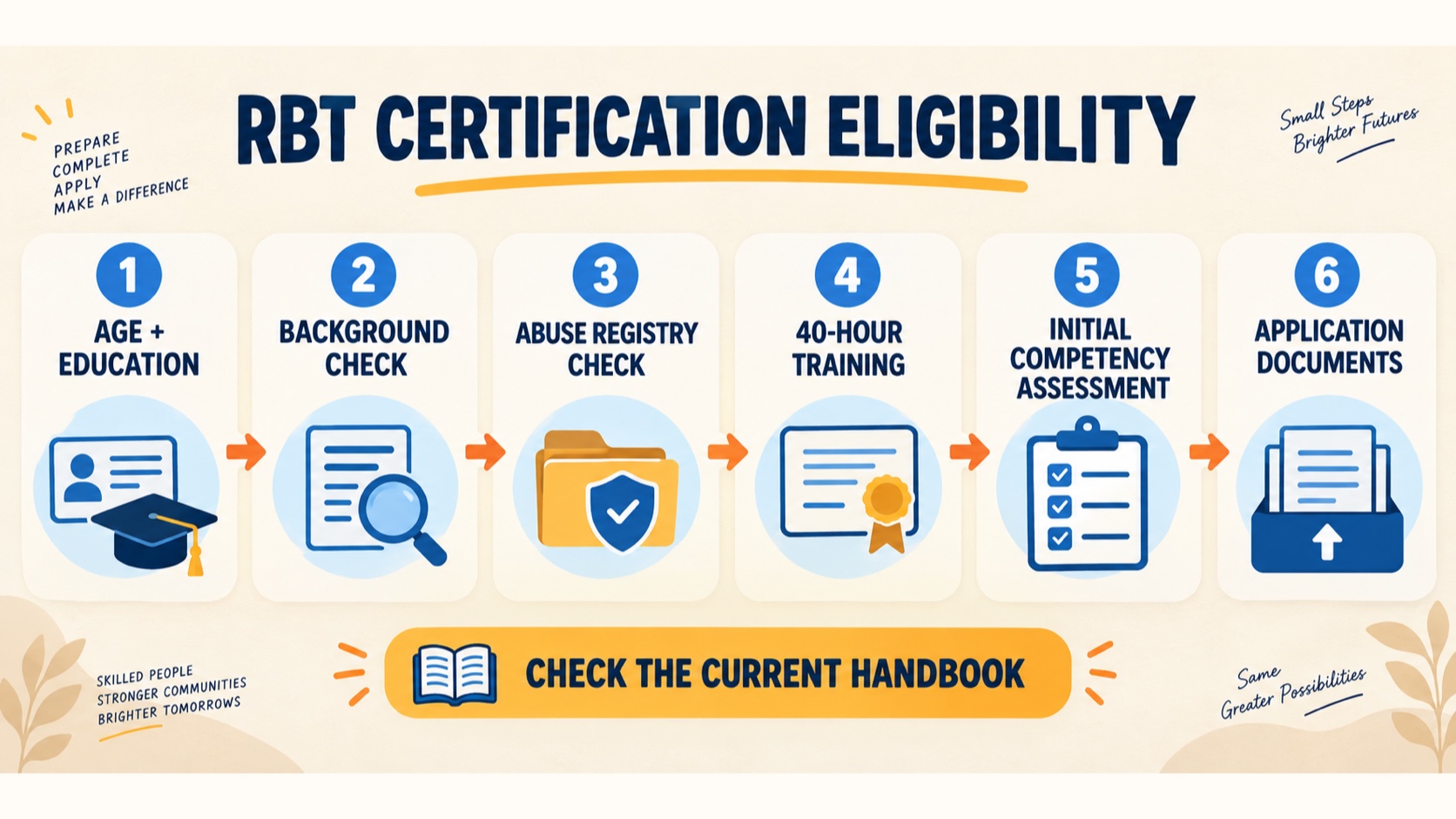
The current RBT Handbook lists several requirements that must be met before an applicant pays for an RBT certification application. The timing of the checks is important. For example, the handbook says the background check and abuse registry check must be completed no more than 180 days before paying for the application. A document that was acceptable for an earlier attempt may not automatically satisfy a current application.
Age, education, and checks
You must be at least 18 when you submit the certification application and have at least a high school-level education or equivalent. An attesting certificant confirms the relevant information, including age, education, and the required checks. The attesting certificant cannot be related to, subordinate to, or employed by the applicant.
You also need a criminal background check and an abuse registry check comparable to the checks used for relevant care, education, or support roles in the community where services will be provided. The BACB handbook notes that fingerprinting is not required by the BACB itself, although a state, employer, or organization may have additional procedures. That is a useful distinction: separate the BACB requirement from a local hiring or licensing requirement.
Forty-hour training
For current 2026 applications, the handbook describes a 40-hour training requirement tied to the RBT 2026 40-Hour Training Requirements and Curriculum Outline. The training must be completed in no less than five days and no more than 180 days, counting the start and end dates. The BACB does not provide the training, issue certificates of completion, or recommend a training provider. Your provider supplies the certificate that you submit with the application.
Before enrolling, ask the provider which version of the curriculum the course follows and how the completion certificate will document the dates and hours. If you completed training under an earlier version, do not assume it will qualify. The current handbook says previously completed training may be eligible only if it meets the current requirements.
Initial competency assessment
After completing the required training, you must demonstrate competence on the current RBT Initial Competency Assessment. The handbook describes a 90-day window before submitting the certification application and requires the completed assessment to be uploaded with the application. The assessor also has independence requirements, so arrange the assessment with someone who meets the current BACB rules rather than treating a class completion quiz as the assessment.
The application path, step by step
Once the eligibility pieces are ready, the application is a document-control task as much as it is a credentialing task. Use your legal name consistently, save copies of what you submit, and do not wait until the last day of a document window.
- Create your BACB Portal account. Use your full legal name as it appears on government-issued identification. The handbook recommends using a personal email address rather than a work email, because certification notices and password resets need to follow you if your employer changes.
- Complete the required documents. Prepare the RBT Certification Application Attestation form, the current 40-hour training certificate, and the completed Initial Competency Assessment packet.
- Start the RBT Certification Application. Enter the information requested in the portal and upload clear PDF or JPEG copies. The BACB states that unclear or unreadable documents may not be accepted.
- Answer disclosures carefully. Read the application questions about health conditions that could affect safe and competent work, investigations, disciplinary actions, and other official actions. If a disclosure triggers an Ethics Self-Reporting Statement, the application may be placed on hold while it is reviewed.
- Submit payment after the package is ready. The application is active for a limited period. The handbook recommends waiting until the requirements are complete because an incomplete application may require a new application and fee.
- Wait for processing and follow Action Items. The handbook says applicants should allow two weeks for processing. If the application is not approved, the portal and email response should explain the next steps.
A simple folder structure can prevent avoidable mistakes: one folder for identity and checks, one for training, one for the competency assessment, and one for submitted application receipts. Name files with the document type and completion date, but do not store your BACB login in an article draft or share it with an employer.
How the exam fits into the process
The examination is one stage in the certification path, not a substitute for eligibility or competency evidence. According to the BACB RBT page, the current pathway includes meeting requirements, applying, receiving an application determination, scheduling, and passing the examination. The version of the exam in effect when you schedule your appointment is the version that matters for your appointment.
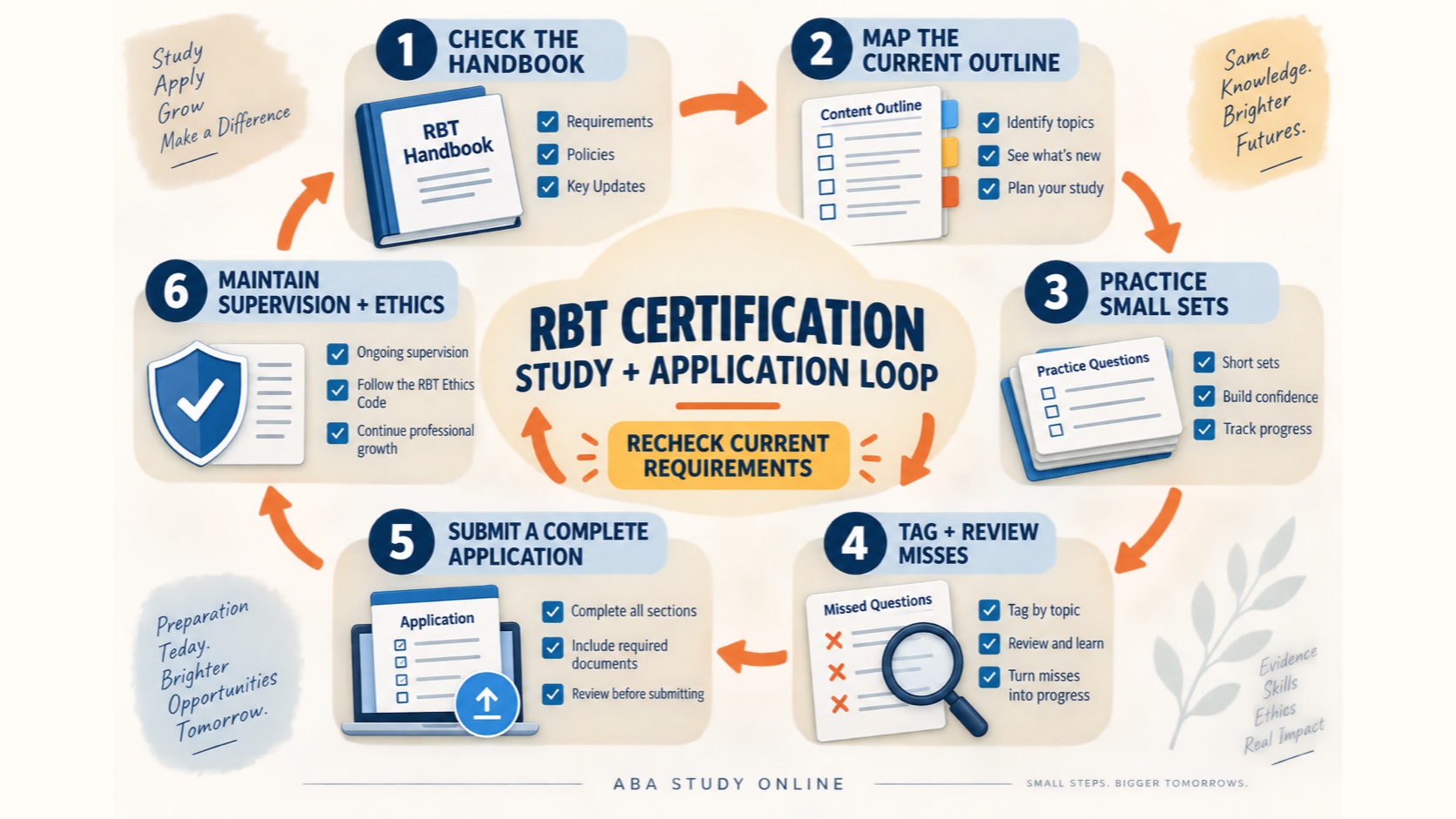
Use the current RBT Test Content Outline as a study map. It is better to turn the outline into a small practice system than to read a large glossary without checking whether you can apply the idea. For each domain, make a short loop:
- read the task language and identify the observable action;
- answer a small set of questions without looking at notes;
- tag each miss by concept, measurement error, or question-reading error;
- review the source concept and explain why the correct option fits;
- try a new example that changes the setting but keeps the underlying principle.
For example, if a question asks you to choose a measurement procedure, do not memorize a single phrase in isolation. Ask what is being measured, what observation window is available, and what decision the data will support. That kind of reasoning is useful because it connects terminology to the technician’s actual role.
What happens after certification
Certification is not the end of the responsibility. The current RBT materials describe ongoing supervision, adherence to the RBT Ethics Code, and recertification requirements. The maintenance cycle changes across the current transition, so do not copy an old renewal checklist from a study group or a previous employer without checking the current handbook.
The June 2026 handbook distinguishes requirements that apply before 2026 certification or recertification from requirements that apply after 2026 certification or recertification. The current pathway shown in the handbook includes ongoing supervision and ethics responsibilities, annual recertification for the earlier pathway, and a two-year recertification cycle with 12 hours of professional development for the later pathway. Confirm which pathway applies to you and use the version of the handbook in force when you act.
- Keep supervision records in the format required by the current rules.
- Ask your supervisor or Requirements Coordinator when a procedure, safety issue, or scope question is unclear.
- Track renewal dates and professional-development evidence before the deadline is close.
- Use the BACB’s current ethics and self-reporting guidance when a reportable event or conflict arises.
- Recheck the handbook when the BACB publishes a new version; the handbook says updates may be published quarterly as needed.
Planning checklist and FAQ
Before you start
- Have I confirmed that I am at least 18 and have a high school-level education or equivalent?
- Do I know who can attest to my eligibility and who can conduct my competency assessment?
- Will my background and abuse registry checks still be within the current time window when I pay?
- Does my 40-hour course match the current BACB training requirements?
- Have I made a copy of every document I plan to upload?
Frequently asked questions
Is passing the RBT exam enough to become certified?
No. The exam is one part of the pathway. You also need to meet the eligibility requirements, submit the required application documents, receive approval, and follow the current BACB process.
Does the BACB provide the 40-hour training?
No. The BACB handbook says the BACB does not provide the training, certificates of completion, or training-provider recommendations. Compare a provider’s curriculum and certificate process with the current official requirements.
Can I use an old RBT study guide?
You can use older material for general concepts, but verify requirements, dates, forms, examination information, and maintenance rules against the current handbook and BACB pages before relying on it.
What should I do if my application document is unclear?
Replace it with a clear PDF or JPEG and check that the name, dates, signatures, and required fields match your portal account. If the situation is not covered by the handbook, ask the BACB rather than guessing.
RBT certification becomes much less confusing when you treat it as a sequence of verifiable steps. Start with the current handbook, build a document checklist around your own dates, and use the test-content outline to guide practice after the eligibility work is underway.