RBT Initial Competency Assessment: The 2026 Packet Explained
If you are searching for the RBT initial competency assessment, you are probably trying to place one practical requirement in the larger RBT certification sequence. The important distinction is this: the initial competency assessment is a skills-and-knowledge evaluation, not the RBT certification examination. It is completed after the 40-hour training and before you submit your RBT certification application.
The current BACB packet is effective January 1, 2026. It requires all 19 task items to be completed, uses different assessment types depending on the task, and places specific responsibilities on the responsible assessor. This guide explains how to read the packet, what to ask before scheduling, and which parts are still controlled by the official RBT Handbook and BACB application process.
Quick answer: The RBT Initial Competency Assessment is a BACB-required demonstration that an RBT applicant can competently perform the tasks in the current assessment packet. The 2026 packet must be completed after the 40-hour training and no more than 90 days before submitting the RBT certification application. A completed BACB form is submitted with the application; a self-created substitute form is not accepted.
Where it fits in the RBT sequence
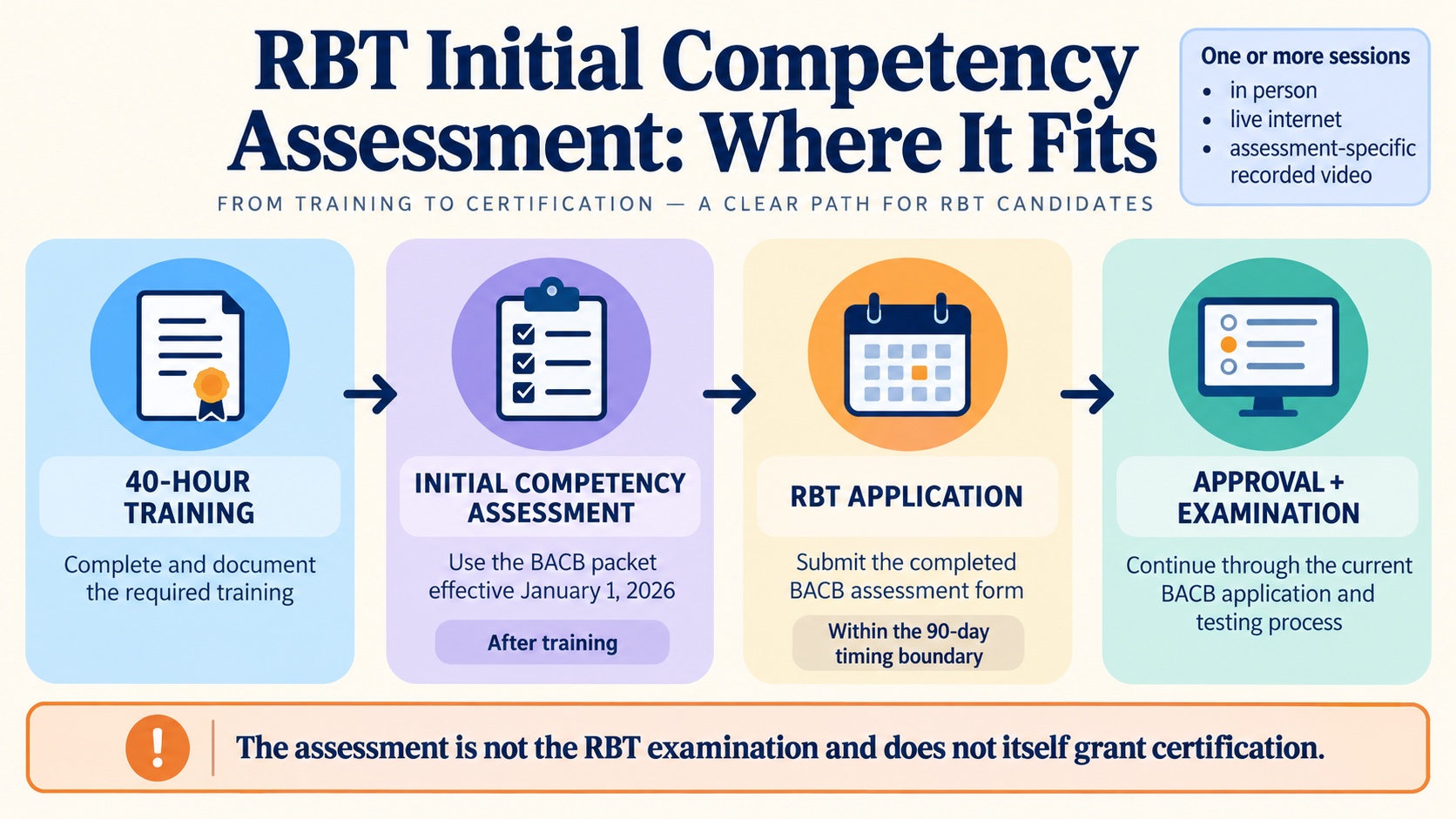
Think of the assessment as a bridge between learning the required training content and documenting that you can perform or explain the relevant tasks. A simplified sequence looks like this:
- Complete the required 40-hour RBT training. The training is its own requirement and should be documented before the competency assessment begins.
- Complete the Initial Competency Assessment. A qualified responsible assessor oversees the evaluation using the current BACB packet.
- Submit the required application documents. The completed initial assessment is included with the RBT certification application, along with the other documents required by the current process.
- Follow the examination process. Application approval and authorization to test are separate steps. Passing the competency assessment does not itself make someone an RBT or replace the certification examination.
The timing rule is easy to miss: the initial assessment must happen after the 40-hour training is complete, and it cannot be completed more than 90 days before the RBT certification application is submitted. If you are planning far ahead, confirm the dates with the responsible assessor and the current BACB instructions rather than relying on an old checklist.
Who can oversee the initial competency assessment?
The 2026 packet names a responsible assessor. This person is an active BCaBA or BCBA certificant who has completed the 8-hour supervision training and is responsible for overseeing the assessment. The responsible assessor does more than sign a page at the end. They must ensure that the assessment follows the packet, sign the completed assessment, maintain the records, and ensure quality when assistant assessors are involved.
The relationship requirement is just as important as the credential. The responsible assessor must be employed by the same organization as, or have a contractual relationship with, the applicant and the client or clients involved in the assessment. The organization must also be the entity providing services to the client. If a BCaBA or RBT serves as an assessor, the packet adds supervisor relationship requirements as well.
Some tasks may be delegated to an assistant assessor who has demonstrated proficiency through direct observation and holds an active RBT certification or higher. The responsible assessor remains accountable for the overall assessment. Assistant assessors can be used for portions of an assessment, and more than one assistant assessor may be involved, but the packet’s oversight and relationship rules still apply.
Assessors may not be related to, subordinate to, or employed by the applicant during the assessment. The packet does allow the assessor to be the same person who delivered the 40-hour training, as long as that person meets all of the assessor requirements. Before scheduling, ask who the responsible assessor is, which organization relationship applies, and which person will sign the final attestation.
How the assessment can be delivered
The assessment may occur over one or more sessions. The packet permits in-person delivery, live delivery through the internet, or observation of recorded videos created specifically for the purpose of the assessment. This does not mean every task can be handled in any format. The assessment type must match the instructions for the specific task and the assessor must be able to judge competence.
With a client
The assessor observes you performing the task with a client who is receiving behavior-analytic services. The packet specifically requires three of tasks 6–14 to be demonstrated with a client. Client dignity, privacy, consent, safety, and the service organization’s procedures still matter; the assessment is not permission to improvise outside the treatment plan or workplace protocol.
Role-play
In role-play, another person acts in a situation similar to one that might occur with a client. The packet allows role-play when circumstances do not permit an evaluation with a client. Role-play is not a way to skip competence. You still need to perform the task accurately enough for the assessor to mark it competent.
Interview
An interview is live, either in person or through the internet. You must accurately describe or discuss the relevant concept and give examples and nonexamples when applicable. Questions may be tailored to your current clients or workplace parameters. Interview tasks are especially relevant to professionalism, boundaries, supervision requirements, and when to seek clinical direction.
The 19 tasks in the 2026 packet
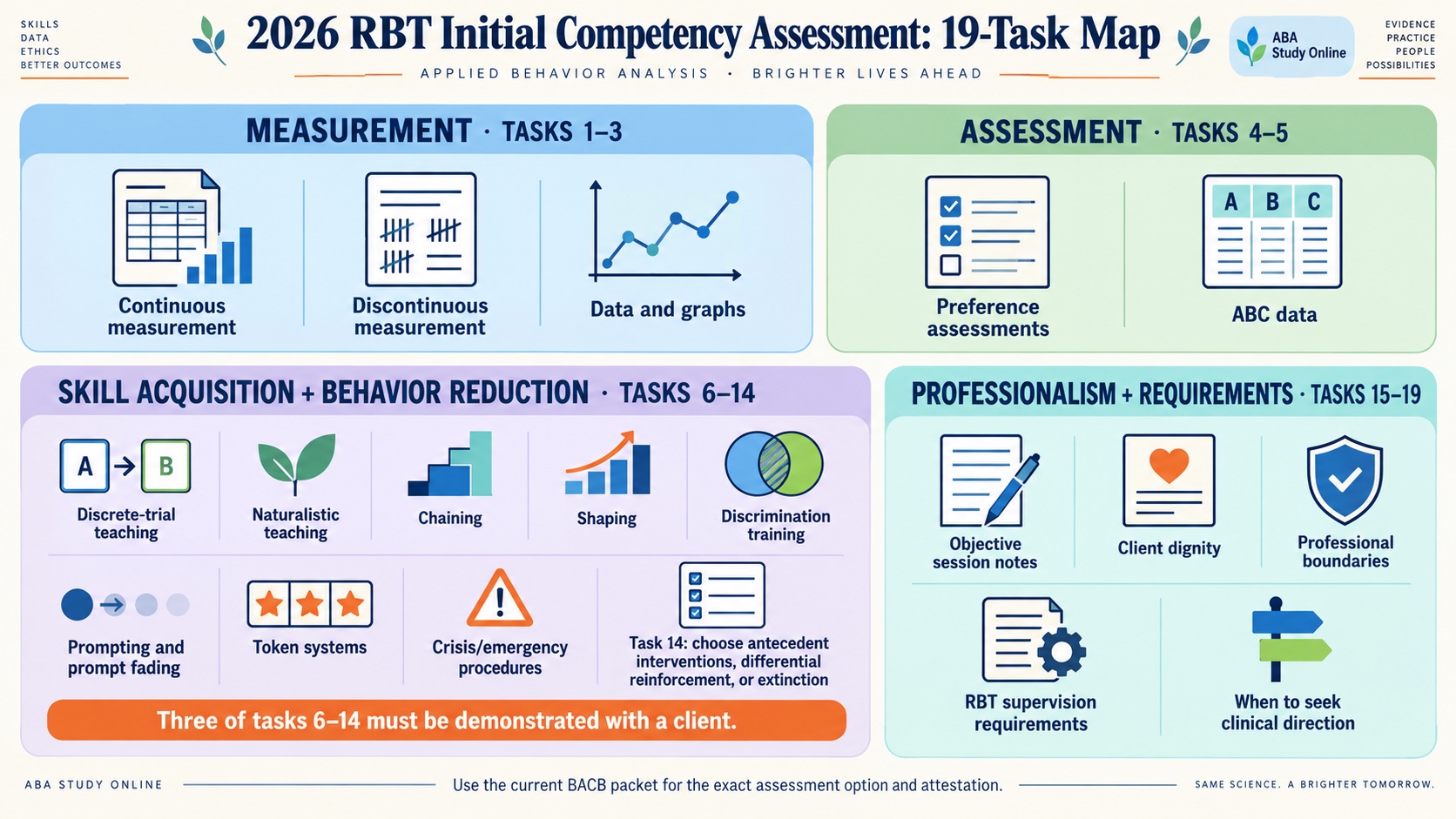
The packet groups the tasks into four practical areas. You do not need to memorize the headings as a substitute for reading the form, but the grouping helps you see what the assessment is trying to sample.
| Area | Tasks | What the group checks |
|---|---|---|
| Measurement | 1–3 | Continuous measurement, discontinuous measurement, and entering data or updating graphs |
| Assessment | 4–5 | Preference assessments and ABC data collection |
| Skill acquisition and behavior reduction | 6–14 | Teaching and behavior-change procedures, with three tasks demonstrated with a client |
| Professionalism and requirements | 15–19 | Objective session notes, client dignity, professional boundaries, supervision standards, and clinical direction |
Tasks 6–14 include discrete-trial teaching, naturalistic teaching, chaining, shaping, discrimination training, prompting and prompt fading, token systems, and crisis or emergency procedures according to protocol. Task 14 asks you to demonstrate one of three options: antecedent interventions, differential reinforcement, or extinction. The correct option depends on the packet and the assessment plan; do not assume you must demonstrate all three under task 14.
Tasks 15–19 are not “extra paperwork.” They ask you to generate objective session notes, give examples of maintaining client dignity and professional boundaries, describe BACB supervision standards for RBTs, and explain a situation in which you would seek clinical direction from your supervisor. These tasks test professional judgment as well as procedural language.
Competence, feedback, and documentation
The assessor provides an opportunity for each task and evaluates whether it was performed competently. If you do not demonstrate competence, the assessor may give corrective feedback and assess the task on another day. That process is repeated until competence is demonstrated. The packet says corrective feedback may not be delivered on the final assessment of a task, which protects the distinction between teaching and the final observation of competent performance.
Once a task is observed as competent, the assessor initials the task and marks the assessment type used. After all tasks are competently performed, the responsible assessor signs and dates the final attestation. The completed BACB Initial Competency Assessment is then submitted with the certification application. The packet states that non-BACB forms will not be accepted.
The responsible assessor must maintain documentation of each assessment, including relevant assessor records, for at least seven years. That retention responsibility belongs to the assessor and organization, but it is still useful for an applicant to keep a clear personal record of the packet version, completion date, assessor names, and the application submission date.
Common mistakes
- Calling the competency assessment the RBT exam: the assessment is a practical requirement; the certification examination is a separate step.
- Completing it before the 40-hour training: the current packet requires the training to be complete first.
- Using an old packet or home-made form: check the effective date and submit the current BACB form.
- Assuming every task can be role-played: three tasks from 6–14 must be demonstrated with a client, and each task has its own allowed options.
- Ignoring the organization relationship: assessor, applicant, client, and service organization must fit the packet’s relationship requirements.
- Skipping the professional tasks: objective notes, dignity, boundaries, supervision, and clinical direction are part of the 19-task assessment.
FAQ
Is the RBT initial competency assessment the same as the RBT exam?
No. The initial competency assessment is a prerequisite-style practical assessment of the tasks in the BACB packet. The RBT certification examination is a separate examination step after the application process is approved.
How many tasks are on the 2026 assessment?
The current packet contains 19 task items. All 19 must be completed, with the packet’s permitted assessment type selected for each task.
Can the initial competency assessment be online?
The packet allows live delivery through the internet and observations of recorded videos created specifically for the assessment, as well as in-person delivery. The assessor must still follow the task-specific instructions and be able to evaluate competence.
Who signs the completed assessment?
The responsible assessor signs and dates the final attestation after all tasks have been competently performed. The responsible assessor must meet the current BACB credential, supervision-training, organization, and relationship requirements.
How long is the assessment valid?
The key current timing rule is that it cannot be completed more than 90 days before submitting the RBT certification application. Check the current RBT Handbook and application instructions for your situation, especially if dates or requirements change.
Sources
- BACB RBT Initial Competency Assessment Packet: Effective January 1, 2026
- BACB RBT certification resources
- BACB Supervision, Assessment, Training, and Oversight
- BACB Application Processing Updates and document versions
- BACB RBT examination and 2026 transition information
- BACB Recent and Upcoming Changes to Requirements