
RBT Certification in Texas: BACB Steps, State Rules, and Employer Checks
If you search for RBT certification in Texas, you may be looking for a clear answer to two different questions: how to become a Registered Behavior Technician through the Behavior Analyst Certification Board (BACB), and what Texas requires or permits when you work as a behavior technician. Those questions overlap in practice, but they are not the same credential or application.
The short answer is that the BACB administers the national RBT certification pathway. Texas does not turn that pathway into a separate TDLR RBT license application. Texas still matters because state law, the supervising professional, the service setting, the employer, and sometimes the payer can affect how technician services are organized. Use the current BACB RBT Handbook for certification steps, then verify the Texas and workplace rules that apply to your specific role.
Quick answer: what “RBT certification Texas” means
An RBT is a paraprofessional certified in behavior analysis through the BACB. The RBT works under the direction and close supervision of an RBT Supervisor and/or RBT Requirements Coordinator. The certification is not permission to practice independently as a behavior analyst.
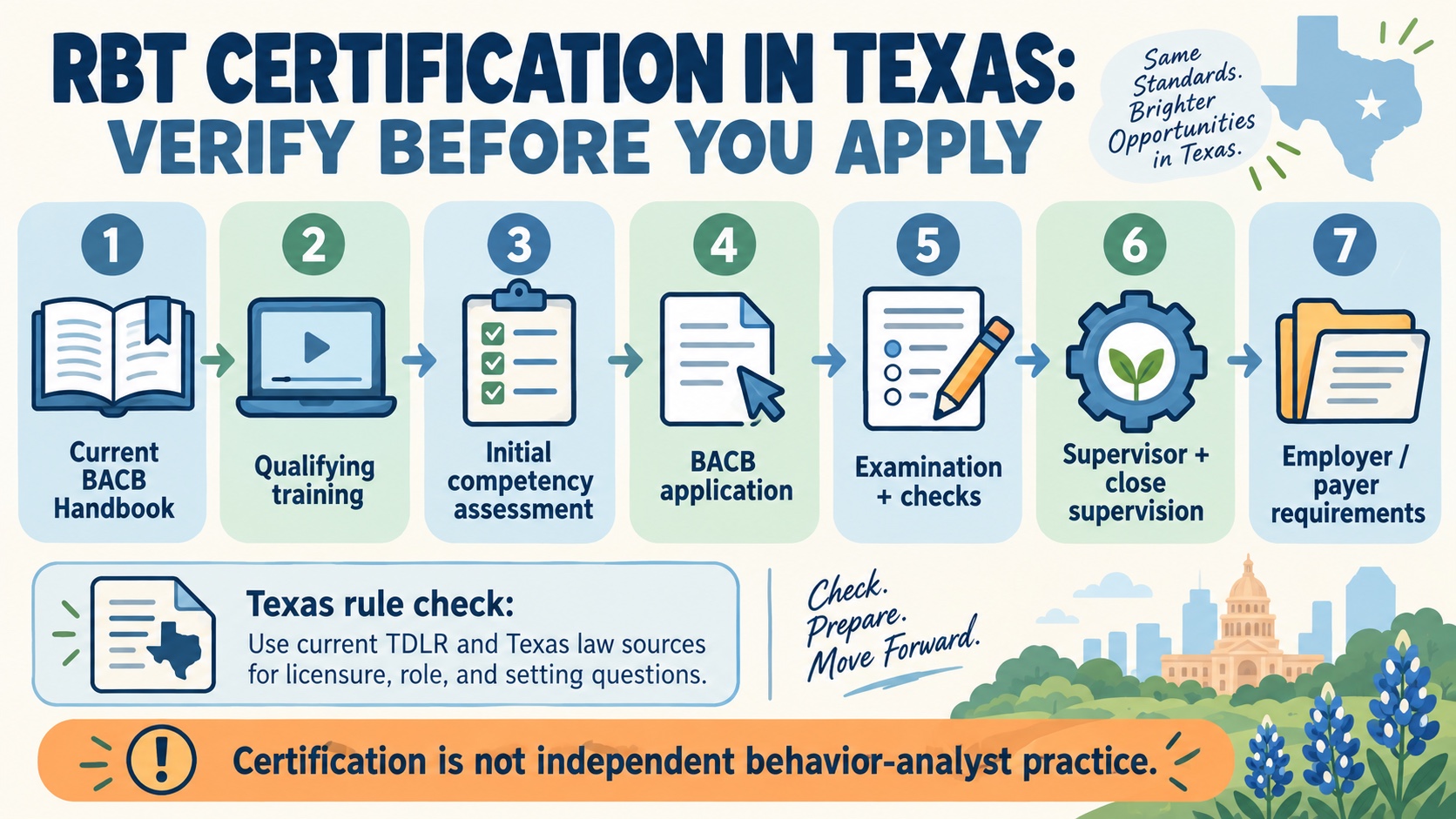
For a person living in Texas, the practical sequence is usually:
- Read the current BACB RBT Handbook and confirm that the RBT pathway fits your goal.
- Complete the required training through a provider that meets the current BACB rules.
- Complete the initial competency assessment with an appropriate qualified assessor.
- Submit the BACB application and complete the required examination, background, and registry steps described in the current materials.
- Before accepting work, confirm the supervising arrangement, employer requirements, setting requirements, and any Texas-specific rules that affect the position.
The order and details of requirements can change. An old course page, social-media checklist, or practice-test explanation is not a substitute for the current BACB Handbook. When a Texas source discusses a behavior analyst or assistant behavior analyst license, read the title carefully: that may be a different professional pathway from RBT certification.
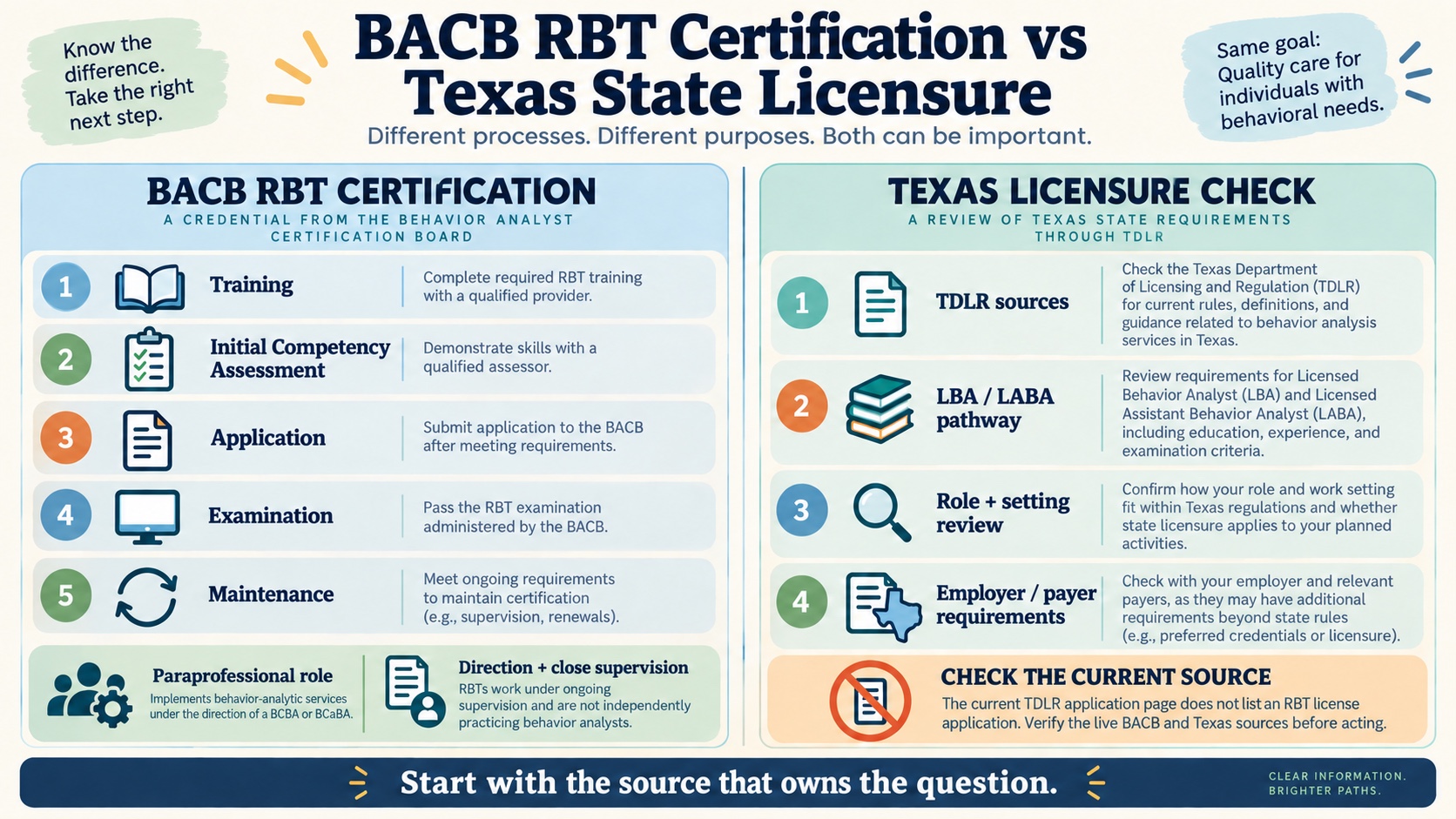
BACB RBT certification versus Texas licensure
The easiest way to avoid confusion is to separate the credential owner, the role, and the work setting. The BACB RBT credential answers whether you completed the national certification process for the RBT role. Texas licensing materials answer questions about state-regulated behavior-analyst professions and the conditions under which certain services or titles are regulated or exempt.
| Question | RBT certification | Texas behavior-analyst licensure or oversight |
|---|---|---|
| Who administers the main credential? | The BACB administers the national RBT certification pathway. | Texas TDLR administers the state behavior-analyst licensing program described in its application and rules materials. |
| What kind of role is it? | A paraprofessional technician role carried out under required direction and close supervision. | LBA/LABA licensure is a separate state pathway with separate requirements and title boundaries. |
| Where do you start? | The current BACB RBT page and RBT Handbook. | The current TDLR behavior-analyst application, laws, and rules pages when the question concerns state licensure. |
| Does it authorize independent behavior analysis? | No. RBT certification does not make the holder an independent behavior analyst. | State licensure questions must be answered from the current Texas rules and the person’s actual role and setting. |
Texas TDLR’s application page presents applications for Texas Behavior Analyst and Assistant Behavior Analyst licenses. It does not present an RBT license application. That does not mean state context is irrelevant. It means the questions are routed differently: start with BACB for RBT certification, and use TDLR and the Texas Occupations Code for state-licensure and role-boundary questions.
The current RBT certification pathway
The current BACB Handbook should control the details, but the pathway can be understood as a series of checkpoints. Thinking in checkpoints helps you study and prevents a common mistake: treating a completed training course as if it were the entire certification.
1. Confirm the current pathway
Start at the BACB RBT page and open the current Handbook. Check the eligibility language, training rules, competency-assessment requirements, application instructions, examination information, and maintenance obligations. Do not rely on a “Texas RBT license” page that cannot identify the current BACB source behind its checklist.
2. Complete qualifying training
Choose training that matches the current BACB requirements and keep your completion records. A course may teach useful ABA concepts while still failing to meet a current application requirement. Ask the provider what documentation it issues, which version of the BACB requirements it follows, and who can answer a question about your individual application.
3. Complete the initial competency assessment
The competency assessment is a separate checkpoint from training. It is intended to evaluate whether you can demonstrate the required technician skills, not merely whether you watched lessons. Confirm the assessor’s qualification and the assessment documentation before scheduling it. If you are studying with practice questions, use them to identify concepts that need review; do not treat a quiz score as an official competency assessment.
4. Submit the application and complete examination steps
After the required prerequisites are ready, follow the current BACB application process. Read every field carefully, keep your account information consistent, and retain copies of submitted documents. Examination authorization and scheduling instructions can change, so use the current BACB and testing-provider directions instead of an old appointment screenshot.
5. Maintain the certification and the supervision arrangement
Certification is not the end of the workflow. The current Handbook includes maintenance expectations, and an RBT’s work continues to depend on the required direction and close supervision. Keep your records current and ask your employer or supervisor how the organization tracks supervision, documentation, and renewal-related deadlines.
Supervision and role boundaries in Texas
Texas Occupations Code Chapter 506 describes a paraprofessional technician exemption when services are provided under the extended authority and direction of a licensed behavior analyst or licensed assistant behavior analyst. The statute names examples such as an applied behavior analysis technician, behavior technician, tutor, or front-line therapist. The exact application of a law depends on the role, setting, supervising professional, and current rule language, so this article does not turn that provision into individual legal advice.
The practical lesson is important: an RBT should know who is responsible for supervision and how the service organization documents that relationship. Ask:
- Who is the current RBT Supervisor or RBT Requirements Coordinator for the work?
- Which licensed or certified professional directs the services in this setting?
- How are supervision contacts, competency support, and performance feedback documented?
- Does the employer require anything beyond BACB certification, such as orientation, background checks, CPR training, or payer enrollment?
- Does the client’s payer or the service setting impose a separate credentialing or documentation rule?
An RBT credential does not by itself answer all five questions. It also does not convert an RBT into an LBA or LABA. If a job advertisement uses several titles interchangeably, ask the hiring organization which credential and supervision structure apply to the actual duties.
What to verify before you apply or work
Use a source-first checklist before paying for training or submitting an application. This reduces the risk of following a stale “Texas requirements” page that combines national certification and state licensure into one inaccurate process.
- Verify the credential owner. For RBT certification, begin with the BACB RBT page and current RBT Handbook.
- Verify the training record. Ask how the provider’s certificate maps to the current BACB requirement and keep the official completion documentation.
- Verify the competency assessor. Confirm the person’s current qualification and the form or record that must be submitted.
- Verify the Texas question. If the question is about an LBA/LABA license, a protected title, a service arrangement, or a state rule, read the current TDLR and Texas law sources.
- Verify the workplace. Get the supervisor’s name, supervision expectations, documentation process, and any employer or payer prerequisites in writing.
- Verify the date. Save the date you checked each source. Texas rules and BACB requirements can be updated, and a future article reader may need to repeat the check.
Common mistakes to avoid
Searching for a Texas RBT license number. The current TDLR application page is for Texas behavior-analyst and assistant behavior-analyst licenses. Start with the BACB for the RBT credential and use TDLR for state-licensure questions.
Confusing RBT with LBA or LABA. These labels describe different roles and pathways. A technician credential does not replace the education, examination, certification, or state-licensure requirements for a behavior analyst.
Treating training as certification. Training, competency assessment, application, examination, and maintenance are different checkpoints. A course completion certificate alone does not prove the full pathway is complete.
Using an old Texas checklist. Save and recheck the official TDLR laws-and-rules page and the BACB Handbook. Proposed rule changes and portal updates should not be presented as final requirements until their status is clear.
Assuming certification guarantees a job or payer approval. Employers and payers can have additional rules. Ask the organization that will supervise and employ you for the requirements attached to the actual position.
FAQ
Does Texas have a separate RBT license?
The current sources reviewed for this guide describe the RBT as a BACB certification pathway, while Texas TDLR presents state applications for Behavior Analyst and Assistant Behavior Analyst licenses. Do not assume that an RBT needs a separate TDLR license; verify the current law and the role-specific requirements for your workplace.
Where do I apply for RBT certification in Texas?
Start with the current BACB RBT page and RBT Handbook. Texas location affects your employer, supervision, and state-rule checks, but the national RBT certification process is administered through the BACB pathway.
Can an RBT work independently in Texas?
RBT work is performed under the direction and close supervision described by the BACB pathway. An RBT should not represent the certification as independent behavior-analyst practice. Confirm the actual supervision structure with the employer and supervising professional.
Do Texas employers require more than BACB certification?
They may. A workplace can require background checks, orientation, health documentation, CPR training, payer enrollment, or other role-specific steps. Ask the hiring organization for its current checklist rather than assuming the BACB credential is the only item.
Can I use an online RBT course?
An online course may be useful, but the relevant question is whether it meets the current BACB training requirement and provides acceptable documentation. Confirm the provider’s current alignment, then complete the separate competency assessment and remaining BACB steps.
Official sources and study next steps
For a current decision, read the primary source that matches the question:
- BACB RBT overview
- Current BACB RBT Handbook
- Texas TDLR behavior-analyst application page
- Texas TDLR behavior-analyst laws and rules
- Texas Occupations Code, Chapter 506
- ABA Study Online RBT certification study guide
- ABA Study Online RBT competency-assessment study resource
- ABA Study Online RBT practice questions
Use ABA Study Online for structured review and practice, but return to the current BACB and Texas sources whenever a requirement, title, supervision rule, or application instruction may have changed.