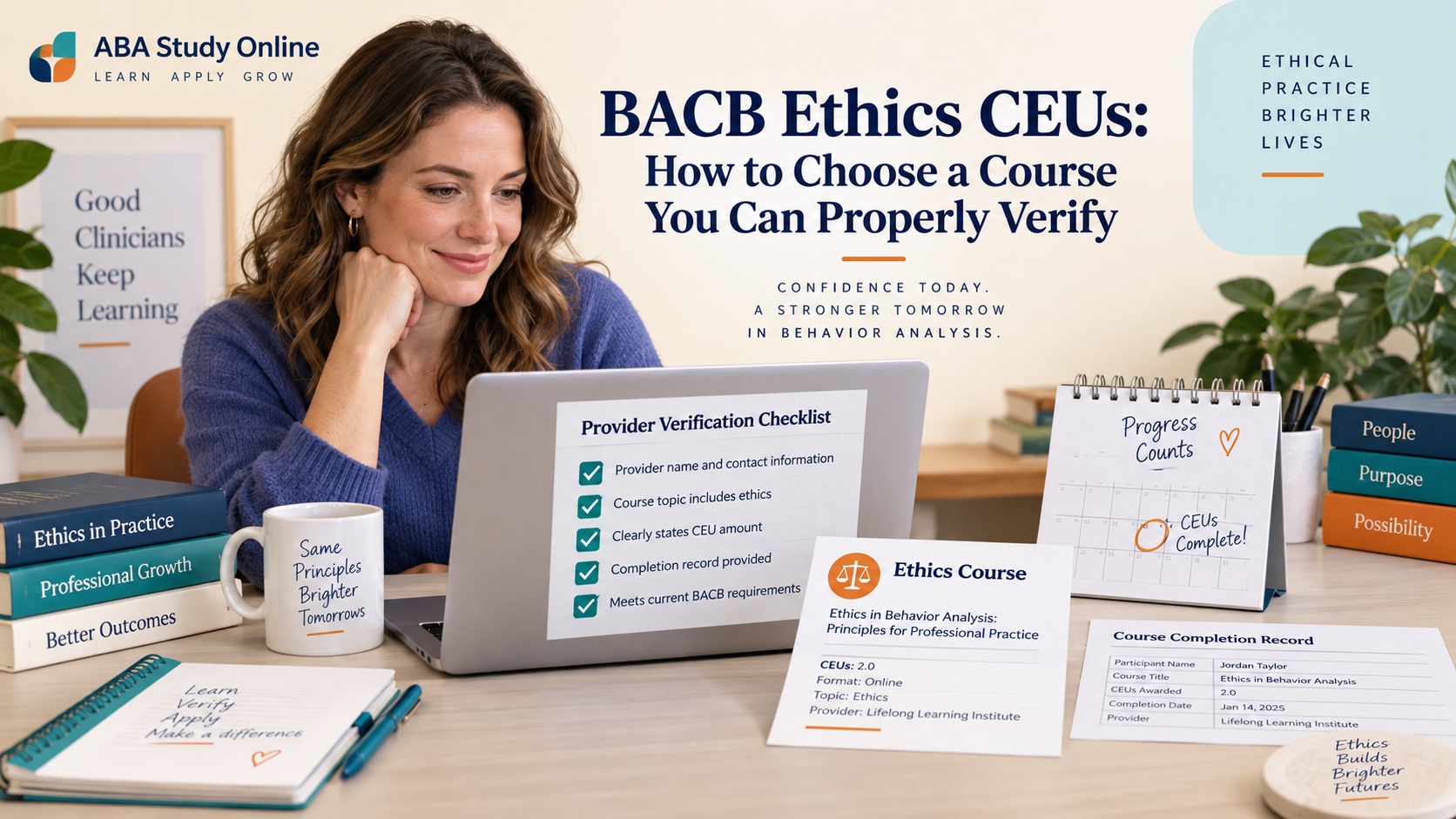
BACB Ethics CEUs: How to Choose a Course You Can Properly Verify
Searching for BACB ethics CEUs usually means you want to meet a real maintenance requirement without spending time or money on a course that does not fit your credential or recertification cycle. The safest approach is not to choose the most attractive certificate. Start by checking who the course is for, who is responsible for the event, how the event is categorized, and whether the content is actually centered on ethics or cultural/contextual responsiveness.
This guide separates the current BCBA and BCaBA numbers from the published 2027 framework, then gives you a practical verification path. It also explains why an ABA Study Online lesson, article, or app activity is study support rather than BACB CEU credit.
Quick answer: an ethics CE opportunity should match your credential and recertification cycle, come from a provider whose current ACE status you can verify, identify the intended CE category, and devote most of its content to ethics or cultural/contextual responsiveness. A course does not become an Ethics CE simply because its title includes “ethics,” it is free, or it provides a completion certificate.
BCBA and BCaBA ethics CEU numbers
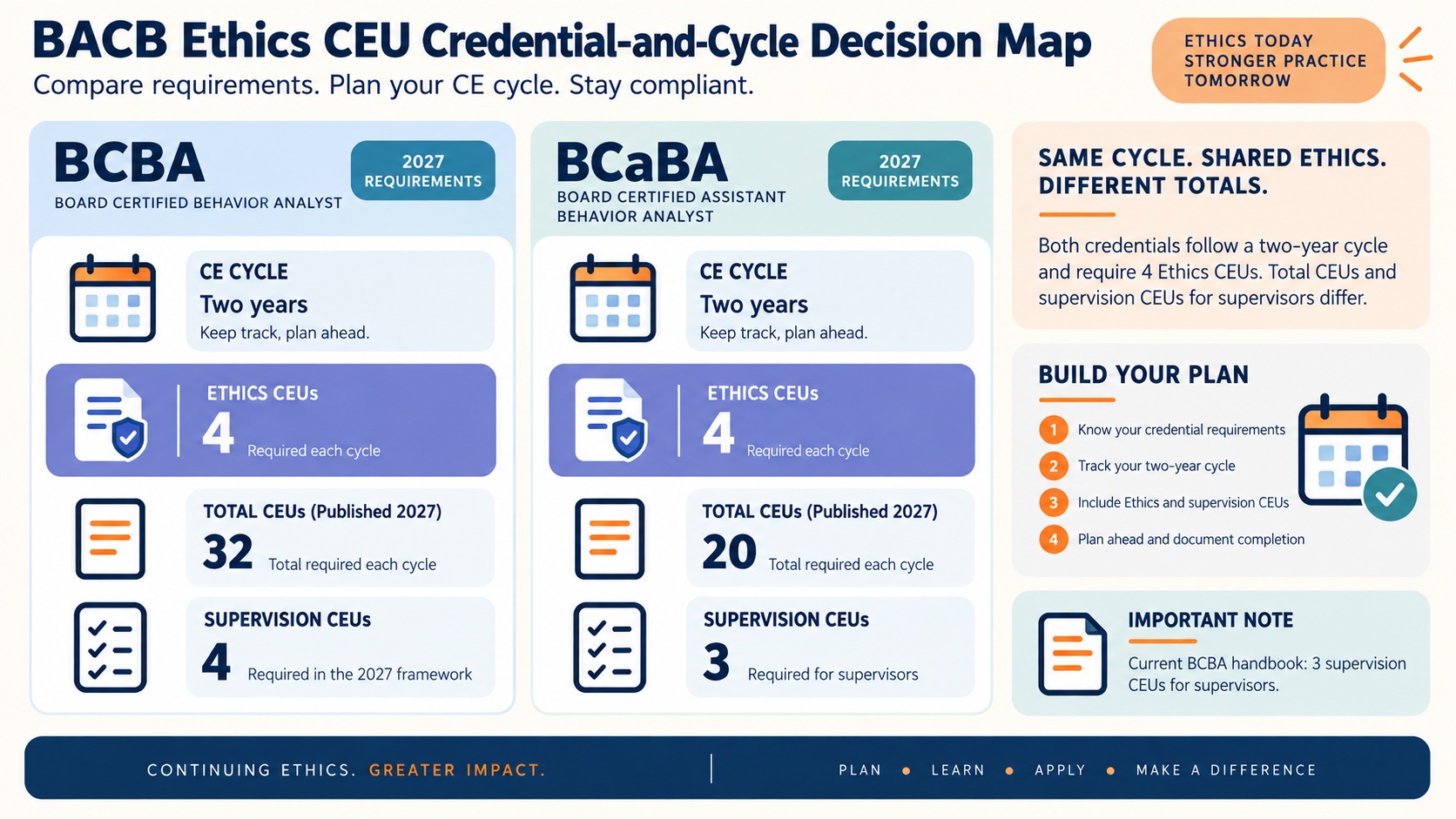
Use the number for your credential, then check the handbook or requirements document that governs your cycle. The current June 2026 BCBA Handbook states that a BCBA needs 32 CEUs in each two-year recertification cycle, including 4 ethics CEUs. A BCBA who supervised the ongoing practice of RBTs, BCaBAs, or certification trainees during the cycle must also obtain the current supervision minimum of 3 CEUs.
The published 2027 framework keeps the BCBA total at 32 and lists 4 supervision CEUs for supervisors. The 2027 BCaBA Requirements document states that a BCaBA needs 20 CEUs per two-year cycle, including 4 ethics CEUs and 3 supervision CEUs for supervisors. These are not interchangeable totals. If you hold or maintain a specific credential, use its own handbook and current BACB portal instructions.
| Credential | Published 2027 total | Ethics minimum | Supervision minimum, if applicable |
|---|---|---|---|
| BCBA | 32 CEUs per 2-year cycle | 4 CEUs | 4 CEUs |
| BCaBA | 20 CEUs per 2-year cycle | 4 CEUs | 3 CEUs |
For a current BCBA cycle, the handbook still states 3 supervision CEUs for supervisors. That is why your tracking sheet should include the cycle dates and the source version you used. Do not replace a current-cycle number with a future number just because a provider has updated its marketing page.
What the BACB ethics-content definition requires
The 2027 BCBA and BCaBA documents clarify that Ethics CE may involve events related to BACB ethics requirements and/or cultural/contextual responsiveness. The content must relate to behavior-analytic practice or applied research and be directly linked to behavior-analytic literature or established practice. Most of the event must focus on ethics or cultural/contextual responsiveness.
That last sentence is the useful decision rule. Imagine a two-hour course about data collection that spends ten minutes mentioning confidentiality. It may be valuable learning, but the short ethics reference does not automatically make the whole course an Ethics CE event. By contrast, a course that examines informed consent, assent, boundaries, cultural and contextual variables, conflicts of interest, or ethical decision-making throughout its examples has a clearer basis for the ethics category—provided the provider’s event documentation supports that classification.
Read the description for the actual emphasis, not only the badge or category filter. Look for a defined learning objective, a behavior-analytic connection, the event category, and a completion process. If the description is vague, ask the provider how the event is categorized before you pay or count it.
How to verify the provider and the event
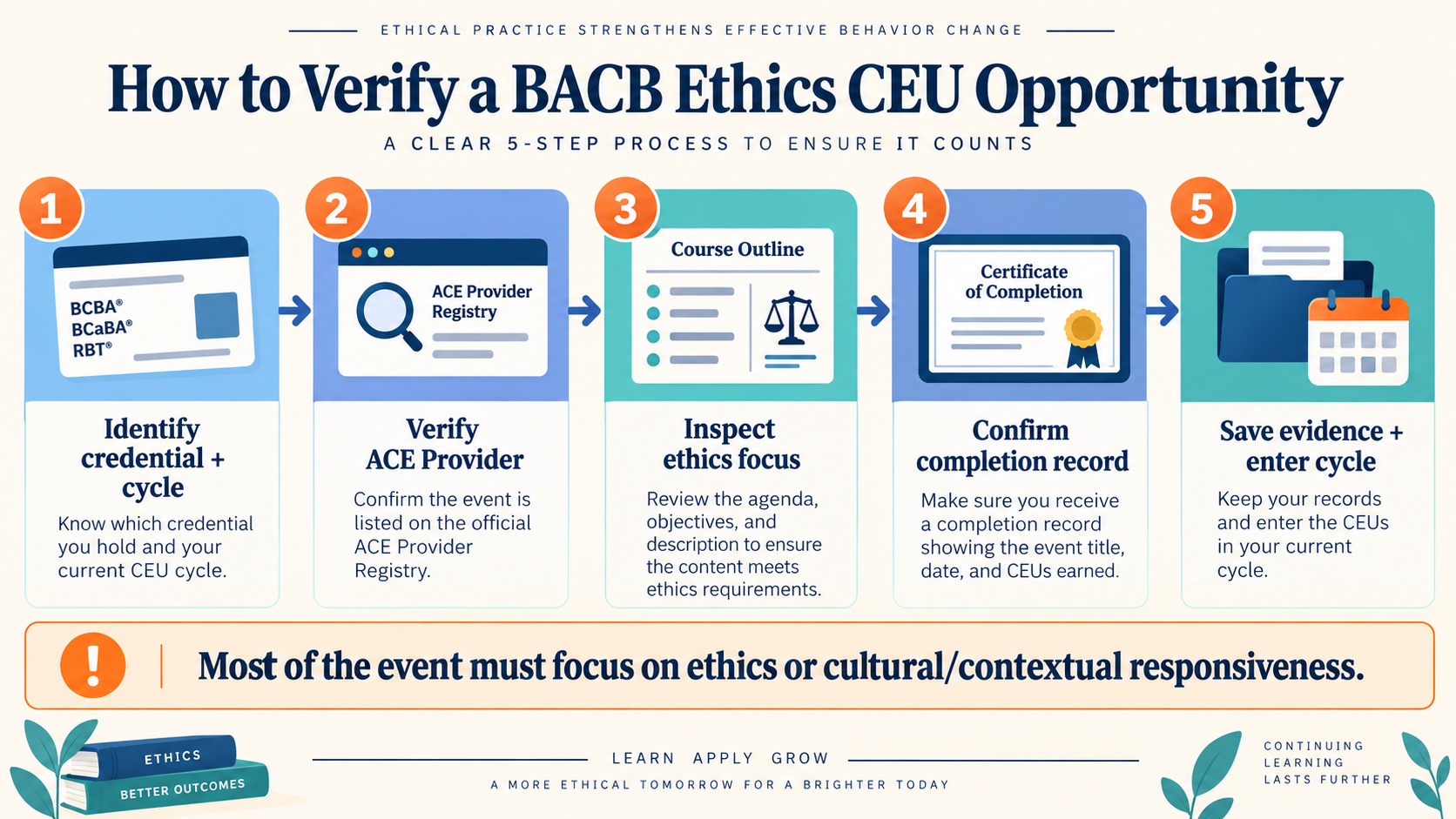
The BACB’s Authorized Continuing Education Providers page says that ACE Providers can provide Learning CE to BCBA and BCaBA certificants and professional development to RBT certificants. It also links to the ACE Provider Verification Registry. Use that registry as the first check, rather than relying on a provider’s old logo, screenshot, or claim that it is “BACB approved.”
Then audit the individual event. A useful five-question check is:
- Who is it for? Does the event identify BCBA/BCaBA Learning CE, rather than RBT professional development?
- What is the category? Does the provider identify the event as Ethics CE, and does the description show that most of the content fits the BACB definition?
- Who is responsible? Does the event page match the organization or individual shown in the registry?
- How is completion documented? Will you receive a record that identifies the event, date, category, amount, and provider?
- When does it count? Does the completion date fall inside the two-year cycle to which you will apply it?
A live webinar, recorded course, conference session, university activity, or self-study option may use a different completion method. Do not calculate CEUs from video runtime on your own. Follow the provider’s current instructions and keep the supporting record that the BACB portal asks you to enter.
What to save for your record
Create one row for every event instead of keeping a folder of unnamed certificates. Record the provider name as it appears in the registry, the date you verified its ACE status, event title, event date or completion date, category, CEU amount, and the location of the certificate or other completion evidence. If the event description explains the ethics focus, save that page or a dated record according to the provider’s terms.
Keep your cycle dates visible at the top of the sheet. The current BCBA Handbook says that CEUs must be earned in the cycle to which they are applied, that missed CEUs cannot be made up after the recertification date, and that excess CEUs cannot be applied to the next cycle. The same basic tracking habit protects you from a last-minute category gap: review total CEUs and ethics CEUs separately.
Why RBT professional development is different
The BACB ACE page uses two different labels: Learning CE for BCBA and BCaBA certificants, and professional development for RBT certificants. That distinction matters when you search for “BACB ethics CEUs.” An RBT event may be relevant to ethical practice, but you should not assume that it can be entered as a BCBA or BCaBA Ethics CE, and you should not use a BCBA/BCaBA CE total to plan RBT maintenance.
Choose the page and record that match your credential. For an RBT, consult the current RBT Handbook and the provider’s RBT professional-development documentation. For a BCBA or BCaBA, use the applicable maintenance handbook, ACE registry, event category, and completion record.
A practical selection example
Suppose you find a low-cost online course titled “Ethics in ABA.” Before counting it, open the provider’s listing and ask whether the course is attached to a current ACE Provider. Read the outline. If most modules address informed consent, assent, privacy, professional boundaries, cultural/contextual responsiveness, and ethical decision-making in behavior-analytic practice, the description is consistent with the published Ethics CE boundary. If the course is mostly about reinforcement procedures with one final ethics slide, keep it as general learning unless the provider gives a clear, current category explanation.
Next, compare the record you will receive with your credential. If you are a BCaBA, do not copy a BCBA total into your tracker. If you are a BCBA who supervised during the cycle, keep the supervision category separate. Finally, record the course in the cycle where you completed it. You are not trying to make a marketing page sound official; you are building a traceable record that matches the current rules.
Common mistakes
- Counting the word “ethics” in the title: inspect the event’s actual focus and category.
- Trusting a badge: verify the provider in the live BACB registry.
- Mixing credentials: BCBA and BCaBA totals are different, even though both have a four-ethics-CE minimum in the published 2027 documents.
- Mixing current and future rules: the current BCBA Handbook lists 3 supervision CEUs for supervisors; the 2027 BCBA framework lists 4.
- Confusing RBT PD with Learning CE: use the maintenance route for the credential you actually hold.
- Saving only a PDF: keep the provider, category, date, amount, and cycle context with the certificate.
- Leaving the search until recertification week: track category gaps throughout the two-year cycle.
Study support between verified CE events
ABA Study Online can help you review ethics concepts, connect a missed practice question to a theory block, and revisit material in the app. Those are learning and retrieval supports. They do not automatically issue BACB CEUs, ACE certificates, or provider approval, so keep them separate from the official continuing-education record.
Want a structured BCBA review path?
Use ABA Study Online’s BCBA learning and practice resources to review concepts between verified CE events. This study support is independent and does not issue BACB CEUs or ACE certificates.
FAQ
How many ethics CEUs does a BCBA need?
The current BCBA Handbook requires 4 ethics CEUs within each two-year recertification cycle. The published 2027 BCBA framework retains that 4-CEU ethics minimum.
Do BCaBAs need ethics CEUs?
Yes. The published 2027 BCaBA Requirements state 20 total CEUs per two-year cycle, including 4 ethics CEUs and 3 supervision CEUs for supervisors.
Does a certificate prove that a course counts as an ethics CEU?
No. Check the provider’s current ACE status, the event category, the ethics-content focus, the completion record, and the date for your cycle. A certificate is part of the record, not the entire eligibility decision.
Can ABA Study Online issue BACB ethics CEUs?
Not through the study articles, free resources, practice questions, or app review activities described here. They are study support and should not be entered as BACB CEUs or ACE certificates.
Is the 2027 BCBA exam based on a seventh-edition task list?
No. The BACB’s 2027 BCBA Requirements document says the examination is based on the BCBA Test Content Outline, 6th edition, which took effect January 1, 2025. The 2027 changes discussed here concern eligibility and maintenance requirements, including the future supervision CEU number.