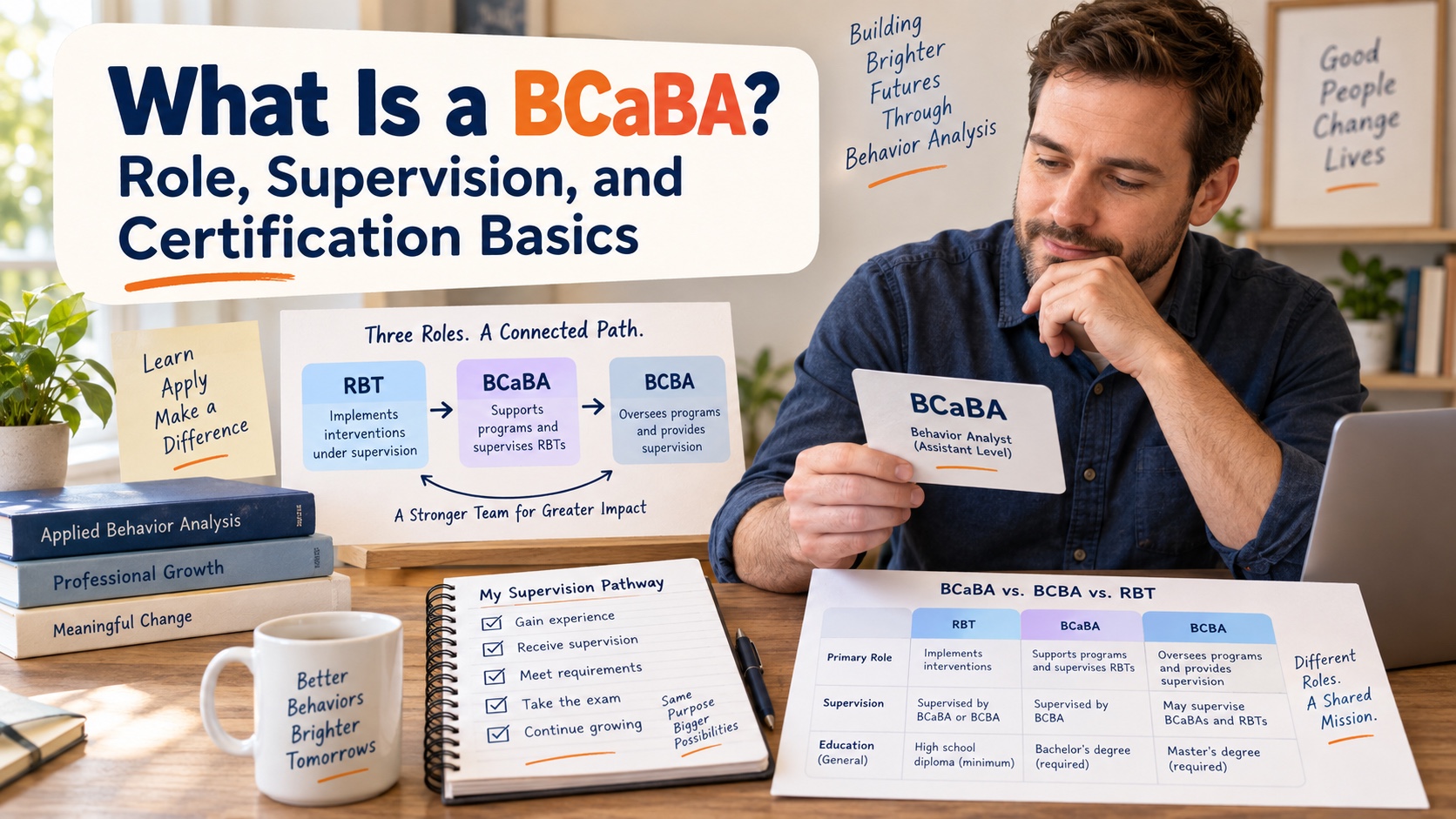
What Is a BCaBA? Role, Supervision, and Certification Basics
If you are asking what a BCaBA is, you may have seen the title in an ABA job posting, a university program, or an RBT supervision plan. BCaBA stands for Board Certified Assistant Behavior Analyst. It is an undergraduate-level certification in behavior analysis issued by the Behavior Analyst Certification Board (BACB).
The simplest role boundary is this: a BCaBA may provide behavior-analytic services under the supervision of a BCBA, and a BCaBA may supervise RBT work when the current BACB and workplace requirements are met. A BCaBA is not the same credential as a BCBA, an RBT, or a general ABA paraprofessional title.
BCaBA definition in plain language
A BCaBA is a certified behavior analyst at the assistant level. “Assistant” describes the certification level and supervision structure; it does not mean that the person is merely observing or unable to use behavior-analytic skills. A BCaBA may participate in assessment, teaching, data review, caregiver or staff support, and behavior-change services when those activities fit the person’s competence, role, supervision, employer policies, and applicable law.
The BACB describes the BCaBA as an undergraduate-level certification. By contrast, the BCBA is a graduate-level certification. The difference is not simply the number of letters after someone’s name. It affects the supervision relationship, the qualification pathway, and the kinds of responsibility a person may hold.
What a BCaBA title does not mean
The title does not mean “assistant” in the everyday sense of an untrained helper, and it does not mean that the person is a BCBA in waiting who can make every independent clinical decision. It also does not mean that a person’s job title, degree, or experience automatically satisfies BACB certification requirements. The credential is a formal role with its own education, fieldwork, examination, ethics, supervision, and maintenance rules.
It is also useful to separate certification from licensure. The BACB credential is a professional certification; a state or another jurisdiction may regulate the delivery of behavior-analytic services separately. Before accepting a role, ask which credential the employer requires, who will supervise the work, what records are kept, and which local rules apply.
What does a BCaBA do?
In everyday practice, a BCaBA may help implement and monitor behavior-analytic services, collect and interpret data with appropriate oversight, support skill-acquisition or behavior-reduction programs, communicate with a supervising BCBA, and help organize training or feedback for direct-service staff. The exact duties depend on the service setting and the supervisor’s plan.
A BCaBA’s work is connected to supervision in two directions:
- BCBA supervision: BCaBAs may provide services under the supervision of a BCBA. The supervisor is responsible for meeting the applicable supervision and documentation requirements.
- RBT supervision: BCaBAs may supervise RBT work within the role-specific BACB rules. The current supervision guidance identifies BCaBAs as possible RBT Supervisors, while the RBT Handbook supplies the detailed requirements.
This means a BCaBA should not treat a credential as permission to work outside the supervision structure. The person must still follow the current BACB Handbook, ethics requirements, supervisor instructions, employer policies, and state or local rules. A job title used by one organization may also be broader or narrower than the BACB certification role.
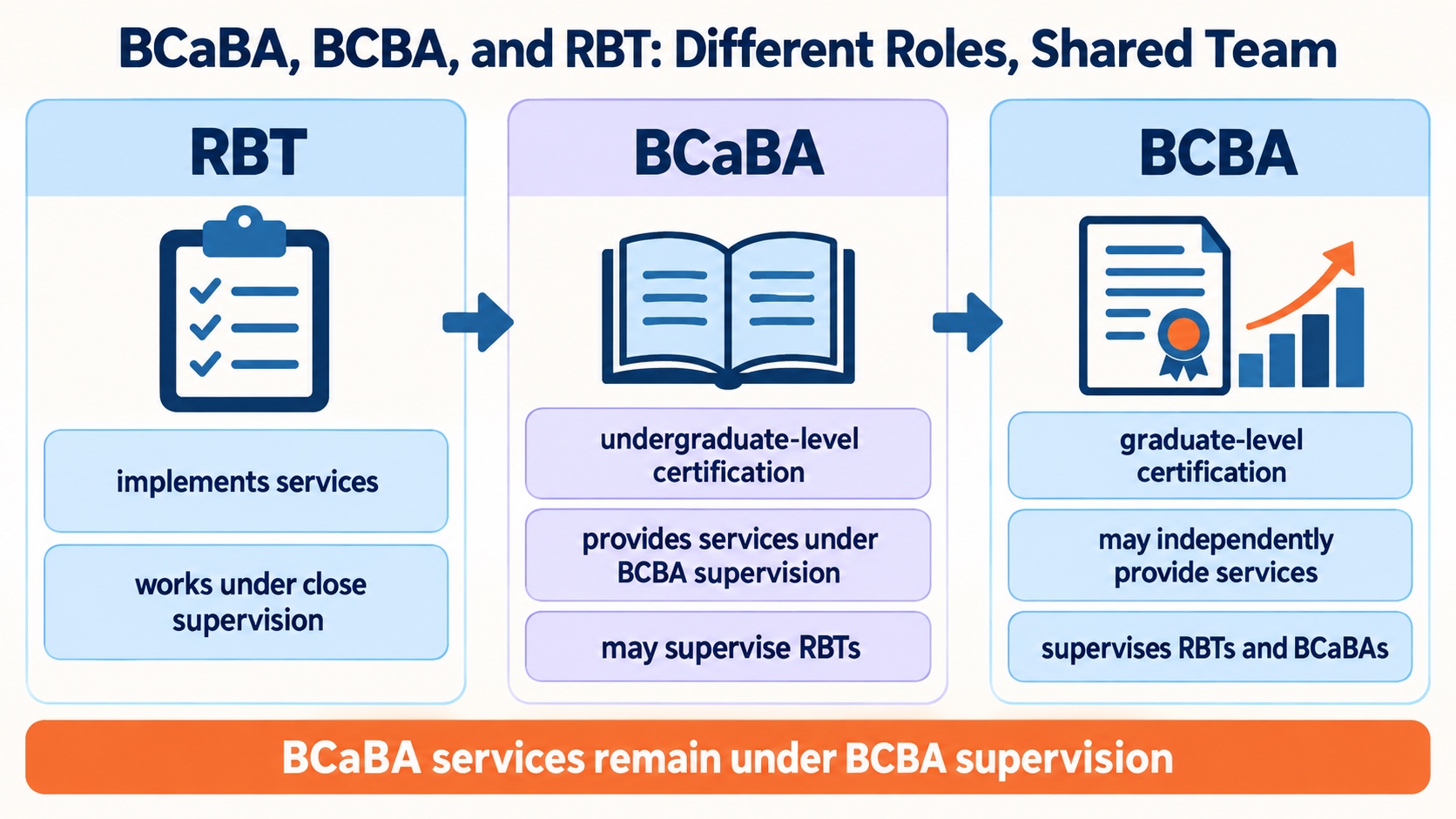
BCaBA vs BCBA vs RBT
These three titles often appear in the same ABA workplace, so a comparison helps:
| Role | Plain-language level | Supervision boundary |
|---|---|---|
| BCaBA | Undergraduate-level behavior-analysis certification | Provides behavior-analytic services under BCBA supervision; may supervise RBT work under the applicable rules. |
| BCBA | Graduate-level behavior-analysis certification | May independently provide behavior-analytic services and supervise RBTs, BCaBAs, and other professionals within the certification, ethics, and jurisdiction rules. |
| RBT | Paraprofessional behavior-analysis certification | Implements services under the direction and close supervision of an RBT Supervisor or RBT Requirements Coordinator. |
The comparison is about BACB-level role boundaries, not a promise about a particular workplace. State licensure and employer policies can add requirements. A BCaBA may have valuable experience, but experience alone does not change the certification level or remove the BCBA supervision relationship.
How the BCaBA certification path works
The detailed pathway belongs in the current BCaBA Handbook and certification-requirements guide, but the high-level sequence is useful:
- Meet the degree and coursework pathway: the applicable requirements depend on the pathway and the date of application.
- Complete qualifying supervised fieldwork: fieldwork is documented under a qualified supervisor using the forms and rules that apply to the pathway and date.
- Apply to the BACB: the application requires the current forms, attestations, and supporting documents.
- Pass the BCaBA examination: the current examination is based on the BCaBA Test Content Outline (6th ed.), which is separate from the certification-requirements document.
- Maintain the certification: ongoing supervision, continuing education, ethics, and renewal rules apply after certification.
This overview is not an individual eligibility decision. If you are planning the credential, compare your dates and documents with the live BACB Handbook and the official transition resources before choosing courses or counting fieldwork.
For study planning, begin with the current BCaBA Test Content Outline for exam topics, then use the Handbook for eligibility and maintenance requirements. Practice questions and concept notes can support learning, but they do not replace qualifying coursework, supervised fieldwork, the application review, or the examination.
What to know about the 2027 transition
Important BCaBA certification changes take effect January 1, 2027. The BACB has published a 2027 BCaBA Requirements page and transition guidance with updated coursework, fieldwork, forms, and timing information. A learner who is applying around the transition should not rely on a generic “BCaBA requirements” summary written for a different date.
The BCaBA examination and the certification requirements are related but not identical. The current exam outline is the source for exam content; the Handbook and 2027 transition documents control eligibility and application evidence. Keep those sources separate when planning your study.
FAQ
What does BCaBA stand for?
BCaBA stands for Board Certified Assistant Behavior Analyst. It is an undergraduate-level BACB certification in behavior analysis.
Can a BCaBA work without a BCBA?
Under the BACB role definition, BCaBAs provide behavior-analytic services under BCBA supervision. The supervising arrangement, documentation, employer policies, and state rules still need to be verified for the specific job.
Can a BCaBA supervise an RBT?
BCaBAs may serve as RBT Supervisors under the applicable BACB requirements. The current RBT Handbook and supervision guidance should be used for the detailed conditions, documentation, and ongoing supervision rules.
Is a BCaBA the same as a BCBA?
No. BCaBA is the undergraduate-level assistant certification; BCBA is the graduate-level certification. Their supervision and responsibility structures are different.
Is BCaBA certification changing in 2027?
Yes. The BACB has published BCaBA requirement changes and transition guidance for January 1, 2027. Use the live official documents for your application date rather than treating this definition page as a complete requirements checklist.