RBT Certification in North Carolina: BACB Steps, State Boundaries, and Medicaid Checks
If you are searching for RBT certification in North Carolina, you may be trying to solve more than one problem at once: how to earn the national Registered Behavior Technician credential, what North Carolina law says about behavior technicians, and whether a workplace or payer has added a deadline. Those layers overlap, but they are not the same document or authority.
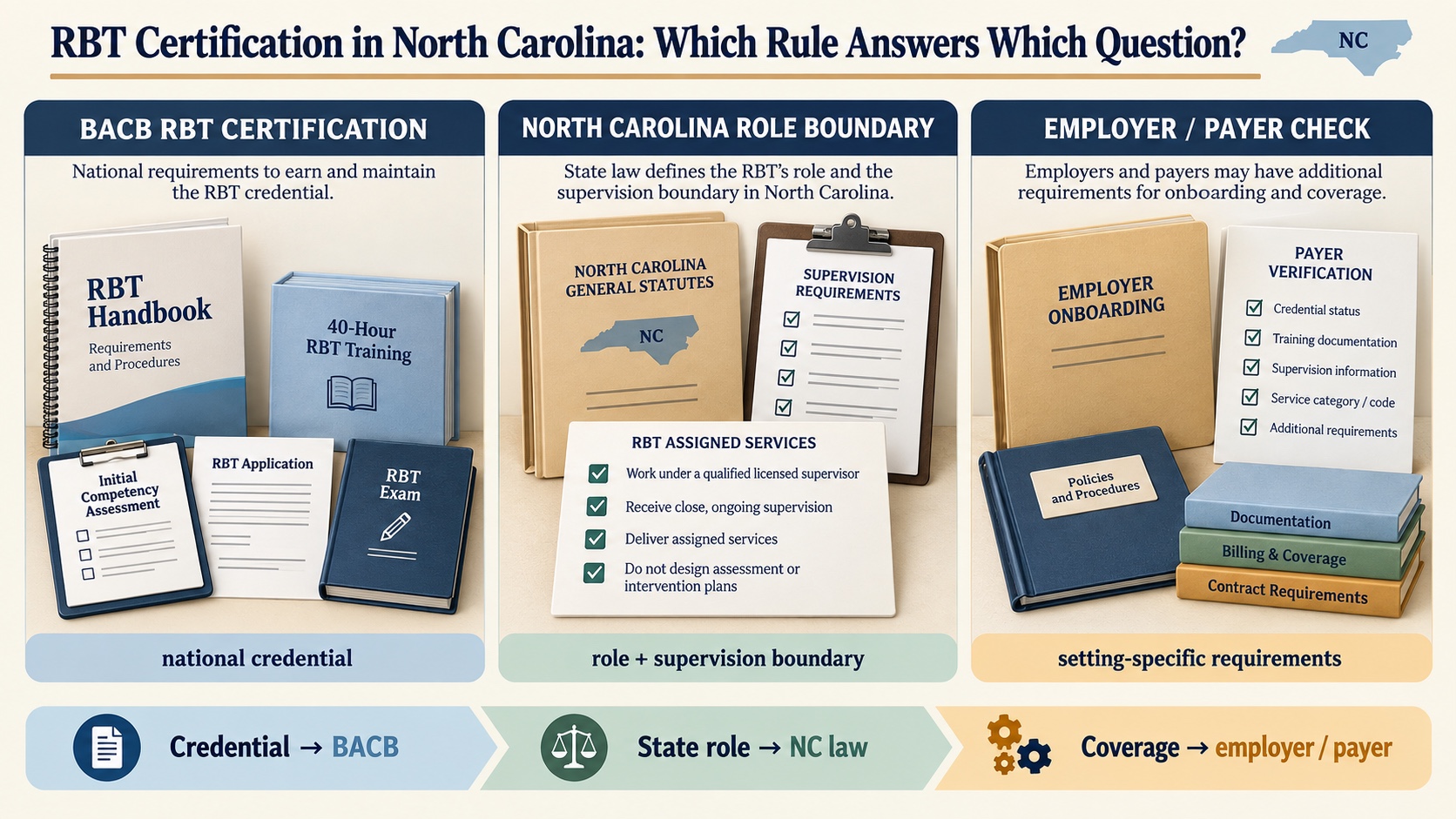
The short answer is that the BACB administers the RBT certification pathway. North Carolina then adds a state practice and supervision context, and NC Medicaid has a current reimbursement rule for certain research-based behavioral health treatment services. Use the current BACB RBT Handbook for certification, the North Carolina statute for role boundaries, and your employer or payer for setting-specific instructions.
Table of Contents
Short answer: what “RBT certification NC” means
North Carolina does not turn the BACB RBT credential into a general behavior-analyst license application. Start with the BACB’s RBT requirements. Then check the North Carolina behavior-technician rule, the supervising professional, the employer’s onboarding requirements, and the payer policy that applies to your services.
That routing answer prevents three common mistakes. First, a 40-hour training certificate is not the same as RBT certification. Second, a North Carolina license application for a behavior analyst or assistant behavior analyst is not automatically an RBT application. Third, a Medicaid reimbursement rule for one service benefit should not be presented as a universal certification law for every RBT job.
The BACB certification pathway still comes first
The BACB describes an RBT as a paraprofessional certification in behavior analysis. RBTs assist with behavior-analytic services under the direction and close supervision of an RBT Supervisor and/or RBT Requirements Coordinator. The national credential is therefore about meeting BACB requirements and maintaining the credential; it is not an independent behavior-analyst license.
The current June 2026 RBT Handbook gives the national sequence. Before applying, an applicant must be at least 18, have at least a high-school-level education or equivalent, and complete the required background and abuse-registry checks within the stated windows. The applicant also completes the current 40-hour training and Initial Competency Assessment, creates or uses a BACB portal account, submits the application documents, receives an approved determination, and takes the certification examination.
North Carolina can affect how those steps are arranged. An employer may require additional fingerprinting, a state or organization background process, a particular supervisor, or a payer-specific credential before assigning services. The BACB Handbook itself notes that fingerprinting is not required by the BACB, but that it may vary by state and organization. Treat those additions as local checks, not as replacements for the BACB requirements.
What North Carolina adds to the picture
North Carolina General Statutes, Chapter 90, Article 43, define a behavior technician as a paraprofessional who delivers applied behavior analysis services under the close, ongoing supervision of a licensed behavior analyst, licensed assistant behavior analyst, or another professional licensed under the listed chapters when that professional’s scope, education, training, and experience fit the work.
The statute also draws an important role boundary: a behavior technician does not design assessment or intervention plans or procedures. The technician delivers services assigned by a supervisor who is responsible for the technician’s work. That is consistent with the practical RBT boundary in the BACB system: implement assigned procedures, collect and document information as directed, communicate concerns, and seek clinical direction rather than independently changing a treatment plan.
The North Carolina Behavior Analyst Licensure Board is the state board for professional behavior-analysis licenses. Its application and FAQ materials focus on licensed behavior analysts and licensed assistant behavior analysts. That does not mean that an RBT applicant should file the same license application or meet the same degree-level requirements. Check the title of the credential and the office that issues it before you upload a document or pay a fee.
State context can still matter even when the credential comes from the BACB. The employer may need an appropriately licensed supervisor. A service program may have its own credential, documentation, and observation rules. A payer may define which staff can deliver a reimbursable service. In a home, clinic, school, or community setting, ask which rule governs the specific work you are being asked to perform.
The current NC Medicaid certification timeline
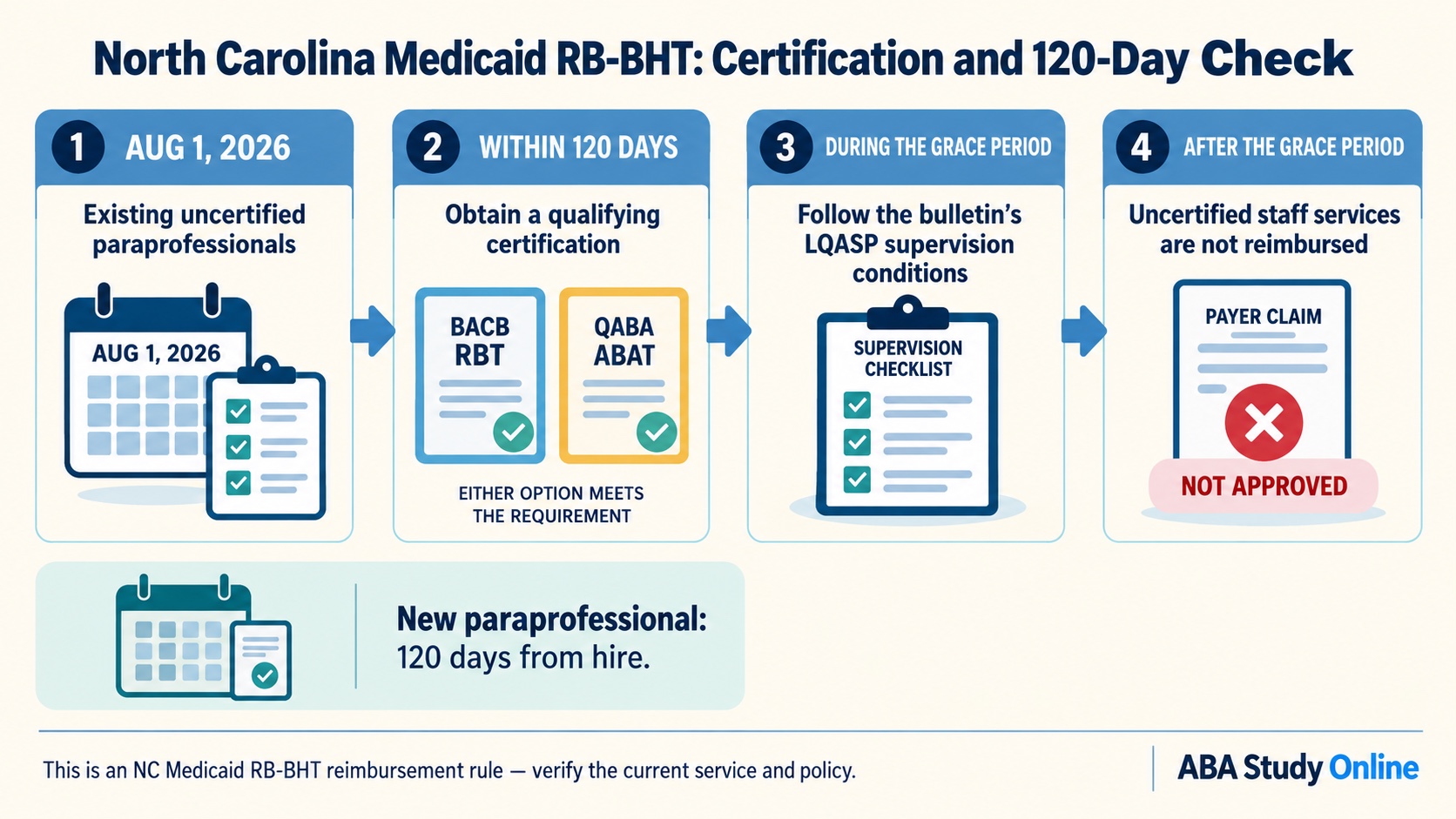
North Carolina Medicaid issued an updated reminder on August 31, 2026, about research-based behavioral health treatment services under Clinical Coverage Policy 8F. The bulletin says that existing and new paraprofessionals providing these services to Medicaid beneficiaries need at least one qualifying certification for services to be reimbursed. It lists BACB RBT certification and QABA ABAT certification as qualifying options.
The bulletin gives a 120-day timing rule. For existing paraprofessionals without a qualifying certification, the grace period begins August 1, 2026. A new paraprofessional must obtain a qualifying certification within 120 days of hire. During the grace period, the bulletin describes supervision by a Licensed Qualified Autism Service Provider for services to remain reimbursable. After the grace period, claims for services delivered by an uncertified paraprofessional will not be reimbursed.
This is an important North Carolina search-intent detail, but label it accurately. The bulletin is a current NC Medicaid RB-BHT provider and reimbursement rule. It is not a statement that every North Carolina employer, private payer, school, or community program uses the same 120-day window. If your job or client is not part of the covered Medicaid service, ask the employer or payer which credential and date rules apply.
Also avoid assuming that a person can solve the deadline by purchasing a course. A training course can be one step in the BACB pathway, but the RBT credential still requires the current application, Initial Competency Assessment, examination, and other eligibility requirements. A provider’s internal hiring deadline may be earlier than the maximum time allowed by a payer rule.
Supervision and scope boundaries
Before accepting an RBT position in North Carolina, identify the person responsible for your work. Ask whether the supervisor meets the BACB requirements for RBT supervision and whether the service setting also requires a North Carolina license or another professional qualification. The current BACB Handbook says an RBT must receive ongoing supervision for at least 5% of the hours spent providing behavior-analytic services each calendar month. That national maintenance requirement does not erase additional state, employer, or payer expectations.
Clarify what you will be asked to do. Typical assigned tasks may include implementing teaching procedures, conducting preference assessments, recording data, writing objective session notes, and communicating changes or safety concerns. Do not agree to independently design an assessment, change an intervention plan, diagnose, promise a clinical outcome, or use a procedure that is not in the approved plan or within your training.
The supervision relationship should also have a practical feedback path. Know how to reach the supervisor, how urgent concerns are handled, where approved protocols are stored, and how data are reviewed. If a client’s response does not match the plan, pause at the safety boundary and ask for clinical direction. A certification title does not authorize improvising a new treatment procedure.
A North Carolina verification checklist
- Name the credential: are you pursuing BACB RBT certification, applying for a different North Carolina professional license, or meeting an employer requirement?
- Open the current BACB Handbook: confirm the age, education, background checks, 40-hour training, Initial Competency Assessment, application, exam, ethics, and maintenance requirements.
- Ask about local checks: confirm whether the employer or setting requires fingerprinting, additional background screening, health documentation, or other onboarding records.
- Identify the supervisor: confirm who is responsible for the work and how ongoing supervision will be scheduled and documented.
- Check the payer: if services involve NC Medicaid RB-BHT, ask whether the August 2026 CCP 8F certification and 120-day rule applies to your role and start date.
- Keep the boundaries visible: the RBT implements assigned services and communicates; the RBT does not independently design assessment or intervention plans.
- Recheck before applying: download or open the live official source because handbook versions, state policies, and payer instructions can change.
For studying, the ABA Study Online RBT certification guide covers the national pathway, while the RBT learning path, RBT practice questions, and app review tools can support terminology, scenarios, and review. These resources do not issue BACB certification, conduct the official competency assessment, provide a North Carolina license, or decide whether a Medicaid claim is reimbursable.
RBT certification in North Carolina FAQ
Is RBT certification different in North Carolina?
The BACB certification requirements are the national starting point. North Carolina adds state-law, supervision, employer, and payer context. A person may need to satisfy more than one set of conditions for a particular job or reimbursable service, but that does not create a separate universal NC RBT certification application.
Do RBTs need a North Carolina behavior-analyst license?
Do not assume so. The North Carolina behavior-analyst licensure board’s materials concern professional behavior-analyst and assistant behavior-analyst licenses. North Carolina law describes a behavior-technician exemption and supervision boundary. Ask the employer or payer which rule applies to your specific service and supervisor.
What does the NC Medicaid 120-day rule mean?
The August 31, 2026 NC Medicaid reminder says that, for covered RB-BHT services, existing uncertified paraprofessionals have a grace period beginning August 1, 2026, and new paraprofessionals have 120 days from hire to obtain a qualifying RBT or ABAT certification. It is a reimbursement and provider-policy rule, so verify that the service and payer are within its scope.
Can a 40-hour course make me an RBT in North Carolina?
No. The 40-hour training is one BACB eligibility requirement. You still need the other current eligibility documents, Initial Competency Assessment, application, approved determination, examination, and maintenance requirements. State or employer requirements can add another layer.