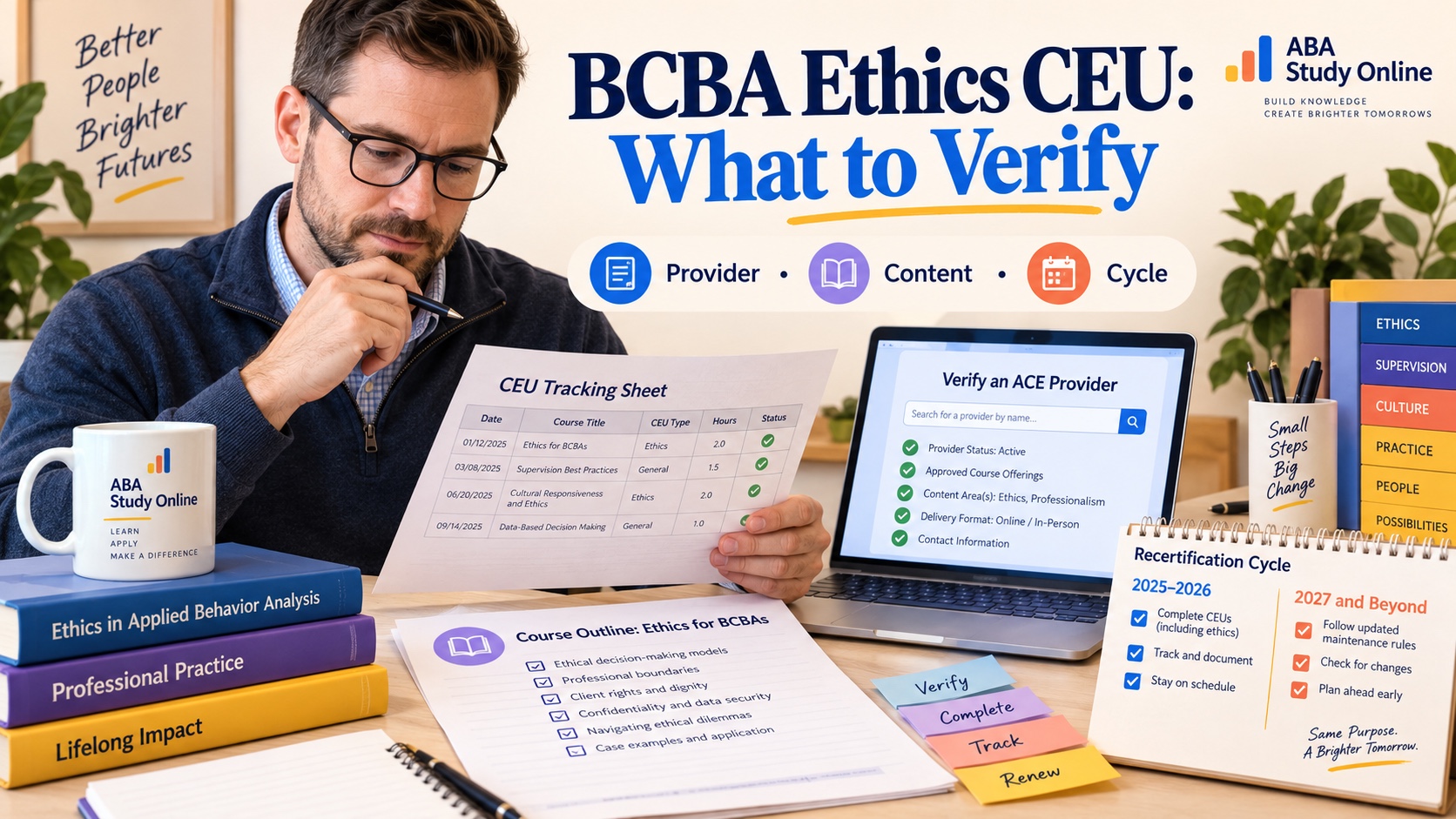
BCBA Ethics CEU: How to Verify a Course Before You Count It
If you are searching for a BCBA ethics CEU, you probably want a course that is useful, documented, and appropriate for your current recertification cycle. The safest choice is not automatically the cheapest course or the one with “ethics” in the title. First confirm your BCBA requirement, then verify the provider, the individual event, the content focus, and the completion record.
This guide focuses on the BCBA-specific decision. It separates current handbook rules from the 2027 framework, explains how the BACB’s ACE system fits into the check, and shows how to keep an ABA Study Online study activity separate from official CE credit.
Table of Contents
Short answer: what makes a BCBA ethics CEU count?
A BCBA ethics CEU should fit your credential and recertification cycle, be connected to a recognized CE activity or documentation route, and have content that actually qualifies as ethics or cultural/contextual responsiveness under the current BACB guidance. A completion certificate helps document the event, but it does not by itself make the event an Ethics CE.
Use this order:
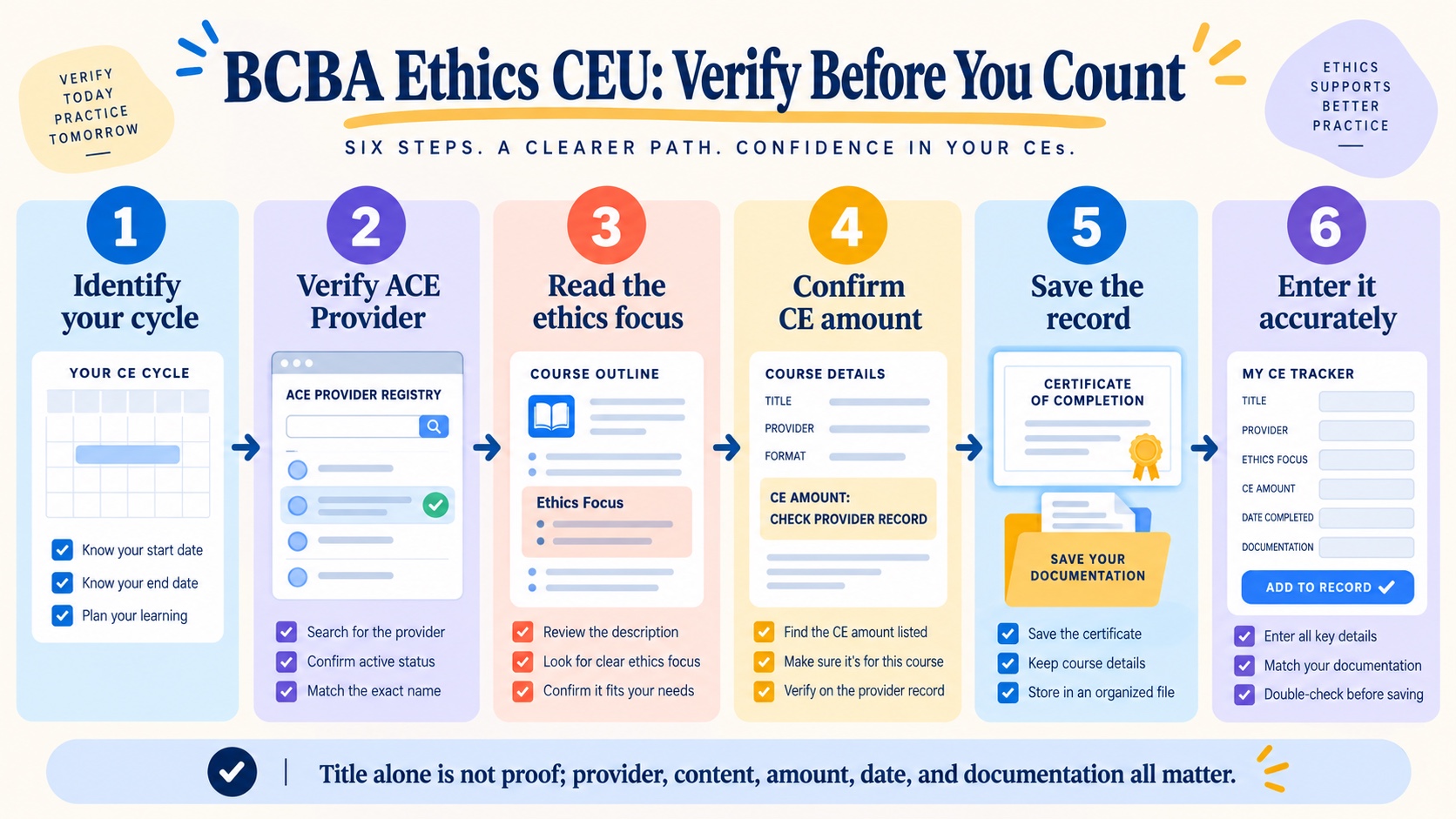
- Identify the cycle. Write down the start date and recertification date for your BCBA cycle.
- Confirm the number. Check the current BCBA Handbook rather than a provider’s old FAQ.
- Verify the provider. Use the BACB ACE Provider Verification Registry when the activity is offered as Learning CE by an ACE Provider.
- Inspect the event. Read the learning objectives, category, amount, date, and content emphasis.
- Save the record. Keep the certificate or other required documentation and enter the information accurately in the BACB portal.
This is a verification workflow, not an endorsement of a particular course. If the provider cannot explain the category or documentation, pause before counting it.
Current BCBA ethics CEU numbers
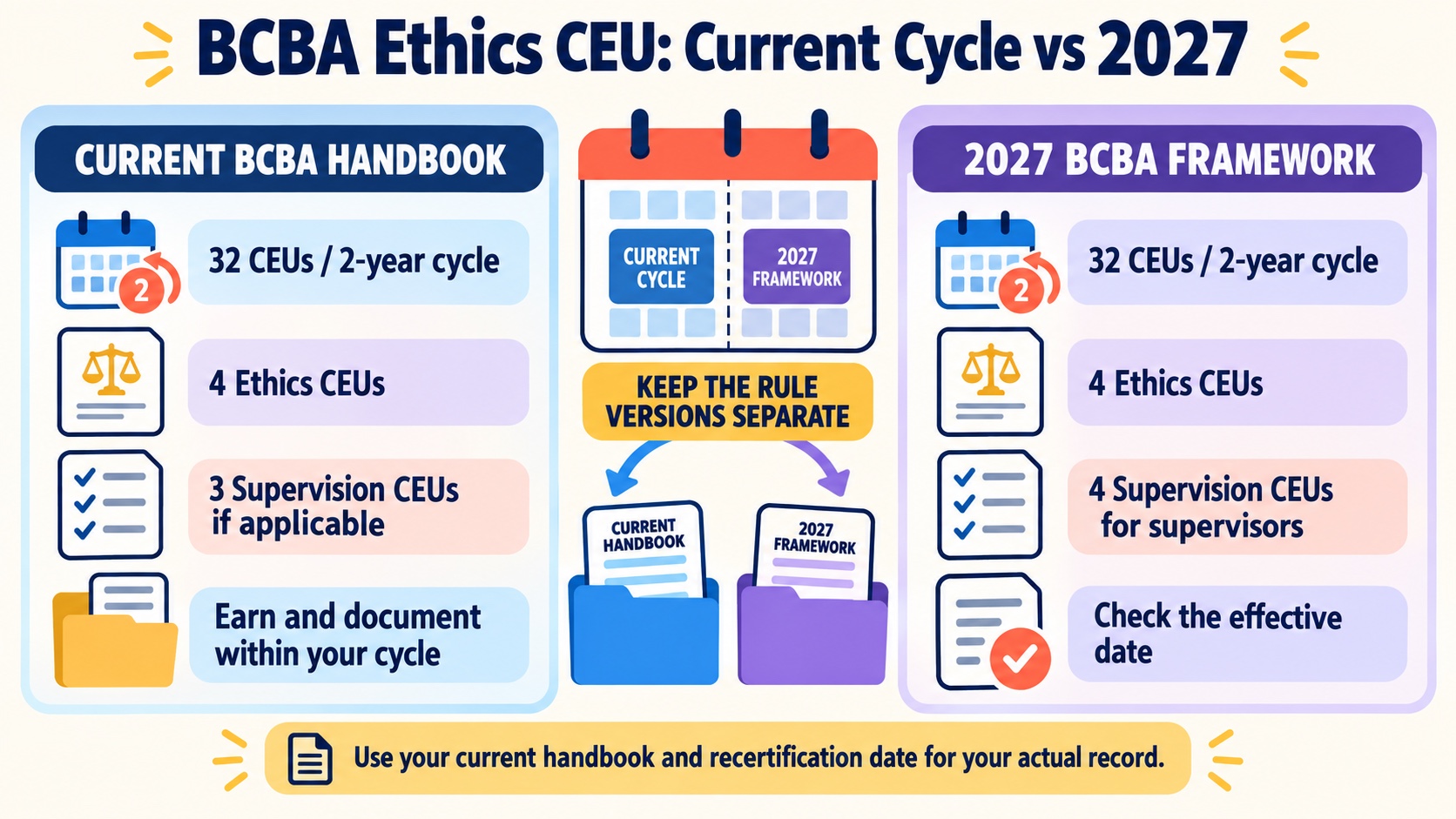
The current BCBA Handbook updated in June 2026 states that a BCBA needs 32 CEUs in each two-year recertification cycle, including 4 CEUs in ethics. It also lists 3 supervision CEUs for supervisors under the current handbook. The ethics minimum is the part owned by this page; supervision is a separate category that may apply based on your role.
Do not treat “4 ethics CEUs” as four courses. The amount can be earned through activities that meet the relevant rules, and the BACB handbook explains how different CE activity types are documented and calculated. For ACE Learning CE, the current handbook describes the relationship between learning minutes and CEU values. Use the official record and current portal instructions rather than converting a video’s advertised runtime yourself.
Also keep the total and the category in separate columns. A BCBA can have 32 total CEUs and still be short on Ethics CEUs. Conversely, a large ethics course does not remove the need to meet the total cycle requirement or any applicable supervision requirement.
What the ethics-content check looks for
The BACB’s 2027 requirements describe Ethics CE as events related to BACB ethics requirements and/or cultural/contextual responsiveness. The content must relate to behavior-analytic practice or applied research and connect directly to behavior-analytic literature or established practice. Most of the event must focus on ethics or cultural/contextual responsiveness.
That gives you a useful test. A two-hour workshop about data collection with a five-minute reminder about confidentiality may be valuable learning, but the ethics label alone does not prove that the entire event belongs in the Ethics CE category. A course that spends its main time on informed consent, assent, privacy, professional boundaries, conflicts of interest, cultural/contextual responsiveness, ethical decision-making, or the application of the BACB Ethics Code has a clearer content fit—assuming the provider’s current documentation supports the category.
Read beyond the title and marketing badge. Look for a stated audience, learning objectives, content outline, behavior-analytic context, CE category, and completion record. If the course page uses “ethics” as a broad label but does not identify what is taught or how it is categorized, ask the provider before you pay or enter it into your portal.
How to verify the ACE provider and event
The BACB says that ACE Providers are authorized to provide Learning CE to BCBA and BCaBA certificants and professional development to RBT certificants. The BACB also provides an ACE Provider Verification Registry. Start with the registry and confirm that the organization or individual is current. Do not rely on an old ACE logo, a screenshot, or the phrase “BACB approved” without checking the live listing.
Then review the individual event. A short event audit should answer:
- Is it intended for BCBA Learning CE rather than RBT professional development?
- Does the provider identify the event as Ethics CE, and does the outline support that label?
- Does the event page match the provider identity in the registry?
- What is the learning amount, and how is the completion amount calculated?
- What record will you receive, and does it show the title, date, category, amount, and provider?
A university course, conference session, live webinar, recorded event, or other activity may have a different documentation route. The fact that a resource is educational does not tell you how to enter it. Follow the current handbook and the provider’s current instructions.
How to track the CEU in your cycle
Create a tracker with one row per event. Record your credential, cycle dates, provider name, registry-check date, event title, event date or completion date, category, CEU amount, and the location of your supporting documentation. If the course description explains its ethics focus, save a dated copy or link according to the provider’s terms.
The current BCBA Handbook says CEUs must be earned within the cycle to which they are applied. It also says missed CEUs cannot be made up after the recertification date and excess CEUs cannot be rolled into the next cycle. That makes a monthly audit more useful than a last-minute certificate search.
Use three status labels: verified, needs provider clarification, and not counted. A course can remain useful learning while waiting for a category answer. Separating learning value from compliance value prevents a useful study resource from being entered as an official Ethics CE without evidence.
How the 2027 change affects the check
The BACB’s 2027 BCBA Requirements keep the two-year cycle at 32 CEUs and keep the ethics minimum at 4 CEUs. The document lists 4 supervision CEUs for supervisors, while the current June 2026 handbook lists 3 supervision CEUs for supervisors. That is a transition distinction, not a reason to backdate the future supervision number into your current cycle.
Use your recertification date and the official document that governs the cycle. If a provider advertises “2027 compliant,” ask what that phrase means: ethics content, supervision content, the provider’s ACE status, or the date the event is offered. A future label does not replace a current handbook check.
A practical course-selection example
Suppose you find a course called “Ethics in Behavior Analysis.” Before counting it, check whether the provider appears in the current ACE registry and whether the event is identified as Learning CE for BCBA certificants. Read the outline. If most modules examine confidentiality, informed consent, assent, boundaries, conflicts, cultural/contextual responsiveness, and ethical decision-making in behavior-analytic practice, the course has a stronger content rationale. If it is primarily a general ABA methods course with one ethics slide, keep it in the “learning to review” column until the provider clarifies the category.
Then verify the amount, record it in the correct cycle, and save the certificate or other documentation. Do not count the same learning event twice, and do not use an ABA Study Online article or app review session as a BACB CEU unless it is separately offered and documented through an authorized route that you have verified.
Common mistakes
- Choosing by title: the word “ethics” does not prove the event’s content or category.
- Trusting a logo: verify the current ACE provider record.
- Mixing cycles: a certificate earned outside your current cycle may not fill the current requirement.
- Backdating 2027 rules: the current handbook and future requirements have different supervision numbers.
- Confusing RBT PD with BCBA Learning CE: match the activity to the credential you hold.
- Saving only the completion badge: keep provider, category, date, amount, and cycle context together.
- Counting study support as official CE: learning value and BACB credit are different records.
BCBA ethics CEU FAQ
How many ethics CEUs does a BCBA need?
The current BCBA Handbook lists 4 ethics CEUs within each two-year recertification cycle. The published 2027 framework also lists 4 ethics CEUs.
Can a free course be a BCBA ethics CEU?
Price does not decide the category. Verify the provider, event, ethics focus, amount, completion record, and cycle. Free access alone does not establish BACB CE credit.
Does a certificate prove that a course counts?
No. A certificate is documentation. You still need to verify the provider and event category against the current rules and your cycle.
Can ABA Study Online issue BCBA ethics CEUs?
The free articles, app review activities, and practice questions described here are study support; they do not automatically issue BACB CEUs or ACE certificates.
Is the 2027 BCBA exam based on a seventh-edition task list?
No. The 2027 BCBA requirements document identifies the BCBA Test Content Outline, 6th edition, as the examination basis. The 2027 maintenance changes are a separate issue from the exam outline.