BCaBA Course: Coursework, Pathway 2, and the 2027 Requirements
Searching for a BCaBA course can mean several different things. You might be looking for one introductory class, a complete behavior-analytic course sequence, or a university program that can document coursework for BCaBA certification. Those are related choices, but they are not interchangeable. A single class can teach useful ABA concepts without satisfying every Pathway 2 requirement, and a course sequence is still only one part of the certification process.
This guide explains what to check before enrolling, how the current Pathway 2 coursework works, and what the BACB has published for the January 1, 2027 transition. It is an educational planning resource, not an individual transcript review or a recommendation of a particular school. When your degree, course dates, location, or application timing matters, use the current BCaBA Handbook and your program’s designated contact as the controlling sources.
Table of Contents
Quick answer: what a BCaBA course must do
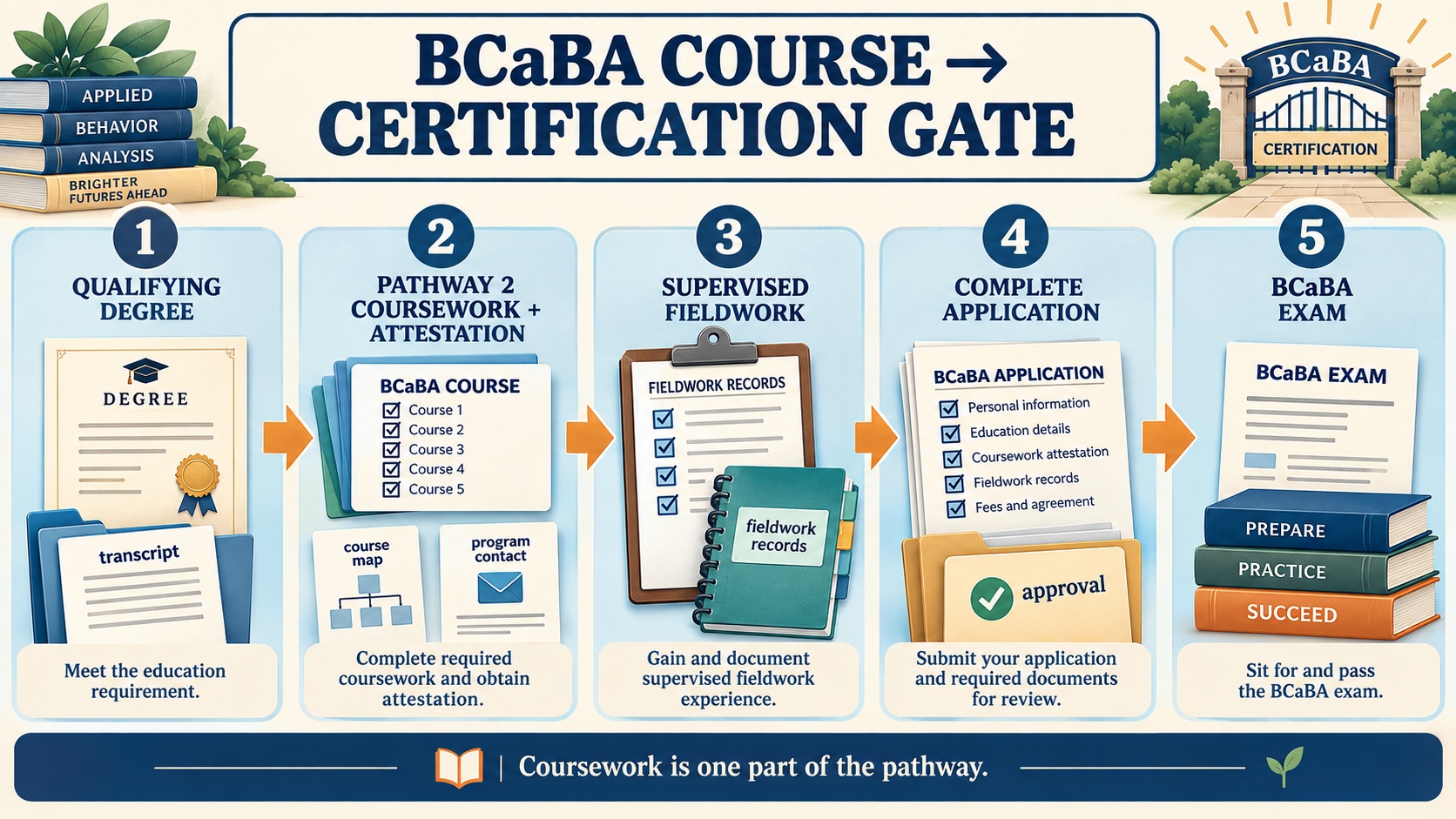
There is no universal “BCaBA course” that automatically gives a person the credential. For certification planning, qualifying Pathway 2 coursework must fit a larger chain:
- You have a qualifying undergraduate degree or higher.
- Your behavior-analytic coursework covers the required content areas and instructional hours for the rule set that governs your application.
- The coursework was completed for academic credit, within the applicable time window, with the required passing grades, at an institution that can document the Pathway 2 requirements.
- You complete the required supervised fieldwork and keep the verification records.
- You submit a complete application, receive an approved determination, and then take the BCaBA examination.
That is why the best first question is not “Is this course online?” It is “Can this institution show how this course fits the BACB content table and provide the required records when I apply?” Online delivery may be convenient, but delivery format alone does not establish eligibility.
A single course versus qualifying coursework
A single BCaBA-related class may focus on topics such as learning principles, measurement, assessment, ethics, or intervention. It can be valuable for exploration or professional development. But the BCaBA Pathway 2 requirement is a complete set of behavior-analytic content areas and instructional hours, not simply proof that you completed one ABA class.
Think of three different products that are often described with similar words:
- One course: a class with a defined syllabus, credit value, and topic scope. It may satisfy part of a larger requirement, but it may not cover the full table.
- A qualifying coursework sequence: a connected set of university courses designed to cover the required Pathway 2 content and hours, with records that can be verified.
- A certification pathway: coursework plus the degree, supervised fieldwork, application, and examination requirements. This is the whole eligibility plan, not the name of one class.
A certificate of completion, a workshop, an exam-prep subscription, a CEU event, and a self-paced study module should not be treated as automatic substitutes for qualifying academic coursework. Before enrolling, ask the school or program contact to identify the applicable BACB pathway, content area, instructional hours, academic-credit status, grade requirement, and documentation process.
The current Pathway 2 course requirements
The current BCaBA Handbook, updated in June 2026, describes Pathway 2 as an undergraduate degree or higher from a qualifying institution, acceptable behavior-analytic coursework, and supervised fieldwork. The coursework must be undergraduate level or higher and completed at the qualifying institution where you were enrolled. The handbook also says the coursework must be obtained within 10 years of the application year, carry academic credit, be completed at an institution with a Pathway 2 Program Contact, and show a passing grade: C or higher in a graded course, or pass in a pass/fail system.
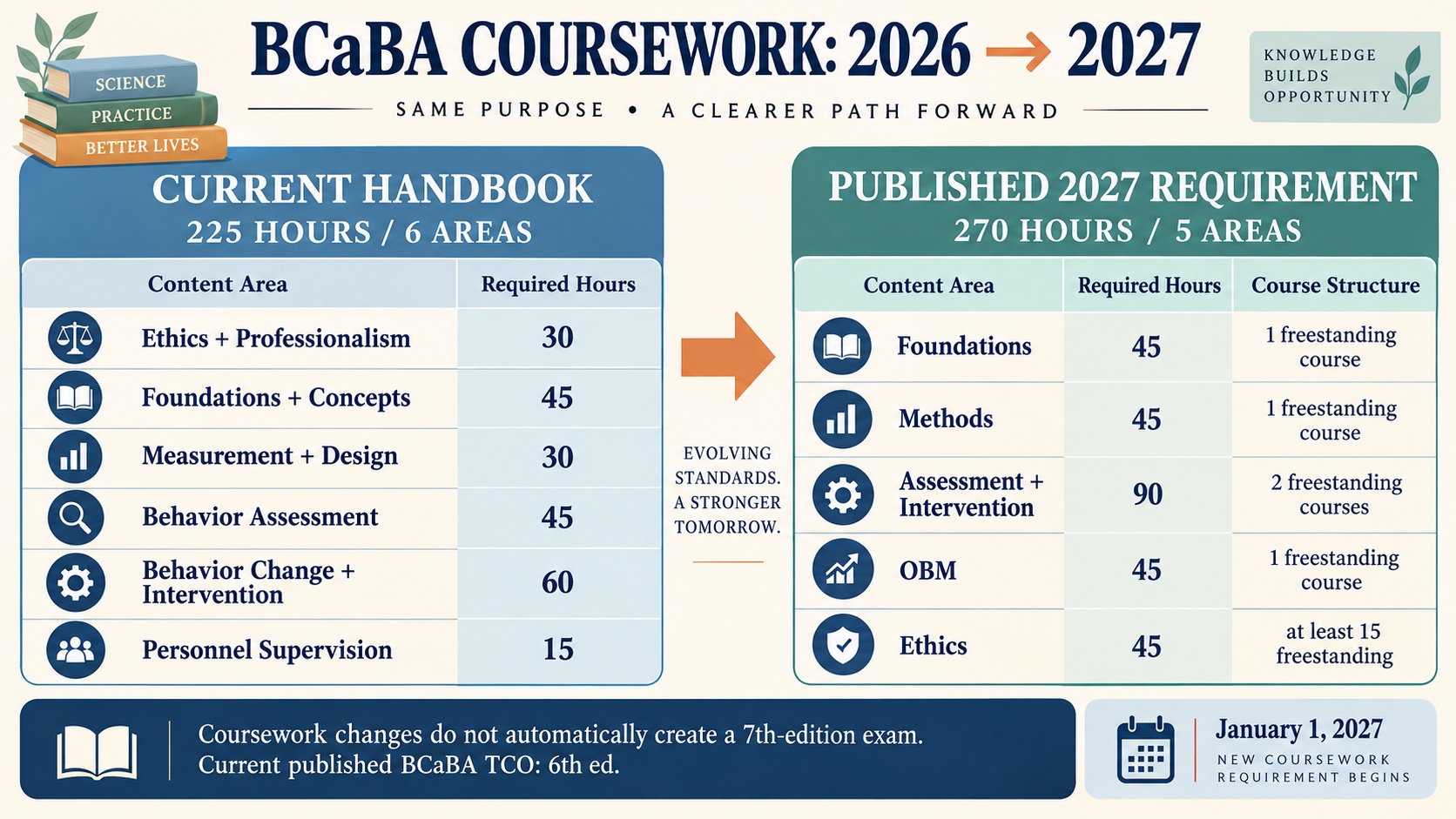
Under the current coursework table, the required content totals 225 instructional hours:
| Current content area | Hours |
|---|---|
| BACB Ethics Code, code-enforcement system, and professionalism | 30 |
| Philosophical underpinnings; concepts and principles | 45 |
| Measurement, data display and interpretation; experimental design | 30 |
| Behavior assessment | 45 |
| Behavior-change procedures; selecting and implementing interventions | 60 |
| Personnel supervision and management | 15 |
| Total | 225 |
The current table includes an important ethics condition: at least 15 ethics hours must be taught in one or more freestanding courses, meaning the ethics and professionalism content makes up the majority of each applicable course. A course title that contains the word “ethics” is not enough by itself. The institution’s course description, hours, transcript, and attestation must line up with the rule.
Credit conversions can also matter. The BACB uses 15 instructional hours per semester credit hour and 10 per quarter credit hour for requirements that can be applied globally. That does not mean every credit-bearing class automatically qualifies; the credit and content still have to fit the applicable framework.
Transcripts, Program Contacts, and attestation
For Pathway 2, the school’s documentation process is part of your course decision. The BACB’s university-training guidance explains that a full-time faculty member with an active BCBA certification can serve as the institution’s Pathway 2 Program Contact and complete coursework attestations for qualifying students. As of January 1, 2026, the BACB-managed attestation system replaced the former ABAI Verified Course Sequence process for the current Pathway 2 workflow.
In practical terms, expect two kinds of evidence:
- Official transcript evidence: the transcript shows the institution, course, academic credit, grade, and relevant dates. If you transferred schools, you may need transcripts from each institution where qualifying coursework was completed.
- Coursework attestation: the designated Program Contact confirms that the institution’s records meet the applicable Pathway 2 content and hour requirements.
Read “verified,” “aligned,” and “approved” carefully on marketing pages. Ask who will provide the attestation and which requirements apply to your application date. Do not rely on an old VCS logo or an undated claim that a course is “BACB approved.”
What coursework does not replace
Even a complete qualifying coursework sequence does not replace the other parts of BCaBA eligibility. Under the current handbook, you still need supervised fieldwork. The overview lists either 1,300 hours of Supervised Fieldwork or 1,000 hours of Concentrated Supervised Fieldwork, with supervision percentages and additional requirements. You must use the forms and documentation rules that apply to your application.
You also need to submit the certification application and pass the examination. The exam is a separate assessment of knowledge and decision-making. The currently published BCaBA examination is based on the BCaBA Test Content Outline (6th ed.), which took effect January 1, 2025. A course can support exam preparation, but neither course completion nor a practice score is the same as examination authorization or certification.
For the broader sequence, see the site’s BCaBA requirements self-check. If your eligibility record is already clear and you are moving into test planning, the BCaBA exam requirements guide is the more specific next page. This article stays focused on how to evaluate a course or course sequence.
What changes in 2027
The BACB’s 2027 BCaBA requirements take effect January 1, 2027. The two eligibility pathways remain, but Pathway 2 coursework is reorganized and expands from the current 225-hour structure to 270 total hours. The new content map is:
| 2027 content area | Hours and course rule |
|---|---|
| Foundations of Behavior Analysis | 45 hours in 1 freestanding course |
| Methods of Behavior Analysis | 45 hours in 1 freestanding course |
| Behavior Assessment and Intervention | 90 hours in 2 freestanding courses |
| Organizational Behavior Management | 45 hours in 1 freestanding course |
| Ethics in Behavior Analysis | 45 hours; at least 15 in a freestanding course |
| Total | 270 hours |
“Freestanding” means the required content makes up the majority of the course. The transition guide recommends that students whose application may fall after January 1, 2027 review their completed coursework with a program advisor. If your earlier classes do not include the new standalone Foundations, Methods, two-course Assessment and Intervention, or 45-hour OBM structure, you may need additional coursework under the rules that govern your application.
The 2027 overview also changes concentrated fieldwork from 1,000 to 800 hours. That is separate from choosing a course. If your application date is close to the transition, review both records with the current BACB documents; meeting one coursework table does not settle the whole application.
A course-selection checklist
Before enrolling in a BCaBA course or sequence, ask for written answers to these questions:
- Is this one class, a complete academic sequence, or a degree pathway?
- Which BCaBA eligibility pathway is the program designed to support?
- Which current or 2027 content area and instructional hours does each course cover?
- Is the coursework undergraduate level or higher, for academic credit, and graded under the required standard?
- Does the institution have a BACB-eligible Pathway 2 Program Contact who can submit the attestation?
- Will the school provide official transcripts and explain how transferred coursework is handled?
- What is the program’s plan for students applying around January 1, 2027?
- Which parts of certification remain outside the course—degree, fieldwork, application, and examination?
Save the syllabus, course descriptions, credit information, transcript, and written guidance you receive. Then compare them with the live BACB documents before you apply. A careful record is more useful than a broad marketing label.
BCaBA course FAQ
Can one online course qualify me for BCaBA certification?
Usually, one course covers only part of the Pathway 2 content map. Online delivery does not automatically disqualify a course, but the institution, academic credit, content hours, grade, Program Contact, attestation, and the rest of the eligibility record must fit the applicable BACB requirements.
How many hours are required for current BCaBA Pathway 2 coursework?
The current BCaBA Handbook lists 225 instructional hours across six content areas. The BACB’s published 2027 requirements increase the Pathway 2 total to 270 hours across five reorganized areas with freestanding-course rules.
Is a BCaBA course the same as a BCaBA study guide?
No. A university course or sequence is an eligibility-and-learning record. A study guide or practice resource supports preparation but does not replace official transcripts, coursework attestation, supervised fieldwork, application approval, or the certification examination.
Does the 2027 coursework change mean the exam becomes a 7th edition?
Not based on the published 2027 BCaBA requirements. That document identifies the BCaBA examination as based on the 6th-edition Test Content Outline effective January 1, 2025. Check the BACB’s current examination source for future updates instead of inferring an exam edition from a coursework change.
Can ABA Study Online confirm that my course qualifies?
No. ABA Study Online can provide educational explanations and study resources, but it is not presented here as a BACB Pathway 2 Program Contact, attestor, degree program, or official eligibility reviewer. Ask the institution and use the current BACB Handbook for your individual record.