BCaBA Exam Requirements: What Must Be Complete Before You Schedule
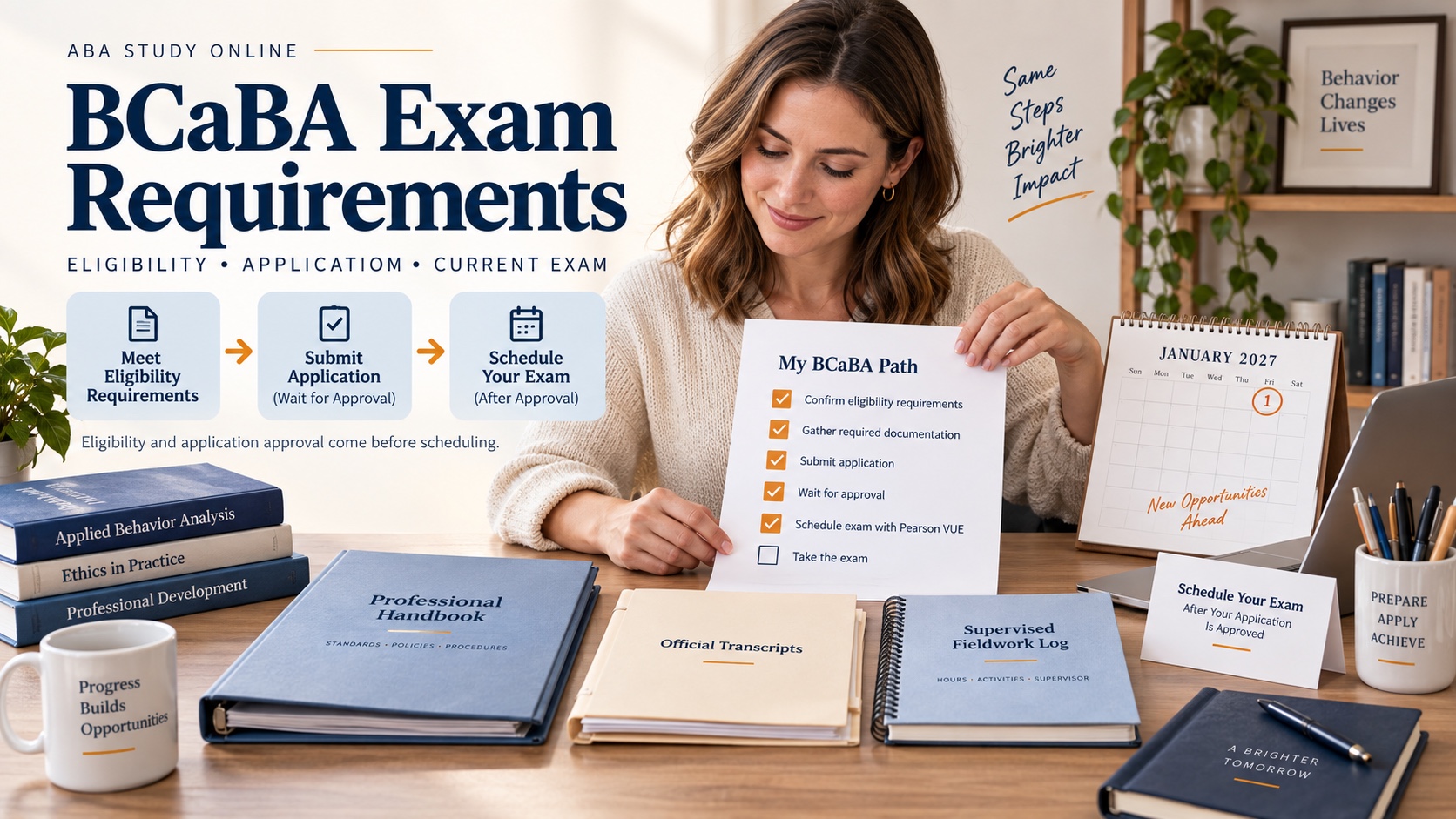
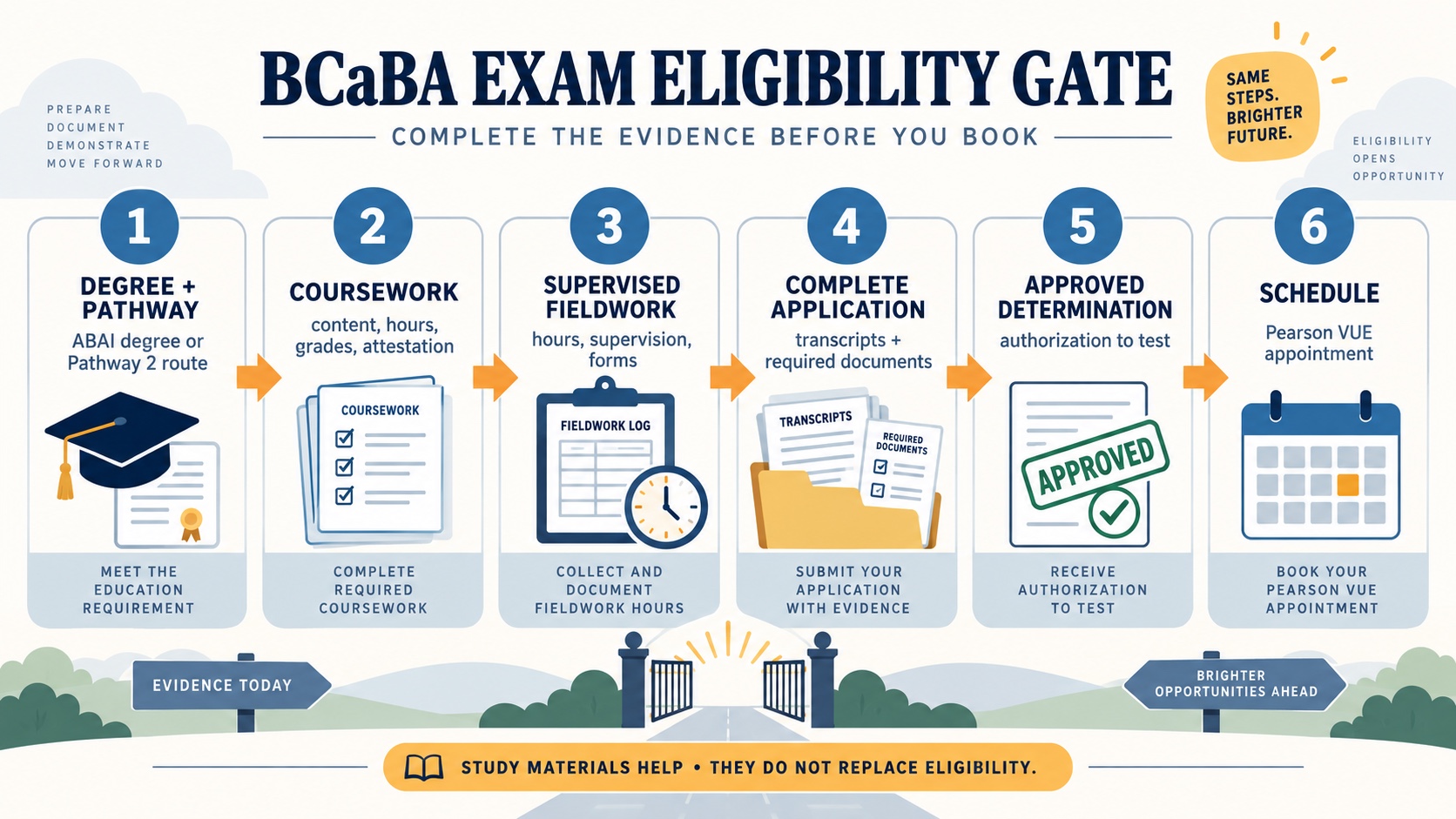
Searching for BCaBA exam requirements can lead you into two different checklists. One checklist asks whether you are eligible to apply for BCaBA certification. The other asks what the current examination is like. They connect, but they are not the same question. You need to complete the applicable eligibility pathway, submit the required application evidence, receive an approved determination, and then schedule the examination through Pearson VUE.
This guide keeps those steps in order. It summarizes the current BCaBA examination boundary, explains the evidence that belongs before scheduling, and separates the 2027 eligibility transition from the examination outline. It is an educational planning resource, not an individual eligibility determination. When your transcript, fieldwork, location, or application date matters, use the current BCaBA Handbook as the controlling source.
Table of Contents
Quick answer: the BCaBA exam gate
The short version is:
- Choose the BCaBA eligibility pathway that matches your education.
- Complete the required degree, behavior-analytic coursework, and supervised fieldwork for that pathway.
- Prepare the official transcripts, fieldwork verification, attestations, and other documents required for your application.
- Submit a complete certification application and wait for the BACB’s approved determination.
- After authorization, schedule and pay for the examination through your Pearson VUE account.
- Prepare for the current examination using the active BCaBA Test Content Outline, Ethics Code, and training materials.
A practice quiz, an exam-prep course, or a study app can help you learn the content, but none of those products replaces certification eligibility or application approval. Think of preparation as the learning lane and the Handbook as the requirements lane.
The eligibility requirements before the exam
The current BCaBA Handbook describes two eligibility pathways. Both pathways lead to the same final gate: you must meet the applicable requirements, apply, and pass the BCaBA certification examination. The difference is how your degree and behavior-analytic preparation are established.
Pathway 1: an ABAI-accredited degree program
Under Pathway 1, you have a bachelor’s degree or higher from an ABAI-accredited program and complete supervised fieldwork in applied behavior analysis. The degree must have been obtained while the program was accredited and must meet the date and documentation rules in the current Handbook. An official transcript is used to verify the degree.
This route can feel straightforward because the degree program is designed to contain the relevant behavior-analytic education. It still does not remove the fieldwork or application steps. A program title alone is not the same as a completed, documented eligibility record.
Pathway 2: behavior-analytic coursework
Under Pathway 2, you need a bachelor’s degree or higher from a qualifying institution, behavior-analytic coursework at the undergraduate level or higher, and supervised fieldwork. The coursework must meet the current content and hour table, be completed within the applicable time window, carry academic credit, and reflect a passing grade. The institution must also have a qualifying Pathway 2 Program Contact.
The current Pathway 2 table totals 225 hours across philosophical underpinnings and concepts, measurement and experimental design, behavior assessment, behavior-change procedures and intervention, personnel supervision and management, and ethics/professionalism. The current table also includes a freestanding-course condition for part of the ethics content. Do not decide that a transcript qualifies from course titles alone; course descriptions, hours, dates, grades, and the program’s attestation can all matter.
For a broader comparison of pathways and current-versus-2027 planning, read the site’s BCaBA requirements self-check. This page narrows the question to what must be in place before the examination can be scheduled.
What your application must prove
The exam is not the first document review. Your application needs to show that the eligibility chain is complete. The exact materials depend on your pathway and situation, but the planning categories are stable:
- Degree evidence: an official transcript with the information needed to verify the qualifying degree.
- Coursework evidence: official transcript(s) for qualifying behavior-analytic coursework. If you changed institutions, the BACB may need records from each relevant institution.
- Pathway 2 attestation: when Pathway 2 applies, the designated Program Contact confirms the coursework requirements through the applicable attestation process.
- Fieldwork evidence: signed final verification forms and supporting records. If audited, you may need monthly forms, an audit log, supervision contracts, and the documentation system that supports your hours.
- Application information: your portal details, identity information, payment, and any other documents or forms required by the current Handbook.
Supervised fieldwork is not simply a large number written in a spreadsheet. The current overview lists either 1,300 hours of Supervised Fieldwork or 1,000 hours of Concentrated Supervised Fieldwork, with supervision, observation, individual-versus-group, and unrestricted-activity requirements attached. You also need a qualified supervisor and a signed supervision contract before accruing qualifying hours. If a fieldwork record is incomplete, more studying will not solve the application problem.
The current BCaBA examination requirements
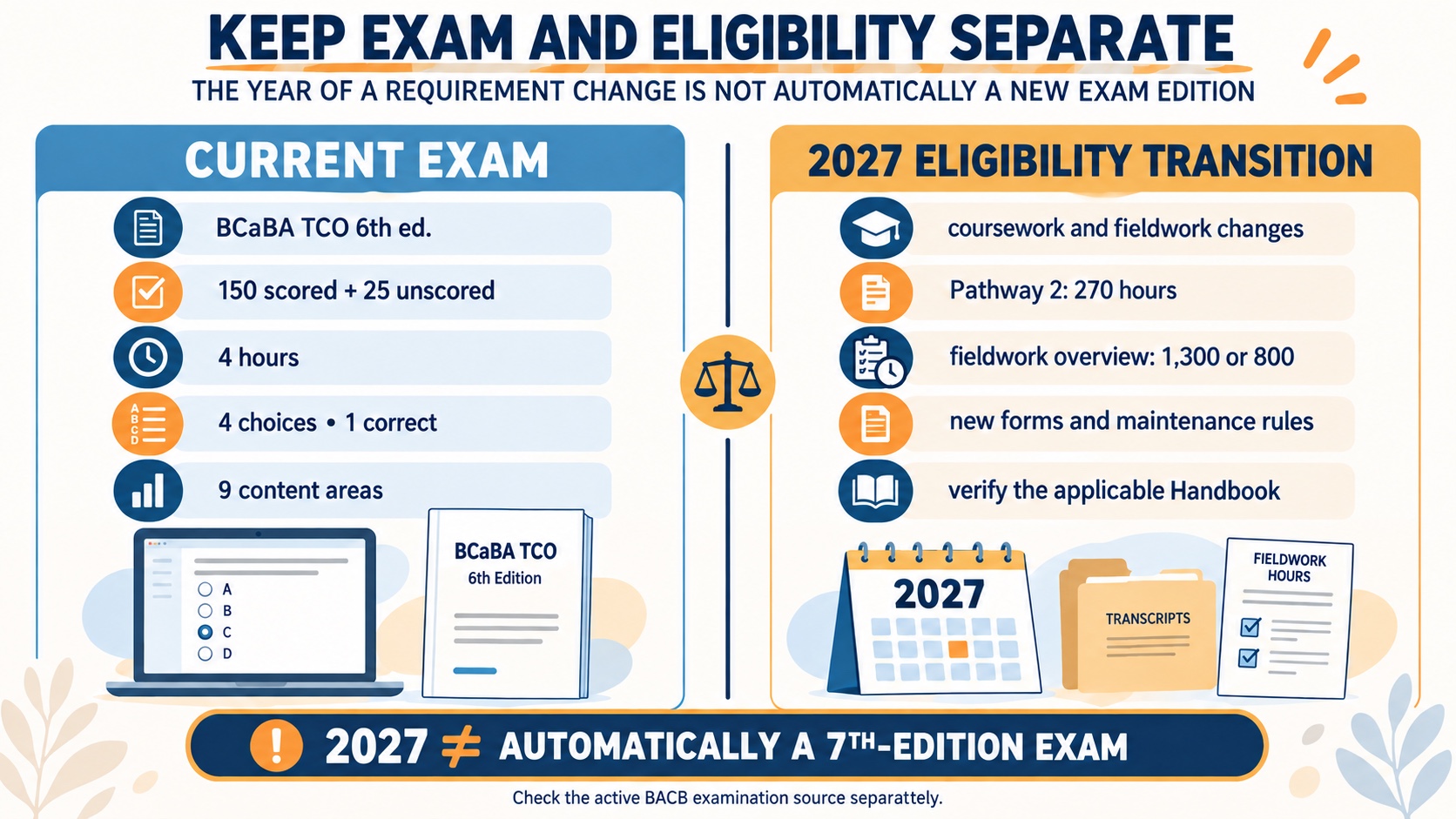
Once the BACB authorizes you to test, the current BCaBA examination is based on the BCaBA Test Content Outline (6th ed.). The outline became the examination basis in 2025. The current Handbook describes the examination as follows:
- 175 multiple-choice questions total: 150 scored questions and 25 unscored questions.
- Four hours: the allocated time includes the required instructions, navigation material, examination, and review time.
- Four answer choices: each question has one correct answer.
- Nine content areas: the TCO organizes 90 tasks across behaviorism and foundations, concepts and principles, measurement, experimental design, ethics, assessment, behavior-change procedures, intervention development and monitoring, and supervisory relationships.
- Overall result: the Handbook says the result is based on overall performance rather than a separate pass requirement in each content area.
- English and computer-based delivery: the current Handbook states that the BCaBA examination is offered in English and delivered at authorized Pearson VUE testing centers.
The examination requirements are not the same as a promise about a practice score. The BACB recommends reviewing the current TCO, Ethics Code, and materials from your training. It does not endorse specific study guides, and purchasing a study resource does not guarantee a passing result. For a full format-and-study discussion, use the related BCaBA exam overview; for pacing details, see how long the BCaBA exam is.
Scheduling, accommodations, and retakes
After your application receives an approved determination, you schedule the examination through your Pearson VUE account. The BACB does not schedule the appointment for you. Keep the approval communication, appointment confirmation, and current Handbook together so that the exam date is tied to the authorization period that appears in your portal.
If you need an examination accommodation, submit the required BACB form and supporting documentation with the certification application. The Handbook says you should not attempt to schedule until you receive the status of the accommodation request and the instructions for scheduling. That timing matters: an accommodation request is part of the application process, not an adjustment you should assume will be available after you book the appointment.
If you do not pass, the Handbook describes a retake process through the portal. The current 06/2026 Handbook states that the retake application becomes available after a failed attempt, that there is a 30-day wait before retesting, and that the authorization period allows up to eight total attempts. Fees and policies can change—and should be checked in the current Handbook and Portal before planning a retake budget—so this article does not turn a time-sensitive fee into a permanent claim.
How 2027 changes fit
The most important 2027 rule is a boundary rule: do not combine an eligibility update with an exam-edition claim. The BACB’s 2027 BCaBA materials describe changes to eligibility, coursework, fieldwork, forms, and maintenance that begin January 1, 2027. The transition guidance separately says there are no upcoming changes to the BCaBA examination or TCO in that guidance. Examination and certification-requirement updates can occur independently.
For example, the 2027 Pathway 2 coursework structure totals 270 hours, and the 2027 fieldwork overview lists 1,300 Supervised or 800 Concentrated hours. Those are important eligibility facts for a future application, but they do not prove that the current BCaBA examination has become a 7th edition. The active examination outline must be checked from the BACB’s examination resources.
A pre-scheduling checklist
Before you treat yourself as ready to schedule, answer these questions in writing:
- Which pathway am I using, and does my degree fit that pathway?
- Do my official transcripts show the required degree and behavior-analytic coursework?
- If Pathway 2 applies, has the institution’s Program Contact completed the relevant attestation?
- Are my supervised fieldwork hours, supervision, observations, and unrestricted activities documented under the applicable rules?
- Do I have the required final verification forms and supporting records if an audit occurs?
- Have I submitted a complete application and received an approved determination?
- Am I using the current BCaBA TCO and Handbook rather than assuming that an older task list or a 2027 headline answers the exam question?
- If I need accommodations, have I received the status and scheduling instructions before booking?
These questions turn “I think I am ready” into a record you can review with your program contact or supervisor. They also show why an exam-prep plan should have two tracks: one for certification evidence and one for the knowledge and decision-making tested by the examination.
BCaBA exam requirements FAQ
Can I schedule the BCaBA exam before my application is approved?
The current process is to meet the applicable eligibility requirements, submit the certification application, receive an approved determination, and then schedule through Pearson VUE. Do not treat an account, a study course, or an incomplete application as examination authorization.
What is the current BCaBA exam based on?
The current exam is based on the BCaBA Test Content Outline (6th ed.), effective beginning in 2025. The current Handbook lists 150 scored and 25 unscored questions, four hours, and four answer choices with one correct answer.
Does 2027 mean the BCaBA exam becomes a 7th edition?
Not automatically. The published 2027 BCaBA materials address eligibility and maintenance changes, while the transition guidance keeps examination and TCO updates separate. Check the active BACB examination source rather than inferring an exam edition from the calendar year.
Where should I study after the requirements are clear?
Use the BCaBA learning path for structured review, free BCaBA questions for application practice, and the site’s BCaBA exam-prep guide for a repeatable study loop. These are independent educational resources, not BACB-endorsed examination materials.