YouTube RBT Study Videos: How to Use Them Safely for the 2026 Exam
Searching for “YouTube RBT” can lead you to official BACB process videos, independent exam-review lessons, skill demonstrations, and older videos that use a previous task-list version. Those resources can make a difficult topic easier to see and hear, but they are not interchangeable. The most useful question is not “Which video guarantees that I will pass?” It is “What learning job can this video do, and does its content match the current RBT requirements?”
For 2026 preparation, begin with the current BACB materials. The RBT examination uses the RBT Test Content Outline, 3rd edition, beginning January 1, 2026. YouTube review can help you understand a concept, practice retrieval, or notice a skill demonstration. It does not replace the required 40-hour training, Initial Competency Assessment, application steps, examination, or ongoing supervision.
Table of Contents
What does “YouTube RBT” usually mean?
It is a broad search phrase rather than the name of one official BACB resource. A searcher may want a video about the RBT certification process, an explanation of a behavior-analysis concept, practice questions, a demonstration of a skill, or a review of the content tested on the exam. These goals overlap, but they require different kinds of evidence.
Official BACB videos are the best starting point for process information. The BACB RBT resources include materials about what an RBT is, how to become an RBT, how to maintain certification, and the RBT certification examination. The BACB also maintains a video archive and directs users to its official video resources. Independent creators may be useful for explanations and practice, but an independent video should not be presented as BACB training, an official exam question, or an official endorsement.
A simple way to organize your search is to label each video before you watch it:
- Process video: explains an application, examination, certification, or maintenance step.
- Concept video: explains terminology or principles such as reinforcement, prompting, measurement, or functions of behavior.
- Practice video: presents questions, scenarios, or answer rationales for retrieval practice.
- Skill demonstration: shows an example of a procedure or interaction, often for discussion with a qualified trainer or supervisor.
Which types of RBT videos are useful?
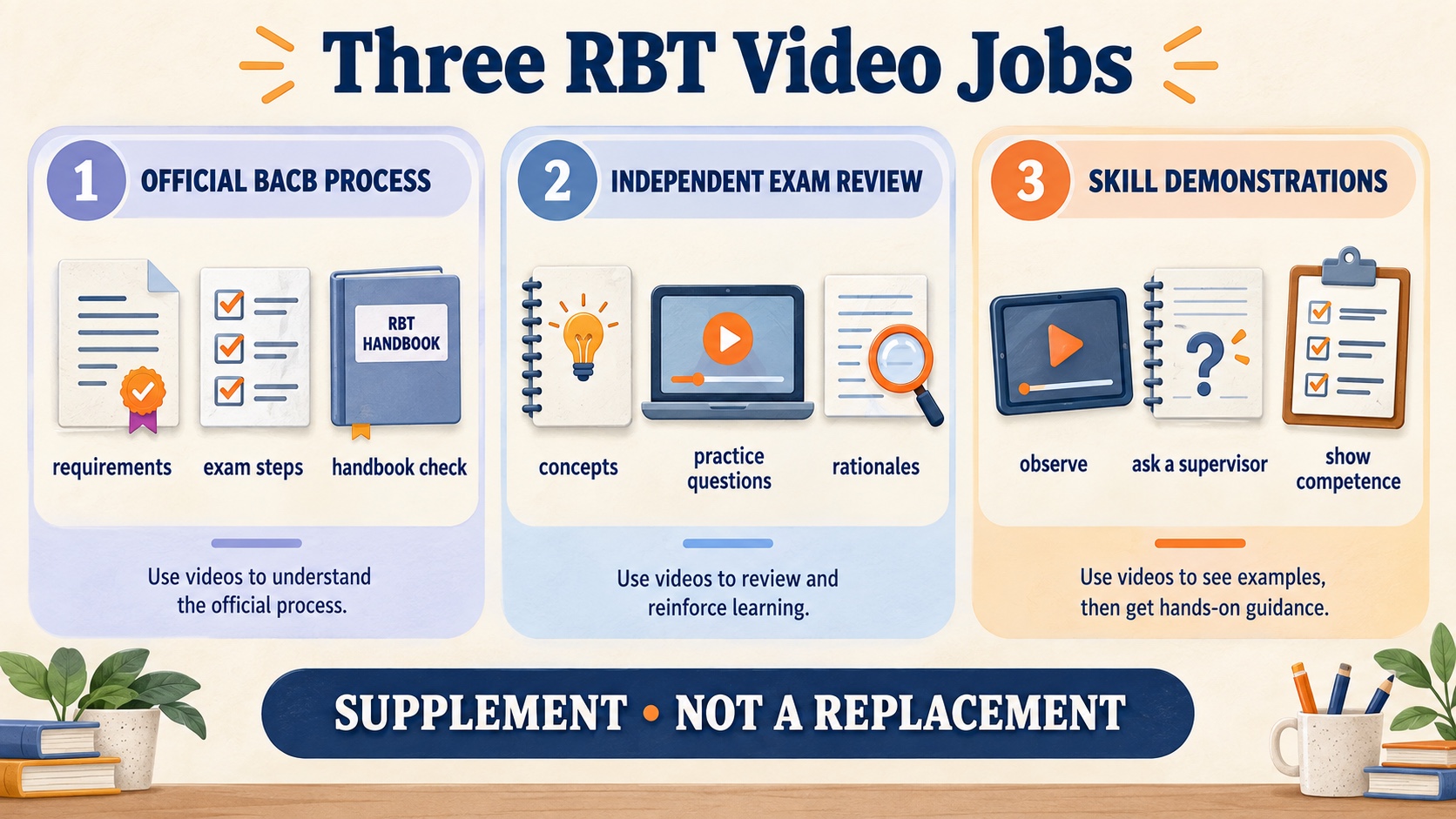
There is no single video type that should carry your entire preparation. Use different types for different jobs, and keep the official source in control whenever the question concerns a current requirement.
1. Official BACB process videos
Use these when you need to understand the certification pathway, an examination step, or a BACB process. They are particularly helpful when a third-party study video gives a short answer but does not explain where the rule comes from. After watching, open the current RBT Handbook or the relevant BACB page and confirm the step in writing.
2. Independent exam-review videos
These can be helpful for plain-language explanations, worked scenarios, and practice questions. Some independent libraries combine RBT skills, practice questions, content-outline reviews, and competency tutorials. Treat the creator’s explanation as study material, not as an official BACB rule. A good lesson tells you what it is teaching, identifies the current version it is using, gives a reasoned answer, and encourages you to verify rules in the official handbook.
3. Skill and competency demonstrations
Video can make an abstract procedure easier to observe. However, watching someone demonstrate a skill is not the same as demonstrating your own competence. The RBT Initial Competency Assessment is a separate requirement. If a video shows a procedure, use it to generate questions for your 40-hour training or supervisor: What is the target response? What is being measured? What would count as an error? What feedback would be appropriate? Do not treat a public video as permission to practice with a client or as a substitute for supervised assessment.
How do you check whether a video is current?
Look beyond the upload date. A video can be recent and still use an older outline, while an older video can explain a stable concept accurately. Check the version, the claim, and the source together.
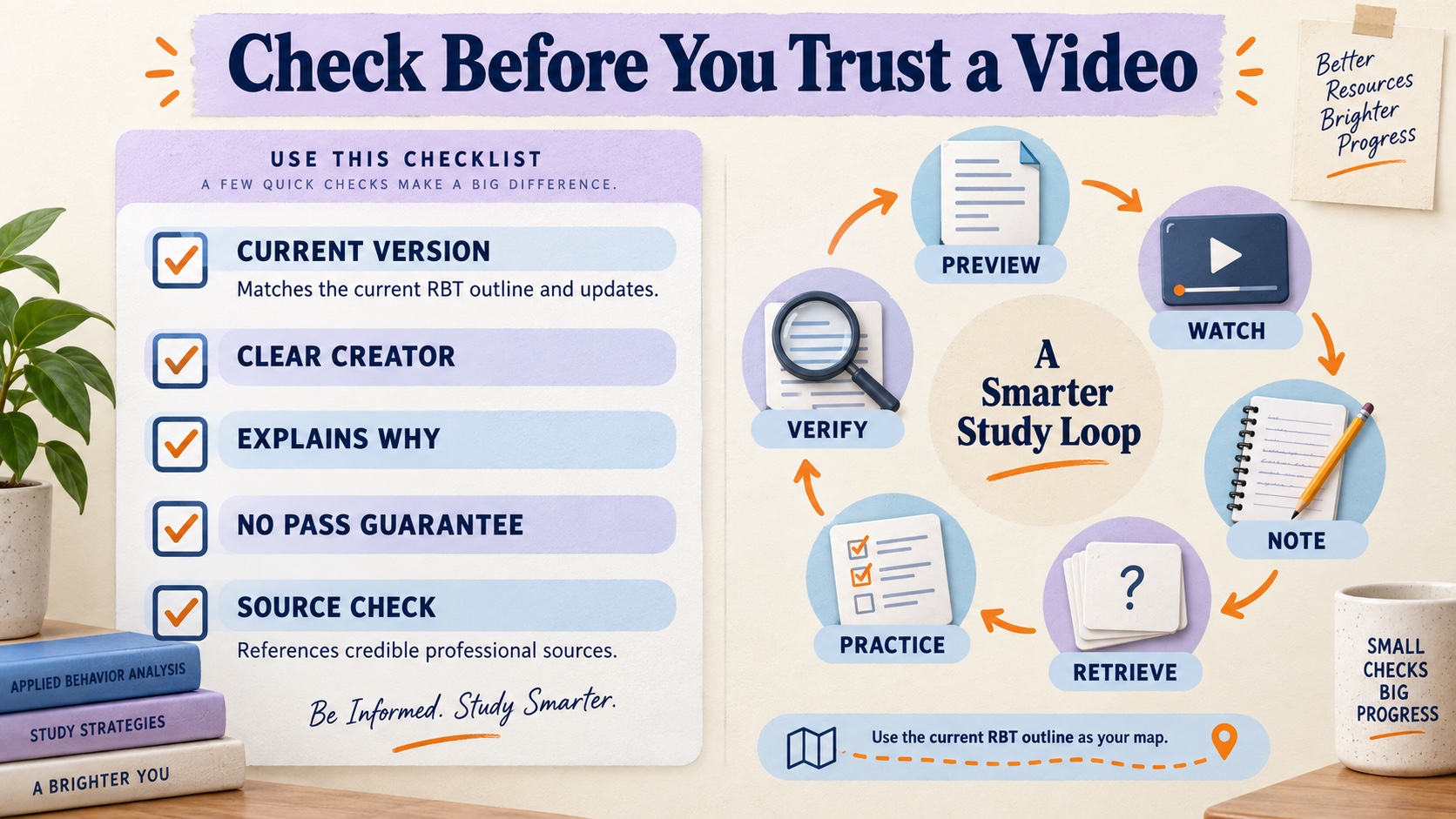
- Read the version language. Does the description name the current RBT Test Content Outline, 3rd edition? If it says “task list” without explaining which version it means, pause before using it as a 2026 exam map.
- Separate stable concepts from changing procedures. A basic explanation of reinforcement may remain useful. Application rules, examination steps, and handbook requirements need current BACB verification.
- Check the creator and the scope. Does the creator identify relevant education or experience? Does the video explain that it is independent study material rather than BACB content?
- Look for reasoning, not just an answer. Practice questions are more useful when the video explains why one answer fits the scenario and why the alternatives do not.
- Watch for overpromises. “Guaranteed pass,” “official questions,” or “BACB approved” are warning signs unless the claim is clearly supported by a current official source. Independent videos should not imply that the BACB has reviewed them.
- Record the verification date. Keep a note showing the video title, creator, upload date, version language, and the official page you used to check a current rule.
The current 2026 exam boundary matters because a video can use familiar language while organizing content around an older framework. That does not make every older explanation useless. It means you should use the current BACB outline as the map, and use videos as explanations or retrieval tools within that map.
How should you study with an RBT video?
Passive watching feels productive because the lesson is easy to follow. Learning becomes stronger when you interrupt the video and ask yourself to retrieve, explain, and apply what you just saw. A short repeatable loop works well:
- Preview: write one question you want the video to answer and identify which RBT content area it belongs to.
- Watch in a small section: stop after a concept, example, or question instead of letting a long playlist run continuously.
- Note the rule in your own words: include the key term, the observable example, and the boundary or exception.
- Retrieve without the video: close the screen and explain the idea, draw the sequence, or answer a new scenario from memory.
- Practice and correct: complete a few current practice questions, then record why your answer was correct or incorrect.
- Verify: check process and requirement statements against the current BACB page, handbook, or content outline.
For a concept such as prompting, your note might separate the definition from a scenario: what the prompt is, when it is delivered, how it is faded, and what data would show progress. For a certification-process video, your note should instead list the step, the official source, and the question that still needs confirmation. This prevents a memorable explanation from becoming an unsupported rule.
You can use the ABA Study Online RBT learning path to organize concept review and the RBT practice area to turn video notes into retrieval practice. Those resources are study supports, not BACB certification materials.
What can videos not replace?
YouTube is a delivery platform, not a credentialing pathway. A video cannot replace the requirements that apply to your application and certification track. In particular, video watching does not replace the RBT 40-hour training, the Initial Competency Assessment, the BACB application, the certification examination, or ongoing supervision.
It also cannot establish that a particular intervention is appropriate for a particular client. A demonstration may omit context that matters in practice, such as the learner’s assessment information, consent, communication needs, safety plan, reinforcement history, or supervisor direction. Use demonstrations for learning questions and discussion; follow your training, employer procedures, and qualified supervisor’s guidance when working with a client.
What mistakes should you avoid?
- Building a playlist instead of a study plan: more watch time does not automatically create more retrieval or skill.
- Using an old exam map without checking the version: compare the video with the current RBT TCO before treating it as a complete outline.
- Confusing a demonstration with an assessment: observing a skill is not the same as showing competence under the required assessment process.
- Accepting a creator’s claim as an official rule: verify current requirements through BACB materials.
- Practicing with a client because a video made it look simple: client care requires training, authorization, context, and supervision.
- Studying only the answers: explain why an answer fits and what evidence would change your decision.
A reliable RBT video workflow is therefore small and deliberate: choose one learning job, check the version, watch actively, retrieve without the screen, practice with feedback, and verify any current-rule statement. That is more defensible than collecting a large playlist with no source or review method.
YouTube RBT FAQ
Are there official RBT videos on YouTube? The BACB publishes official video resources and maintains a BACB video archive. Use the BACB website and its official channel or linked video pages to confirm that a process video is genuinely from the BACB.
Can YouTube videos help me prepare for the RBT exam? Yes, as supplemental explanations and retrieval prompts. Use the current RBT Test Content Outline, 3rd edition, as the exam-content reference for 2026 preparation.
Are YouTube RBT videos enough to become an RBT? No. They do not replace the required training, competency assessment, application, examination, or supervision requirements.
Should I avoid older RBT videos? Not automatically. Older videos may explain stable concepts, but check version-sensitive claims against the current BACB handbook and RBT content outline before relying on them.
Do skill videos count as the Initial Competency Assessment? No. Watching a demonstration is not your own competency demonstration and does not replace the required assessment process.