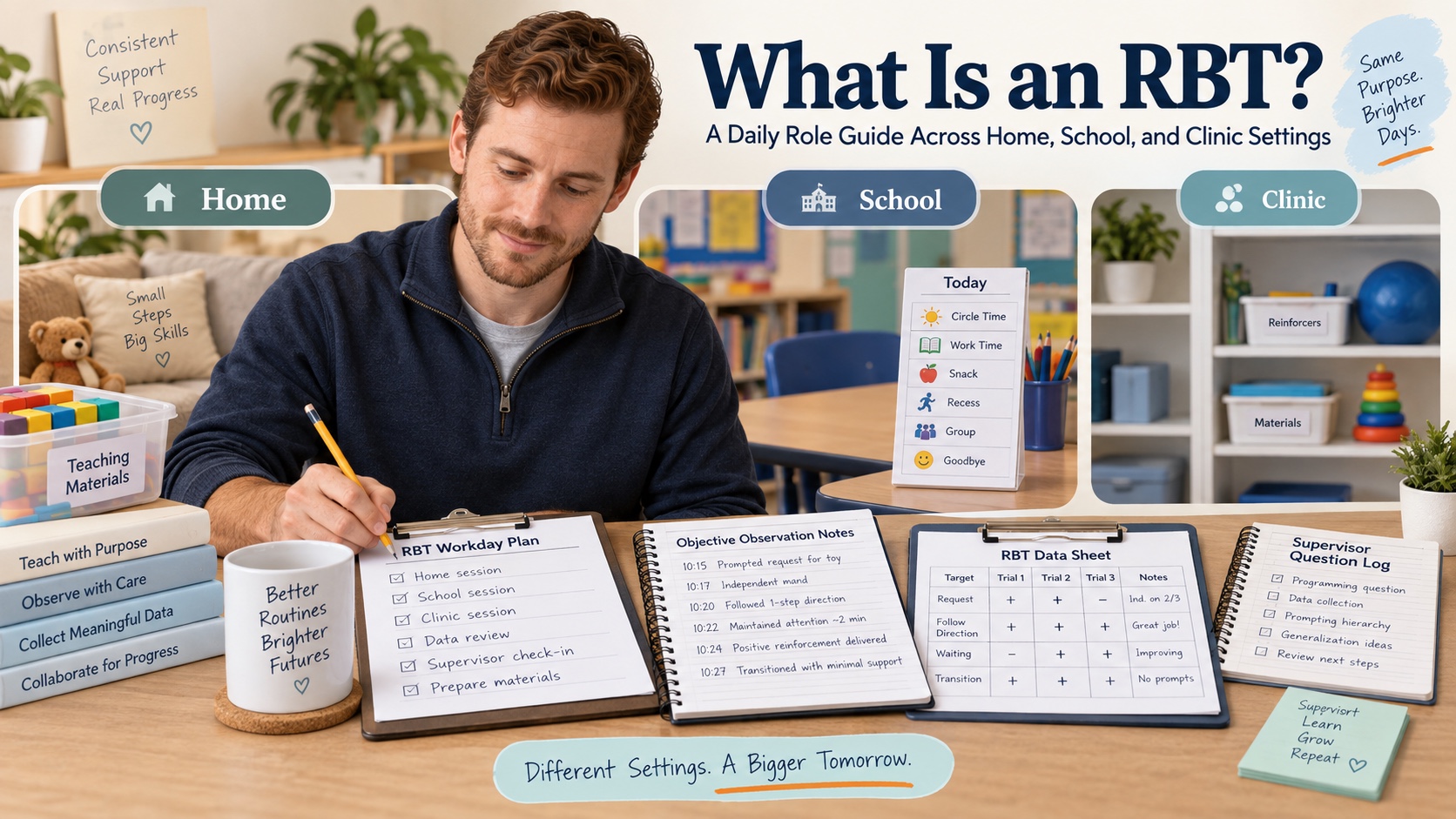
What Is an RBT? A Daily Role Guide Across Home, School, and Clinic Settings
RBT stands for Registered Behavior Technician. The Behavior Analyst Certification Board describes RBT certification as a paraprofessional certification in behavior analysis. That definition becomes much easier to understand when you picture the work: an RBT helps implement assigned behavior-analytic procedures, records observable information, documents sessions, and communicates with the supervising team.
An RBT may work in a family home, school, clinic, community setting, or another service environment. The materials and schedule can change from place to place, but the core boundary does not: an RBT works under the direction and close supervision of the responsible supervisor or requirements coordinator. The technician does not independently become a BCBA, replace clinical oversight, or invent a new program because a session is difficult.
This guide uses three settings to show what the role looks like in practice. It is an independent educational explanation, not individualized supervision, a universal session-note template, a certification decision, or a substitute for the current RBT Handbook.
Quick answer: An RBT is a trained and credentialed behavior technician who supports behavior-analytic services under supervision. The daily work may include preparing materials, following a written teaching or behavior-reduction procedure, collecting the defined data, writing objective notes, protecting privacy, and bringing questions or changes back to the supervising team.
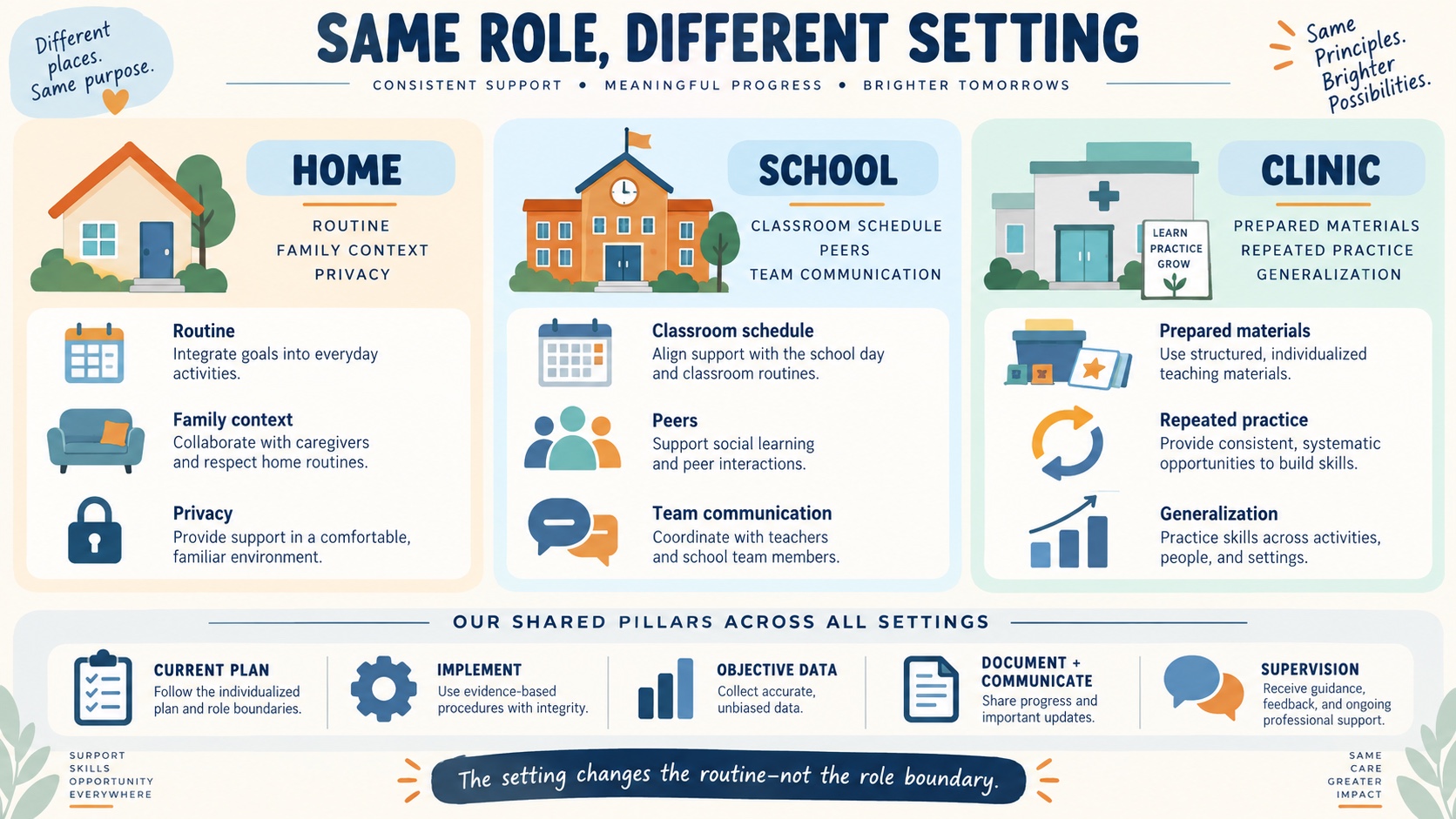
What stays the same in every setting
It is tempting to define the role by location: “home RBT,” “school RBT,” or “clinic RBT.” Those labels describe context, not three different credentials. Across settings, a strong RBT routine has the same five pillars.
- Start with the current plan. Review the goals, operational definitions, teaching arrangement, measurement system, safety directions, and materials that apply to the session.
- Implement what you were trained to implement. Deliver instructions, prompts, reinforcement, practice opportunities, or other procedures as written and modeled by the responsible team.
- Observe behavior in concrete terms. Record what happened, when it happened, and what was present in the environment instead of guessing at a diagnosis or internal state.
- Document and communicate. Complete the required records and tell the supervisor about barriers, changes, safety concerns, or unclear steps.
- Protect dignity and confidentiality. Use respectful language, handle information carefully, and follow the current ethics and workplace requirements.
These pillars are why the role is more than “being with a learner” and more focused than “doing anything related to behavior.” The RBT creates reliable opportunities for the plan to be implemented and for the team to receive usable information. The supervising professional remains responsible for decisions that require broader assessment, clinical judgment, or authority beyond the technician’s role.
What changes at home, school, and clinic
Home-based work
In a home, the environment may change from one session to the next. Siblings, visitors, meals, routines, noise, and available materials can all affect how a plan is implemented. The RBT may need to prepare a small teaching area, explain the planned routine to a caregiver according to the supervisor’s direction, and record how natural events relate to the defined target or skill.
Home-based work requires extra care with privacy and role boundaries. An RBT is a professional entering a family’s living space, not a household employee or an informal adviser. If a caregiver asks the technician to change a goal, interpret a diagnosis, or promise an outcome, the appropriate response is to acknowledge the question and bring it to the responsible supervisor.
School-based work
In a school, the RBT works around a classroom schedule, instruction, transitions, peers, and school staff. The plan may need to fit a group activity or a naturally occurring opportunity rather than a quiet one-to-one block. The RBT can support the assigned skill or behavior procedure while coordinating respectfully with authorized team members.
School work also makes confidentiality especially visible. A note or conversation should not disclose private information in a hallway, group chat, or public social-media post. When the classroom teacher reports a concern, the RBT can document the observable event and follow the communication path set by the service team. The technician should not promise that a school routine will be changed without the people who have authority to make that decision.
Clinic-based work
In a clinic, materials and teaching spaces may be more predictable, but the RBT still has to notice generalization. A skill that looks strong at a table may need practice with different materials, people, instructions, or locations when the plan calls for it. The RBT can prepare materials, run the defined teaching opportunities, record the planned measure, and communicate patterns that the supervisor should review.
Clinic routines can create another misunderstanding: a familiar room does not give an RBT permission to change the intervention independently. If a learner does not respond as expected, the technician can check whether the instruction, prompt, consequence, and data procedure were implemented as trained. If the issue continues, the RBT documents it and asks for supervision rather than silently improvising.
Across all three settings, the useful question is not “Which setting is easiest?” It is “What information does this setting add?” A home may reveal how a routine works with family members, a school may reveal how a skill fits a group schedule, and a clinic may make repeated teaching opportunities easier to arrange. These observations can support team discussion when they are recorded within the plan. They should not be used to compare a learner’s behavior casually across settings or to make a new conclusion without the appropriate review.
From observation to useful documentation
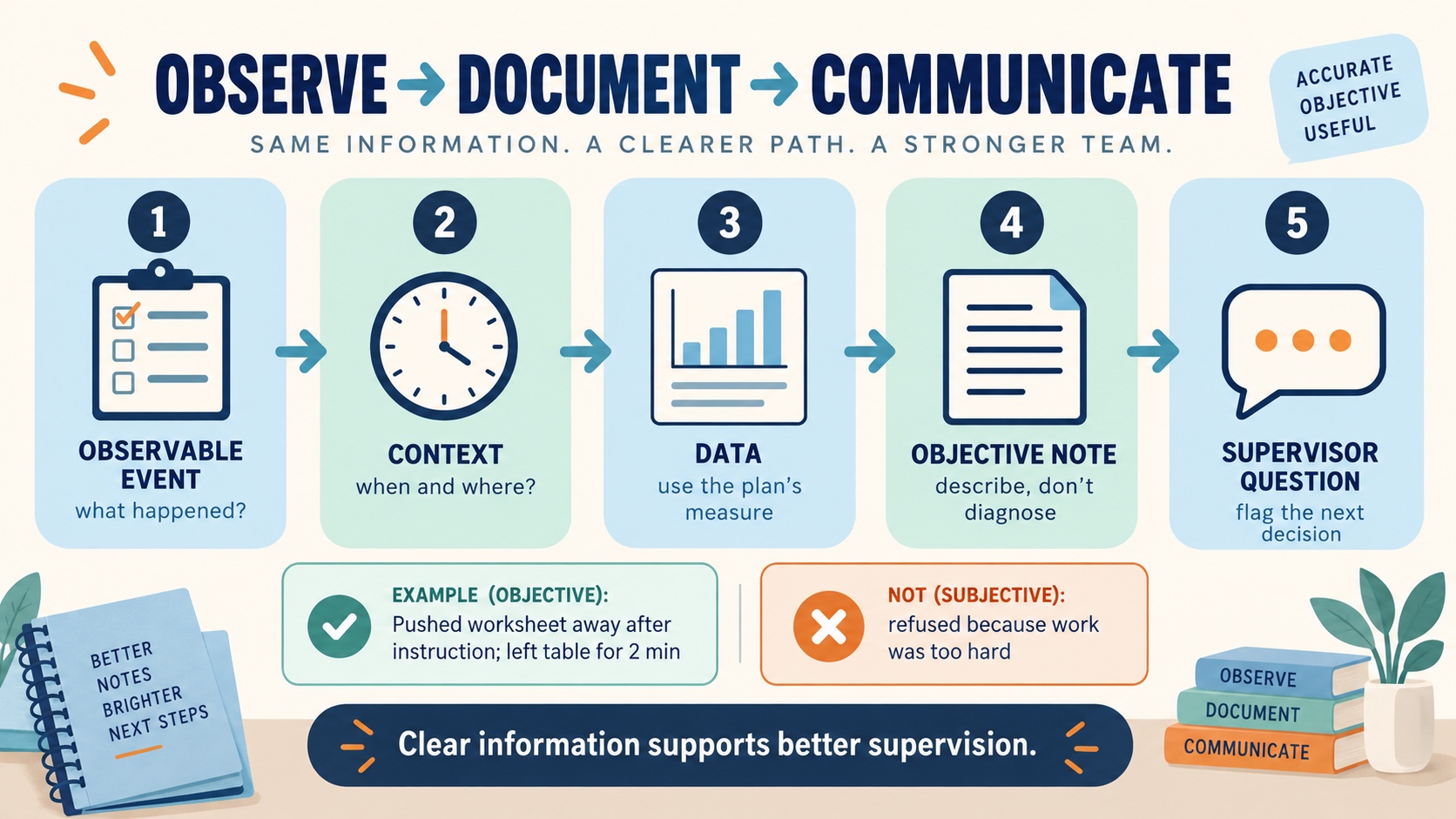
One of the clearest ways to understand an RBT’s contribution is to follow the path from an event to a useful team message. Consider a fictional example. During a home session, the learner pushes a worksheet away after an instruction and leaves the table. A vague note might say, “The learner refused because the work was too hard.” That sentence includes an interpretation and leaves out the information needed to check it.
A more useful observation might state what instruction was given, what materials were present, what the learner did, how long the learner was away if duration is part of the plan, and what happened next. The RBT can then ask the supervisor whether the current measurement and response procedure still fit the situation. The RBT is not diagnosing the reason for the behavior; the RBT is improving the quality of the information available for review.
Before completing a note, ask:
- Did I describe observable behavior rather than a label?
- Did I use the measurement system defined in the current plan?
- Did I record the relevant instruction, context, or consequence when required?
- Did I protect identifying information and follow the approved communication route?
- Did I flag a safety issue, implementation barrier, or unclear procedure for supervision?
What an RBT does not decide alone
An RBT can be highly skilled and still have a defined scope. The current BACB role description and supervision structure do not make the technician an independent behavior analyst. An RBT should not independently diagnose, create a complete treatment plan, rewrite goals, select an assessment battery, or promise a clinical outcome. The exact responsibilities also depend on the current plan, supervisor, employer, setting, and applicable local requirements.
This boundary is not a criticism of the role. It is a protection for the learner and the team. A technician who notices a problem, describes it accurately, and asks for the right supervision may prevent a small implementation issue from becoming a misleading data pattern. A technician who quietly changes the procedure may make the later data impossible to interpret.
Training and certification questions are related but separate. Completing a training course does not by itself answer every question about competency assessment, application, examination, or ongoing supervision. If that is your next question, use the RBT certification guide, the RBT training guide, or the competency assessment guide, and check the current BACB handbook.
Which resource fits your next question?
- For a short definition and acronym explanation, read the RBT meaning guide.
- For the broad role and certification pathway, read What Is an RBT? Role, Supervision, and the Certification Path.
- For requirements, use the RBT certification guide and the current official handbook.
- For study support, start with the RBT learning path and the RBT practice questions.
What is an RBT FAQ
What does an RBT do every day?
An RBT may prepare materials, implement assigned teaching or behavior-reduction procedures, collect defined data, write objective notes, communicate observations, and participate in supervision. The exact routine depends on the current plan and setting.
Can an RBT work at home, school, and clinic?
RBT services may occur in different settings, depending on the service arrangement. The environment changes the schedule, materials, people, and privacy considerations; it does not remove the supervision boundary.
Is an RBT the same as a BCBA?
No. RBT and BCBA are different credentials with different requirements and responsibilities. An RBT supports implementation within supervision; a BCBA has a different professional role and certification scope.
Does an RBT decide why a behavior happened?
An RBT can record relevant observable events and communicate patterns. Assessment conclusions and changes to a behavior-analytic plan belong to the appropriate supervising or clinical team.