What Is an RBT Certification? The Credential Explained
RBT certification is a paraprofessional certification in behavior analysis issued by the Behavior Analyst Certification Board (BACB). An RBT helps deliver behavior-analytic services under the direction and close supervision of an RBT Supervisor and/or RBT Requirements Coordinator who is responsible for the work.
The phrase can be confusing because several different things happen on the way to certification. A 40-hour training course, an initial competency assessment, an application, an examination result, and a job at an ABA provider may all be part of the route, but none of those labels alone means that you are currently a certified RBT. This page focuses on that distinction. For the complete route from training through maintenance, see the full RBT certification pathway guide.
Table of Contents
What RBT certification means
An RBT certification identifies a person who has met the BACB’s applicable requirements for the Registered Behavior Technician credential and is maintaining that credential under the current rules. It is a professional certification, not a college degree, a general “ABA certificate,” or a guarantee that the person can practice independently.
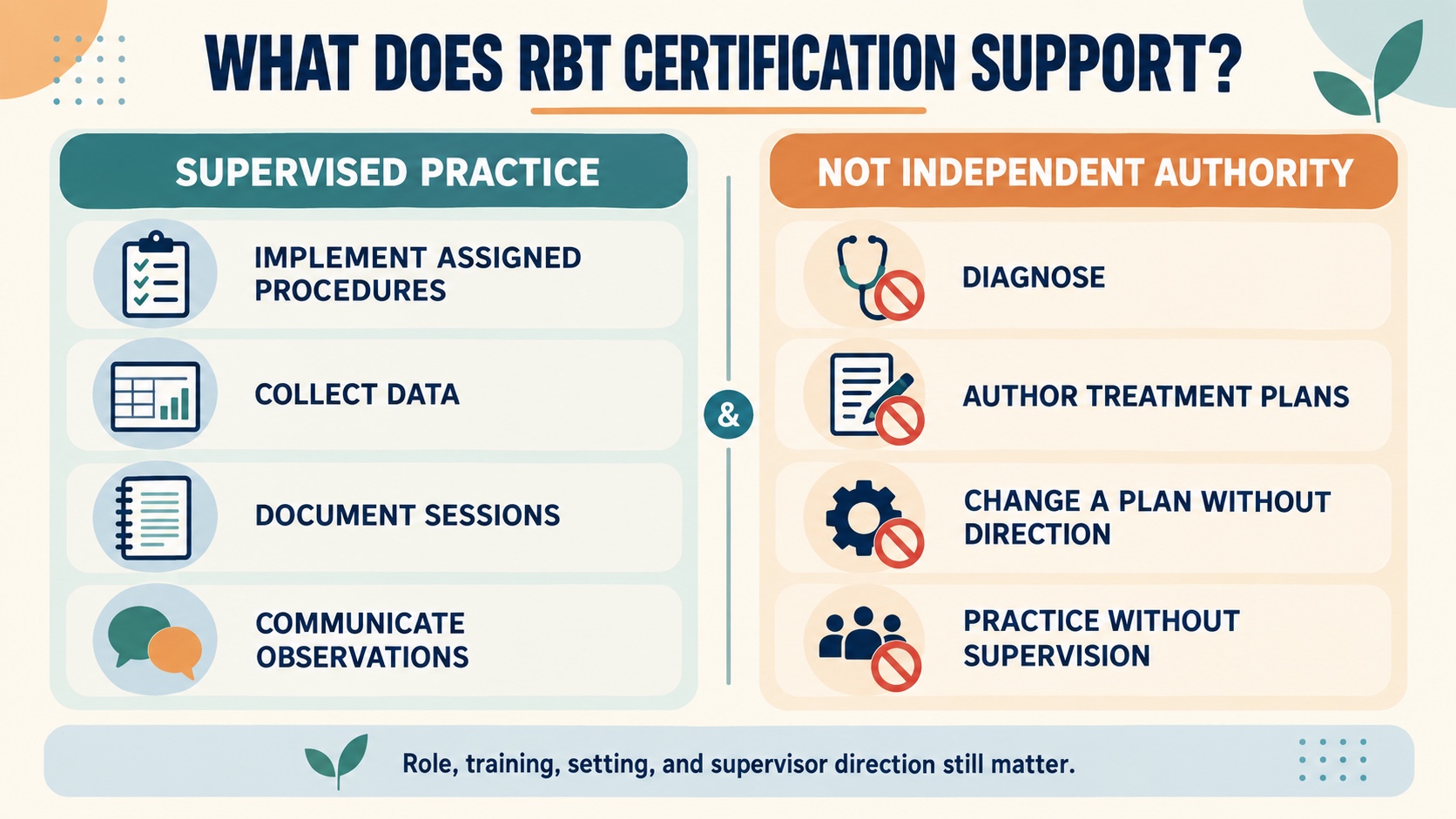
The supervised role matters. RBTs may implement assigned procedures, collect and document data, communicate observations, and participate in behavior-analytic services within their training and direction. The responsible supervisor remains accountable for supervision and for decisions outside the RBT’s role. Certification does not authorize an RBT to diagnose, independently design treatment plans, change a behavior plan without direction, or provide unsupervised clinical judgment.
It is also useful to distinguish an RBT from a general behavior technician or behavior therapist job title. Employers may use different titles for staff who perform similar tasks, and local organizations may add hiring requirements. A job title is not the same thing as an active BACB certification. When the distinction matters, check the person’s current credential status and the rules that apply to the setting.
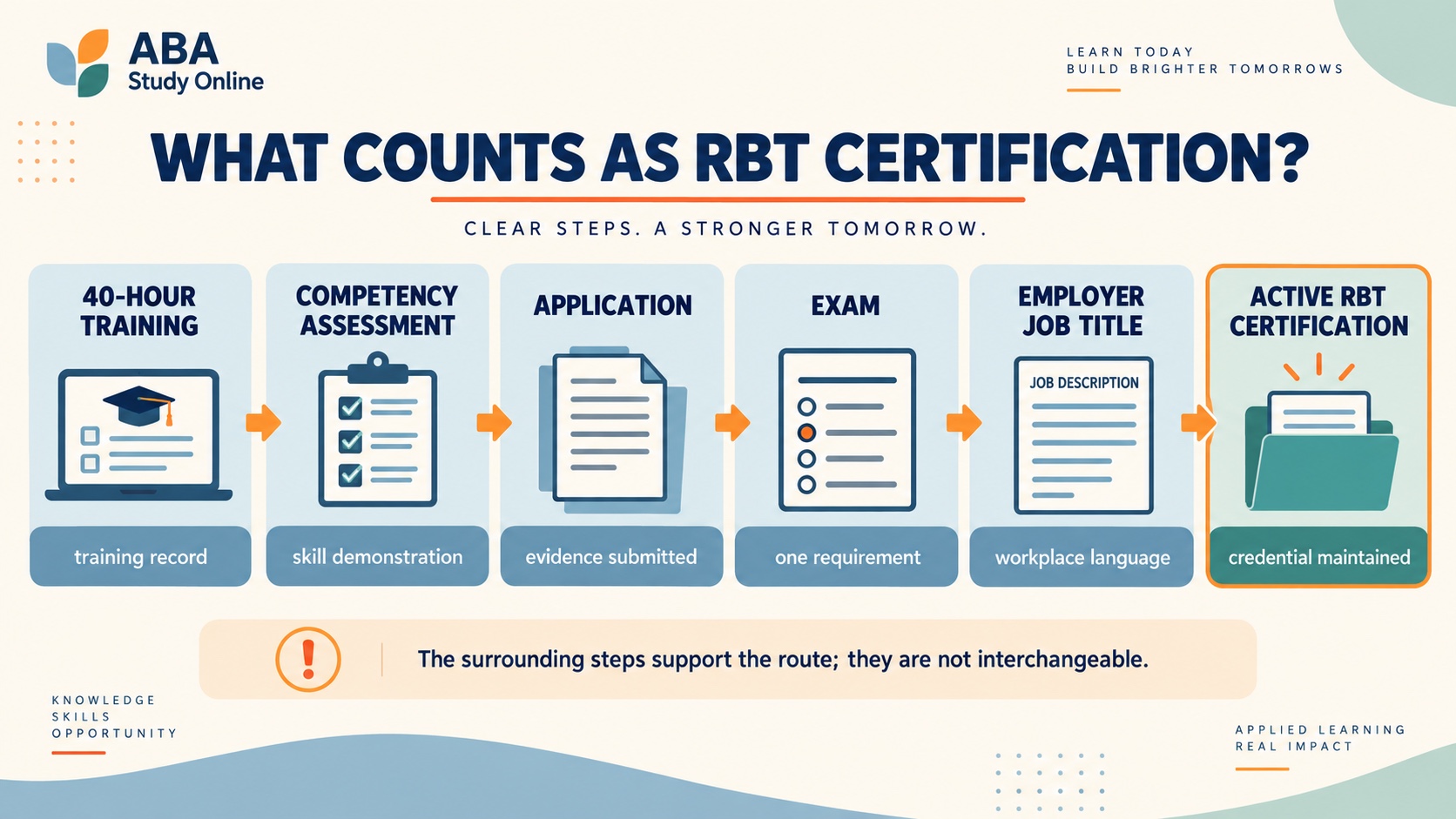
Certification versus the documents around it
| What you may hear | What it does | What it does not prove by itself |
|---|---|---|
| 40-hour training certificate | Documents completion of a training program designed to meet the applicable training requirement. | It is not the BACB credential and does not replace the competency assessment, application, or examination. |
| Initial competency assessment | Documents performance of the required technician tasks with an eligible assessor. | It is not a certification card or an examination result. |
| Certification application | Submits evidence for BACB review and begins the application process. | Submitting or paying for an application is not the same as approval. |
| RBT examination result | Reports performance on the certification examination after the applicant is authorized to test. | Passing one step does not erase the other applicable requirements or maintenance duties. |
| Employer job title | Describes a position or staffing role at an organization. | It does not establish active BACB certification or answer state and payer requirements. |
| RBT certification | Represents the BACB credential after the applicable requirements are met and while it is maintained. | It does not authorize independent diagnosis, treatment-plan authorship, or unsupervised practice. |
This is why “RBT certification course” deserves a closer look. Some providers use that phrase to describe a course intended to help someone meet the 40-hour training requirement. The provider may issue a training certificate, but it does not become the BACB simply by using the word “certification” in its marketing. Ask what the course actually provides, which requirement version it follows, and which steps remain separate.
There is also a timing distinction. A person can finish training but not yet be eligible to use the RBT credential. A person can submit an application but still be waiting for review or authorization. A person can pass the examination but still need to follow the determination and maintenance instructions that apply to the credential. In other words, “I completed a requirement” and “I hold an active certification” are different statements. Clear records help you know which statement your documents support.
The same caution applies to screenshots and downloadable badges. A badge may show that someone completed a lesson, passed a provider quiz, or finished a workplace orientation. Those accomplishments can be useful, but the label should identify what was completed and who issued it. If the document does not say whether it is a training record, assessment record, application document, or BACB credential, do not assume that the most impressive-sounding interpretation is correct.
What the current 2026 credential route includes
For people applying under the 2026 requirements, the current RBT Handbook describes several distinct eligibility steps. The exact evidence and timing should be checked in the current Handbook, but the high-level map includes:
- Basic eligibility and checks: age, education, and the required background and abuse-registry checks.
- 40-hour training: a program designed to meet the current training requirements and completed within the applicable time window.
- Initial competency assessment: a separate demonstration that the applicant can perform the applicable technician tasks.
- Application and attestation: submission of the required evidence through the BACB process.
- Examination: the current RBT examination based on the RBT Test Content Outline, 3rd edition, beginning in 2026.
- Maintenance: ongoing supervision, ethics and self-reporting responsibilities, and the current recertification or professional-development requirements.
The examination is one part of the route, not a synonym for certification. The current RBT TCO, 3rd edition, organizes 43 tasks across six domains and the Handbook describes 85 questions delivered, 75 scored and 10 unscored, four answer choices with one correct answer, and 90 minutes. Those details help a learner prepare, but a practice score or a course completion does not turn into the credential automatically.
Requirements can change. If a webpage, employer slide, or course certificate uses an older edition, compare it with the current RBT Handbook and TCO. The BACB’s current resource pages also separate examination updates from other eligibility and maintenance updates. Do not decide that a document is valid simply because it has “RBT” in its title.
What an RBT certification allows in practice
Certification supports a supervised technician role. Depending on the assigned program and the setting, an RBT may implement teaching or behavior-reduction procedures, collect measurement data, document sessions, communicate observations, and participate in assessment or training activities within the defined scope. The supervisor provides direction, monitors implementation, and handles decisions that require a different level of authority or expertise.
Certification does not mean that every RBT performs every ABA task, or that a credential overrides the employer’s policies, a client’s consent, a state rule, a payer requirement, or the supervisor’s instructions. Good practice includes asking for clarification when the task is outside training, when the data are unreliable, when a safety concern appears, or when a caregiver or colleague asks for a decision the RBT should not make independently.
How to read a certification claim
If a school, employer, or course page says “get RBT certified,” ask five plain questions:
- Is this describing a training course, the BACB application, the exam, or the credential itself?
- Which current RBT Handbook and TCO version does the material use?
- Who completes or signs the competency assessment and attestation?
- What steps remain after the course ends?
- How will supervision and maintenance be handled after certification?
A clear provider will answer those questions without implying that a payment, a downloadable certificate, or a short quiz creates BACB certification. For study, the RBT learning path, free RBT practice questions, ABA glossary, and ABA Study Online app can help you understand concepts and prepare for the exam. They are learning supports, not an application approval, competency assessment, or certification decision.
FAQ and official sources
Is a 40-hour course the same as RBT certification?
No. It is one training requirement or eligibility component. The competency assessment, application, examination, and ongoing maintenance requirements are separate.
Does passing the RBT exam make someone certified immediately?
Passing the examination is an important step, but certification depends on meeting the applicable requirements and receiving the relevant BACB determination. Use the current Handbook for the complete process.
Can an RBT work independently?
RBTs provide behavior-analytic services under the direction and close supervision of the responsible supervisor or requirements coordinator. Certification does not authorize independent diagnosis, treatment-plan authorship, or unsupervised clinical decision making.
Is an RBT job title proof of certification?
No. Employers may use different titles and may add their own requirements. A job title and an active BACB credential are different facts.
Where should I check the current requirements?
Start with the BACB RBT Handbook, the current RBT TCO, and the BACB RBT resource page. Recheck them before relying on an older course page or employer document.