What Is an RBT? Role, Supervision, and the Certification Path
RBT stands for Registered Behavior Technician. The Behavior Analyst Certification Board describes RBT certification as a paraprofessional certification in behavior analysis. RBTs assist in delivering behavior-analytic services and practice under the direction and close supervision of an RBT Supervisor and/or RBT Requirements Coordinator who is responsible for their work.
That definition is short, but the role makes more sense when you see how it fits into a service team. An RBT may collect data, implement teaching or behavior-reduction procedures, document sessions, and communicate observations. The RBT does not independently become a BCBA, design every client program, or replace the supervisor’s clinical responsibility. Training, a competency assessment, an application, an examination, and ongoing supervision are connected stages, not interchangeable labels.
Table of Contents
Quick answer: an RBT is a trained and credentialed behavior technician who supports behavior-analytic services under required supervision. The role is practical and collaborative. An RBT follows the current plan, records observable information, helps implement teaching or behavior-reduction procedures, protects client dignity and privacy, and brings questions or concerns to the responsible supervisor.
What an RBT does in ABA services
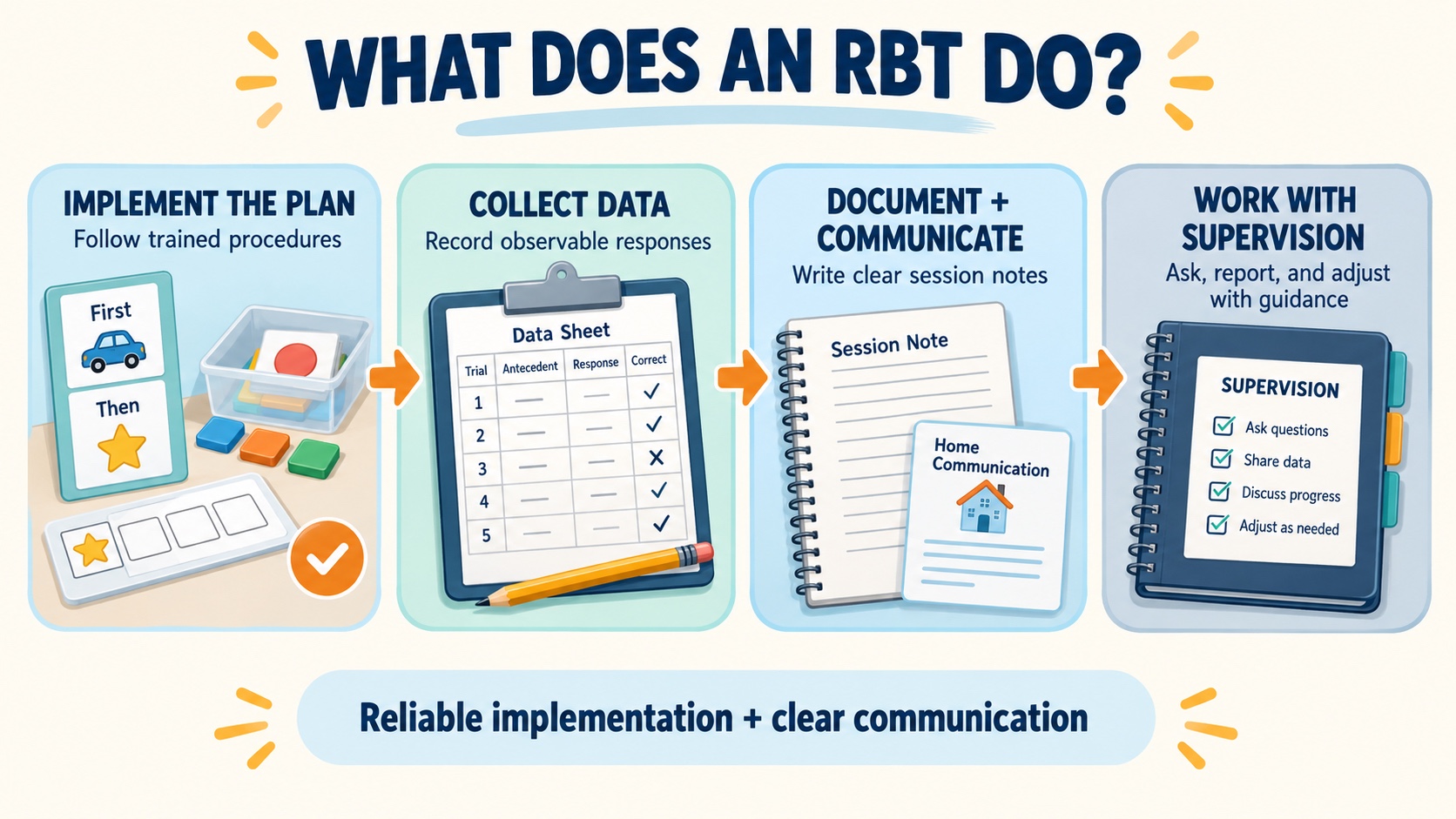
The exact daily routine depends on the service setting and the client’s plan, but the role usually has four connected parts.
Implement the plan you were trained to use
An RBT may deliver instructions, arrange materials, provide prompts, reinforce responses, support communication, and follow a written behavior-reduction procedure. The important phrase is the plan you were trained to use. An RBT is not expected to invent a new intervention because a session feels difficult. If a procedure is unclear, unsafe, or not working as expected, the appropriate action is to pause when necessary, follow safety directions, document what occurred, and contact the responsible supervisor.
Collect and record useful data
Data collection turns a session into information that the service team can review. Depending on the plan, an RBT may record frequency, duration, latency, interval data, trial-by-trial responses, task completion, or another defined measure. Good recording starts with an observable definition. “The learner was upset” is broad. A description such as “the learner pushed the materials away and left the table for two minutes after the instruction” gives the supervisor something concrete to examine.
Support teaching and behavior change
RBT work can include skill-acquisition procedures such as prompting, prompt fading, shaping, chaining, discrimination practice, or naturalistic teaching when those procedures are part of the current plan. It can also include implementing an approved behavior-reduction or replacement-skill procedure. The goal is not to make an RBT an independent treatment designer. The goal is reliable implementation, clear data, and respectful interaction so the supervising professional can make informed decisions.
Communicate as part of a team
Documentation and communication are clinical responsibilities, not administrative extras. An RBT may report changes in the session, ask for clarification, describe an implementation barrier, and record objective notes. Communication should protect confidentiality and avoid turning an observation into an unsupported diagnosis. A clear question to a supervisor is often more helpful than a confident guess.
What an RBT is not
New learners sometimes hear “behavior technician” and imagine that the role includes every kind of ABA decision. It does not. The credential, training, supervision arrangement, current plan, and applicable workplace or local requirements all matter.
- An RBT is not a BCBA. BCBA certification is a different credential with different education, fieldwork, examination, and supervision requirements. An RBT may later pursue that path, but experience as an RBT does not automatically grant it.
- An RBT is not an independent behavior analyst. RBT practice occurs under direction and close supervision. The technician should not independently diagnose, select a complete treatment plan, or make a certification decision.
- An RBT is not defined by a job title alone. An organization may use “behavior technician” as a job title. When current credential status matters, verify it through the appropriate process rather than assuming the title proves certification.
- An RBT is not a replacement for a supervisor. Questions about assessment, changes to a plan, risk, scope, or unusual client situations should be brought to the responsible supervisor.
These boundaries are not meant to make the role small. They make responsibility visible. A well-supported RBT can have a major effect on whether a teaching plan is implemented consistently and whether the team receives usable information about the learner’s progress.
Why the supervision boundary matters day to day
Supervision is not only a scheduled meeting or a signature on a form. It gives the RBT a place to check whether a procedure is being implemented as intended, whether the data system still fits the plan, and whether a change in the learner’s context needs clinical review. A technician who asks a precise question early can prevent a small implementation problem from becoming a confusing data pattern later.
For example, an RBT may notice that a learner is responding differently when a new material is introduced. The RBT can describe the setting event, the instruction, the response, the consequence, and any relevant measurement information. The RBT should not independently conclude that the learner has a new diagnosis or replace the intervention. The supervisor can review the evidence, decide whether the plan needs attention, and communicate the next step.
This division of responsibility also protects the learner. Clear supervision helps the team notice when a procedure is difficult to implement, when a replacement skill needs more teaching opportunities, or when a safety concern requires a different response. It supports consistency without asking one technician to carry decisions that belong to the broader clinical team.
That is why a strong RBT orientation teaches both action and judgment: what to do when the plan is clear, what to document when the session changes, and when to bring the decision back to supervision.
How the certification path fits together
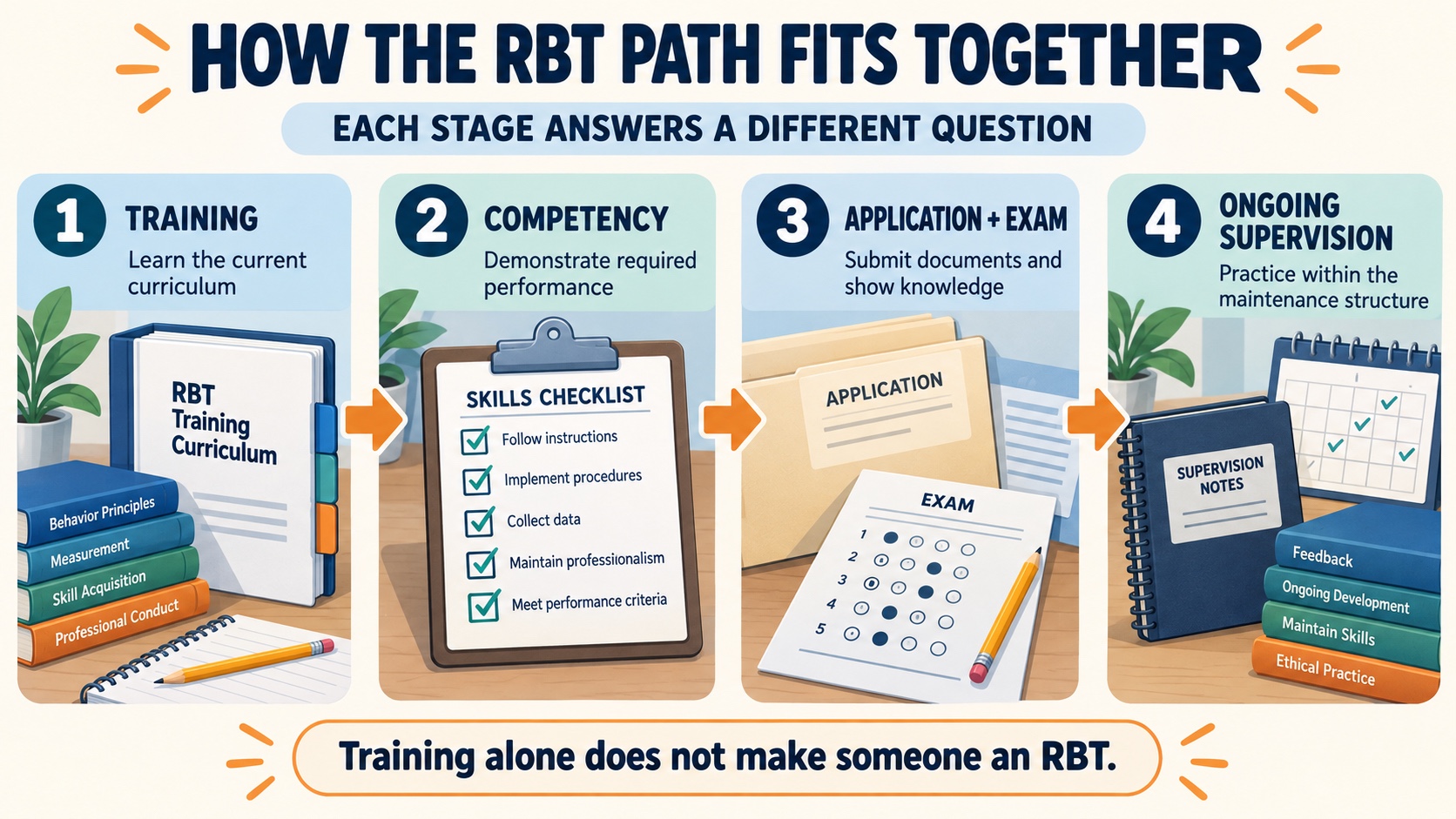
“How do I become an RBT?” is a different search from “what is an RBT?”, but a short pathway map helps a beginner understand the role. Use the current BACB Handbook for the controlling requirements, because documents and transition rules can change.
- Complete the required training. For applicants applying on or after January 1, 2026, the BACB’s current 40-hour training requirements describe the curriculum, timing, delivery, active-learning, and trainer boundaries. A course certificate alone does not make someone an RBT.
- Demonstrate competency. The Initial Competency Assessment is a separate performance-based stage. It is not the same as the written examination and should be completed with the current official packet and a qualified responsible assessor.
- Apply and take the examination. The application and written RBT examination are separate from training and competency assessment. The current RBT Test Content Outline is the appropriate source for exam content, while the handbook governs administrative steps.
- Practice with ongoing supervision. Once certified, an RBT continues to work within the supervision and maintenance requirements that apply to the credential. Supervision is part of the role, not just a temporary step before someone works alone.
The stages overlap in everyday preparation. For example, practicing data collection can help with both training and competency. But the evidence required at each stage is different. A quiz can show knowledge, a demonstration can show performance under defined conditions, and an application can show that the required documents were submitted. Do not treat one type of evidence as a substitute for another.
A first-week example
Suppose Alex has just joined an ABA service team. Alex reviews the learner’s current plan with the supervisor, practices the data system, rehearses prompting and reinforcement with feedback, and asks how to document a session when a planned material is unavailable. During the session, Alex records what happened rather than writing a guess about the learner’s motivation. Afterward, Alex brings the data and the question to the supervisor.
That example shows the role more clearly than a job-title definition alone. Alex is not making every clinical decision, but Alex is doing important professional work: implementing a plan, observing carefully, documenting accurately, and using supervision. Competence is built through clear expectations, practice, feedback, and repeated performance under the conditions of the service context.
Which resource should you use next?
Choose the next page by your actual question:
- If you want the abbreviation, role meaning, and boundary details, read the RBT meaning guide.
- If you want the full application and credential pathway, open the RBT certification guide.
- If you are comparing certification with general job language, see what RBT certification means.
- If you are choosing or evaluating training, use the RBT training guide.
- If you are preparing for the practical assessment, use the RBT competency assessment guide.
- If you need a structured study route, start with the RBT study path.
Whichever page you read, keep the official BACB source nearby. Educational explanations can make a requirement easier to understand, but they should not replace the live handbook, packet, supervisor direction, or application instructions.
What is an RBT FAQ
What does RBT stand for?
RBT stands for Registered Behavior Technician. The BACB describes it as a paraprofessional certification in behavior analysis.
Can an RBT work without supervision?
RBTs practice under the direction and close supervision of an RBT Supervisor and/or RBT Requirements Coordinator who is responsible for their work. The current handbook and service organization determine the specific supervision requirements.
Is an RBT the same as a BCBA?
No. RBT and BCBA are different credentials with different responsibilities and requirements. An RBT supports service delivery within a supervision structure; a BCBA has a different certification scope and professional role.
Does finishing RBT training make someone an RBT?
No. Training is one stage. The current pathway also includes the applicable competency assessment, application, examination, and maintenance/supervision requirements.