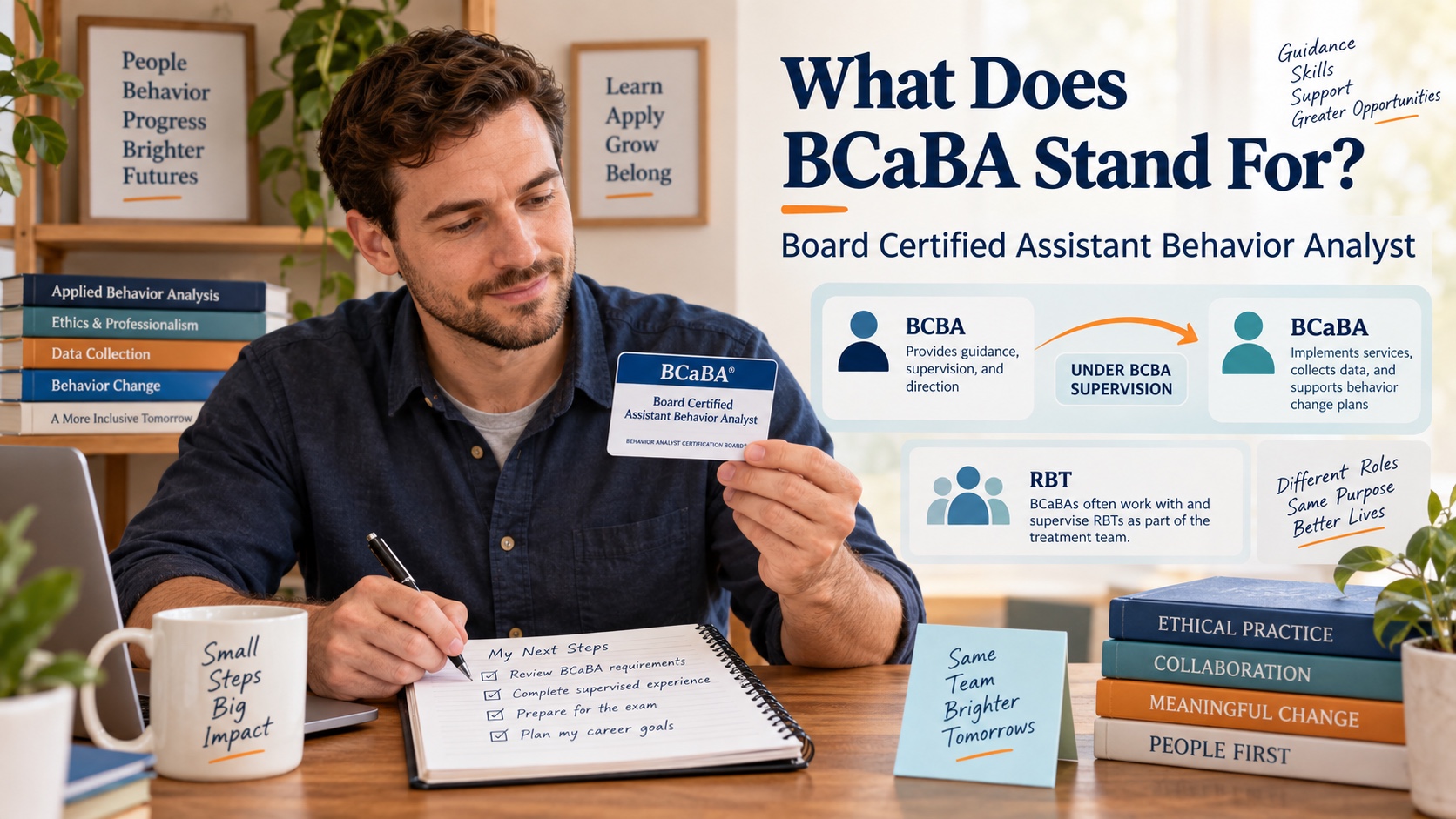
What Does BCaBA Stand For? Board Certified Assistant Behavior Analyst
BCaBA stands for Board Certified Assistant Behavior Analyst. The Behavior Analyst Certification Board describes the BCaBA as an undergraduate-level certification in behavior analysis. BCaBAs may provide behavior-analytic services under the supervision of a BCBA, and they may supervise the work of RBTs within applicable requirements.
The word “assistant” can cause confusion. It does not mean that a BCaBA only performs office or administrative tasks. It describes a credential with a supervised practice structure. A BCaBA can contribute important behavior-analytic work while remaining accountable to a qualified BCBA and the current BACB requirements.
This guide explains the acronym, the credential level, and the role relationship among BCaBAs, BCBAs, and RBTs. For current requirements, always check the BACB BCaBA resources and the BCaBA Handbook.
Table of Contents
What each part of BCaBA means
The title becomes easier to remember when you unpack it:
- Board Certified: the credential belongs to a formal certification system. It is not simply a job title that any employer can assign.
- Assistant: the professional works within a supervised structure and does not practice independently as a BCBA would within applicable requirements.
- Behavior Analyst: the role is grounded in behavior analysis and behavior-analytic service delivery, not a general title for every support worker.
The acronym itself does not tell you every duty a person performs. Duties depend on training, competence, the service plan, the supervising BCBA, the setting, employer procedures, and applicable law or licensure.
What the BCaBA credential represents
A BCaBA has completed the requirements associated with an undergraduate-level behavior-analysis certification. In a supervised service setting, a BCaBA may help implement behavior-change procedures, collect and review data, support assessment activities, communicate with families and team members, and coach RBT implementation when the supervision arrangement allows it.
These are examples, not a universal checklist. A BCaBA should accept work that matches their training and competence, use the current plan, document what occurred, and bring unexpected changes or concerns to the supervising BCBA. The credential supports meaningful professional contribution without granting independent practice.
Why BCBA supervision matters
BCBA supervision is part of the definition of the credential, not an optional extra. The BACB states that BCaBAs may only provide behavior-analytic services under BCBA supervision. The supervising arrangement should make responsibility clear for each case, setting, service, and observation.
Effective supervision can include observing performance, reviewing data and written materials, providing feedback, modeling technical and ethical behavior, guiding problem-solving, and evaluating the effects of services. If the BCaBA is asked to change a goal, redesign a comprehensive intervention, or make a decision outside the assigned scope, the question should move to the responsible BCBA.
The current BCaBA supervision resources and handbook explain the requirements. A workplace’s informal statement that “the BCaBA is in charge today” does not replace a qualified supervision arrangement.
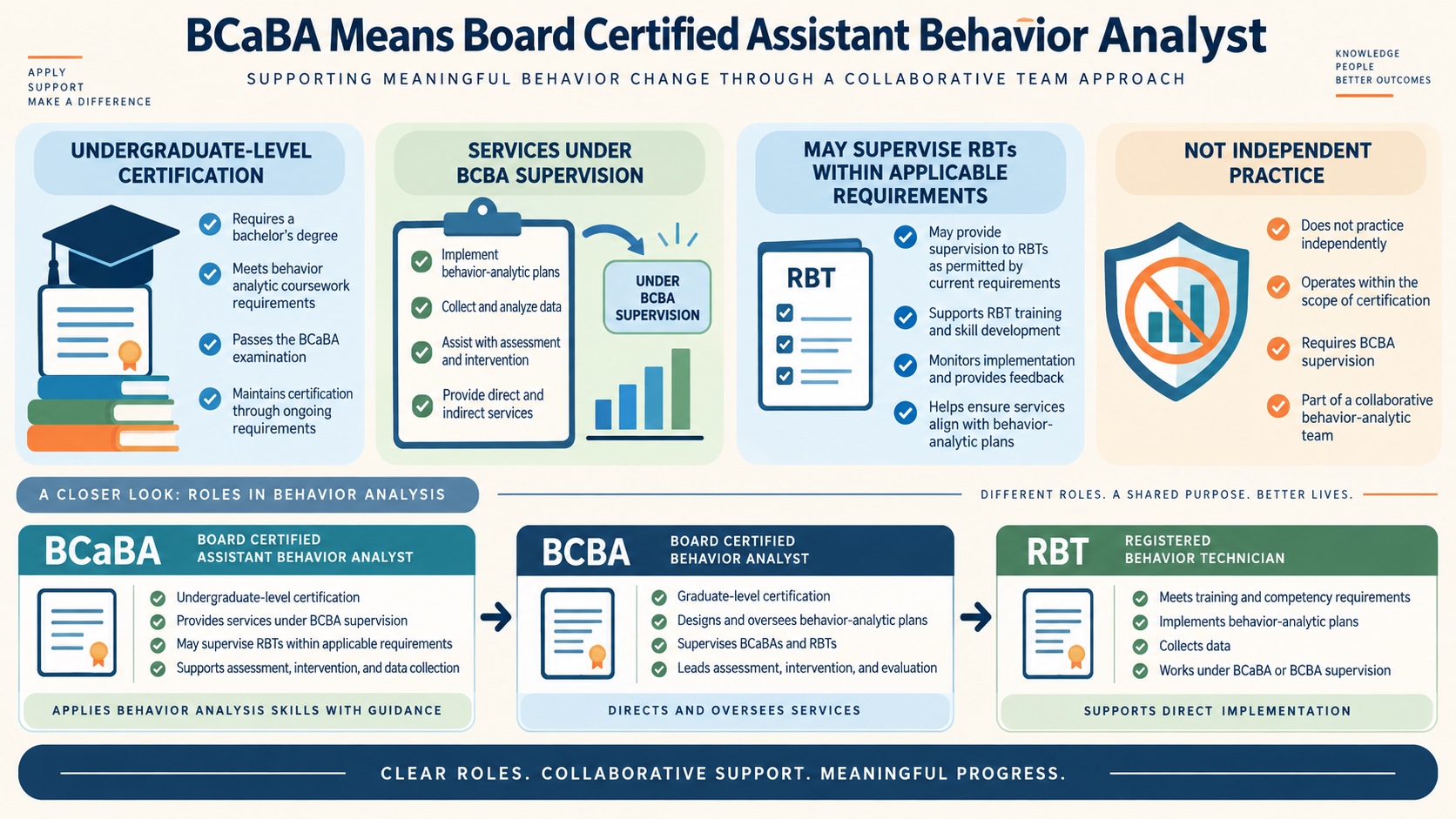
BCaBA vs. BCBA vs. RBT
| Credential | High-level meaning | Supervision boundary |
|---|---|---|
| BCaBA | Undergraduate-level behavior-analysis certification | Provides services under BCBA supervision; may supervise RBT work within applicable requirements. |
| BCBA | Graduate-level behavior analyst certification | May practice independently within applicable requirements and supervise behavior-analytic work. |
| RBT | Paraprofessional behavior-analysis certification | Assists with service delivery under close, ongoing supervision. |
The roles form a team, not a simple ranking of people. A BCaBA may be the person delivering frequent support in a program, an RBT may implement carefully trained procedures every day, and a BCBA may hold the broader independent-practice and supervision responsibility. Good coordination keeps the responsibility chain visible.
For a learner or family, the practical question is often not “Which title is higher?” but “Who is responsible for this decision, and who is supervising the work?” Asking that question helps separate the person implementing a procedure from the professional responsible for the case and for approving meaningful changes. It also helps teams explain roles accurately when several credentials appear in the same service setting.
What the role can look like at work
Imagine a BCaBA supporting a learner’s communication program. The supervising BCBA defines the goals and procedure. The BCaBA prepares teaching materials, observes implementation, reviews the data, helps the RBT use the prompting and reinforcement steps consistently, and reports progress or concerns to the BCBA. If the data suggest a major change is needed, the BCaBA brings that pattern to the BCBA instead of independently rewriting the program.
This example shows why the role can be both hands-on and supervised. A BCaBA may make many moment-to-moment decisions within a written plan while still requiring BCBA guidance for decisions that change the case, exceed competence, or carry broader ethical or legal responsibility.
What BCaBA does not mean
Because the acronym is easy to misread, it is worth slowing down before using it in a job description, study note, or family conversation. A credential label should describe the person’s actual authorization and supervision arrangement, not suggest a broader scope than the current BACB materials support.
It does not mean BCBA
BCaBA and BCBA are separate certifications with different education and supervision structures. A BCaBA should not describe the credential as a BCBA or suggest that it grants the same independent-practice authority.
It does not mean independent practice
BCaBAs may not practice independently. Ongoing supervision is part of maintaining the credential, and the applicable handbook sets the details.
It does not mean every task is automatically allowed
A BCaBA still needs appropriate training, competence, assignment, supervision, and compliance with local requirements. The title alone does not authorize a task outside the person’s role or skill.
It does not mean “assistant” is unimportant
The assistant role is a structured professional role. The boundary helps the team know who is responsible for supervision, plan changes, case decisions, and the quality of services.
Where to learn more
Use the official BACB sources for certification, fieldwork, supervision, ethics, and examination requirements. Then use study resources to learn concepts and practice applying them. ABA Study Online’s BCaBA learning resources and BCaBA practice questions are independent educational materials; they do not replace the BACB Handbook or determine certification eligibility.
If your question is about eligibility, go to the current BCaBA requirements. If it is about job responsibilities, see what a BCaBA can do. Keeping those search tasks separate makes it easier to find the right answer.
FAQ and official sources
What does BCaBA stand for?
BCaBA stands for Board Certified Assistant Behavior Analyst.
What level is a BCaBA?
The BACB describes BCaBA as an undergraduate-level certification in behavior analysis.
Can a BCaBA practice independently?
No. BCaBAs provide behavior-analytic services under BCBA supervision and may not practice independently.
Can a BCaBA supervise an RBT?
Yes, BCaBAs may supervise RBT work within applicable requirements. The BCaBA remains under BCBA supervision.
Where can I verify the meaning and current role?
Start with the BACB BCaBA page, the current BCaBA Handbook, and the BACB supervision resources.