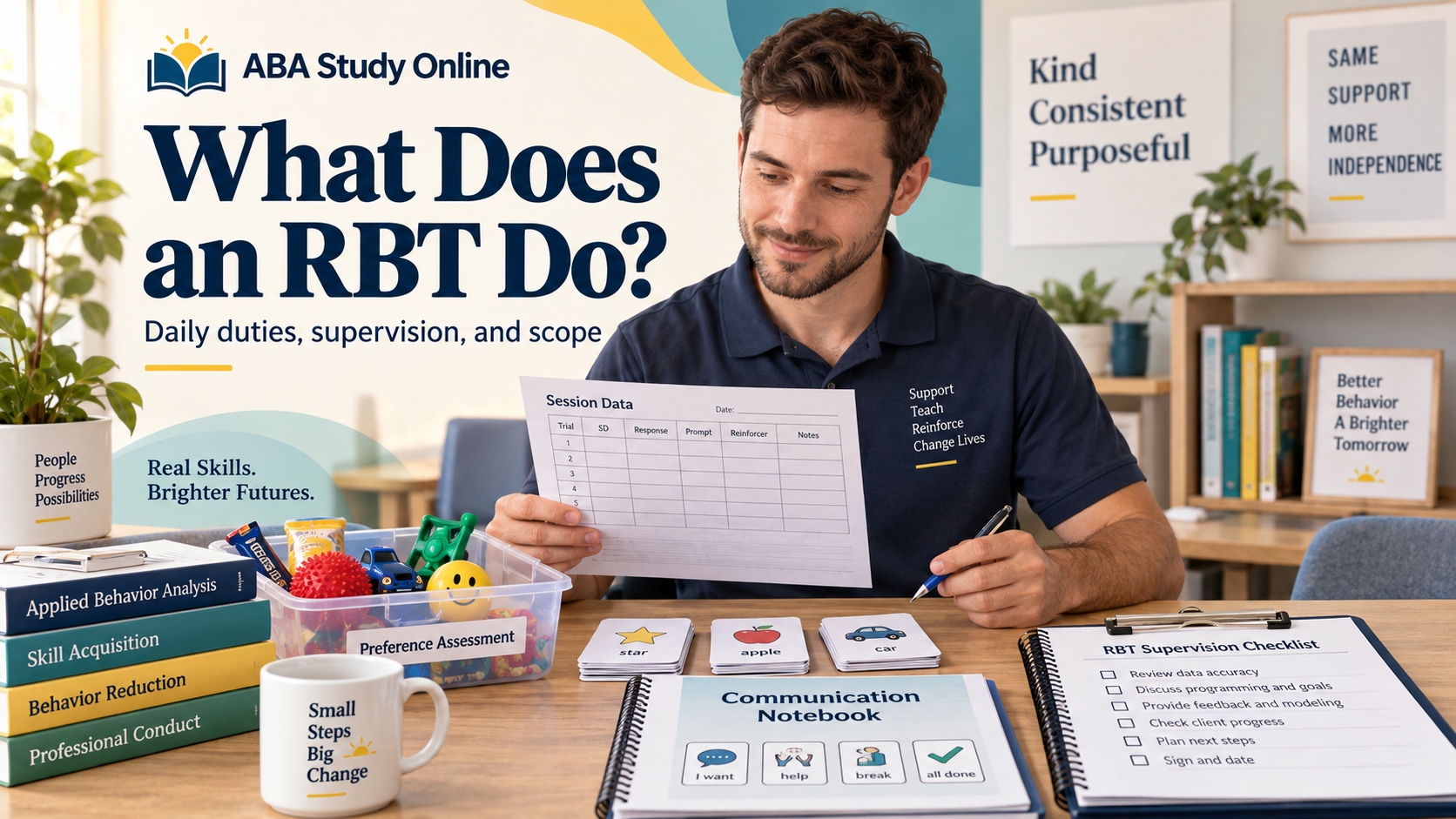
What Does an RBT Do? Daily Duties, Supervision, and Scope
If you ask, what do RBT do, you are probably trying to picture the work behind the title Registered Behavior Technician. The short answer is that an RBT helps deliver behavior-analytic services by implementing assigned procedures, collecting data, supporting skill development, documenting sessions, and communicating observations to the supervising professional. The role is active and important, but it is not independent clinical practice.
The exact day depends on the client, setting, treatment plan, supervisor, organization, and current requirements. This article explains the common workflow and the boundaries that keep the work ethical and useful. It is not a substitute for the current RBT Handbook, employer training, supervision, or local law.
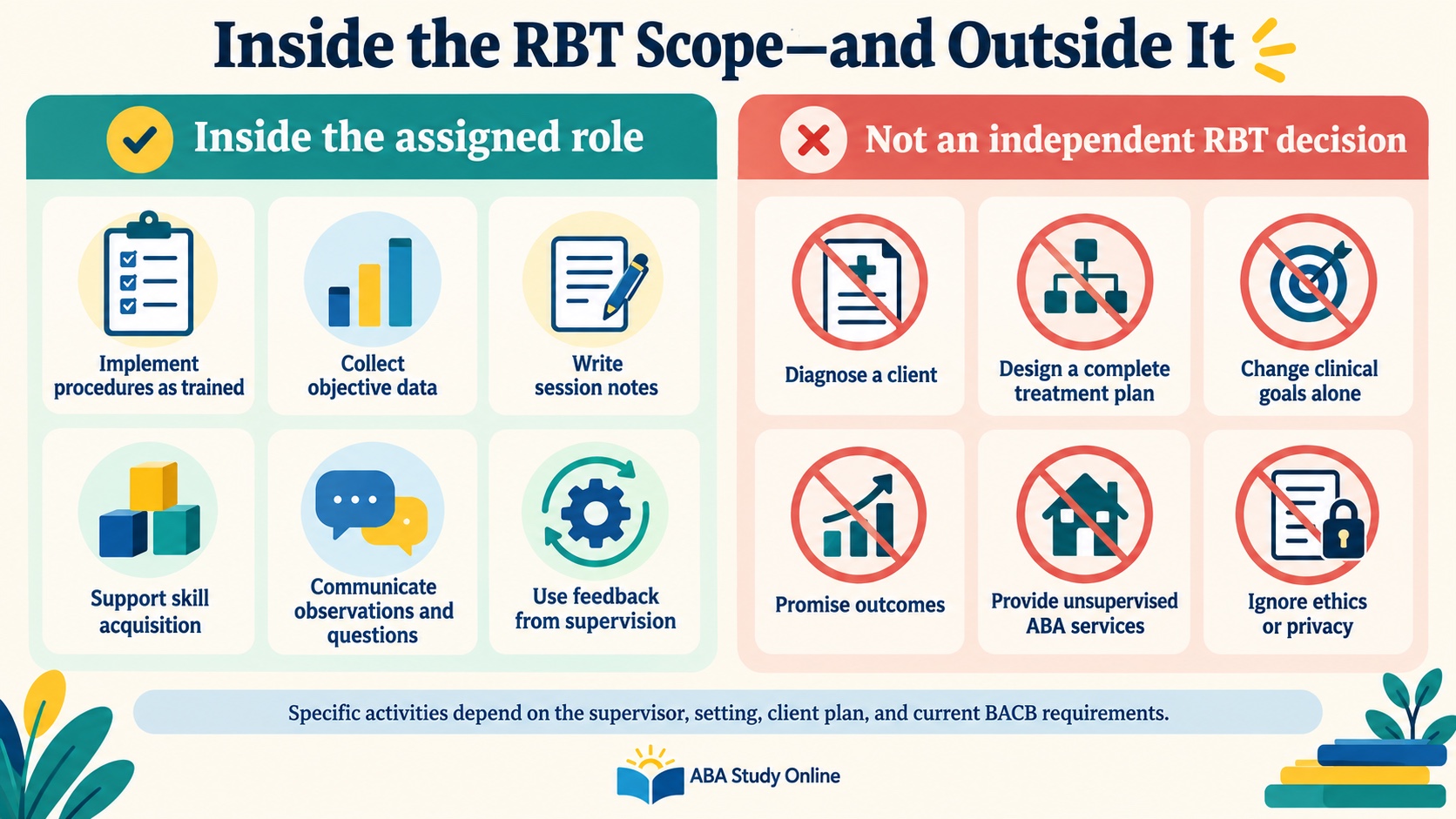
Quick answer: an RBT may prepare materials, implement behavior-analytic teaching and behavior-reduction procedures as assigned, conduct certain activities such as preference assessments when directed, collect observable data, write objective session notes, support generalization, and discuss progress or questions with a supervisor. RBTs do not independently diagnose, design a complete treatment plan, change clinical goals alone, promise outcomes, or provide unsupervised behavior-analytic services.
The supervised RBT workflow
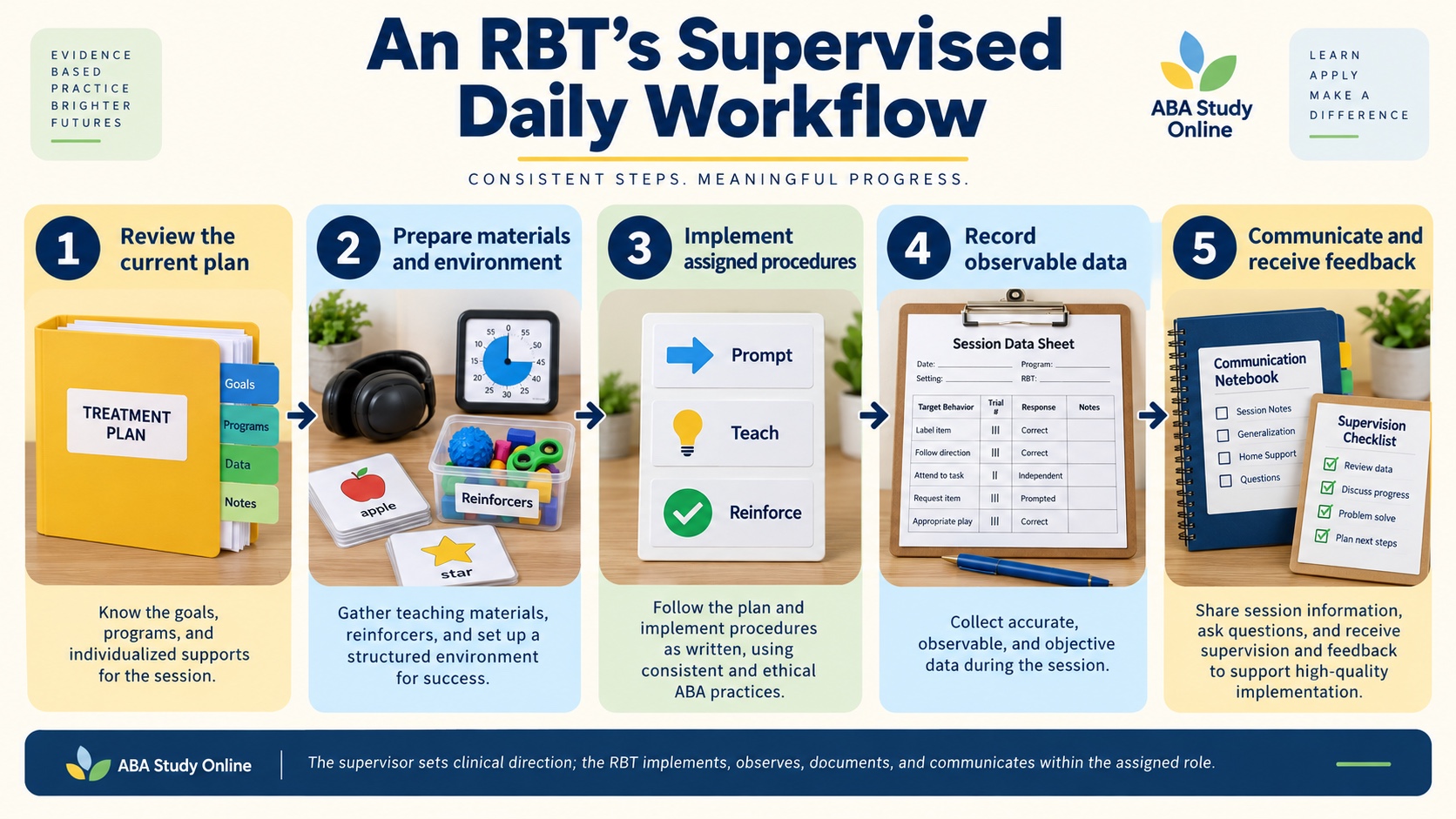
A typical session is easier to understand as a sequence than as a list of isolated tasks:
- Review the current plan: know the goals, procedures, safety directions, data definitions, and materials for the session.
- Prepare the environment: arrange teaching materials, reinforcers, visual supports, and a setting that supports engagement and dignity.
- Implement assigned procedures: follow the plan as trained, use prompts and reinforcement correctly, and respond consistently.
- Record observable information: collect accurate data and write notes that describe what happened without guessing about private events.
- Communicate and receive feedback: tell the supervisor what was observed, ask questions, review data, and practice improvements.
This flow shows why “RBT just plays with children” is an incomplete description. Play may be part of a naturalistic teaching arrangement, but the RBT is still implementing a purposeful, supervised plan and recording information that supports decision-making.
Common tasks an RBT may perform
The BACB’s current RBT Handbook states that activities are determined by the supervisor and may include conducting preference assessments, implementing discrete-trial teaching procedures, and generating session notes. Other assigned tasks may include:
- Teaching communication, self-care, play, social, academic, or daily-living skills according to the plan.
- Using prompts, prompt fading, shaping, chaining, modeling, or reinforcement procedures as trained.
- Collecting frequency, duration, latency, interval, trial-by-trial, or other defined data when those measures fit the plan.
- Supporting generalization by practicing a skill with different materials, people, instructions, or settings when directed.
- Implementing behavior-reduction procedures and following safety or crisis instructions within training and policy.
- Preparing materials, organizing data, and reporting barriers that affect implementation.
A task is not appropriate simply because it appears on a generic job description. The supervisor determines which activities the RBT is trained, authorized, and competent to perform with a particular client. If the plan changes, the RBT should receive instruction and feedback rather than quietly guessing how to proceed.
Data collection and session notes
Data turns a session into information that the supervising professional can review. An RBT may record whether a defined response occurred, how long it lasted, how quickly it began, how many opportunities were completed, or how much prompting was needed. The correct measure comes from the operational definition and plan, not from what is easiest to write down.
Good session notes describe observable events, relevant context, procedures used, client responses, and communication with the supervisor. They should not include invented motives such as “the client was lazy” or present a guess as a measurement. They should also protect privacy and follow the organization’s documentation rules.
For example, “the learner completed four of five requests independently after the visual prompt was presented” is more useful than “the learner had a good day.” The first sentence identifies an observable response and the support used. The exact wording and measure still depend on the plan and the supervisor’s guidance.
Communication and feedback
RBTs are often the team members who see the most direct implementation, so their observations can be valuable. Communication may include reporting data, describing a change in the environment, identifying a possible barrier, asking whether a procedure was implemented correctly, or telling the supervisor that a material was unavailable.
Communication is not the same as making a clinical decision. An RBT can say, “The learner did not contact the replacement response during these opportunities, and the visual was missing,” then ask what to do next. The supervisor can evaluate the pattern, review the plan, and decide whether a change is needed. This division protects the client and gives the RBT a clear route when the session does not look like the written plan.
What an RBT should not do independently
RBT certification does not authorize independent behavior-analytic practice. An RBT should not independently diagnose, design a complete treatment plan, select clinical goals without direction, promise a family a specific outcome, or provide behavior-analytic services without the required supervision. An RBT also should not change a procedure simply because it seems faster or because a previous client used a different plan.
Scope includes ethics and privacy. Do not share identifiable client details in a public group, copy a client’s data into an unsecured personal app, or discuss a family casually with people who are not part of the authorized team. Follow the RBT Ethics Code (2.0), the organization’s policies, and the supervisor’s instructions.
Why ongoing supervision matters
The current RBT Handbook describes close, ongoing supervision as a way to maintain behavior-analytic, professional, and ethical skills and support high-quality services. It states that an RBT must obtain ongoing supervision for at least 5% of the hours spent providing behavior-analytic services each calendar month, and that the requirements apply at each organization where the RBT provides services.
Supervision can include observing implementation, reviewing data, modeling a procedure, practicing a skill, giving feedback, discussing ethics, and planning next steps. A useful supervision meeting does not merely collect a signature; it helps the RBT become more accurate, consistent, responsive, and confident within scope.
How the setting changes the day
In a home, an RBT may work on communication, routines, play, transitions, or daily-living skills with caregivers involved. In a clinic, the day may include structured teaching, group routines, data systems, and coordination with several team members. In a school or community setting, the RBT may support skills across natural activities and communicate with authorized school or service-team partners.
The setting changes the materials and rhythm, not the basic boundary. The RBT still follows the assigned plan, protects privacy, records observable data, communicates with the supervisor, and asks for guidance when the current procedure does not fit what is happening.
RBT vs. BT, therapist, and BCBA
RBT: a specific BACB paraprofessional certification with defined eligibility, examination, ethics, supervision, and maintenance requirements.
BT or behavior technician: an employer’s job title that may describe direct-care work. A person can be called a BT without holding the RBT credential. Ask which training, supervision, and certification rules apply.
Therapist: a broad label whose meaning varies by organization and jurisdiction. It does not explain the RBT credential or the person’s scope by itself.
BCBA: a graduate-level professional who may independently practice within applicable rules and supervise RBTs and BCaBAs. The BCBA sets clinical direction; the RBT does not become a BCBA by performing direct implementation.
How to prepare for the role
Start with the current RBT Handbook, task list, ethics code, training materials, and supervisor instructions. Then practice the skills that make daily work reliable: operational definitions, measurement, prompting, reinforcement, teaching procedures, objective notes, privacy, and communication. A concept question is most useful when you can explain what the RBT should do next and why that action stays within the plan.
The RBT learning path, free resources library, app practice, and ABA glossary can support study. They are educational tools and do not replace the current BACB pathway, employer training, supervised practice, or professional judgment.
Common misunderstandings
- “RBTs only play with children”: play may be part of teaching, but the work includes procedures, data, documentation, and supervision.
- “The RBT can change the plan in the moment”: report what happened and ask the supervisor for direction.
- “A job title defines the credential”: BT, behavior therapist, and RBT are not automatically interchangeable.
- “Supervision is optional after certification”: ongoing supervision is part of the RBT maintenance boundary.
- “Notes can include opinions”: use observable, plan-relevant language and protect private information.
FAQ
What does an RBT do in a session?
An RBT may prepare materials, implement assigned teaching or behavior-reduction procedures, collect data, write objective notes, support generalization, and communicate observations to the supervisor.
Can an RBT make a treatment plan?
No. An RBT works under supervision and does not independently design a complete behavior-analytic treatment plan or choose clinical goals alone.
Do RBTs collect data?
Yes, when data collection is part of the assigned plan. The measure, definition, and recording method should come from the current plan and supervisor instruction.
How much supervision does an RBT need?
The current RBT Handbook states a minimum of 5% of the hours spent providing behavior-analytic services each calendar month, with requirements applying at each organization where services are provided. Review the current handbook for the full supervision requirements.
Is an RBT the same as a behavior technician?
No. Behavior technician may be a workplace title, while RBT is a specific BACB certification. Some employers use both terms, but the title alone does not establish the credential.