What Do I Need to Become a BCaBA?
If you are asking what do I need to become a BCaBA, begin with the date as well as the checklist. The Board Certified Assistant Behavior Analyst certification is an undergraduate-level BACB certification. The current route involves a qualifying degree, one of the BACB eligibility pathways, supervised fieldwork, an application, and the BCaBA examination. The BACB has also announced significant BCaBA requirements changes taking effect on January 1, 2027, so a checklist copied from an older course may not be enough for a future application.
This guide gives you a planning map, not an individual eligibility decision. Your transcript, program, fieldwork documents, application date, state rules, and supervisor arrangement all matter. Use the current BCaBA Handbook and transition guidance as the controlling sources, then ask your program advisor or supervisor to review your specific records.
Table of Contents
Short answer: the BCaBA requirements map
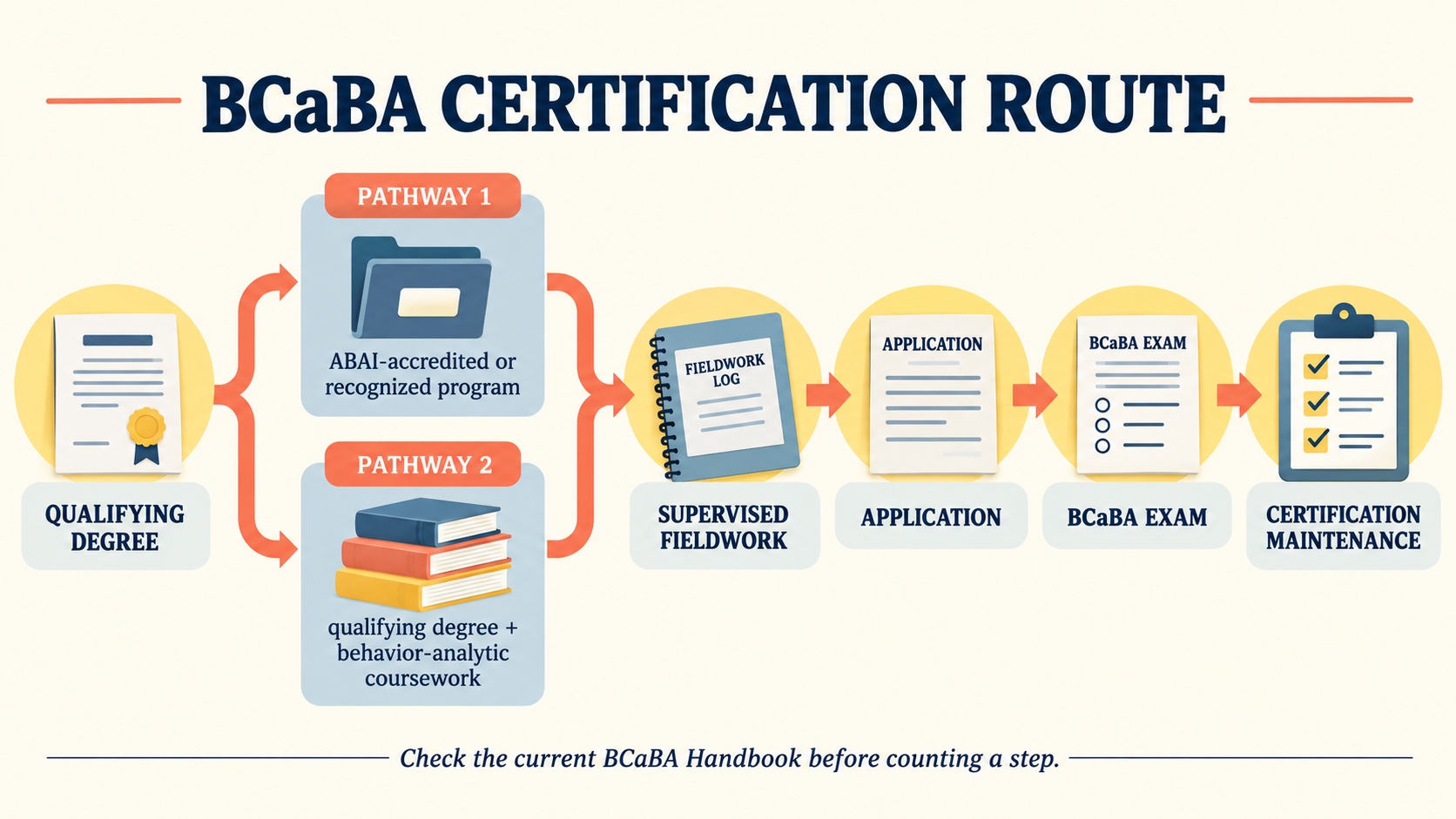
The BCaBA path has six connected parts:
- Qualifying degree: meet the degree requirement for Pathway 1 or Pathway 2.
- Eligibility pathway: use a qualifying degree from an ABAI-accredited or recognized program, or combine a qualifying degree with the required behavior-analytic coursework through Pathway 2.
- Supervised fieldwork: accrue and document the required applied behavior-analysis fieldwork under a qualified supervisor.
- Application: submit the correct application and supporting documents through the BACB process.
- Examination: meet the application determination and pass the BCaBA examination.
- Maintenance: continue meeting supervision, ethics, continuing-education, and renewal requirements after certification.
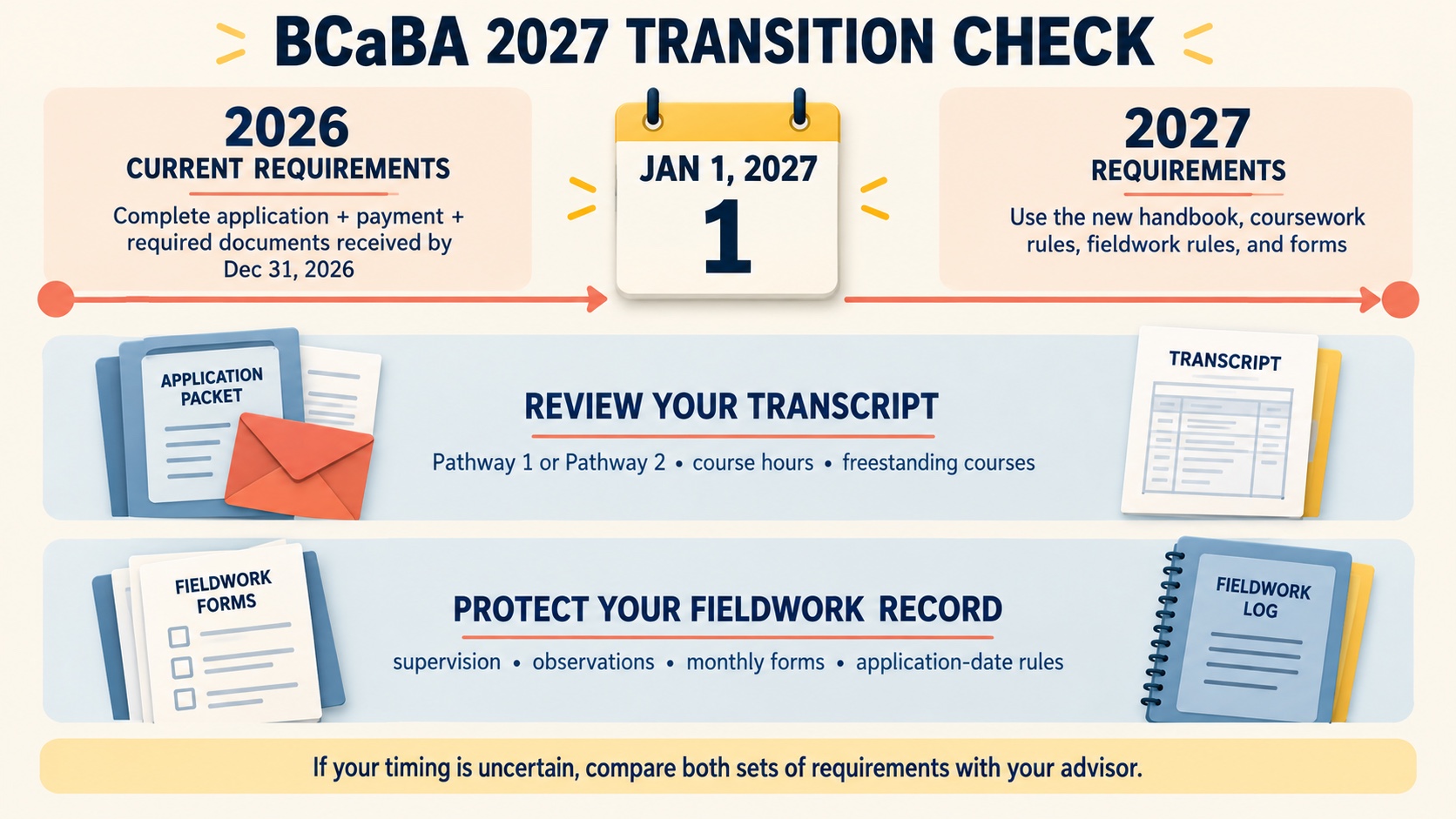
The most important planning question in 2026 is whether you intend to apply before or after January 1, 2027. The BACB says that applications reviewed under the current 2022 requirements must be complete, including payment and required documents, by December 31, 2026. If you apply on or after January 1, 2027, you need to plan against the new requirements that apply at that time.
Choose Pathway 1 or Pathway 2
The BACB transition guide says that Pathway 1 and Pathway 2 remain the two eligibility pathways. The pathways and degree requirements do not change in the transition, but coursework and fieldwork details do. That means the first step is not to copy someone else’s checklist. It is to identify which pathway your degree and program can support.
Pathway 1: degree from an ABAI-accredited or recognized program
Pathway 1 is based on a degree from an Association for Behavior Analysis International, or ABAI, accredited or recognized program. The current handbook specifies the degree and program conditions, so confirm the program status and the date of your degree directly against the handbook. Do not assume that a course with “ABA” in its title automatically makes a degree a Pathway 1 degree.
Even with a Pathway 1 degree, you still need to investigate supervised fieldwork, application documents, the examination, and maintenance. A degree is one part of the route, not the entire certification.
Pathway 2: qualifying degree plus behavior-analytic coursework
Pathway 2 is designed for a person with a bachelor’s degree or higher from a qualifying institution who completes the required behavior-analytic coursework through an institution with the relevant Pathway 2 program contact. The course titles and content coverage matter. A transcript review should look at instructional hours, course content, freestanding-course rules, and how the institution documents the coursework.
Pathway 2 is where the 2027 change creates the most planning work. If a candidate completed coursework under the 2022 requirements but plans to apply in 2027, the transition guide recommends comparing the completed courses with the new content and freestanding-course rules. A program advisor can help determine whether a course needs supplemental instruction or whether another standalone course is needed.
Complete supervised fieldwork
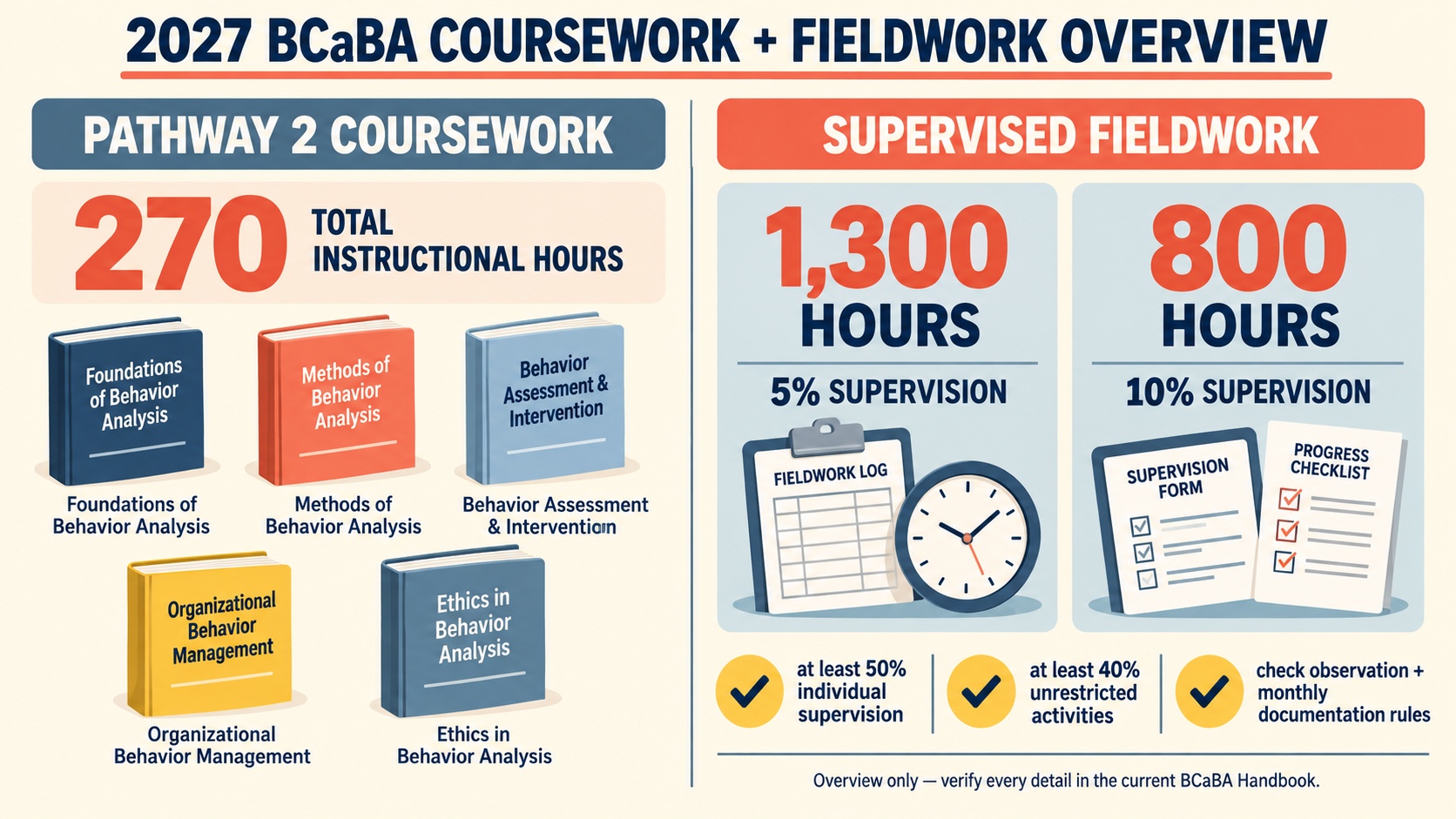
Both pathways require supervised fieldwork in applied behavior analysis. The current 2027 BCaBA Handbook overview lists two fieldwork types: supervised fieldwork and concentrated supervised fieldwork. The overview lists 1,300 hours for supervised fieldwork or 800 hours for concentrated supervised fieldwork.
The hours are only the beginning. The same overview lists 5% supervision for the supervised option and 10% for the concentrated option. It also describes monthly fieldwork ranges, client-observation duration, individual-supervision limits, and an unrestricted-activity requirement. At least 50% of supervised fieldwork hours must be individual supervision, and at least 40% of total supervised fieldwork hours must be unrestricted activities under the 2027 overview.
Keep the words “overview” and “all detailed requirements” together. Fieldwork has documentation, supervisor, activity, observation, and timing rules that cannot be safely reduced to one number. The transition guide also advises candidates who are unsure about their application date to plan and document in a way that can meet both sets of requirements when possible. That can include keeping separate 2022 and 2027 monthly forms with the supervisor.
Before starting or counting hours, confirm:
- which fieldwork type you are using;
- who qualifies as your supervisor;
- which activities count as restricted or unrestricted;
- how supervision percentage and individual supervision will be recorded;
- how observations will be documented under the application rules you expect to use;
- which monthly and final verification forms match your application date.
What changes for 2027 coursework
For 2027 Pathway 2 coursework, the updated handbook lists 270 total instructional hours. The required content areas are Foundations of Behavior Analysis, Methods of Behavior Analysis, Behavior Assessment & Intervention, Organizational Behavior Management, and Ethics in Behavior Analysis. The table also assigns specific hour totals and freestanding-course rules to those areas.
The transition guide gives examples of the practical differences a candidate may need to check. Foundations must be completed as a standalone course. Methods increases to 45 content hours and must be standalone. Behavior Assessment and Intervention must be covered in two freestanding courses. Organizational Behavior Management increases to 45 content hours in a freestanding course. Ethics increases to 45 content hours, with at least 15 hours taught in a freestanding course.
These details are useful for planning, but they are not permission to self-approve a transcript. The BACB advises candidates to review the number of content hours with a program advisor. Save syllabi, transcripts, course descriptions, and written guidance so you can explain how each course maps to the current content area.
How the 2027 transition affects planning
The transition does not mean every candidate must start over. It means the requirements that apply to the application date matter. If you are close to applying under the 2022 requirements, verify that the BACB has received the complete application, payment, and required documents by the stated deadline. If you are not ready, plan under the 2027 requirements and ask your advisor which parts of your completed work carry forward.
Fieldwork is especially important during the transition. The BACB guidance explains that fieldwork must meet the requirements in place when you submit the application. If a candidate is unsure about timing, the guide recommends meeting both sets of requirements where possible, keeping both documentation systems, and retaining records. It also notes that qualifying hours must be accrued within five years.
Do not make a deadline decision based on a social-media post, a course advertisement, or a partial screenshot. Check the current BCaBA Handbook, transition guide, and BACB application instructions. Then get the plan in writing from your program advisor or supervisor.
Application, examination, and maintenance
Submit the application
After the degree, pathway, coursework, and fieldwork requirements are in order, follow the current BACB application process. Your application may depend on transcripts, fieldwork verification forms, attestations, supervisor information, and other documents. A candidate should not submit based on the assumption that a course completion email or a personal spreadsheet is enough.
Pass the BCaBA examination
The current BACB examination-information page lists the BCaBA examination as 175 multiple-choice questions with four hours of testing time. It also says that the current BCaBA Test Content Outline is the 6th edition as of January 1, 2025. Use the BCaBA handbook and current outline for study boundaries, policies, and examination-day information. Do not mix BCBA or RBT practice sets into a BCaBA study plan without checking the content outline.
Maintain certification
Certification does not end on the day you pass. BCaBAs provide services under BCBA supervision, and the current handbook includes ongoing supervision, ethics, continuing education, renewal, and inactive-status rules. Before accepting a role, ask who the qualified supervisor is and how the organization will document the ongoing requirements.
A practical BCaBA planning checklist
- Choose an application window. Decide whether you are realistically applying under the current requirements or after January 1, 2027.
- Confirm your degree route. Identify Pathway 1 or Pathway 2 and save evidence about the program or qualifying institution.
- Map the transcript. For Pathway 2, match every course to the current content area, hours, and freestanding-course rule.
- Set up fieldwork documentation before accruing hours. Confirm supervisor qualification, fieldwork type, monthly limits, supervision percentage, observation rules, and forms.
- Review the application packet. Check transcripts, verification forms, attestations, background or ethics items, payment, and any current portal instructions.
- Study from the BCaBA track. Use the current 6th-edition content outline and BCaBA handbook, not a generic ABA question bank alone.
- Plan maintenance before certification. Confirm BCBA supervision, continuing education, ethics, renewal, and documentation expectations for the role you want.
Common mistakes
- Using a 2022 checklist for a 2027 application: the transition changes coursework and fieldwork details.
- Counting course titles instead of content: the hour and freestanding-course rules matter.
- Counting fieldwork before confirming the system: an hour is not automatically qualifying because it happened in an ABA setting.
- Waiting until the deadline to collect forms: fieldwork documentation and supervisor signatures are easier to protect when recorded monthly.
- Confusing BCaBA with BCBA: BCaBA is an undergraduate-level certification and services are provided under BCBA supervision.
- Assuming passing the exam completes maintenance: ongoing supervision, ethics, continuing education, and renewal still matter.
BCaBA requirements FAQ
What degree do I need to become a BCaBA?
You need to meet the degree requirement for Pathway 1 or Pathway 2 under the current BCaBA Handbook. Pathway 1 uses a degree from an ABAI-accredited or recognized program. Pathway 2 uses a qualifying degree plus the required behavior-analytic coursework through the applicable program route.
How many fieldwork hours are required for a BCaBA in 2027?
The 2027 handbook overview lists 1,300 hours for supervised fieldwork or 800 hours for concentrated supervised fieldwork. Each option has additional supervision, observation, activity, monthly-range, and documentation requirements, so do not plan from the total alone.
How many coursework hours are required for Pathway 2?
The 2027 handbook lists 270 total instructional hours across the specified content areas, with freestanding-course rules. Have your transcript and syllabi reviewed against the current handbook; a general number cannot determine whether your individual courses qualify.
Can I still apply under the 2022 BCaBA requirements?
The BACB says a complete application, including payment and required documents, must be received by December 31, 2026 to be reviewed under the current 2022 requirements. Confirm the current instructions and your readiness directly with the BACB and your advisor.
Does a BCaBA work independently?
The BACB describes BCaBAs as providing behavior-analytic services under the supervision of a BCBA. BCaBAs may supervise RBTs under the applicable rules, but they are not the same certification as a BCBA.
Official sources
- BACB: BCaBA certification and application resources
- BACB: BCaBA Handbook
- BACB: Guidance for Meeting the BCaBA Requirements During the 2027 Transition
- BACB: 2027 BCBA and BCaBA Requirements
- BACB: Examination Information
- ABA Study Online BCaBA learning hub, BCaBA practice questions, and BCBA learning hub