
What Do Board Certified Behavior Analysts Do? Roles, Decisions, and Collaboration
If you are asking what board certified behavior analysts do, start with the decision process rather than a job title. A BCBA uses behavior-analytic assessment and data to define meaningful goals, design and evaluate interventions, support implementation, and adjust services when the evidence says something needs to change. The exact work depends on the setting, the client’s needs, the employer, the BCBA’s competence, and applicable state or payer rules.
In plain language, the role is not simply “working with behavior.” It is a cycle of careful observation, testable decisions, teaching, measurement, and feedback. A BCBA may work directly with a learner, coach caregivers or teachers, supervise RBTs or BCaBAs, or spend much of the day analyzing data and coordinating a team. The credential does not make every BCBA’s caseload or legal scope identical.
Table of Contents
Short answer: what the role is
The core work of a BCBA is to make behavior-analytic decisions that are individualized, observable, measurable, and ethically responsible. Typical responsibilities can include defining target behaviors and skills, reviewing records and direct observations, conducting or contributing to assessments, selecting teaching or behavior-change procedures, monitoring outcomes, and revising a plan when it is not producing the intended result.
A BCBA may also train people who implement a plan. That training is not an afterthought: if a procedure is too complicated, poorly modeled, or not feasible in the person’s daily environment, the written plan may not be enough. Effective practice therefore considers both client outcomes and the conditions that help caregivers, teachers, RBTs, or BCaBAs perform their responsibilities competently.
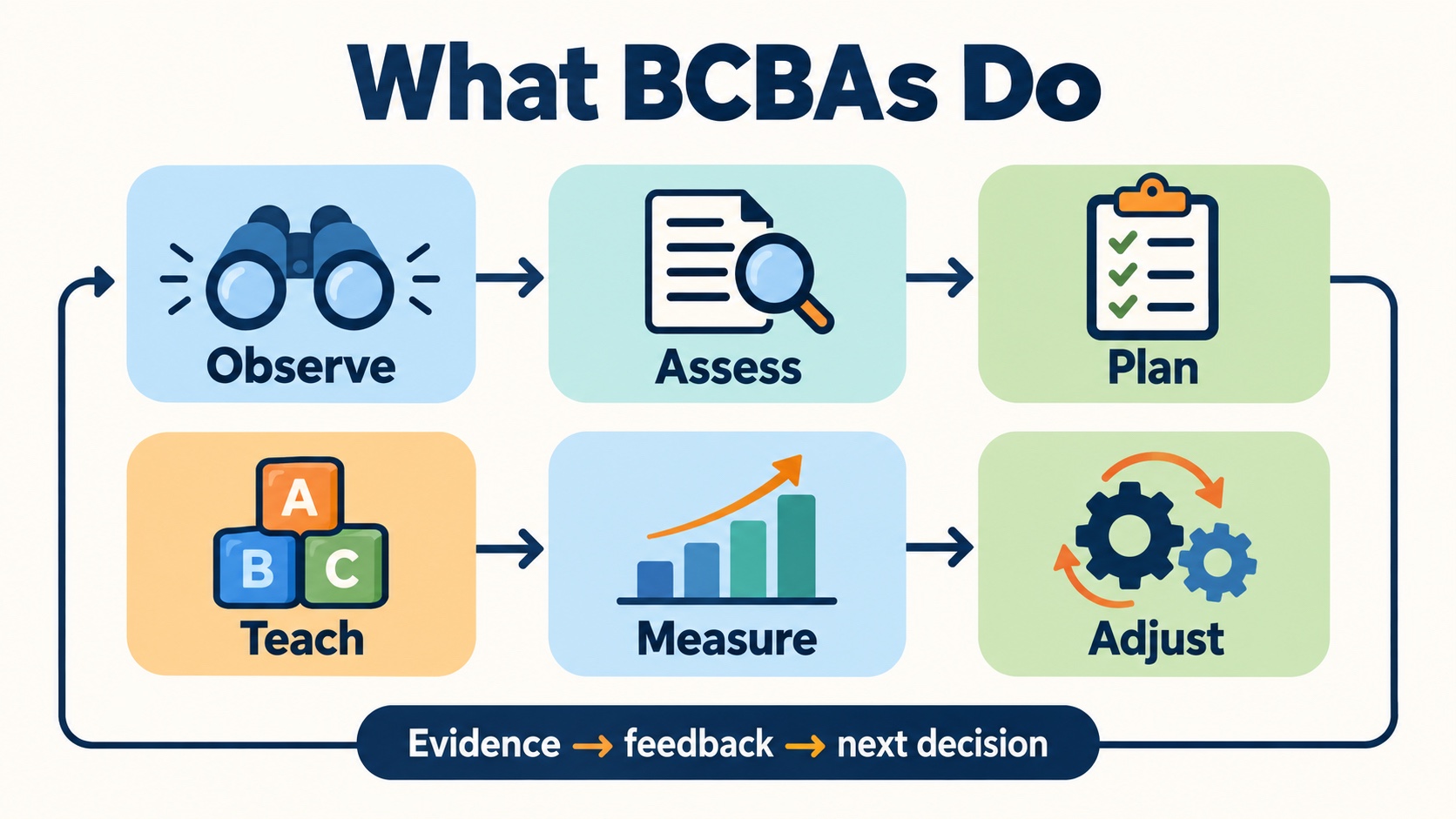
The BCBA workflow from observation to adjustment
- Observe and define: describe what is happening in terms that another trained person could recognize. A useful description identifies the behavior, context, and consequence instead of relying on a broad label such as “noncompliant.”
- Assess: gather relevant information, consider patterns and possible environmental variables, and select assessment procedures that fit the question. Assessment is not the same as guessing a cause from one incident.
- Plan: select goals that matter in the person’s life, choose procedures within the BCBA’s competence, and specify how progress will be measured. Plans should include enough detail for implementation and review.
- Teach and support: model procedures, arrange practice, provide feedback, and coordinate with the people who will use the plan. Teaching may involve communication, daily living, academic, social, or other functional skills depending on the case.
- Measure: review data for level, trend, variability, and meaningful change. The question is not merely whether a chart moved; it is whether the result supports the goal and the next decision.
- Adjust: continue, refine, replace, or pause a procedure based on evidence and context. A BCBA should explain the reason for a change and communicate it to the people responsible for implementation.
How BCBAs work with other people
Many services are team-based. RBTs may implement procedures and collect data under the supervision structure required for their role. BCaBAs may provide behavior-analytic services under BCBA supervision. Caregivers, teachers, speech-language professionals, occupational therapists, physicians, and other partners may contribute information or support goals within their own roles. The BCBA’s job is not to erase those distinctions; it is to coordinate behavior-analytic decisions responsibly and communicate clearly.
Supervision can involve setting expectations, teaching procedures, observing performance, giving feedback, and checking whether training is effective. The BACB’s supervision resources distinguish ongoing service supervision, assessment or training roles, and supervised fieldwork for people pursuing certification. The right arrangement depends on the current handbook, the people involved, and applicable legal and organizational requirements.
Where the work can happen
BCBAs work in many environments, including clinics, homes, schools, community programs, hospitals, residential services, universities, and organizational settings. The same analytic habits can appear in different contexts, but the goals and procedures should be relevant to that context. A school consultation, a caregiver coaching session, and an organizational performance project are not interchangeable simply because all involve behavior.
It is also a mistake to assume that every BCBA works primarily with autistic children. Autism services are one common area, but behavior analysis can address learning, communication, daily living, health-related routines, staff performance, organizational systems, and other socially important outcomes when the practitioner has the required competence and authority.
What the certification does not automatically mean
- Certification is not a universal license: state licensure, employer rules, payer requirements, and other regulations may apply.
- A title does not replace competence: behavior analysts should work within their education, training, experience, and current competence.
- Data do not remove judgment: ethical decisions also consider client rights, risks, assent or participation, feasibility, and the effects on meaningful quality of life.
- A plan is not a promise: intervention outcomes depend on the person, context, implementation, measurement quality, and ongoing review.
A bounded example
Imagine a learner who leaves a group activity when a difficult task begins. A careful BCBA would not jump from that description to a fixed explanation. The analyst might clarify what “leaves” looks like, review when it happens, gather information from the people involved, and select an assessment approach that fits the setting. A plan could teach a functional way to request help or a break, change task presentation, and define how to measure participation and communication. The team would then review whether the change is helping, whether it is practical, and whether the learner is gaining a useful skill—not merely whether the person stays seated.
A practical role checklist
When you read a BCBA job description or observe a service, ask:
- What question is the behavior analyst trying to answer?
- How are the behavior and the goal defined so progress can be observed?
- What data will guide the next decision?
- Who implements the plan, and what training or feedback do they receive?
- How are client preferences, risks, rights, and context included?
- What would cause the team to revise the plan?
For a learner, the BCBA learning hub can organize the concepts behind this workflow. It also helps to understand the distinct roles of RBTs and BCaBAs, and to use BCBA practice questions when you are studying the decision rules rather than memorizing job-title descriptions.
What do board certified behavior analysts do FAQ
Do BCBAs work directly with clients?
Some do, and some spend more time assessing, analyzing data, training staff, supervising services, consulting, or coordinating a team. The balance depends on the setting and role.
Do BCBAs only work with autism?
No. Autism services are one common area, but behavior analysts may work on other socially important goals and in other settings when the work fits their competence and applicable rules.
What is the difference between a BCBA and an RBT?
A BCBA is a graduate-level behavior analyst who may practice independently within applicable requirements and supervise certain behavior-analytic services. An RBT is a paraprofessional who implements behavior-analytic services under ongoing supervision. Their responsibilities are not interchangeable.
Does a BCBA certification grant a license to practice everywhere?
No. A BCBA certification and a state or jurisdictional license are separate questions. Check the rules that apply to the location, service, employer, and payer.