
What Does a Board Certified Behavior Analyst Do? Roles, Responsibilities, and Supervision
If you search what do board certified behavior analyst do, you are usually looking for more than a job-title definition. You want to know what happens during a normal week: who reviews the data, who designs the plan, who trains the people implementing it, and who decides whether the plan needs to change. In plain language, a Board Certified Behavior Analyst (BCBA) uses behavior-analytic assessment, measurement, teaching, and decision-making to support meaningful goals while coordinating the people and systems involved in service delivery.
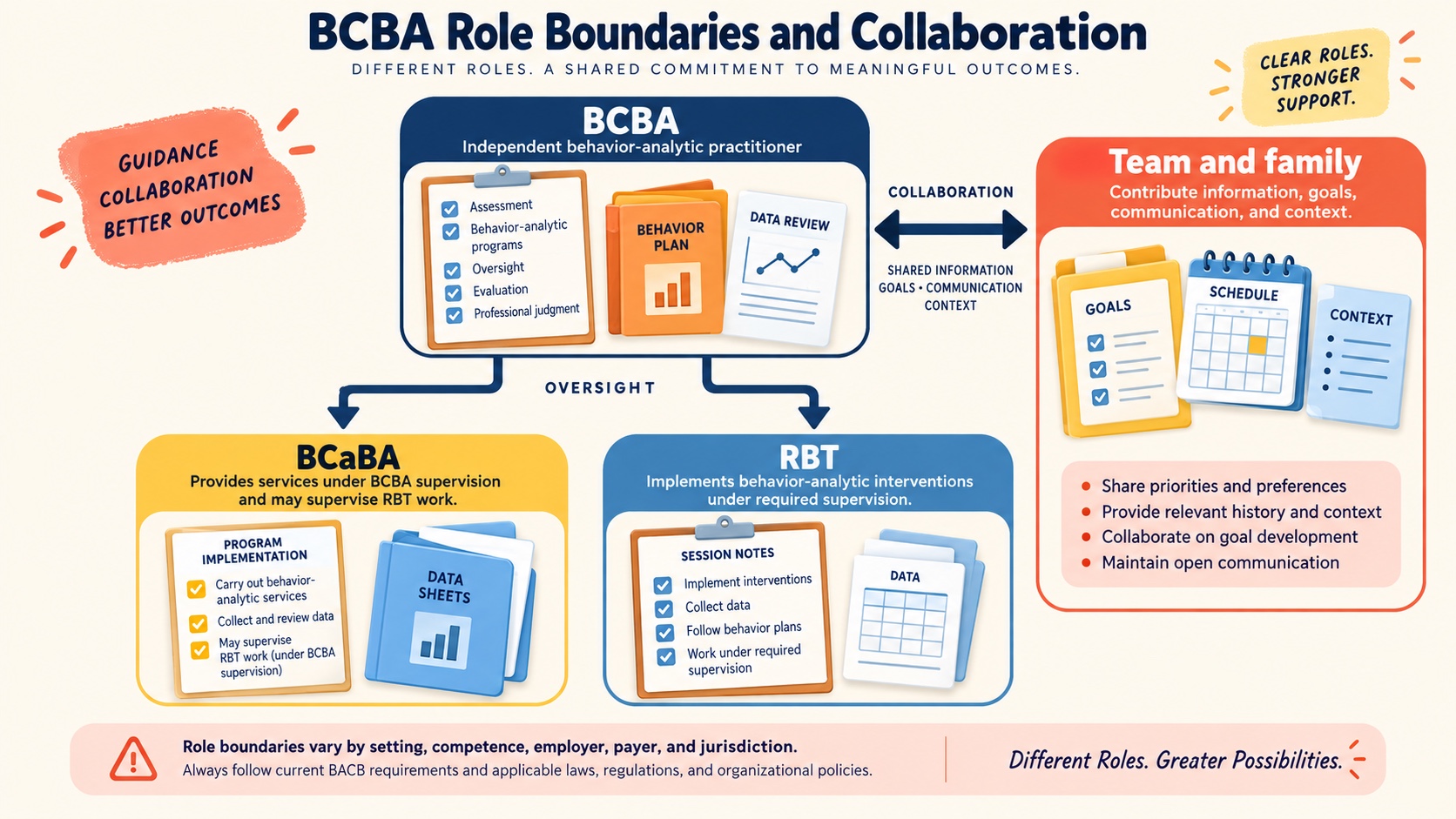
The exact work varies by setting, employer, client needs, payer, applicable laws, and the BCBA’s training and competence. A BCBA in a school, clinic, home-based service, research setting, or organization may have a different schedule. The shared thread is not one universal checklist; it is responsible use of behavior-analytic principles, evidence, collaboration, and supervision. The BACB describes the BCBA as a graduate-level certification and an independent practitioner role, while also identifying supervision and oversight responsibilities that depend on the role being performed.
Quick answer: a BCBA may assess behavior and skill needs, define observable goals, select and monitor behavior-analytic procedures, train and support implementers, supervise RBTs, BCaBAs, or trainees when qualified, review data, communicate with the team, and revise services when the evidence calls for a change. The BCBA is responsible for the quality and boundaries of the work being overseen, but does not necessarily perform every session or every task personally.
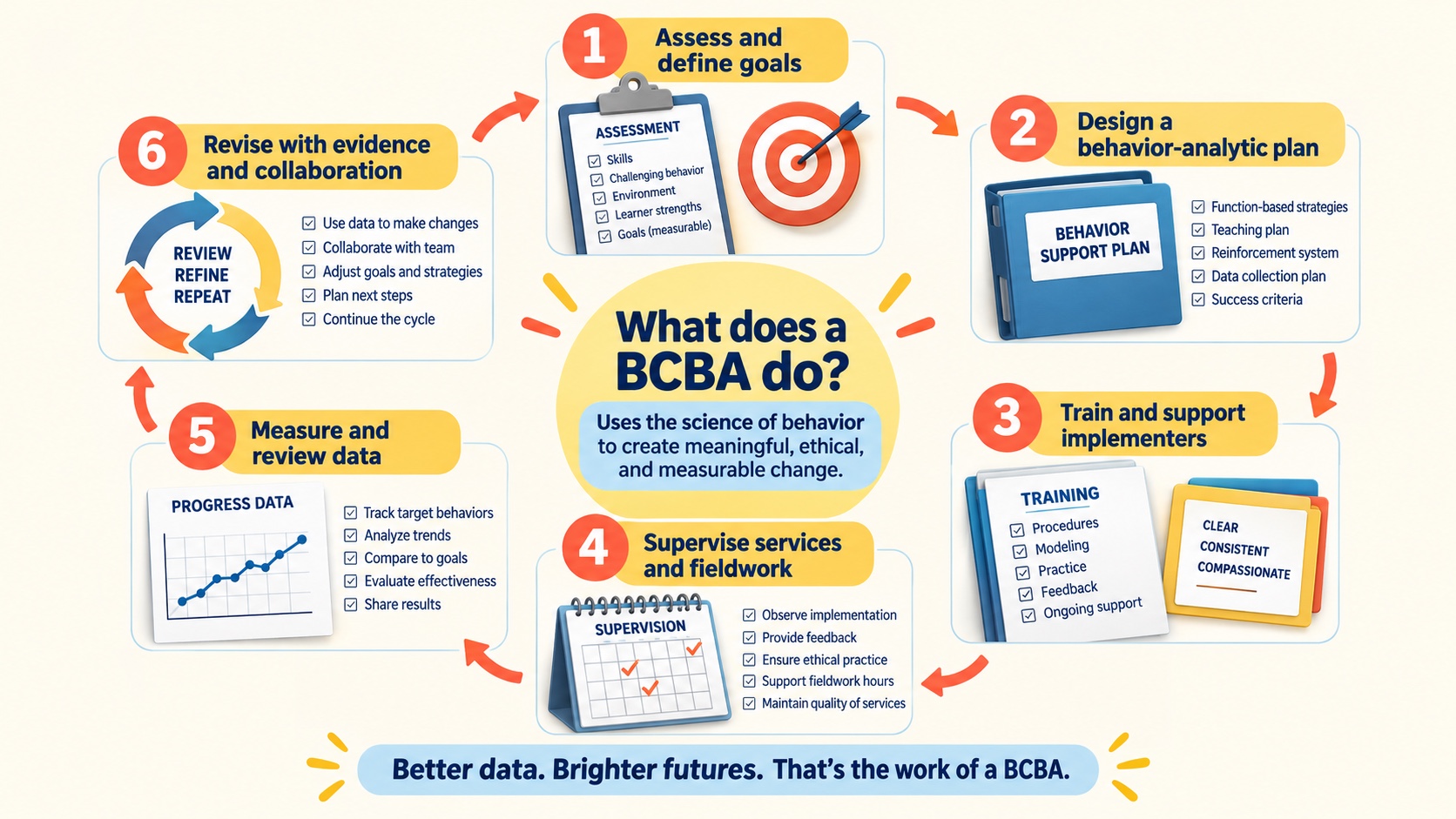
1. Assess needs and define meaningful goals
Assessment is the starting point for good decision-making. Depending on the setting and referral question, a BCBA may review records, interview relevant people, observe behavior, measure skills or behavior, examine environmental conditions, and consider what the learner or team wants to change. The purpose is not to collect interesting information and stop there. The assessment should help clarify the behavior or skill, the context in which it occurs, the current level of performance, and the outcome that matters.
A useful goal is observable and measurable. “Improve communication” is a direction, not yet a measurement plan. A BCBA may help the team define what communication will look like, when it should occur, how it will be recorded, and what level of independence is meaningful. Goal selection should include the learner’s preferences, family or team context, safety, dignity, cultural and contextual responsiveness, and the limits of the service setting.
Assessment also includes knowing when a question is outside the BCBA’s competence or requires another professional. A behavior analyst should not present a behavior-analytic role as a replacement for medical, psychological, speech-language, occupational, or other specialized evaluation when those services are needed. Good collaboration begins with clear boundaries.
2. Design and monitor behavior-analytic plans
After the assessment information is organized, the BCBA may design a teaching plan, behavior-support plan, skill-acquisition program, measurement system, or other behavior-analytic service component. The plan should connect the target, the teaching or support procedure, the expected response, the measurement method, and the decision rule for reviewing progress. A plan is not complete merely because it contains technical terms; the people using it need to understand what to do and how to know whether it is working.
For example, if a learner is working on a replacement communication response, the BCBA might specify the teaching opportunity, prompt sequence, reinforcement arrangement, error-correction approach, generalization targets, and data definition. That is an example of the kind of planning a BCBA may do—not a universal BACB-mandated protocol for every learner. The appropriate plan depends on the assessment, the learner, the setting, the team, and current professional requirements.
Planning is also a review process. A BCBA may look at procedural fidelity, barriers to implementation, changes in the environment, and whether the target outcome is improving. If the data are flat, the first question is not automatically “Which person failed?” The BCBA may check whether the target was defined clearly, whether opportunities were available, whether the procedure was feasible, whether the measurement captured the important change, and whether the plan still fits the context.
3. Train, coach, and supervise implementation
Many BCBAs do not deliver every intervention step themselves. They may train or coach RBTs, BCaBAs, caregivers, teachers, or other team members who implement parts of a plan. Training can include explanation, modeling, practice, feedback, observation, and follow-up checks. The aim is not to make a person memorize a document; it is to build accurate, practical performance and to make sure the plan can be used in the real setting.
The BACB’s current Supervision, Assessment, Training, and Oversight resource separates several contexts: supervising ongoing services, supervising future behavior analysts, assessing RBTs, training RBTs, supervising BCaBAs, and supervising fieldwork. A BCBA’s authority and required preparation depend on which role is being performed. The page also notes that supervisors overseeing certain trainees, BCaBAs, or RBTs must complete the applicable 8-hour supervision training before providing that supervision.
Supervision is more than signing a form. It can involve observing implementation, checking whether procedures are understood, reviewing data, providing feedback, addressing barriers, supporting ethical practice, and documenting the supervision that is required. When a task is delegated to a qualified and proficient assistant assessor or trainer, the responsible BCBA or BCaBA still has an oversight and sign-off role under the applicable rules.
4. Measure outcomes and make decisions
Data help a BCBA decide whether a service is producing the intended change and whether the measurement system is giving a trustworthy picture. A BCBA may review frequency, duration, latency, percentage, rate, trial-by-trial performance, graph trends, procedural-fidelity data, or other measures that fit the question. The measure should be understandable to the people collecting it and useful for the decision that needs to be made.
Data review is not a mechanical promise that a graph alone determines every decision. Context matters. A change in staffing, schedule, health, task difficulty, reinforcement availability, or opportunity may affect performance. The BCBA’s job is to combine measurement with observation, professional judgment, team information, and the learner’s experience, then document a reasoned next step. Sometimes the next step is to continue; sometimes it is to adjust the teaching arrangement, revise the definition, seek consultation, or pause a procedure that is not appropriate.
5. Work within role boundaries
Role clarity prevents a common misunderstanding: “BCBA” does not mean one person personally does everything in an ABA service. The BCBA may provide services directly, but may also plan, supervise, train, review, and coordinate work carried out by others. The BACB states that BCBA certification supports independent behavior-analytic practice and that BCBAs may supervise RBTs, BCaBAs, and other professionals who implement behavior-analytic interventions. That statement does not erase the need to follow current BACB requirements, applicable law, employer policies, payer rules, and competence boundaries.
A BCaBA is not simply a junior BCBA. The BACB describes BCaBAs as providing behavior-analytic services under BCBA supervision and notes that BCaBAs may supervise RBT work. An RBT is not a BCBA or BCaBA; the RBT role is an implementation role performed under the required supervision. The exact arrangement depends on the current handbooks and the service setting.
What a BCBA week may include
A week may include a mixture of direct and indirect work. One morning could involve observing a session and giving feedback. Later, the BCBA might review graphs, update a teaching plan, meet with a caregiver or teacher, train a new implementer, supervise a trainee, write documentation, or coordinate with another professional. Some settings also include scheduling, staff development, quality review, program meetings, and case consultation.
The useful way to picture the role is as a decision-and-support loop rather than a list of isolated tasks:
- Understand the question: clarify the goal, context, and relevant history.
- Measure and assess: define what will be observed and collect useful information.
- Plan: select a feasible, evidence-informed teaching or support approach.
- Prepare the team: teach the people responsible for implementation and check competence.
- Review: look at outcomes, fidelity, context, and the learner’s experience.
- Decide: continue, adjust, consult, or stop a procedure when the evidence and ethical context require it.
Common misunderstandings
- “A BCBA is just an RBT supervisor.” Supervision can be a major responsibility, but assessment, planning, training, measurement, collaboration, and oversight are also part of the role.
- “The BCBA must be in every session.” Some services use trained implementers with required supervision; the schedule depends on the service model and current rules.
- “A BCBA only works with children.” Behavior-analytic work can occur across ages, goals, organizations, and settings when the practitioner is qualified and the service is appropriate.
- “A title guarantees the same duties everywhere.” Employer, setting, jurisdiction, payer, competence, and the specific supervision role matter.
- “Data automatically tell you what to do.” Data are essential, but decisions also require valid measurement, context, observation, collaboration, ethics, and professional judgment.
FAQ
Do BCBAs work directly with clients?
They may. A BCBA can conduct assessment, teach skills, observe sessions, model procedures, or provide direct behavior-analytic services. In other settings, the BCBA may spend more time supervising, training, reviewing data, and coordinating services delivered by other qualified team members.
Do BCBAs supervise RBTs?
Qualified BCBAs may supervise RBTs, and the BACB identifies specific supervision, training, assessment, and ongoing-service requirements. The exact role may be an RBT Supervisor or an RBT Requirements Coordinator, and the current RBT Handbook and BACB supervision resources control the details.
What is the difference between a BCBA and a BCaBA?
The BCBA is a graduate-level certification and independent practitioner role. The BCaBA is an undergraduate-level certification whose behavior-analytic services are provided under BCBA supervision; BCaBAs may supervise RBT work when qualified. Use the current BACB handbooks for the complete requirements.
Does every BCBA do the same work?
No. The role changes with the setting, referral question, employer, client or learner needs, payer, jurisdiction, and the BCBA’s competence. The stable themes are responsible assessment, planning, implementation support, measurement, collaboration, and oversight.
For study support, see the BCBA learning path, BCBA practice questions, BCaBA learning path, RBT learning path, and ABA glossary. These are educational resources, not a certification guarantee or an individual practice decision.