What Can a BCaBA Do? Role, Responsibilities, and Supervision
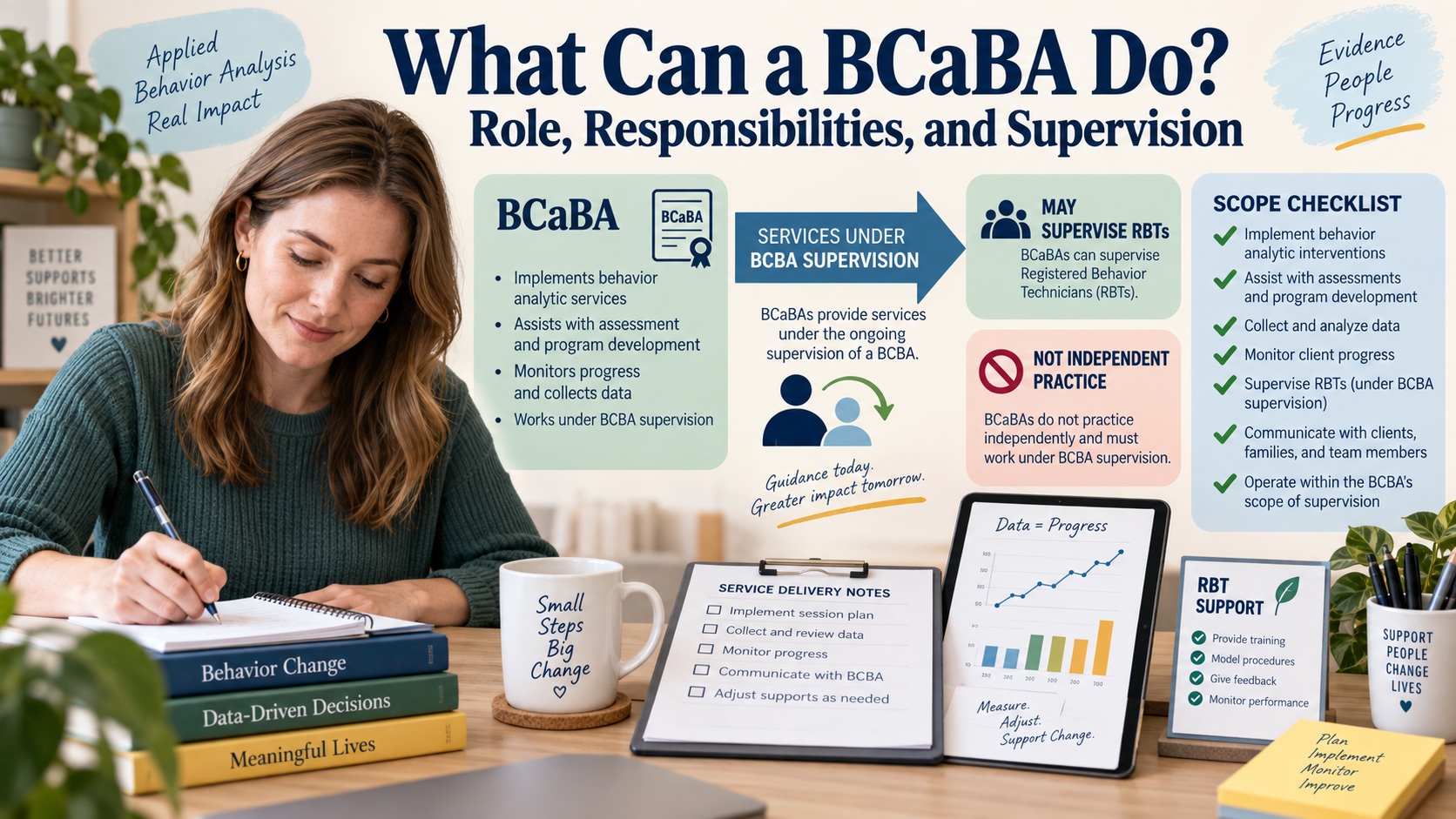
If you ask what can a BCaBA do, the most important answer is about both contribution and boundary. A Board Certified Assistant Behavior Analyst is an undergraduate-level behavior-analysis credential. BCaBAs may provide behavior-analytic services under the supervision of a BCBA, and they may supervise the work of RBTs within the applicable requirements. A BCaBA may not practice independently or replace the BCBA responsible for the case.
That does not make the role passive. A BCaBA can implement and monitor parts of a behavior-analytic service plan, analyze and communicate data, support skill acquisition and behavior-reduction procedures, collaborate with caregivers and staff, and provide structured supervision to RBTs when qualified to do so. The exact duties depend on the plan, setting, supervisor, employer, state or local rules, and current BACB requirements.
This guide explains what the credential can look like in practice without turning a general role description into permission for a particular case. For current requirements, use the BACB BCaBA resources and the BCaBA Handbook.
Table of Contents
What a BCaBA is
BCaBA stands for Board Certified Assistant Behavior Analyst. The credential identifies a professional who has met the applicable BACB requirements for an undergraduate-level certification. “Assistant” describes the credential’s supervised practice structure; it does not mean that the person only performs administrative tasks. A BCaBA can carry out important behavior-analytic work when the assignment, training, supervision, and local rules support it.
The BACB’s current description makes the central boundary clear: BCaBAs may provide behavior-analytic services only under the supervision of a BCBA. The BCBA remains responsible for the supervision arrangement and the clinical or professional decisions assigned to that level of practice.
Behavior-analytic services a BCaBA may provide
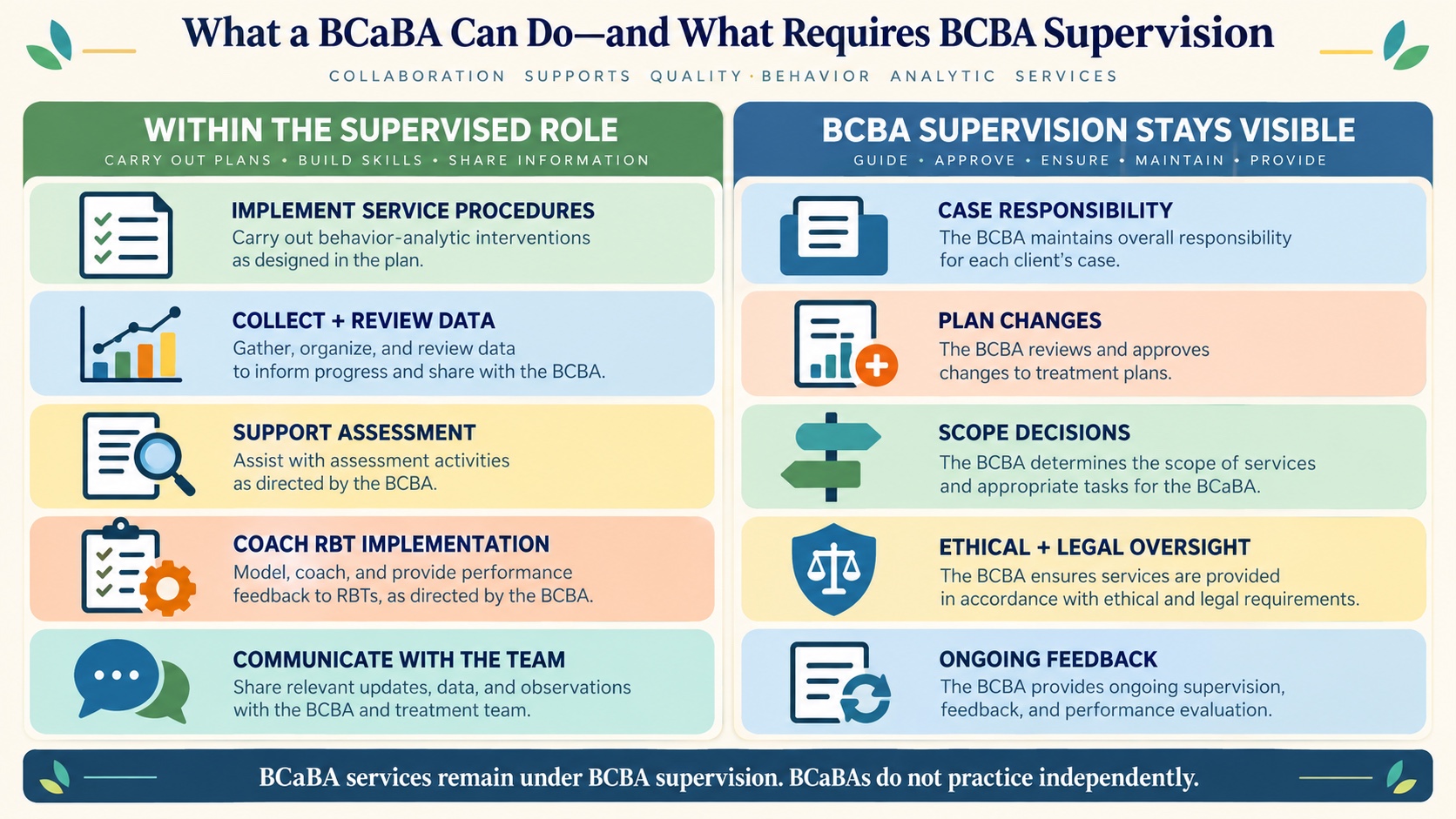
Within a BCBA-supervised service arrangement, a BCaBA may be involved in tasks such as:
- implementing teaching procedures for communication, academic, social, adaptive, or daily-living skills;
- implementing behavior-reduction procedures as written and trained;
- collecting, organizing, and reviewing data on target responses and skill progress;
- preparing session materials, visual supports, teaching opportunities, and data systems;
- providing feedback and coaching to RBTs or other team members within the supervision structure;
- communicating observations, data patterns, barriers, and questions to the supervising BCBA; and
- supporting caregiver or staff training when the BCBA has defined the goals, content, and oversight.
These examples describe possible responsibilities, not an automatic list of permissions. A BCaBA should be trained and competent for the assigned task, work within the written plan and supervision arrangement, and ask for direction when the situation changes. A job description that uses the title “assistant behavior analyst” does not override the current handbook, ethics requirements, licensure rules, or the supervisor’s responsibility.
Data, assessment support, and decision-making
One of the most valuable things a BCaBA can do is turn day-to-day observations into information the team can use. A BCaBA might check whether a response definition is being applied consistently, review a graph for a change in level or trend, compare performance across teaching conditions, or identify that a data-collection procedure needs clarification.
That work still has a decision boundary. Suppose a learner’s independent requests decline after a teaching change. A BCaBA may organize the data, check implementation fidelity, observe the session, and communicate the pattern to the BCBA. The supervising BCBA may then evaluate whether the assessment or intervention needs to change. A BCaBA should not silently redesign a comprehensive behavior plan merely because a graph looks concerning.
Assessment support can include preparing materials, conducting assigned observations, implementing a defined preference-assessment procedure, or documenting relevant context. The specific task must fit the BCaBA’s training, the supervisor’s instructions, the current requirements, and any applicable law or payer policy.
How a BCaBA may work with RBTs
The BACB states that BCaBAs may supervise the work of RBTs. In practice, a BCaBA may help an RBT understand a behavior plan, model a procedure, observe implementation, review data, provide feedback, and communicate concerns to the responsible BCBA. The supervision arrangement must identify who is responsible for the RBT’s work and how the applicable requirements are met.
RBT supervision is not the same as a BCaBA practicing independently. A BCaBA supervising an RBT still practices under BCBA supervision, and the team should be clear about the BCBA’s oversight, the BCaBA’s assigned responsibilities, and the RBT’s direct duties. The BACB’s supervision, assessment, training, and oversight resource identifies the roles and training requirements involved.
For example, a BCaBA may watch an RBT run a prompted communication trial, provide immediate feedback on the written procedure, and review the resulting data. If the plan itself no longer fits the learner’s needs, the BCaBA should bring that question to the BCBA rather than treating the supervision session as permission to independently change the program.
What BCBA supervision means
Supervision is more than a signature on a monthly form. The current BCaBA Handbook describes supervision as a way to improve and maintain the BCaBA’s behavior-analytic, professional, and ethical repertoires while supporting high-quality services. Effective supervision can include observing performance with clients, giving feedback, modeling technical and ethical behavior, reviewing written materials, guiding case conceptualization and problem-solving, and evaluating the effects of supervision.
The BCaBA must have a qualified supervisor responsible for each case and a supervision arrangement that clearly explains responsibilities. If the BCaBA is unsure whether a new task belongs within the assignment, the correct action is to ask the supervisor and document the direction. Working in the same clinic does not, by itself, establish the supervision relationship.
What a BCaBA cannot do independently
A BCaBA may not practice independently. That boundary affects how a BCaBA should describe services, make decisions, and respond to changes in a case.
- No independent behavior-analytic practice: services remain under qualified BCBA supervision.
- No replacing the BCBA: a BCaBA does not become the independently responsible professional simply because they have substantial experience.
- No unassigned clinical redesign: changing goals, assessment conclusions, or comprehensive intervention procedures requires the appropriate supervisor and process.
- No supervision beyond competence or authorization: a BCaBA should supervise RBT work only when the arrangement, training, and applicable requirements support it.
- No ignoring local rules: state licensure, payer policy, employer procedures, and client-specific requirements may add restrictions.
These boundaries protect clients and also protect the BCaBA. A clear escalation path makes it easier to report safety concerns, conflicting instructions, missing data, or procedures that no longer match the learner’s needs.
BCaBA vs. BCBA
| Question | BCaBA | BCBA |
|---|---|---|
| Credential level | Undergraduate-level certification | Graduate-level certification |
| Practice structure | Provides services under BCBA supervision | May practice independently within applicable requirements |
| RBT relationship | May supervise RBT work within applicable requirements | May supervise RBTs, BCaBAs, and other professionals within applicable requirements |
| Decision boundary | Works within the assigned plan and supervision arrangement | Holds the broader independent practitioner and supervisory responsibility defined by the credential and applicable rules |
The comparison is about credential scope, not the value of the person’s contribution. High-quality services depend on coordinated work across roles, accurate data, ethical conduct, and effective supervision.
A practical scope checklist
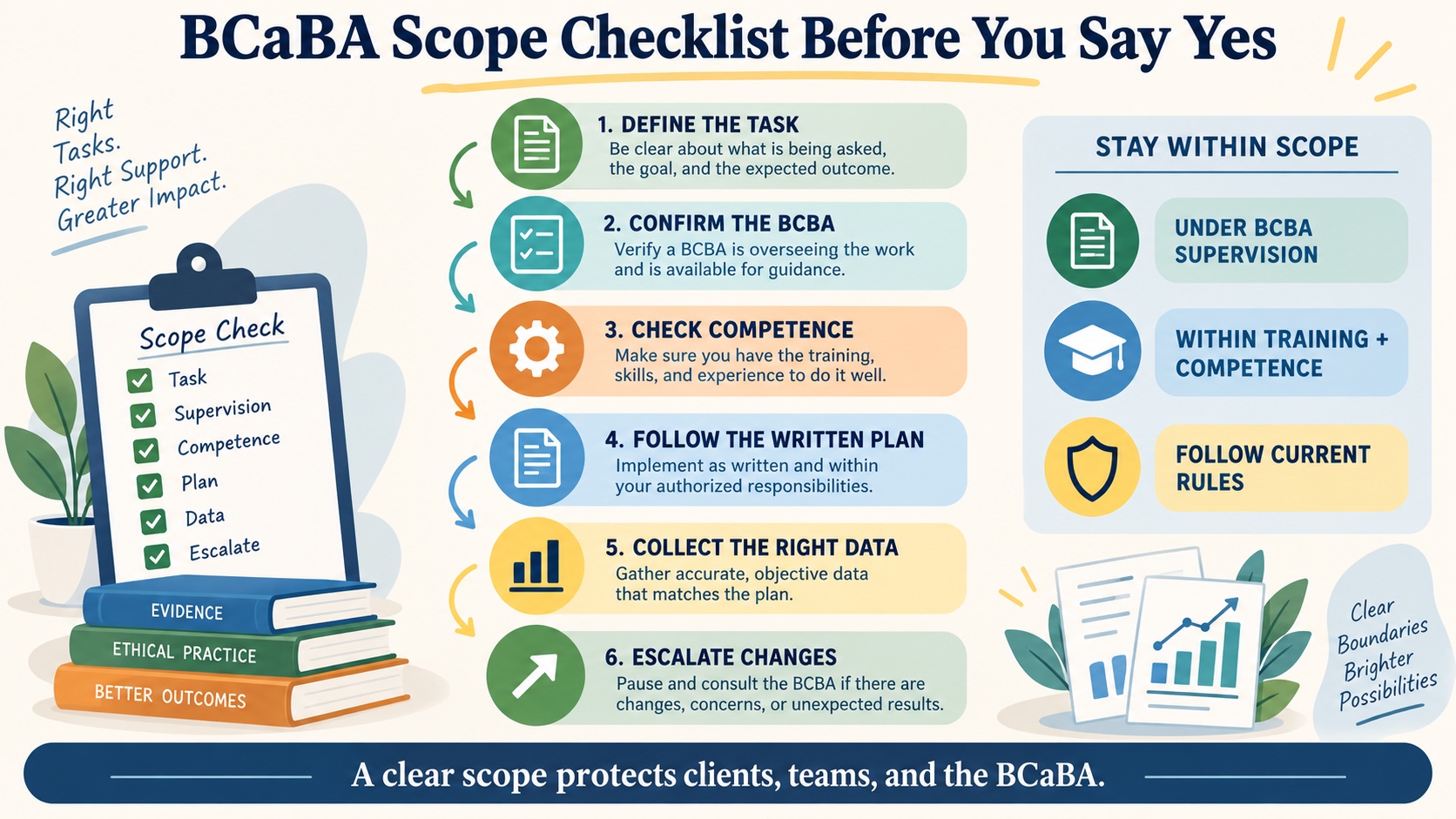
Before accepting a new responsibility, a BCaBA can ask:
- What is the exact task, client, setting, and expected outcome?
- Which BCBA is responsible for the case and available for supervision?
- Do I have the training and demonstrated competence for this task?
- Is the procedure written, current, and consistent with the client’s plan?
- What data should be collected, and how will the supervisor review it?
- Does this request change the plan or exceed my assigned role?
- What do local licensure, payer, employer, ethics, or privacy rules require?
These questions turn a broad “can I do this?” question into a supervision conversation that can be answered responsibly.
FAQ and official sources
What can a BCaBA do?
A BCaBA may provide behavior-analytic services under BCBA supervision and may supervise RBT work within applicable requirements. Specific duties depend on the service plan, supervisor, competence, setting, and current rules.
Can a BCaBA practice independently?
No. The BACB states that BCaBAs may only provide behavior-analytic services under BCBA supervision.
Can a BCaBA supervise an RBT?
Yes, BCaBAs may supervise RBT work within the applicable requirements. The BCaBA remains under BCBA supervision, and the team must define responsibility and documentation clearly.
Can a BCaBA design a behavior plan?
Do not treat the title alone as permission to independently design or change a comprehensive plan. Follow the assignment, supervision arrangement, current handbook, local rules, and the responsible BCBA’s direction.
Where can I learn the BCaBA requirements?
Start with the current BCaBA Handbook, the BACB BCaBA page, and the BACB supervision resources. The ABA Study Online BCaBA learning resources can support study but do not determine scope or authorization.