Verbal Behavior Definition in ABA: What the Term Means
The phrase verbal behavior can sound as if it means speaking out loud. In ABA, it has a more specific meaning. It describes a functional way to study communication by examining the relation among a response, the conditions that occasion it, and the behavior of the listener who helps produce the consequence.
That definition changes how you read a communication example. A spoken word, sign, picture selection, written message, or speech-generating-device response cannot be classified only by its appearance. The same form may do different work in different situations. To understand the term, start with the speaker-listener relationship, then look at the relevant antecedents and consequences.
Quick answer: verbal behavior definition in ABA
In ABA, verbal behavior is communication behavior whose relevant consequences are mediated by another person responding through learned communication practices. The behavior may be vocal, signed, written, picture-based, gestural, or produced through an augmentative and alternative communication system. What matters is not simply the form; it is how the response functions in relation to the speaker, listener, environment, and consequence.
This is a study definition, not a diagnosis or a complete communication assessment. A precise analysis asks what response occurred, what variables were present, what the listener did, and whether the available evidence supports the proposed relation.
What listener mediation means
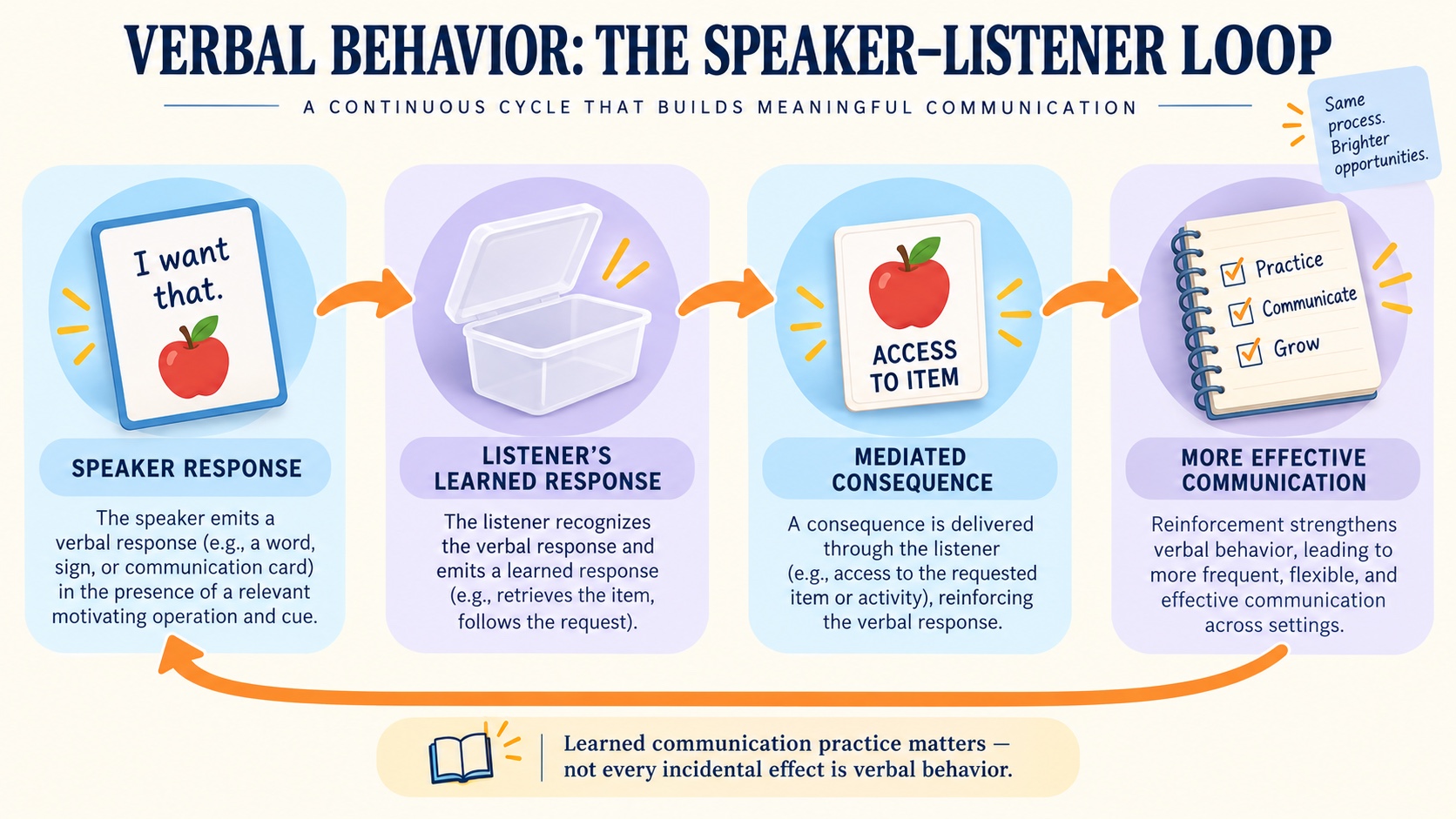
Imagine that a learner hands a communication partner a card that says “open.” The partner recognizes the card, opens a container, and the learner gets access to the activity inside. The learner’s card exchange is not just a physical movement. It works because the partner has learned how to respond to that communication form. The listener’s response mediates access to the relevant outcome.
The word mediated does not mean that every action that changes another person’s behavior automatically qualifies as verbal behavior. The communication arrangement includes a learned social practice. If someone bumps a door by accident and another person happens to open it, the event may involve another person’s behavior, but that single observation does not establish an intentional or learned communication relation. The analyst needs more information about the response, context, history, and consequence.
This speaker-listener view also keeps the analysis grounded in observable events. Instead of asking only what a word “means inside the person,” ask what happened before the response, how the listener responded, and what changed afterward. That does not make communication cold or mechanical. It makes the conditions for effective communication more visible and easier to support respectfully.
Why verbal behavior is not the same as speech
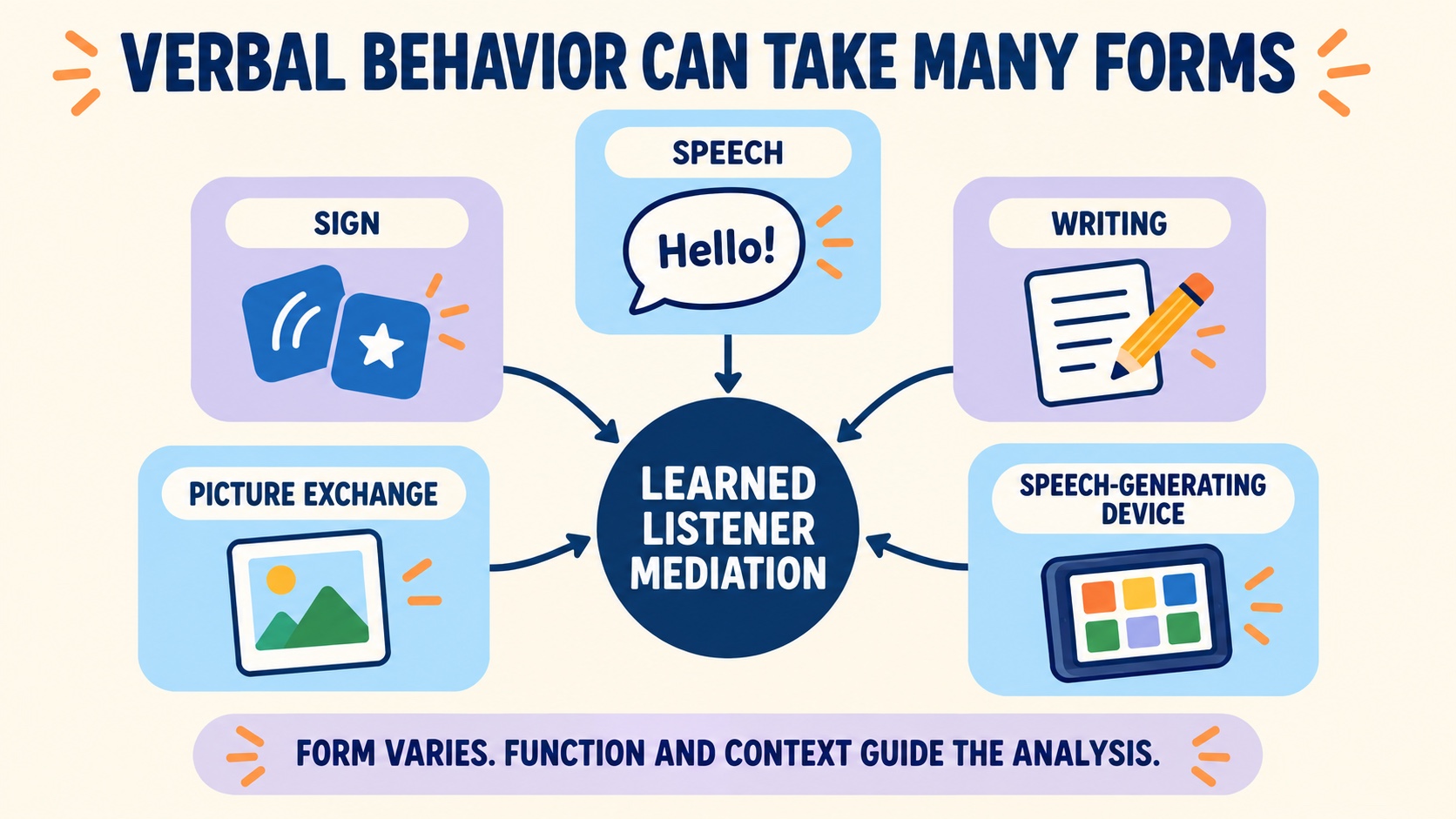
In everyday conversation, verbal often means spoken. In the ABA definition, spoken language is one possible response form, not the boundary of the concept. A person may communicate by:
- speaking a word or phrase;
- using a manual sign or another established movement;
- writing or typing a message;
- selecting a picture or symbol for a communication partner;
- activating a speech-generating device; or
- using another response form that works through a learned listener practice.
Including these forms is not a claim that every gesture or device activation has the same function. A form becomes meaningful for analysis through its conditions and consequences. A picture selection may request access, label an item, answer a question, or serve another communication function depending on the arrangement.
This distinction is important for respectful learning and service design. A spoken response should not be treated as automatically more valuable than an accessible signed, written, picture-based, or device-mediated response. The relevant goals are effective communication, autonomy, dignity, participation, and meaningful access in the person’s daily context.
A speaker-listener example
Consider a fictional example. During a snack routine, a learner selects “water” on a speech-generating device. The partner looks at the display, gets water, and hands it to the learner. The observable record can include the selected symbol, the context, the partner’s response, and the resulting access to water. The example illustrates listener mediation without requiring the learner to use speech.
Now change the arrangement. The learner selects “water” after an adult asks, “What would you like to drink?” The response may be analyzed differently from a spontaneous request because the verbal question is now part of the immediate context. Change it again: the adult says “water” and the learner repeats the sound. The response form may look similar, but the controlling relation is different. A full discussion of mand, tact, echoic, and intraverbal distinctions belongs in the related verbal-operants study page; the key point here is that form alone is not enough.
These examples are intentionally simplified. Real communication may be multiply controlled, and a short note may not contain enough evidence to choose one functional label confidently. Good analysis states what was observed, identifies plausible variables, and marks what remains unknown.
How the definition connects to verbal operants
Verbal operants are more specific units within the broader analysis. Common introductory categories include:
- Mand: communication influenced by a relevant motivating variable and typically followed by a specific reinforcer.
- Tact: communication occasioned by a nonverbal stimulus and often followed by generalized social reinforcement.
- Echoic: a response controlled by a similar verbal model with point-to-point correspondence.
- Intraverbal: a verbal response controlled by another verbal stimulus without point-to-point correspondence.
These labels are not determined by the word itself. In the current BCBA Test Content Outline, distinguishing verbal operants and identifying multiple control are study topics. For a scenario question, name the response form, then look at the motivating variables, nonverbal stimuli, verbal stimuli, listener behavior, and consequence. If more than one variable is present, say so rather than forcing a simple answer from incomplete information.
The definition also does not mean that communication must be perfectly intentional, fluent, or socially typical before it can be studied. A learner can have a strong mand repertoire and a smaller tact repertoire, or communicate effectively in one routine and not yet in another. The analyst’s job is to describe the conditions under which the response works, not to judge the person’s communication by one preferred form.
It is equally important not to turn the definition into a promise that a particular verbal-behavior program will produce a particular outcome. Functional analysis gives practitioners a way to ask better questions about communication and arrange learning opportunities. Goals still need to be socially meaningful, accessible, culturally responsive, and connected to the learner’s preferences and daily life. Data and collaboration guide the next step.
Common mistakes and study checklist
- Defining verbal as vocal: remember that communication modality and verbal behavior are not the same question.
- Ignoring the listener: identify how another person’s learned response mediates the consequence.
- Calling every social effect verbal behavior: look for the learned communication arrangement, not just an incidental effect.
- Classifying from form alone: the same word, sign, or symbol can serve different functions.
- Overstating a short observation: a definition example is not a complete assessment of a person’s repertoire.
Use these questions when reviewing the definition:
- What exactly did the speaker do?
- What did the listener do in response?
- Was the listener’s response part of a learned communication practice?
- What consequence became available to the speaker?
- Could another variable also be influencing the response?
- What information is still missing?
For a broader set of ABA concepts, use the ABA Theory Blocks, practice distinctions with free ABA questions, or search related terms in the ABA Definition Search. The ABA Study Online app can support flashcards and section practice. Current protocols, qualified supervision, and the learner’s preferences remain important for real-world communication decisions.
FAQ and sources
What is the simplest verbal behavior definition in ABA? It is communication behavior whose relevant consequence is mediated by another person responding through a learned communication practice.
Does verbal behavior have to be spoken? No. Speech is one form. Signing, writing, picture exchange, and speech-generating devices may also be forms of verbal behavior when they function through learned listener mediation.
Is verbal behavior a separate type of ABA? It is a functional analysis of communication that uses behavior-analytic principles. It is not a promise, certification, or replacement for the broader science of behavior analysis.
Does one example prove the function of a response? No. A brief example can illustrate a possible relation, but stronger conclusions require clear definitions, repeated observation, and relevant context.