
Verbal Behavior in ABA: Definition and Common Verbal Operants
When people first hear “verbal behavior,” they often think the term means talking. In ABA, the idea is broader and more precise. Verbal behavior is a functional way to analyze communication: what happened before the response, what variables influenced it, and how another person’s consequence helped maintain it.
This means the same spoken word can be different verbal behavior in different situations. A learner might say “cookie” while looking at a cookie, while asking for a cookie, while answering a question about snack, or while repeating an adult’s model. The sound is similar. The relevant behavioral relations are not.
Quick answer: what is verbal behavior in ABA?
Verbal behavior in ABA is a functional account of communication in which responses are classified by the environmental variables that control them and by the consequences that maintain them. The “verbal” part does not require spoken words. Depending on the functional relation, communication can involve speech, signing, writing, picture exchange, gestures, or a speech-generating device.
The most commonly studied elementary verbal operants include the mand, tact, echoic, and intraverbal. They are not simply vocabulary categories. They describe different relations between a response and its antecedents or consequences. In current BCBA exam-study language, distinguishing verbal operants and understanding multiple control are explicit concepts to review, but the BACB Test Content Outline is not a complete definition of verbal behavior.
Form versus function in communication
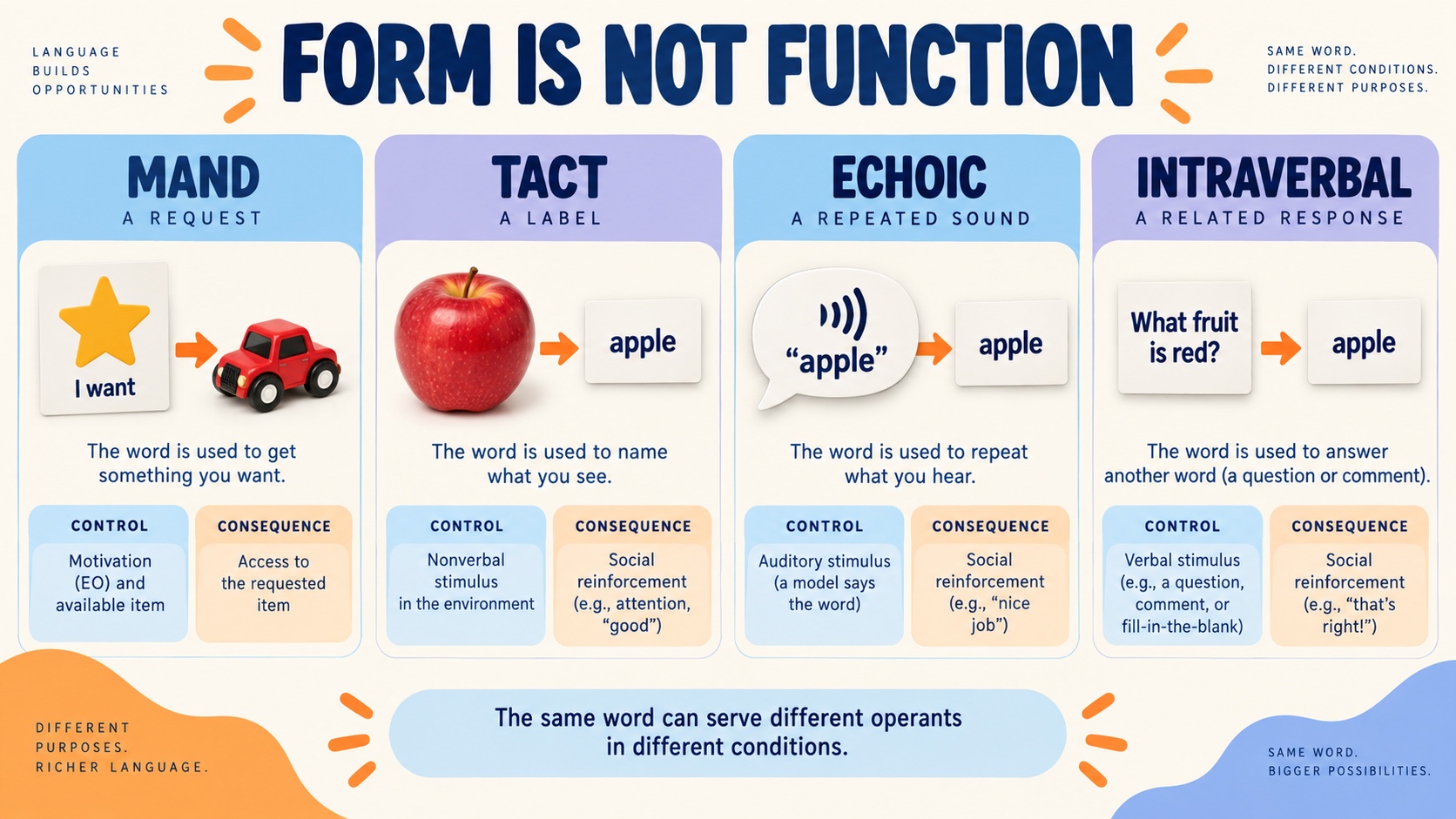
Form describes what the response looks or sounds like: saying “cookie,” pointing to a picture, typing a word, or handing over a card. Function asks what variables occasioned the response and what consequence followed it. Two responses can have different forms but the same function, and two responses with the same form can have different functions.
Consider a picture exchange response. If the learner hands over a picture when access to the item is motivating and receives that item, the response may function as a mand. If the learner selects a picture to label an item after seeing it and receives social acknowledgment, the relevant relation may be a tact. The picture itself does not decide the label; the arrangement and history matter.
This functional approach also prevents a common mistake: treating “language” as one single skill. A learner may label many objects but rarely request them, repeat adult models but struggle to answer questions, or answer familiar questions but not communicate spontaneously. Looking at the operants separately can reveal which conditions support responding and which conditions still need to be assessed.
Mand, tact, echoic, and intraverbal
The following descriptions are study-level summaries. In a real assessment, the response definition, antecedent arrangement, consequence, communication modality, and relevant learning history all need to be considered.
- Mand: a response influenced by a relevant motivating variable and typically followed by a specific reinforcer. For example, a learner says “water” when thirsty and receives water. “Request” is a helpful everyday shortcut, but the motivational condition and specific consequence are part of the analysis.
- Tact: a response occasioned by a nonverbal stimulus, such as an object, event, or property, and often maintained by generalized social consequences. A learner sees a red apple, says “apple,” and receives acknowledgment. The apple is the relevant nonverbal stimulus in this example.
- Echoic: a response controlled by a prior verbal stimulus that resembles the response in form and has point-to-point correspondence. An adult says “ball,” and the learner repeats “ball.” The important relation is not merely that the answer is correct; it is that the prior verbal model controls a corresponding response.
- Intraverbal: a verbal response controlled by a prior verbal stimulus without point-to-point correspondence. An adult asks, “What do you drink?” and the learner answers “water.” The answer is related to the question, but it does not copy its words in the way an echoic does.
These are not the only verbal relations described in a full analysis. Textual behavior, copying a text, taking dictation, autoclitic behavior, audience variables, and other relations can also matter. For an introductory definition page, mand, tact, echoic, and intraverbal provide a useful starting comparison without pretending to cover every part of Skinner’s analysis.
One word, four possible analyses
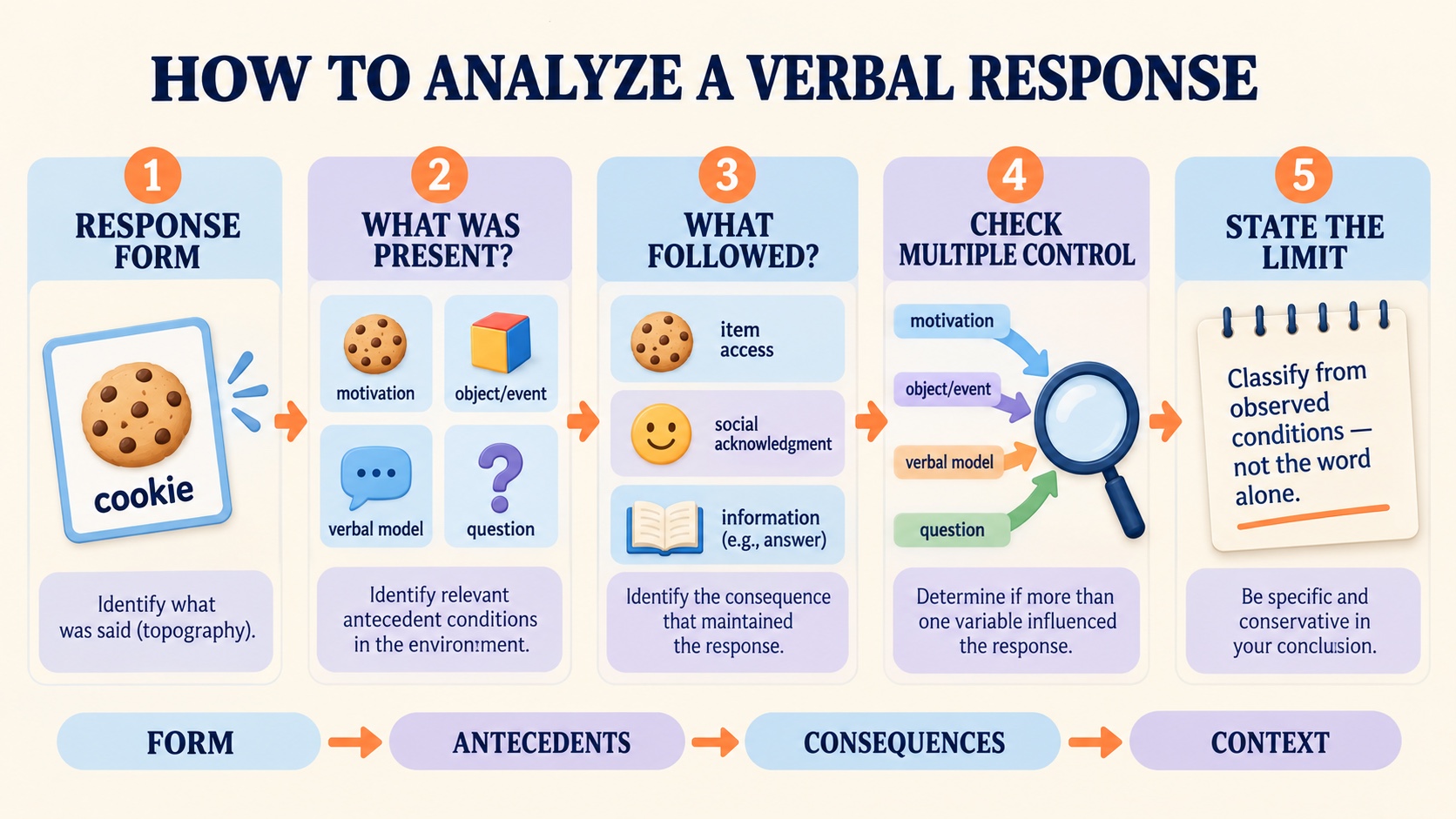
Imagine a fictional learner who says “cookie.” Look at four different arrangements:
- Requesting: the learner has not had a snack, sees cookies available, says “cookie,” and receives one. The motivating condition and specific item consequence support a mand interpretation.
- Labeling: the learner sees a cookie on the table, says “cookie,” and an adult responds with acknowledgment. The nonverbal stimulus supports a tact interpretation.
- Repeating: an adult says “cookie,” and the learner immediately says “cookie.” The matching verbal model supports an echoic interpretation.
- Answering: an adult asks, “What do you want for snack?” and the learner says “cookie.” The verbal question supports an intraverbal relation in this simplified example.
The examples are intentionally clean for study. Real communication can be multiply controlled. The learner may see the cookie, want the cookie, hear part of a question, orient to a particular listener, and respond under several influences at once. Do not decide from the word alone. Ask what was present, what was absent, what consequence followed, and what history makes the response likely in that moment.
Context also matters for respectful assessment. Communication goals should be socially meaningful, culturally responsive, and appropriate to the person’s preferred modality and daily environments. A spoken response is not automatically better than a signed, picture-based, typed, or device-mediated response. The relevant question is whether the communication is effective, accessible, and connected to the learner’s goals and context.
How to analyze a verbal-behavior example
For a study question or a fictional case, use a short evidence path:
- Describe the response form. What did the learner say, sign, write, select, point to, or activate? Keep the description observable.
- Identify the immediate antecedents. Was there a motivating condition, a nonverbal object or event, a verbal model, a question, a visual cue, or a relevant audience?
- Check correspondence. If another person provided a verbal stimulus, did the response repeat it in form, answer it without copying, or do something else?
- Identify the consequence. Did the learner receive the requested item, social acknowledgment, access to information, help, or another outcome? Was the consequence actually delivered and likely relevant?
- Consider multiple control and missing information. If several variables were present, say so. Do not turn a plausible classification into certainty when the record is incomplete.
When documenting a real session, follow the approved data system and role boundaries. A note should separate what was observed from the interpretation. “Said ‘cookie’ after the question and received the snack item” is an observation with context. “The learner has mastered intraverbals” is a much larger claim that would require defined targets, repeated data, and a stated criterion.
For exam preparation, practice contrast rather than memorizing isolated sentences. Ask why the answer is a mand instead of a tact, or an intraverbal instead of an echoic. The strongest explanation names the controlling variable and the consequence, then points out any information the scenario does not provide.
Common mistakes and study checklist
- Equating verbal behavior with speech: analyze function and modality, not just vocal output.
- Classifying by the word: “cookie” is not always a tact, mand, echoic, or intraverbal.
- Calling every answer an intraverbal: check whether the response actually has point-to-point correspondence with a verbal model.
- Calling every request a mand: look for the motivating variable and the specific consequence.
- Ignoring multiple control: real responses may be influenced by more than one variable.
- Making a clinical conclusion from one example: distinguish an educational classification from a complete assessment.
Use these questions to review a case:
- What is the response form, and what communication modality is being used?
- What nonverbal, verbal, motivational, and audience variables were present?
- Was there point-to-point correspondence with a prior verbal stimulus?
- What consequence followed, and why might it maintain responding?
- Could more than one variable be controlling the response?
- What data or context would you need before making a stronger conclusion?
For another pass through ABA concepts, use the ABA Theory Blocks, practice scenario discrimination with free ABA questions, or review related terms in the ABA Definition Search. The ABA Study Online app can support flashcards and section practice, while real communication assessment and intervention should follow qualified supervision and the learner’s context.
FAQ and sources
What is verbal behavior in ABA? It is a functional account of communication that classifies responses by the variables that occasion and maintain them, rather than by response form alone.
Does verbal behavior have to be spoken? No. A response can be vocal, signed, written, picture-based, gestural, or device-mediated. The functional relation is the focus.
What are the four common verbal operants? Mand, tact, echoic, and intraverbal are four common introductory examples. A full analysis includes additional verbal relations and contextual variables.
Can the same word be more than one operant? Yes. The same form can be a mand in one context, a tact in another, an echoic after a verbal model, or an intraverbal in response to a question.
What is multiple control? Multiple control means that more than one antecedent or contextual variable influences a response. It is a reason to examine the full arrangement instead of guessing from one word.
Sources
- BACB Task Lists for BACB Certifications
- BACB BCBA Test Content Outline (6th ed.)
- Michael: On Intraverbal Control and the Definition of the Intraverbal
- A Methodology for Assessing the Functions of Emerging Speech in Children With Developmental Disabilities
- Empirical Applications of Skinner’s Analysis of Verbal Behavior with Humans
- Culturally Responsive Language Assessment Through a Verbal Operant Experimental Analysis