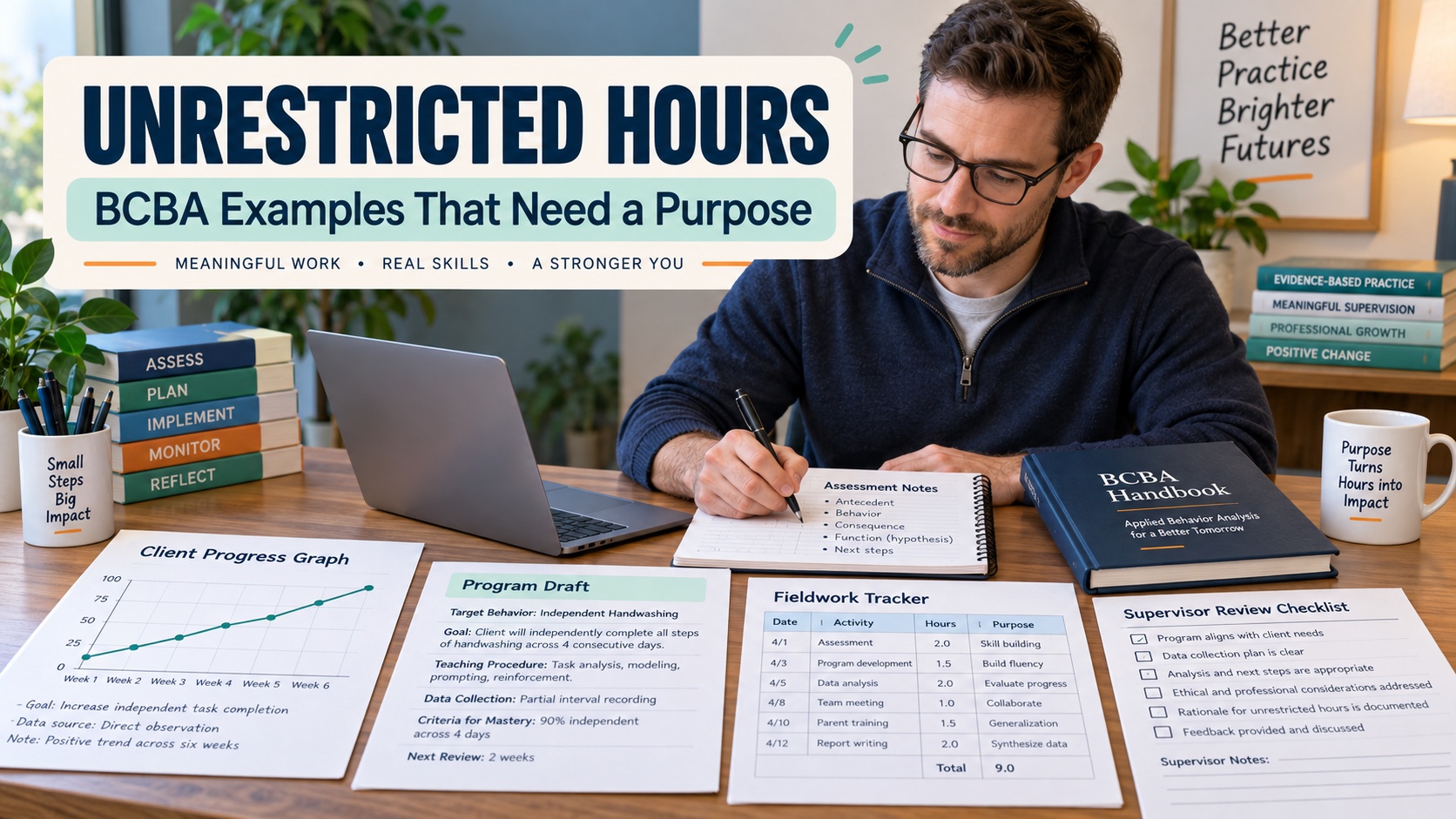
Unrestricted Hours BCBA Examples: What May Count as Fieldwork?
Searching for unrestricted hours BCBA examples usually means you have a practical problem: your schedule contains direct sessions, paperwork, meetings, and study time, but you are not sure which activities develop the skills required of a future BCBA. A list can give you ideas, but a list alone is risky. The same task can be restricted, unrestricted, or not count as fieldwork at all depending on its purpose, client connection, and behavior-analytic content.
The current BACB BCBA Handbook is the controlling source for requirements. Your qualified supervisor decides how an activity fits your fieldwork plan and documentation. Use the examples below to start a specific conversation—not to self-approve hours after the fact.
Table of Contents
Short answer: what makes an activity potentially unrestricted?
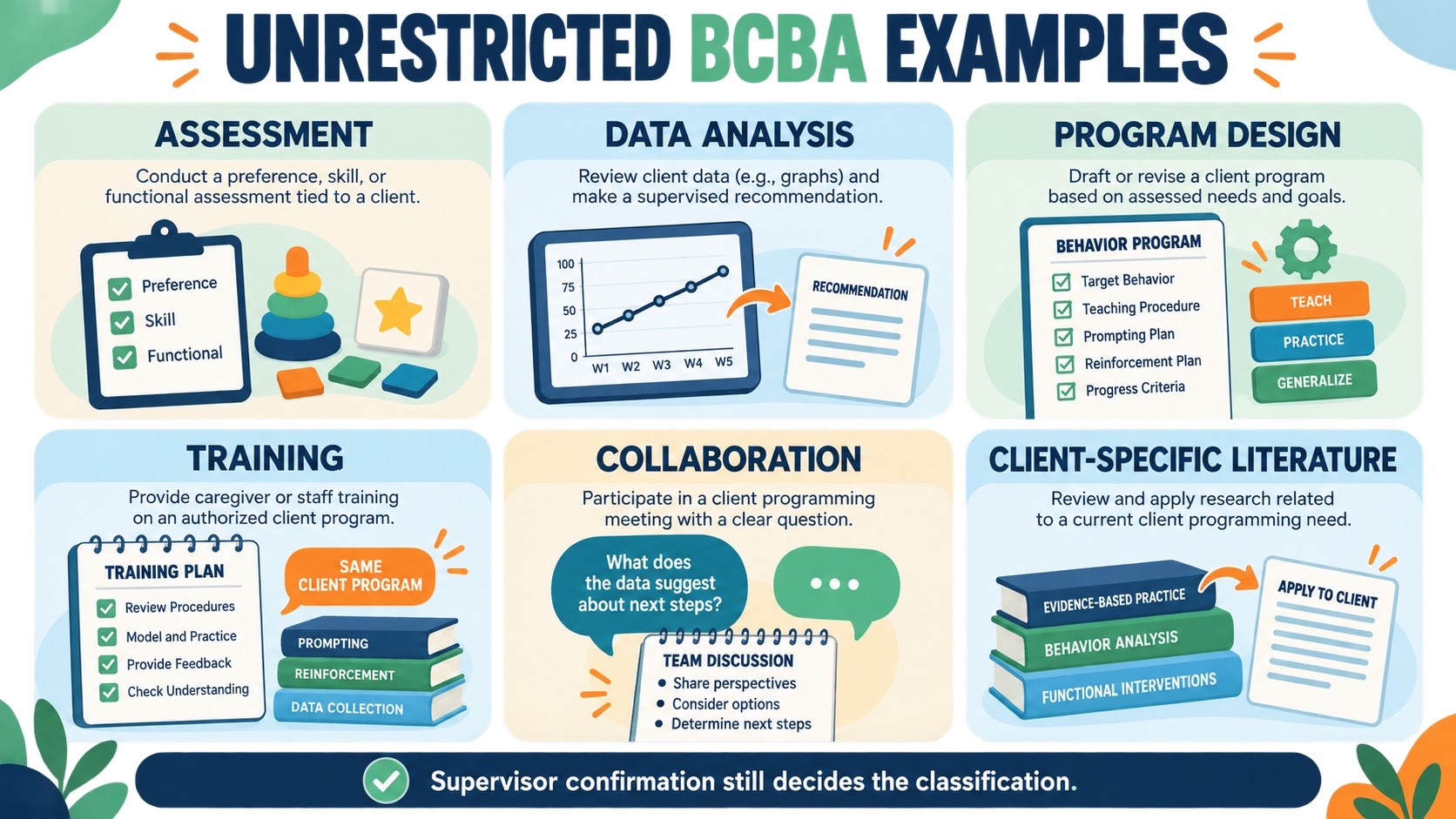
Unrestricted activities are activities most likely to be performed by a BCBA. The current Handbook gives examples such as observation and data collection, behavior-analytic assessments, data graphing and analysis, writing or revising behavior programs, training staff or caregivers, meeting with clients about behavior-analytic programming, and researching literature relevant to a current client.
For an activity to be a useful candidate, ask four questions:
- Is it behavior analytic rather than general administration or generic education?
- Is it tied to a specific current client and a real programming question?
- Does it involve assessment, analysis, program design, training, or another BCBA-level decision rather than only implementing a prepared procedure?
- Has your supervisor agreed that the purpose, documentation, and classification fit your fieldwork plan?
The Handbook also sets the current BCBA fieldwork split: at least 60% of total fieldwork must be unrestricted, while restricted activities may make up no more than 40%. That ratio does not mean every month must look identical, and it does not turn every hour in a clinic into unrestricted work. The activity itself and its purpose matter.
Use a three-part classification test
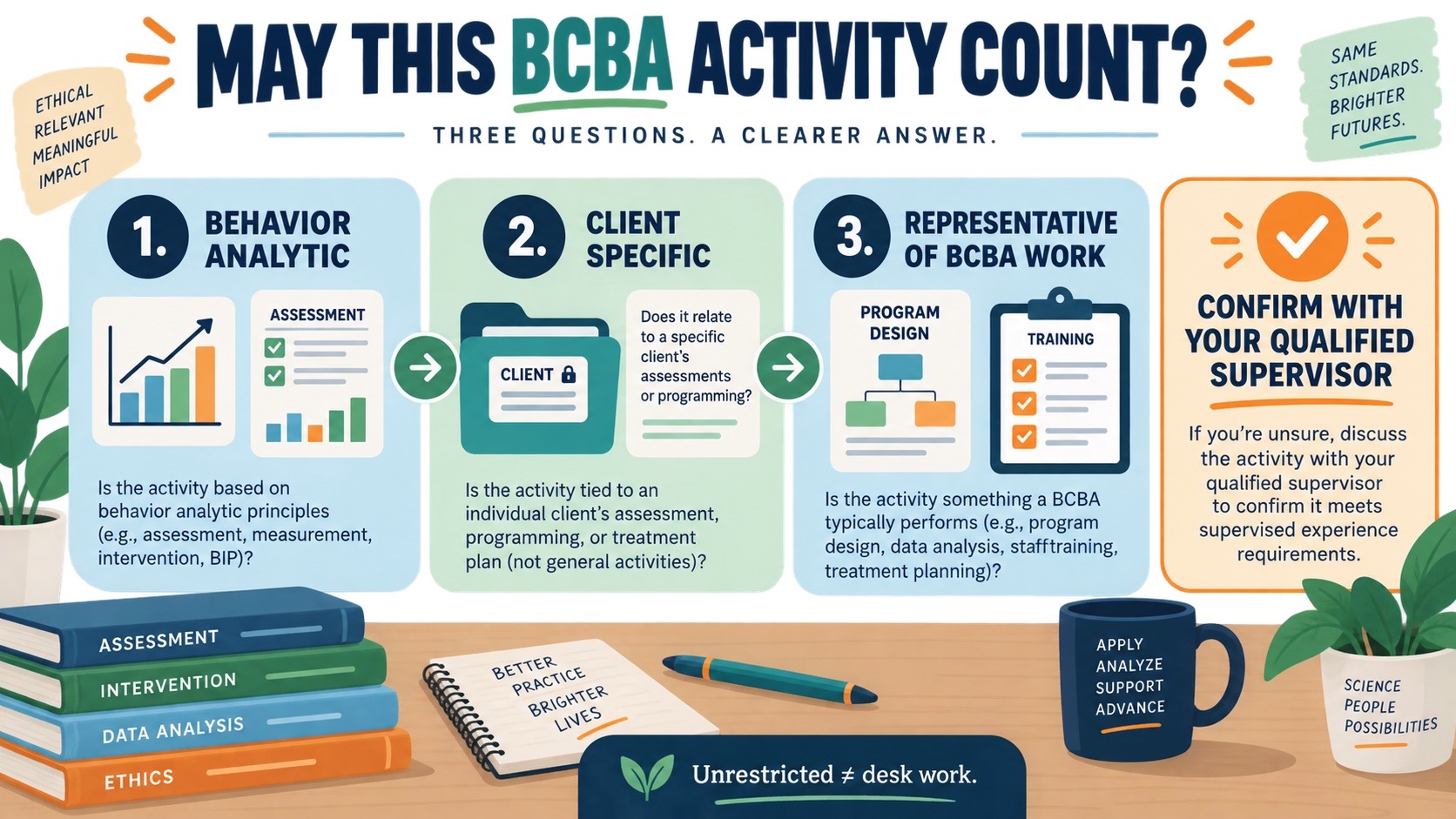
Before adding an activity to a tracker, write a one-sentence purpose statement. “I attended a staff meeting” is too broad. “I reviewed a client’s graphed escape-maintained behavior with the supervisor and drafted two data-based questions for the next treatment review” gives the activity a behavior-analytic and client-specific purpose.
1. Behavior analytic
The work should use behavior-analytic observation, measurement, assessment, intervention planning, data interpretation, training, or related decision-making. A general workplace orientation, billing tutorial, CPR course, or administrative meeting may be valuable, but value alone does not make an activity fieldwork.
2. Client specific
The work should connect to a current client receiving behavior-analytic services through the formal fieldwork relationship. Reading a paper because it is interesting is different from reading and summarizing literature that addresses a current client’s communication, measurement, assessment, or programming question.
3. Representative of BCBA work
The activity should build a skill a BCBA is likely to use: assessing needs, evaluating data, designing or revising programs, training others, collaborating around programming, or making an ethical and evidence-informed recommendation. “Unrestricted” does not mean unsupervised, optional, or unrelated to direct services.
Practical unrestricted BCBA examples
The following examples are starting points for supervisor discussion. Each includes the work product that can make the purpose visible.
Conduct or interpret a behavior-analytic assessment
You might conduct a preference assessment, help collect information for a functional behavior assessment, score a skills assessment, or summarize an intake interview when the work is tied to a client’s programming need. The product could be a scored assessment, a concise summary of patterns, or questions for a supervisor review. Simply delivering a prewritten preference procedure as part of routine treatment may have a different classification, so describe why the assessment was conducted and what decision it informs.
Analyze graphs and make a data-based recommendation
Review a client’s acquisition or behavior-reduction graphs, check measurement quality, identify a meaningful pattern, and prepare a recommendation for supervisor discussion. A useful record names the client, the data source, the behavior or skill, the analysis completed, and the decision that remains with the supervisor. Do not turn a trainee’s draft into an independent treatment-plan change.
Write or revise a behavior-analytic program
Draft an operational definition, teaching sequence, data sheet, behavior plan section, progress summary, or transition recommendation for a current client. The work is strongest when it uses assessment results and is reviewed by the supervisor. Copying a generic template without applying it to a client’s needs is not the same as designing a program.
Train staff or caregivers on a client’s program
Prepare a short training, model a procedure, observe implementation, give performance feedback, and summarize what the team needs next. Keep the training tied to an authorized behavior-analytic program and the specific learner. A general employer orientation or non-behavioral compliance training does not become unrestricted simply because technicians attended.
Meet with a client or team about behavior-analytic programming
A meeting can be a candidate when it involves analyzing a client’s progress, planning assessment, reviewing implementation fidelity, adapting goals, or coordinating behavior-analytic services. The calendar label “team meeting” is not enough. Record the client-specific programming question and the behavior-analytic decisions discussed.
Research literature relevant to a current client
Search and summarize literature that addresses a real programming question for a current client, then bring the limitations and possible applications to supervision. General exam reading, unrelated coursework, and browsing articles without a client connection should not be relabeled as fieldwork. The value is in the client-specific evidence review and the supervised interpretation.
Why the same task can classify differently
Consider data collection. A trainee may collect data solely to implement a client’s treatment program. That can be restricted. Another trainee may design an observation system to answer an assessment question, compare measurement options, and interpret the results with the supervisor. The surface action—watching and recording behavior—looks similar, but the purpose and analytic responsibility differ.
Consider documentation. Writing a behavior-analytic progress summary or program section for a current client may be part of BCBA-level work. Entering routine administrative information, billing, or non-behavioral paperwork is different. Consider training: coaching a caregiver on an individualized behavior-analytic program may be relevant; attending a general software orientation is not.
That is why labels such as “desk work,” “client work,” or “supervision time” are not sufficient. Describe what question the work answered, what behavior-analytic product it produced, and how the supervisor reviewed it.
Activities that may not count
The current Handbook lists examples of activities that do not count as fieldwork, including university coursework and assignments, conferences or workshops, meetings with little or no behavior-analytic content, non-behavioral administration or billing, non-behavior-analytic training, and reading or research unrelated to current clients. Role-playing procedures without a client connection may also fail the client-specific requirement.
Do not try to solve a low unrestricted percentage by renaming ordinary study time. Instead, show your supervisor the gap and ask for supervised opportunities such as graph analysis, assessment preparation, program writing, caregiver training, or a client-specific literature review. A qualified supervisor must decide whether the opportunity fits your fieldwork plan.
How to prepare a fieldwork record
- Name the client and purpose: use the privacy-safe identifier your organization permits and state the programming question.
- Describe the activity: write the observable work completed, not only “supervision” or “meeting.”
- Identify the product: note the graph review, assessment summary, draft program, training material, or literature summary.
- Record supervision: document the feedback, revision, observation, or decision that occurred under the approved relationship.
- Confirm the category: ask the supervisor whether it is unrestricted, restricted, or not countable before relying on it for the ratio.
Keep your tracker consistent with the current Handbook, your supervision agreement, and your organization’s privacy rules. ABA Study Online can help explain the distinction, but it cannot approve your fieldwork hours or replace supervisor judgment.
FAQ and sources
How many unrestricted hours are required for BCBA fieldwork?
The current BACB BCBA Handbook states that at least 60% of total BCBA fieldwork hours must be unrestricted, while restricted activities may make up no more than 40%. Check the current Handbook and your supervisor’s plan for the pathway and dates that apply to you.
Does data collection count as unrestricted?
Sometimes, but not automatically. The purpose matters. Data collection used solely to implement a treatment program may be restricted; assessment-oriented observation and analysis may be unrestricted. Ask your supervisor to classify the specific activity.
Does studying count as unrestricted fieldwork?
Ordinary studying, coursework, homework, and reading unrelated to a current client generally do not count as fieldwork. A client-specific literature review connected to a programming question may be a different activity, but it still requires supervisor confirmation and appropriate documentation.
Who decides whether an activity counts?
Your qualified supervisor should evaluate the activity in the context of your client, relationship, fieldwork plan, and documentation. A general online list cannot approve an individual entry.