
Threats to Internal Validity in ABA: How to Spot Rival Explanations
Internal validity is about the credibility of a causal conclusion. If behavior changes after an ABA intervention begins, can the analyst reasonably attribute the change to that intervention, or could another event, measurement change, or time-related process explain it? A threat to internal validity is an alternative explanation that makes the causal conclusion less secure.
Single-case designs address this problem through repeated measurement, planned phases, prediction, verification, and replication. But no design label makes rival explanations disappear automatically. The learner still needs to inspect the data, the measurement system, the phase changes, the setting, and what else happened during the study.
Quick answer: a threat to internal validity is a plausible rival explanation for the observed change in the dependent variable. Common examples include history, maturation, testing, instrumentation, regression to the mean, treatment interaction, carryover, and setting effects. Stronger single-case logic reduces these threats by keeping measurement stable, scheduling phase changes carefully, and replicating the relation across phases, tiers, settings, or participants.
The main threats to internal validity
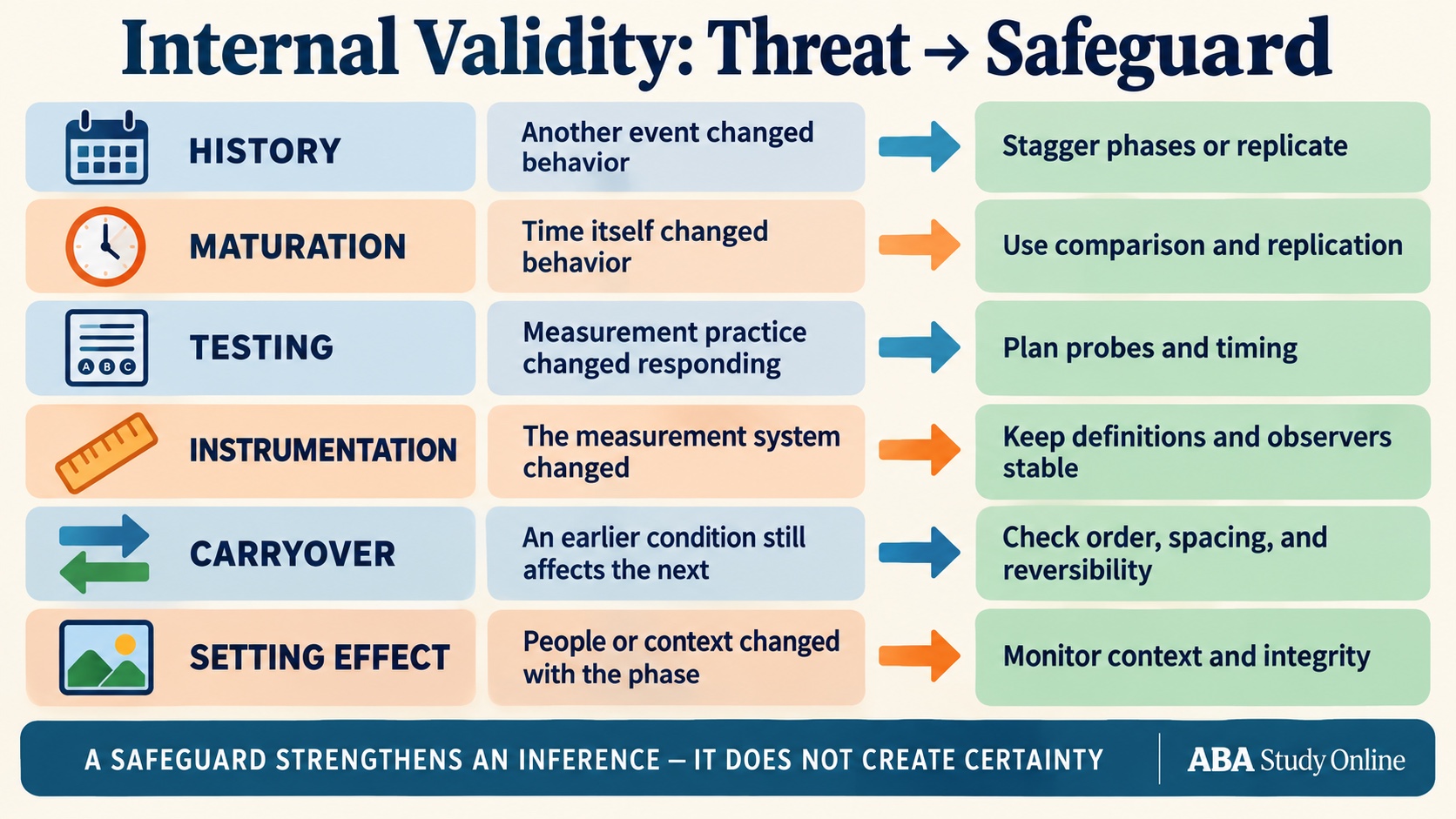
History is an event outside the intervention that occurs during the study and could change behavior. A school schedule changes, a new teacher arrives, a medical event occurs, or another program starts at the same time as the intervention. If the behavior changes after that event, the intervention is not the only possible explanation.
Maturation refers to changes that occur as time passes, such as development, fatigue, recovery, learning from ordinary experience, or changes in motivation. History is a particular event; maturation is a time-related process. The distinction matters when a learner improves gradually even without the planned intervention.
Testing or repeated-measurement effects occur when the experience of being measured changes later performance. Repeated probes may create practice, awareness, or rehearsal. A learner may improve because the assessment itself became familiar rather than because the intervention produced the change.
Instrumentation occurs when the measurement system changes. An observer may use a new definition, a different recording method, a different device, or a different level of attention. If the score changes when the measurement changes, the graph may reflect the instrument rather than behavior.
Regression toward the mean is a statistical pattern in which unusually high or low observations tend to be followed by observations closer to the typical level. In an applied setting, selecting a learner or behavior because of an extreme episode can make later improvement look like an intervention effect even when part of the change would have occurred naturally.
Treatment interaction and carryover occur when a prior condition changes how a later condition works. A treatment may continue to influence behavior after it is withdrawn, or alternating conditions may contaminate one another. The order, spacing, and reversibility of conditions matter.
Setting and procedural-integrity effects arise when the place, people, materials, or implementation quality change with the phase. If the intervention is delivered by a highly trained person but baseline was collected under very different conditions, the phase comparison may include more than the intervention.
An original graph scenario
Imagine a graph of independent task completion. During baseline, the learner completes few steps. An intervention begins, and performance rises quickly. The team is encouraged by the result, but the analyst asks what else changed at the same time.
Suppose a new classroom aide also started that week. The aide used the same intervention plan but provided more frequent attention and help. That additional change creates a possible history or treatment-interaction explanation. Suppose instead that the learner had been practicing the same routine daily in another class. That creates a general practice explanation. If the team changed the task definition between phases, instrumentation becomes a concern.
The graph alone cannot resolve these questions. The analyst needs the phase dates, implementation record, operational definition, observer training, and information about other events. The right exam response is not always the most dramatic threat name. It is the threat that best matches the alternative explanation in the scenario.
How design and measurement can strengthen an inference
Use a clear operational definition. Define the dependent variable before interpreting change. Keep the target response and measurement dimension stable unless the change is deliberately part of the design.
Collect repeated baseline data. Baseline gives the analyst a reference for prediction. It does not need to be perfectly flat, but the pattern should be interpretable enough for the planned comparison.
Plan phase changes and replication. A staggered multiple-baseline introduction, a carefully justified reversal, an alternating-conditions comparison, or another design can create stronger evidence than one before-and-after contrast. The design must fit the behavior, ethics, feasibility, and context.
Monitor procedural integrity. Check whether the intervention was implemented as planned. A weak result may reflect poor implementation; a strong result may reflect an unrecorded extra component. Integrity data make the causal story more transparent.
Track competing events. Record changes in staffing, schedule, materials, medication, instruction, sleep, illness, or other relevant context when appropriate. The point is not to measure everything. It is to notice variables that could plausibly explain the pattern.
These safeguards strengthen an inference; they do not produce certainty by themselves. Internal validity is a reasoned judgment based on the whole design and data pattern.
In an exam question, begin by naming the outcome and the planned independent variable. Then ask what changed besides the intervention and whether that change occurred at a particular time, accumulated gradually, altered measurement, or followed the prior condition. This sequence prevents a familiar threat label from replacing the actual reasoning the scenario requires before naming the threat.
Internal validity compared with other validities
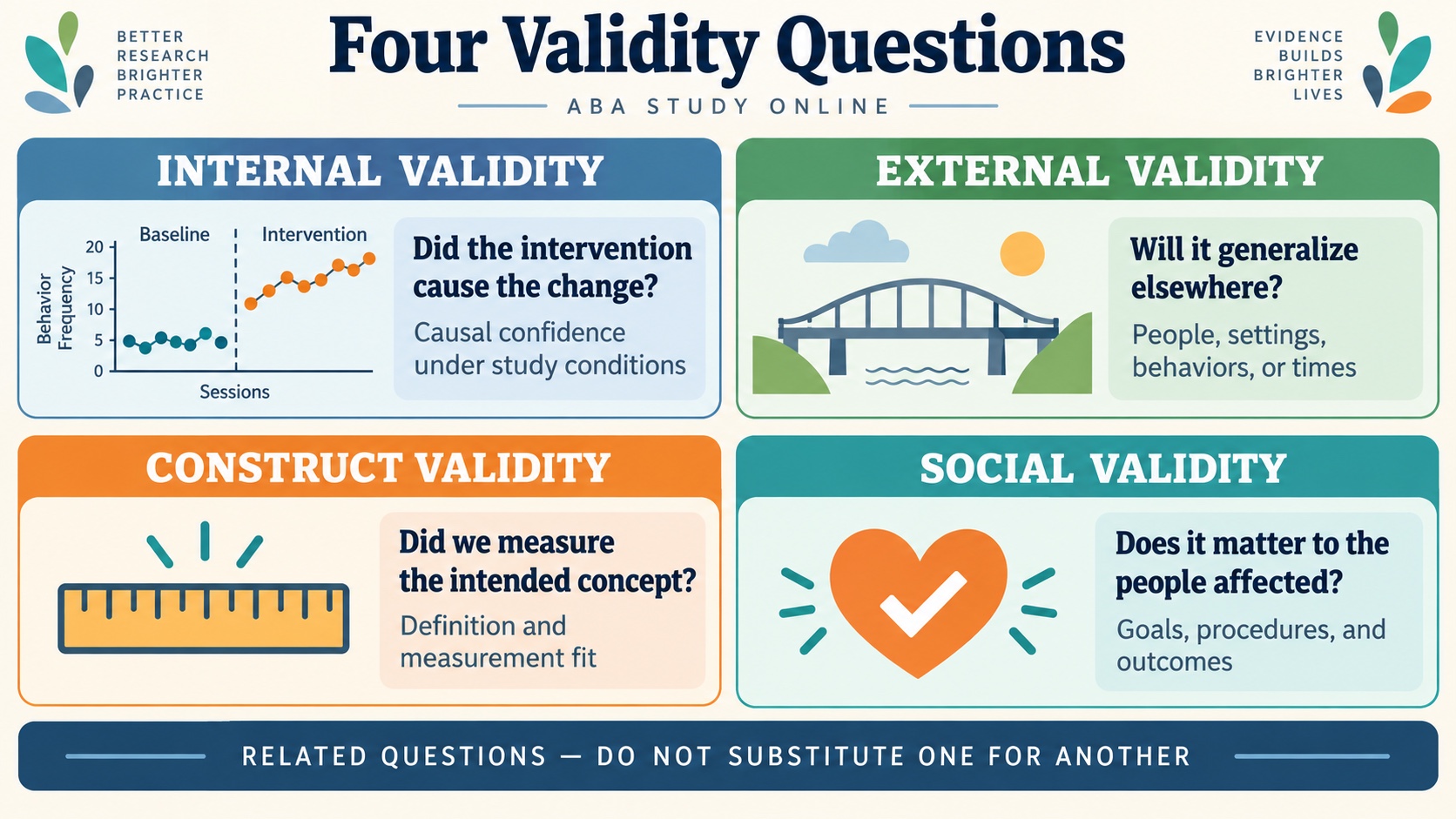
Internal validity asks whether the planned change caused the observed change under the study conditions. External validity asks whether the result is likely to generalize to other people, settings, behaviors, or times. A design can have a strong demonstration in one setting without proving broad generality.
Construct validity asks whether the variables and measures represent the concepts the study claims to examine. If “engagement” is measured only as sitting still, the construct may be too narrow. Social validity asks whether the goals, procedures, and outcomes matter to the people affected. Social validity is not a substitute for internal validity, and internal validity is not a substitute for meaningful outcomes.
Common study mistakes
- Calling every outside event maturation: a specific event is more consistent with history; maturation describes change associated with time passing.
- Assuming a phase line proves causation: a phase change shows timing, not automatically the reason for the change.
- Ignoring measurement drift: a changed observer, definition, or recording system can create an instrumentation threat.
- Using internal validity to mean generalization: causal confidence and broad applicability are different questions.
- Forgetting implementation quality: an intervention cannot be interpreted well if the team does not know whether it was delivered as planned.
- Memorizing threats without reading the scenario: match the label to the rival explanation actually described.
How to study threats efficiently
Create a four-column grid: threat, rival explanation, clue in the scenario, and design or measurement response. For history, write “a specific event happened during the study.” For maturation, write “change accumulated with time.” For instrumentation, write “the measurement system changed.” Then add a short graph example for each.
Use the ABA Theory Blocks to review experimental design, free ABA questions to classify scenario clues, and the ABA Definition Search for internal validity, external validity, procedural integrity, and replication. The ABA Study Online app can support flashcards, section practice, audio review, progress, and tools.
Internal validity FAQ
What is a threat to internal validity in ABA?
It is a plausible alternative explanation for the observed change, such as history, maturation, testing, instrumentation, or treatment carryover.
Why is an AB design vulnerable?
With one baseline and one intervention phase, an AB design may not rule out events or changes that happened at the same time as the intervention. Additional comparison or replication can strengthen the inference.
What is the difference between history and maturation?
History is a particular event during the study. Maturation is a change associated with the passage of time, such as development, fatigue, or recovery.
Does a strong internal-validity design generalize automatically?
No. Internal validity concerns causal confidence under the study conditions. External validity concerns whether the result applies elsewhere.