BACB Task List: Which Current Outline Should You Use?
If you searched for the BACB task list, you are probably trying to find the document that tells you what to study for an RBT, BCaBA, or BCBA examination. The important first step is to separate the search phrase from the current document name. The BACB now organizes current examination content in Test Content Outlines, and the correct outline depends on the credential track you are preparing for.
This guide helps you route yourself to the right source, compare the three tracks without blending them together, and turn the outline into a useful study map. It does not reproduce secure examination questions, decide your eligibility, or replace the current BACB handbook and requirements pages. Think of it as a source-check and study-navigation page for a common search term that can lead to several different documents.
Table of Contents
The short answer: task list versus Test Content Outline
For current study, use the Test Content Outline for your track:
- RBT: RBT Test Content Outline (3rd ed.), for examination content beginning January 1, 2026.
- BCaBA: BCaBA Test Content Outline (6th ed.), for examination content beginning in 2025.
- BCBA: BCBA Test Content Outline (6th ed.), for examination content beginning in 2025.
The BACB’s February 2026 newsletter explains that the examinations are based on these named Test Content Outlines and that there is no longer a BACB document referred to as a task list. That is why you may see two kinds of language in search results: people still type “task list BACB,” while the current source you should study is labeled a Test Content Outline, or TCO.
The distinction is more than a naming preference. An outline describes examination content and the tasks, domains, or areas of knowledge represented on the exam. It is not the same as a handbook, an eligibility checklist, a supervision contract, an ethics code, or a set of recalled questions. Keep those sources connected, but do not ask one document to answer every question.
Which current outline belongs to each track?
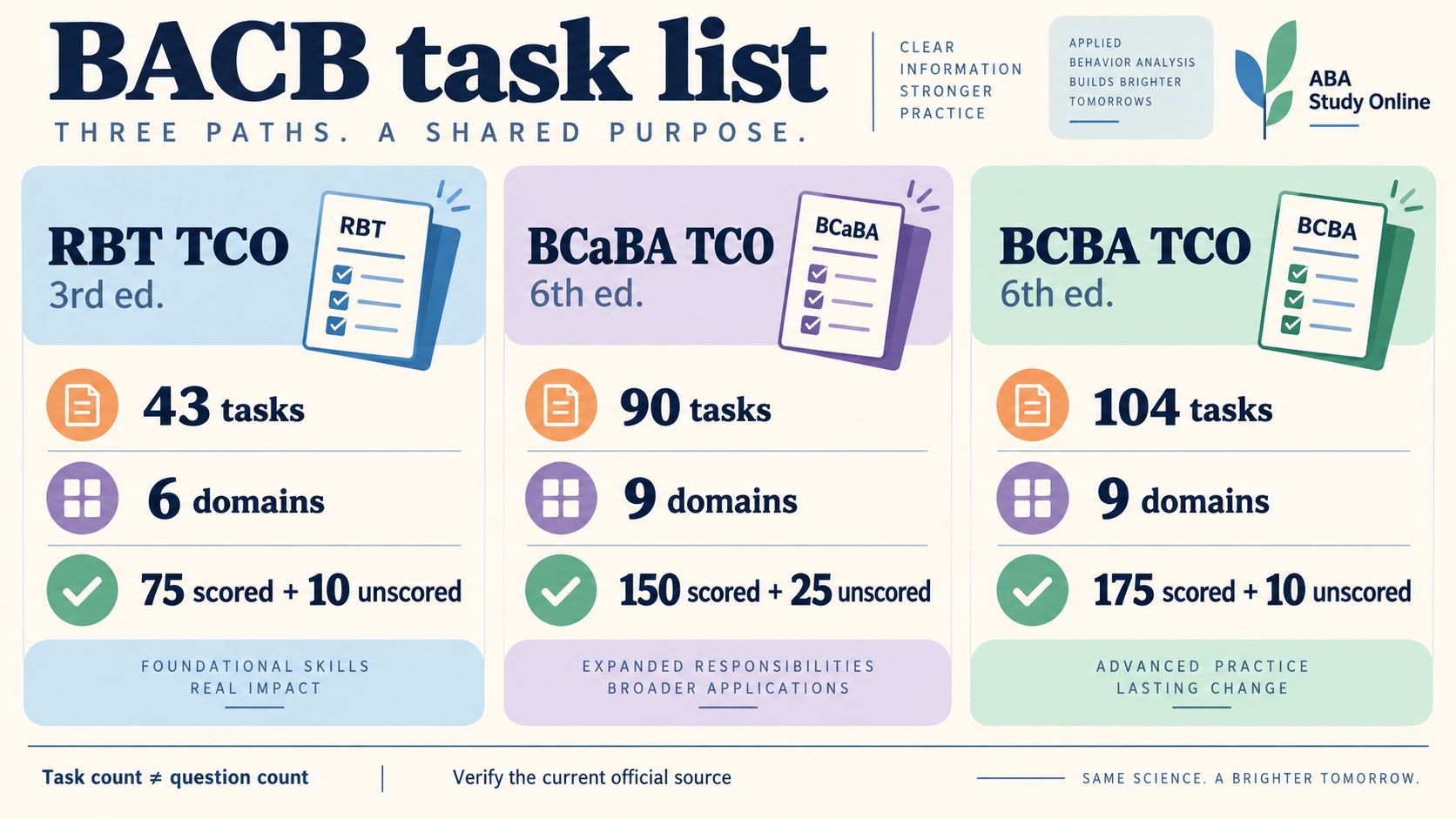
RBT, BCaBA, and BCBA are separate certification tracks with different role boundaries and different content outlines. The numbers below are useful for orientation, but they are not interchangeable. A task count is not the same thing as an exam-question count, and unscored pilot questions are not the same as scored questions.
| Track | Current outline | Tasks and domains | Exam question boundary |
|---|---|---|---|
| RBT | TCO 3rd ed. | 43 tasks in 6 domains | 75 scored + 10 unscored |
| BCaBA | TCO 6th ed. | 90 tasks in 9 domains | 150 scored + 25 unscored |
| BCBA | TCO 6th ed. | 104 tasks in 9 domains | 175 scored + 10 unscored |
The BACB examination-information page separately lists the current total question counts as 85 for RBT, 175 for BCaBA, and 185 for BCBA. It also explains that BACB examinations use multiple-choice questions with four possible answers and one correct answer, delivered through computer-based testing at authorized in-person locations. Use that page for exam structure and the TCO for content; do not merge the two documents into one simplified “task list.”
How to choose the right BACB source
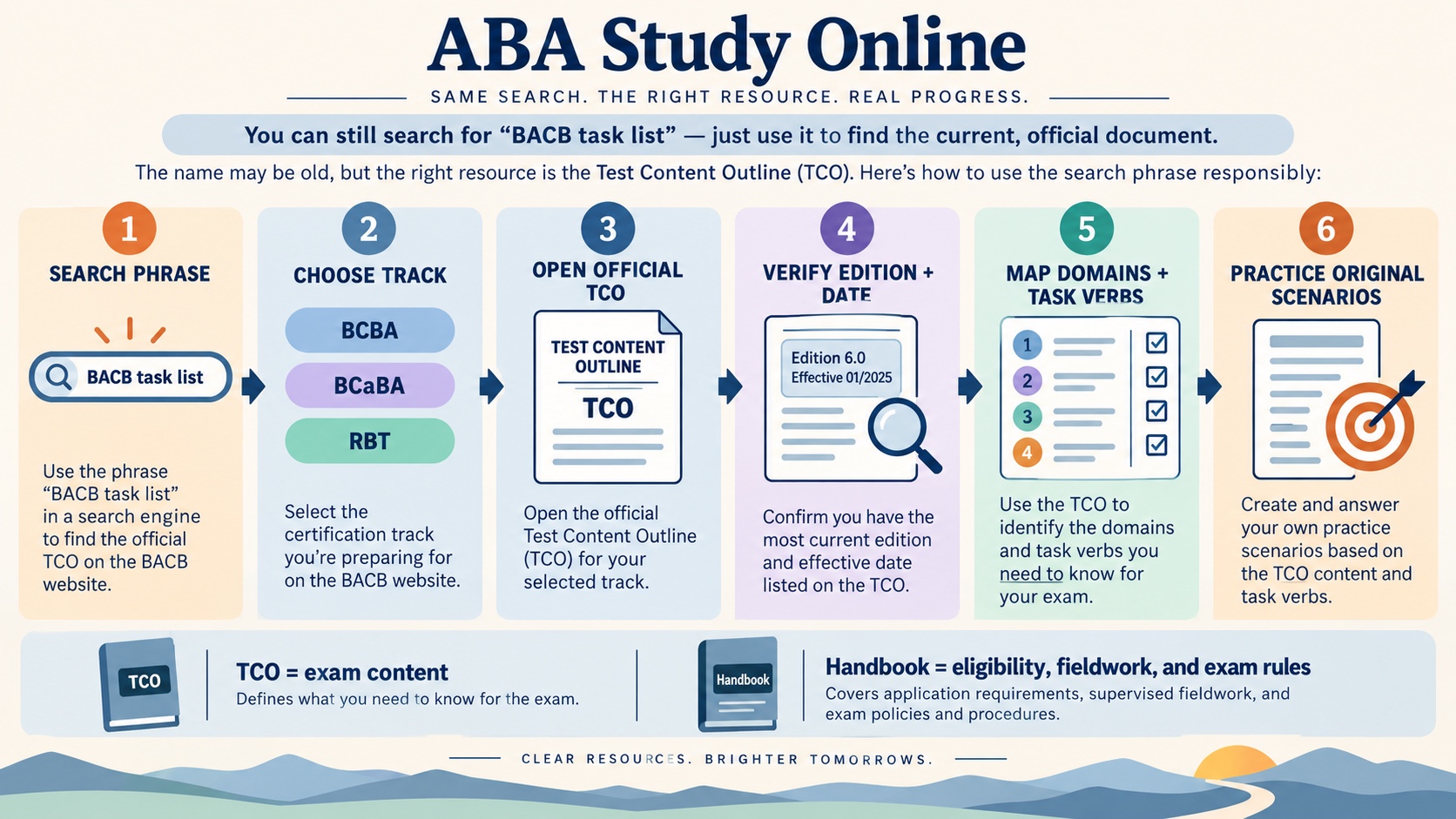
Start by naming the question you are trying to answer. Then open the document that owns that question:
- “What content can appear on my exam?” Open the Test Content Outline for your track. Check the title, edition, effective period, domains, and task statements.
- “What education, fieldwork, or application records do I need?” Open the handbook and current requirements pages for the credential. An outline does not approve coursework or count your hours.
- “What are the test-day rules, time, or delivery details?” Open BACB Examination Information and the examination section of the relevant handbook.
- “What professional boundary or conduct applies?” Check the applicable ethics code, supervision guidance, and any local legal or payer rules. Do not assume the TCO is a practice manual.
- “What should I practice this week?” Translate the current outline into a small, track-specific study set. Use original educational practice, not copied or recalled secure exam content.
When you download a PDF, record the document title and edition in your notes. Add the access date and the source URL. That simple habit prevents an old file from becoming invisible in a folder full of newer resources. If a course, video, or study deck uses “task list” language, compare its edition and track against the official BACB page before building your schedule around it.
How to read an outline as a study map
A TCO becomes useful when you turn it into decisions instead of treating it as a document to read once. Use this sequence:
- Lock the version. Write the exact track, edition, effective period, and source link at the top of your study file.
- Map the domains. Copy the domain names into separate headings. Keep RBT, BCaBA, and BCBA maps in different files so an advanced concept does not quietly become a requirement for another track.
- Notice the task verbs. “Identify,” “distinguish,” “explain,” “interpret,” “select,” and “implement” call for different practice formats. A definition card may help with “identify,” but an applied scenario is more appropriate for “select” or “implement.”
- Connect domain to evidence. For measurement, use data or graphs. For assessment, use a case question and a boundary check. For ethics, identify the facts, responsibilities, consultation need, and documentation step.
- Build a feedback loop. Answer an original question, explain the controlling fact, inspect the distractors, classify the error, and schedule a later retrieval attempt.
- Return to the source when a date appears. Edition names, application rules, fieldwork forms, exam structures, and transition dates should be checked against current BACB pages.
For example, “distinguish between direct, indirect, and product measures” should not become a list of three memorized phrases only. Create a short scenario, identify what evidence is actually being recorded, compare the alternatives, and state what each method can and cannot support. That practice honors the task’s verb and keeps the study action connected to the content outline.
Where to continue for RBT, BCaBA, or BCBA study
Once you know the correct outline, move into the learning path that matches the credential. Use the RBT study path for entry-level measurement, assessment, acquisition, behavior reduction, documentation, and ethics practice. Use the BCaBA study path for the broader undergraduate-level content map, intervention development, monitoring, and supervisory relationships. Use the BCBA study path for deeper work across assessment, experimental design, intervention selection, supervision, and professional decision-making.
For free practice, use ABA questions as a learning loop rather than a prediction machine. Review the rationale, label the task or concept, and write the smallest next action. The goal is not to imitate an official exam or guarantee a result; it is to make your study decisions more precise.
How the 2027 changes fit into the picture
BCBA and BCaBA candidates may also be researching the 2027 requirements transition. That is an important source check, but it is a separate question from “Which outline defines exam content?” Eligibility, coursework, fieldwork, application records, and maintenance rules can change without the current TCO automatically becoming a new edition.
When you plan around 2027, keep two columns in your notes: exam-content source and eligibility or maintenance source. Put the current BCBA or BCaBA TCO in the first column. Put the current handbook, requirements page, and transition guidance in the second. Recheck the official documents before you act on a deadline, and do not turn a social-media phrase such as “new rules” into an unsupported “7th-edition exam” claim.
A practical source-check example
Imagine Jordan searches “task list BACB” after starting a new RBT role. The first result they open is a saved PDF labeled RBT Task List 2nd ed. Instead of building a calendar immediately, Jordan writes down the question: “Which document defines the current RBT exam content?” The official BACB page points to the RBT TCO 3rd ed. beginning January 1, 2026.
Jordan then creates a six-domain map, checks the 43 task statements, and keeps the RBT Handbook in a separate folder for certification and maintenance rules. A practice session focuses on observable description, measurement choice, and graph interpretation. When a question mentions application or supervision, Jordan labels it as a handbook or role-boundary check instead of forcing it into the TCO notes.
Common task-list mistakes
- Using one combined ABA task list: RBT, BCaBA, and BCBA are separate tracks. Choose the track before choosing the document.
- Keeping an old PDF because the title sounds familiar: record the edition and effective period, then compare it with the current BACB page.
- Confusing tasks with questions: a task is a content statement; an exam includes questions and may include unscored pilot items.
- Using the TCO as an eligibility checklist: education, fieldwork, application, supervision, and maintenance belong to other official sources.
- Practicing only definitions: use comparisons, graphs, scenarios, and implementation decisions when the task verb requires more than recall.
- Calling every transition a new exam edition: check whether the official source changed examination content or changed eligibility and maintenance requirements.
- Expecting unofficial practice to guarantee a pass: independent questions can support learning, but they are not BACB endorsement or a pass prediction.
FAQ and official sources
What is the BACB task list called now?
For current examination content, use the named Test Content Outline for the credential track: BCBA TCO 6th ed., BCaBA TCO 6th ed., or RBT TCO 3rd ed. The older phrase “task list” remains common in search queries and study conversations, which is why it is still useful for finding the question.
Is the BCBA task list the same as the BCaBA task list?
No. Both current documents are 6th-edition TCOs, but they are separate outlines with different task counts, domain content, question blueprints, and role boundaries. Open the outline that matches your credential.
Which task list is current for RBT?
The RBT Test Content Outline (3rd ed.) describes examination content beginning January 1, 2026. The older RBT Task List (2nd ed.) is listed by BACB as applying through December 31, 2025, so date-sensitive study plans should check the current RBT source page.
Does the 2027 transition automatically create a 7th-edition exam?
Do not assume that. The 2027 materials concern eligibility, coursework, fieldwork, documentation, or maintenance changes. Treat the current TCO and the 2027 requirements documents as separate source checks until BACB publishes a confirmed examination-content update.
Can ABA Study Online provide an official BACB task list or guarantee certification?
No. ABA Study Online can provide independent explanations, original practice, glossary support, and study tools. The current BACB documents control examination content, certification requirements, and official decisions.
For the source boundary, begin with the BACB Test Content Outlines page and the BACB task-list archive and navigation page. Then open the specific BCBA TCO, BCaBA TCO, or RBT TCO. Use BACB Examination Information for exam structure and the February 2026 BACB newsletter for the current terminology boundary.