
ABA Study Notes: A Practical System for Concepts and Exam Review
Good ABA study notes are small decision tools. They help you answer a question such as “What does this term mean?”, “What would it look like in an observable example?”, or “Which detail would change my answer?” A page of copied sentences may look complete but still be difficult to use when a practice question adds context.
This article gives you a five-part note system for definitions, procedures, measurement, assessment, ethics, and applied scenarios. It also shows how to keep RBT, BCaBA, and BCBA source maps separate, then move a note from website reading into app review, practice, and a later error check. The system is original study guidance; current BACB documents remain the authority for certification requirements and exam scope.
What effective ABA study notes are for
Before writing a note, decide what job it needs to do. A definition note supports accurate recall. A procedure note helps you identify the steps and the conditions under which a procedure makes sense. A measurement note helps you choose what to record and how to describe the result. An ethics note helps you slow down, locate the relevant concern, and identify what should be documented or discussed.
These jobs are related but not identical. If every note is a paragraph copied from a lesson, you may have a library of text without a way to use it. Instead, write notes in a form that invites retrieval. Hide the definition and try to say it aloud. Cover the example and decide which concept it illustrates. Read a short scenario and ask what evidence is missing.
Your source should also be visible. The BACB publishes separate current Test Content Outlines for RBT, BCaBA, and BCBA certification. Use the correct outline and date when you decide what to study; do not turn a general ABA note into a claim that it is official exam content.
The five-part ABA note template
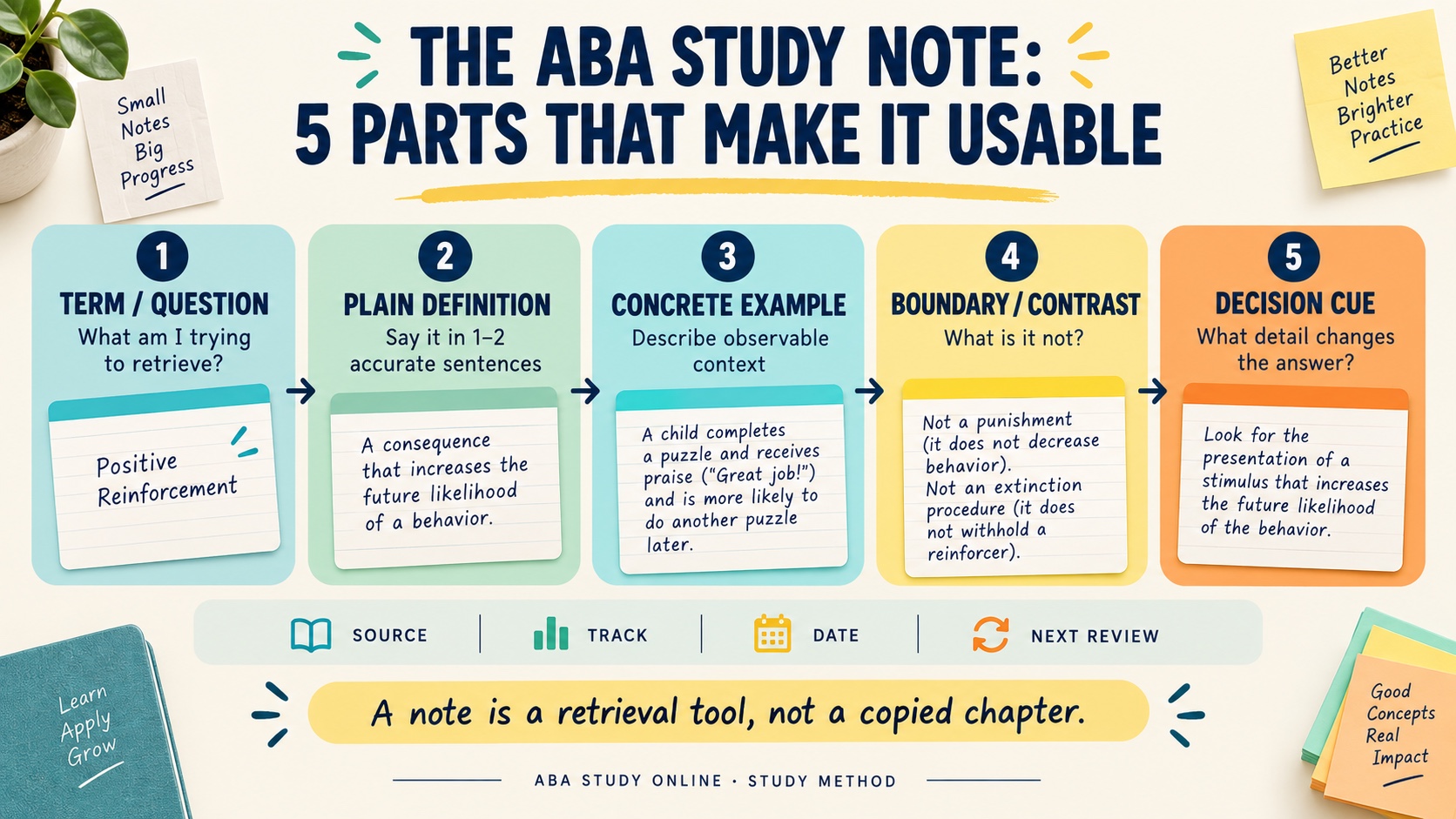
Use one small card or screen for each concept. The five parts are:
- Term or question. Write the exact word you are trying to retrieve, or turn it into a question. “What is response maintenance?” is easier to practice than a page titled “Chapter 6.”
- Plain definition. Explain the concept in one or two sentences using accurate terms. Keep it short enough to say without reading.
- Concrete example. Describe a fictional, observable scenario. Include what happened, what was recorded, or what the learner did—not a vague story about someone being “unmotivated.”
- Boundary or contrast. Say what the concept is not, or compare it with a nearby idea. The contrast is often where a distractor answer becomes easier to reject.
- Decision cue. Record the detail that would change your answer: the measurement dimension, the consequence, the antecedent, the function being assessed, the ethical risk, or the source/date rule.
Add a small footer with the source, track, date reviewed, and next review date. Those fields keep your notes honest without crowding the learning content. If you are unsure whether a statement is a current requirement, mark it “to verify” and link the official page rather than writing a confident guess.
Keep the note proportionate to the question. A single definition may need five short lines. A measurement procedure may need a mini table with the behavior, dimension, recording rule, and example. An ethics scenario may need a separate “people affected” and “consult/document” section. The five parts are a starting frame, not a demand that every topic look identical. When a note grows into a page, ask what the learner must retrieve first and move background reading to the source link.
One useful editing test is the “blank-page test”: hide the source text and try to explain the concept from your note. If you cannot, add a clearer boundary or example. If you can explain it but cannot choose between two answer options, strengthen the decision cue. This keeps note editing tied to the type of error you are actually making.
How to keep RBT, BCaBA, and BCBA notes accurate
One of the easiest ways to create confusion is to store all ABA notes in one undifferentiated exam folder. The field is connected, but the BACB’s current Test Content Outlines and handbooks serve different certification tracks. A note about prompting can be useful across tracks while still needing different depth, vocabulary, or application context.
Use a visible track label:
- RBT: emphasize observable implementation, data collection, documentation, professionalism, and what must be brought to the responsible supervisor.
- BCaBA: connect concepts to assessment, intervention, supervision, and the undergraduate-level credential context described by current BACB sources.
- BCBA: add reasoning about functional relations, assessment, treatment selection, supervision, ethics, research design, and the depth expected by the current BCBA source map.
This does not mean you need three copies of every concept. Keep one shared foundation note and add track-specific “use this when” sections. For current exam boundaries, start with the BACB Test Content Outline index, then open the relevant outline. The BACB Examination Information page answers application and testing questions; it is not a substitute for your learning notes.
A worked example: observation versus interpretation
Suppose the term is observation versus interpretation. A weak note might say, “Observation is what happens; interpretation is the meaning.” That is a beginning, but it does not help with a scenario.
Use the five-part format instead:
- Term/question: What is the difference between an observable description and an interpretation?
- Plain definition: An observation describes events in terms that another trained observer could identify or measure. An interpretation adds an explanation or inferred meaning that still needs support.
- Concrete example: “Jordan pushed the worksheet away and said ‘no’ twice within 30 seconds” is closer to an observable description. “Jordan was lazy” is an interpretation that does not specify what was seen or heard.
- Boundary/contrast: Observable does not mean emotionally cold or incomplete. It means the description gives enough detail for another person to understand what event is being discussed.
- Decision cue: Ask whether a second observer could locate the behavior, count it, time it, or describe the relevant context from the note.
Now turn the note into retrieval practice: present the two statements in a new order and ask which one is observable, what detail is missing, and what additional data would be useful. The note has become a decision rehearsal rather than a sentence to reread.
Move a note through the website and app
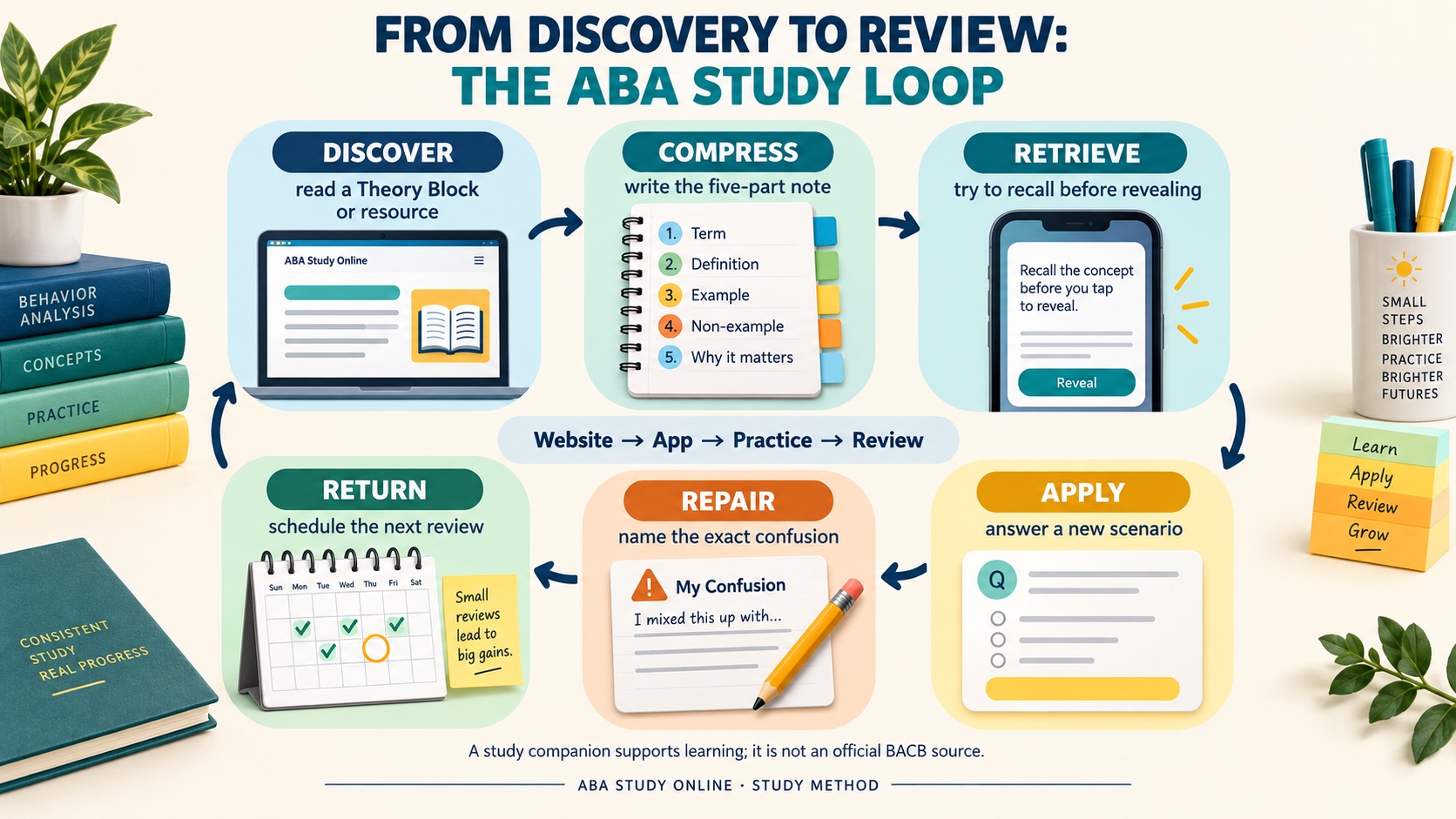
A practical study loop can be short:
- Discover: Read a Theory Block, resource, or definition page on the website.
- Compress: Write the five-part note in your own words and attach the correct track/source label.
- Retrieve: Move the term into a flashcard or app review session. Try to answer before revealing the note.
- Apply: Complete a free practice question or create a tiny scenario that changes one decision cue.
- Repair: If the answer is weak, write one error note: “I confused the definition with the example,” “I missed the measurement dimension,” or “I ignored the source date.”
- Return: Schedule a later review in Today, Learn, flashcards, practice, audio review, progress, or the tools library according to the study layer you need.
On ABA Study Online Theory Blocks, a concept can stay connected to its track. The ABA Definition Search can help when a term is unfamiliar, and free practice can reveal whether the note works under a little context. The ABA Study Online app is a natural place for repeatable review layers; it is still a study companion, not an official BACB source.
Common mistakes and FAQ
Should I copy the whole textbook? Usually not. Keep source links and fuller references nearby, but make the working note small enough to retrieve and explain.
Should every concept be a flashcard? No. A flashcard is useful for a compact retrieval question. A complex procedure may need a concept note, worked example, error note, and later practice scenario.
How do I know whether my note is accurate? Compare its definition and boundary with the current course or official source, then test whether the example actually matches the term. If the statement is a certification requirement, check the current BACB handbook rather than relying on a study note.
Do I need separate notes for each exam track? Use shared foundations where appropriate, but label track-specific depth and source dates. Never assume that the RBT, BCaBA, and BCBA outlines are interchangeable.
What is the best ABA note-taking method? There is no single method that fits every learner. The five-part system is useful because it links definition, example, contrast, and decision cue; change the format when the learning task changes.
The goal is not to produce the fullest notebook. It is to build notes you can retrieve, explain, apply, correct, and revisit. One accurate small note used several times is more valuable than a large folder that never reaches a practice decision.