
How to Study ABA: A Track-Aware Routine That Builds Retrieval and Application
If you search for study ABA, you may be asking several different questions at once. You might be learning the foundations for the first time, preparing for the RBT, BCaBA, or BCBA examination, reviewing concepts for work, or trying to turn a pile of notes into a routine you can actually repeat. Those goals overlap, but they do not require the same scope or the same practice format.
A useful ABA study routine has a simple rhythm: choose the right track, learn one manageable concept, retrieve it without looking, apply it to a new example, review the reasoning, and schedule a delayed return. That rhythm is more useful than collecting more tabs or rereading the same definitions. It also helps you notice whether a problem is vocabulary, discrimination, data interpretation, ethical judgment, or application—not just whether you got a question right.
Table of Contents
Start by choosing your ABA study scope
Before you choose a book, app, video, or question bank, write one sentence that names your current job. “I am learning general ABA concepts” is different from “I am preparing for the RBT examination” or “I am reviewing BCBA assessment tasks.” A broad goal can be a good starting point, but it is too loose to guide a daily session.
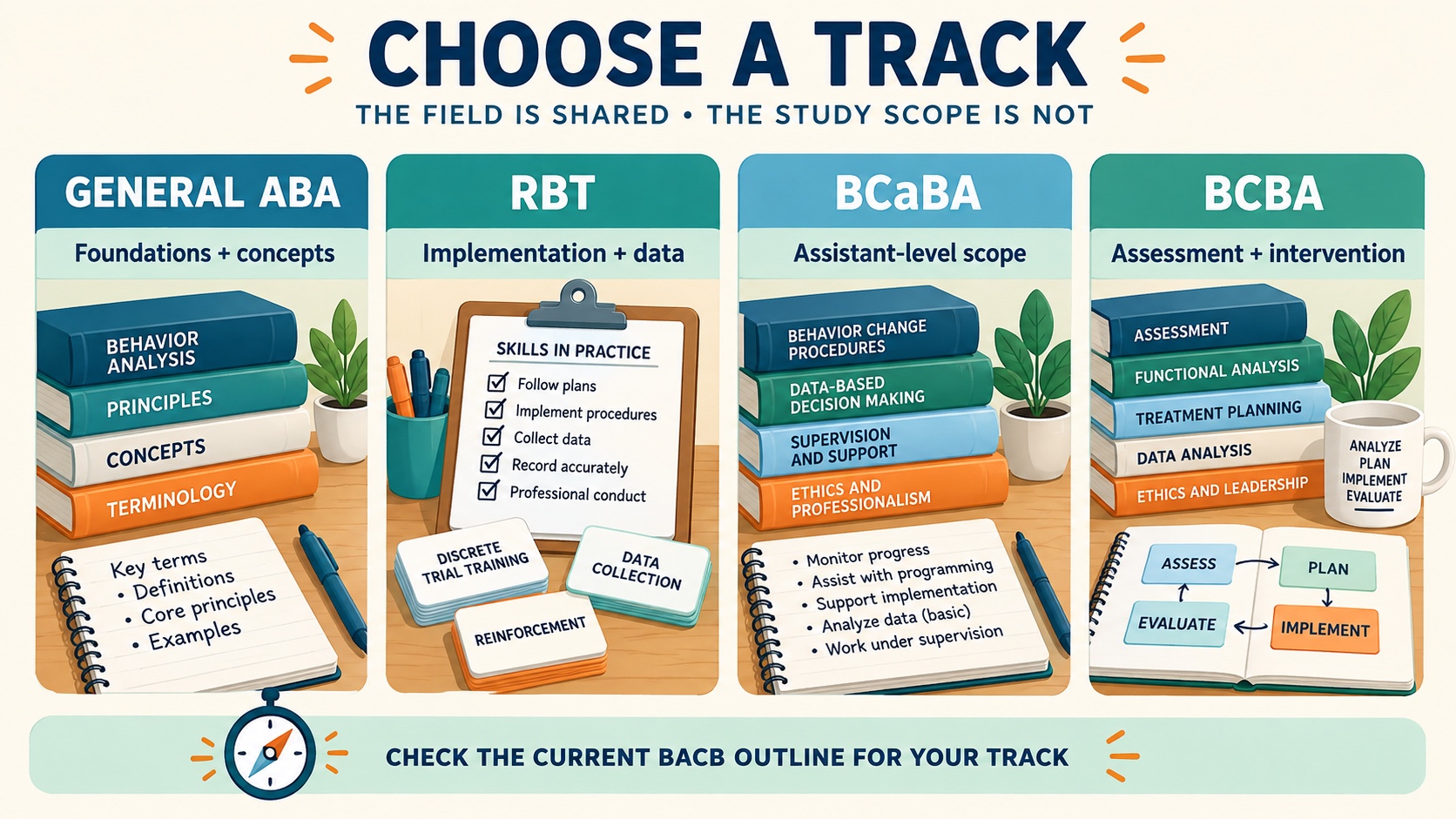
Use the official BACB materials as the boundary for a credential-specific plan. The BACB currently lists a BCBA Test Content Outline (6th ed.), a BCaBA Test Content Outline (6th ed.), and an RBT Test Content Outline (3rd ed.) for examination content. The BACB also explains that ABA, for certification and examination purposes, is defined by the content of the relevant RBT, BCaBA, and BCBA documents. In other words, “ABA” is a shared field, while the expected knowledge and role boundaries vary by track.
A simple starting map looks like this:
- General ABA: build the shared vocabulary, philosophy, concepts, measurement, assessment, teaching, behavior reduction, ethics, and application layer.
- RBT: emphasize implementation, data collection, documentation, skill acquisition, behavior reduction, professional conduct, and supervision boundaries in the current RBT outline.
- BCaBA: study the current BCaBA content outline and the assistant-level scope, then use supervision and application materials for eligibility questions.
- BCBA: use the current BCBA outline to organize deeper assessment, intervention, experimental design, ethics, and supervision topics.
This does not mean you need four separate lives as a learner. It means the same concept should be practiced at the level and within the role that you are preparing to use. If you are unsure which track fits, start with the ABA learning paths and verify the credential-specific boundary in the official BACB handbook rather than guessing from a social post.
Build a small concept map
Do not begin with a list of 200 terms. Begin with a small map that shows how the ideas connect. A useful map can start with five questions:
- What is the behavior or skill? Define it in observable, measurable terms.
- What happens before and after it? Separate context, antecedent events, behavior, and consequences instead of blending them into a story.
- How will it be measured? Choose a dimension and a recording method that match the question.
- What decision follows the data? Identify what would change if the pattern moved up, down, or stayed flat.
- What role and ethical boundary apply? Keep learning examples separate from individualized clinical decisions and respect supervision, consent, assent, privacy, and scope.
For example, if you are studying reinforcement, do more than write “a consequence that increases future behavior.” Add a small comparison: a learner completes a difficult step, a preferred activity becomes available, and the future frequency of that step increases. Then compare it with a consequence that is pleasant but does not increase the behavior. The comparison forces you to use the defining feature—future behavior change—rather than relying on the emotional tone of the consequence.
Keep one page for each cluster. A page for measurement might connect operational definitions, event recording, duration, latency, rate, graphing, and interpretation. A page for skill acquisition might connect prompting, prompt fading, reinforcement, shaping, chaining, generalization, and maintenance. The map is not the whole textbook. It is a set of retrieval cues that tells you what to explain next.
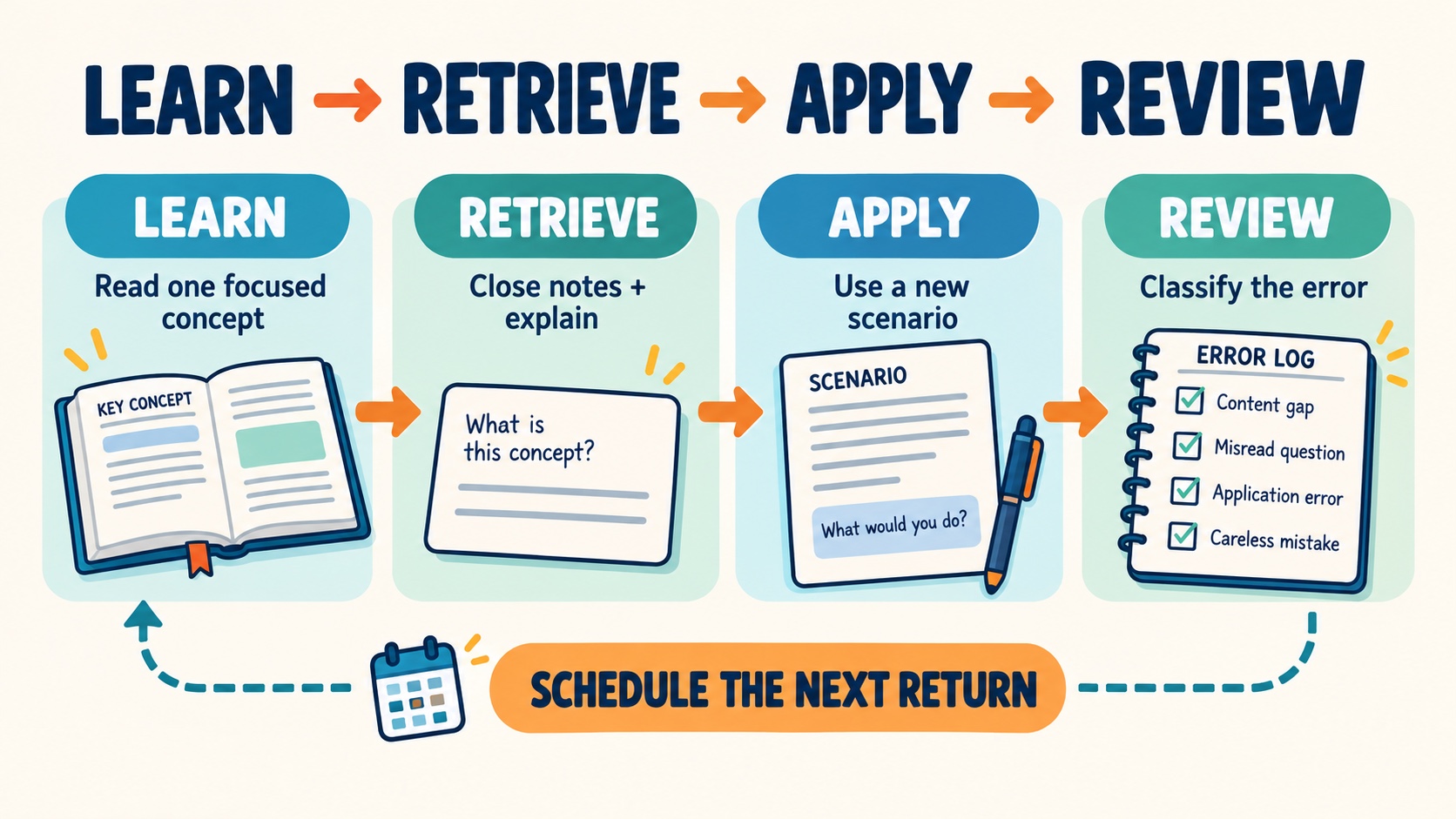
Use the learn–retrieve–apply–review loop
Studying is not one activity. Reading, remembering, applying, and correcting are different moments. A strong routine gives each moment a small job.
Learn a small amount
Read or watch enough to define one distinction and see one example. Stop before the session becomes a passive stream of content. Write a short explanation in your own words, then record the source or outline section that anchors it.
Retrieve without notes
Close the source and answer a prompt from memory. What is the difference between rate and frequency? What makes an operational definition useful? When would a measurement method distort the decision? Retrieval may feel less fluent than rereading, but that effort is part of the practice. Research on test-enhanced learning has found that testing can improve later retention rather than merely measure it.
Apply to a new example
Use a short, invented scenario. Ask what you would observe, what you would measure, which concept controls the decision, and what information is still missing. Keep the example bounded. Do not turn a study prompt into individualized treatment advice or pretend that a paragraph contains enough information for a clinical decision.
Review the reasoning
Check the source and compare your explanation with the rationale. Mark the error type: definition, discrimination, data, reading, ethics, or application. If you were correct but uncertain, keep that item in the review set; a lucky answer is not the same as stable retrieval.
Schedule a delayed return
Put the concept on a later review list instead of immediately rereading it ten times. Distributed-practice research suggests that spacing study episodes can support later retention, while the useful gap depends on the material and the time until you need to remember it. A short return tomorrow, another in several days, and a mixed review later can tell you more than one long session.
Turn practice questions into information
Practice questions are most valuable when they tell you what to do next. After each short set, record more than the percentage:
- Accuracy: what you answered correctly under the conditions you used.
- Confidence: whether you knew the answer or selected it between two uncertain options.
- Error type: whether the problem was vocabulary, a missing distinction, a graph or calculation step, a distractor, or an application decision.
- Latency: whether you answered smoothly, reread repeatedly, or ran out of time.
- Next action: the smallest review step that could repair the error.
Imagine you miss three questions about assessment. One may reflect confusion between indirect and direct information. Another may be a reading error about the target response. A third may show that you can define a tool but cannot explain what decision its data support. “Study assessment” is too vague to repair all three. A better plan assigns one short explanation, one comparison, and one new scenario to the next session.
After focused practice, mix related topics again. Interleaving requires you to decide which concept applies instead of receiving a clue from a block of identical questions. It can feel slower during practice, so use it after the learner has enough foundation to make meaningful comparisons. Mixed practice is not a magic shortcut; it is a way to rehearse discrimination and transfer.
Be careful with score interpretation. An independent practice set is not the BACB examination, and a percentage from one session is not a pass prediction. The BACB’s own examination information explains that performance reports are intended to help identify areas for additional study and should be interpreted cautiously. Use your result to choose the next learning action, not to claim certification readiness from a single number.
A practical 30-minute ABA study block
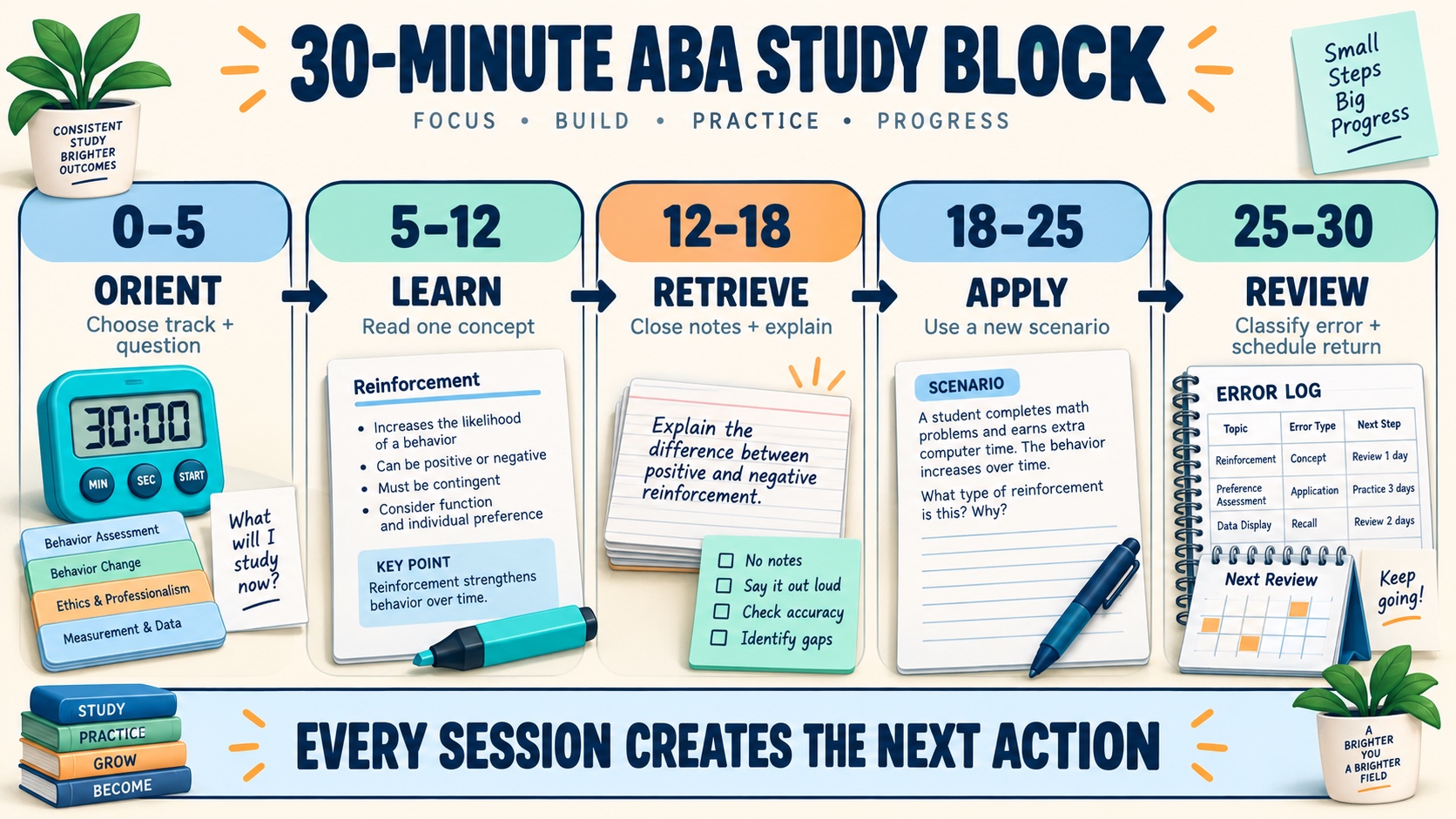
A short session can be serious without trying to cover an entire outline. Here is one repeatable block:
- Minutes 0–5 — orient: write the track, topic, and one question you want to answer.
- Minutes 5–12 — learn: read a focused explanation and add two or three cues to your concept map.
- Minutes 12–18 — retrieve: close the source and explain the idea aloud or in writing; answer two short prompts.
- Minutes 18–25 — apply: work through one original scenario or a small practice set and mark confidence.
- Minutes 25–30 — review: classify one error, write the next action, and schedule the delayed return.
If you have more time, repeat the block with a related concept rather than making the first block indefinite. For example, pair reinforcement with motivating operations, or operational definitions with measurement selection. The pair should create a useful contrast, not a random pile of terms.
Build a weekly routine without cramming
Use a weekly rhythm that alternates foundation, retrieval, application, and mixed review:
- Day 1: learn one concept cluster and make a small map.
- Day 2: retrieve the cluster without notes and repair one weak distinction.
- Day 3: apply the concepts to original scenarios or practice questions.
- Day 4: return to the earlier material after a gap and add a related concept.
- Day 5: use mixed practice and review your error log.
- Day 6 or 7: complete a lighter recap, organize questions, or rest.
Adjust the frequency to your life. The point is not to create a perfect calendar; it is to avoid making every session a first exposure. A realistic plan has a place for new learning and a place for returning. If you use the ABA Study Online app, saved mistakes, flashcards, section practice, audio review, and progress notes can support the shorter return sessions. Use the free practice area when you need an explanation-rich application task, and use the ABA glossary when a definition remains unclear.
Common ABA study mistakes
- Studying the field without choosing a scope: a broad topic list can hide what the current track actually expects.
- Rereading as the whole plan: familiarity can feel like retrieval even when you cannot explain the idea with the source closed.
- Collecting materials instead of using them: a small set of coherent sources is easier to revisit than an unmarked folder of downloads.
- Taking questions without reviewing rationales: the missed item cannot teach you if you never diagnose the decision.
- Only studying what was missed: a narrow error list can hide gaps in content you happened to avoid; keep a balanced return to the whole scope.
- Using secure-content claims: legitimate practice should use original material and avoid live, recalled, leaked, or reconstructed examination questions.
- Turning study examples into clinical advice: real services require qualified supervision, individualized assessment, appropriate consent or assent, privacy, and current ethical and legal guidance.
Study ABA FAQ
What should I study first in ABA?
Start with observable behavior, measurement, basic concepts, reinforcement, assessment, skill acquisition, behavior reduction, generalization and maintenance, and ethics. Then choose the track-specific outline that matches your role or examination goal. The right first topic is one you can define, retrieve, and apply—not simply one with a familiar title.
How many hours a day should I study ABA?
There is no universal number that guarantees learning or certification. Choose a session length you can repeat, use retrieval and application inside it, and build spaced returns across the week. Thirty focused minutes with a next action can be more useful than an unstructured three-hour reread.
Should I use flashcards or practice questions?
Use both for different jobs. Flashcards can strengthen concise definitions and distinctions; practice questions can require discrimination and application. Review the rationale and record uncertainty so the tools produce a study decision rather than only a completion count.
How do I study ABA if I am not sure whether I want RBT, BCaBA, or BCBA?
Begin with shared foundations while you compare the roles, education, supervision, and application requirements in the official BACB materials. Keep a general concept notebook, but do not assume that one track’s outline, scope, or eligibility rules transfer to another.
Can studying ABA guarantee that I pass an exam?
No. A study routine can improve organization, retrieval, application, and review, but no app, course, mock exam, or article can guarantee an examination result. Use the current official handbook and content outline for the credential you are pursuing, and use practice data as feedback for the next study step.