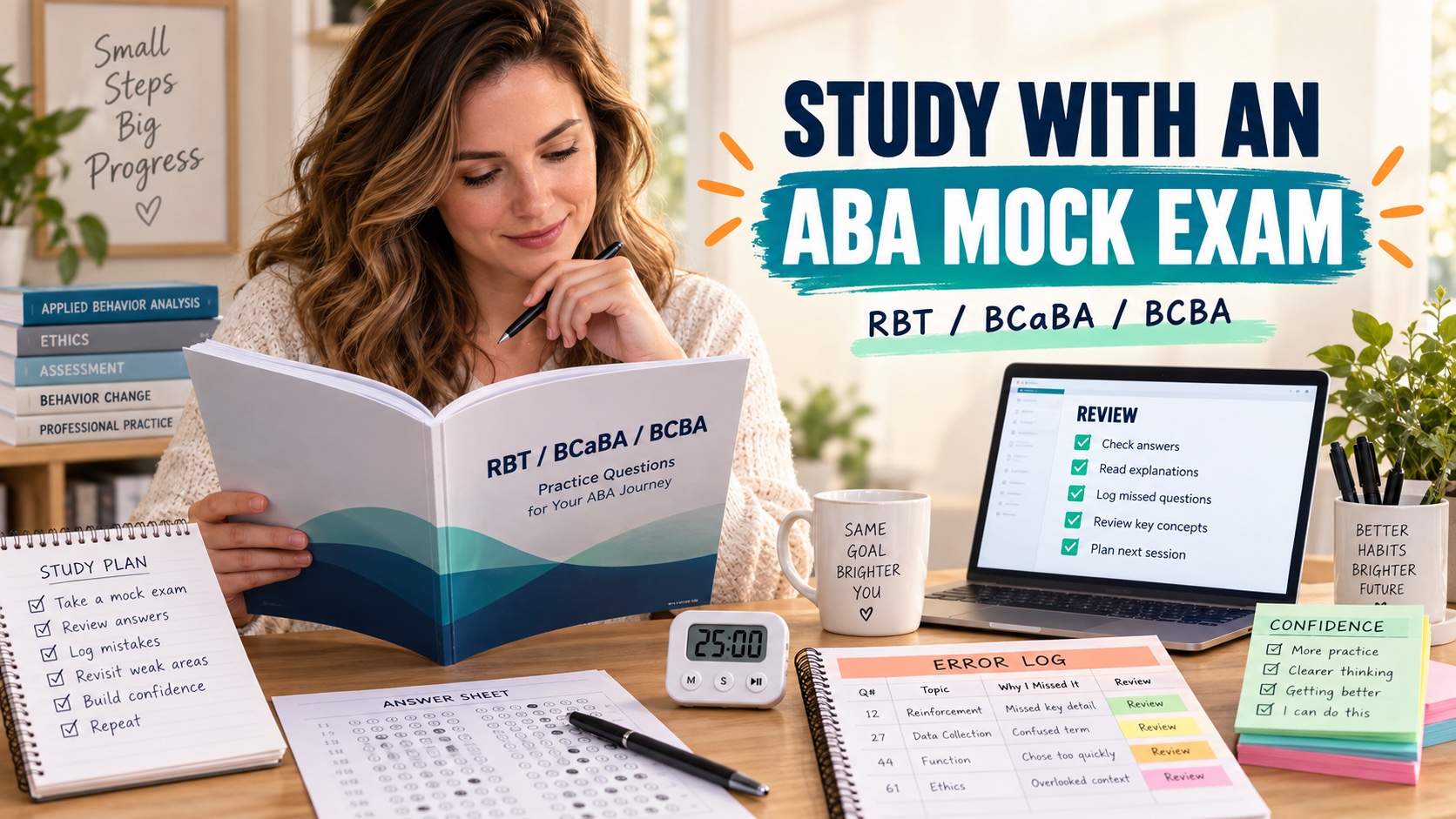
How to Study With an ABA Mock Exam
If you are searching for how to study with an ABA mock exam, you probably do not need another page that simply defines a practice test. You need to know what to do before you start, what to record while you answer, and how to turn a missed question into better preparation. A mock exam can provide that structure, but only when you use it as a diagnostic and rehearsal—not as a verdict about whether you will pass.
Start by matching the practice set to the correct track: RBT, BCaBA, or BCBA. Then run one purposeful session, review the reasoning behind each answer, tag the error, repair one weak concept, and return to it after a delay. That loop is more informative than collecting scores without changing what you study next.
What a mock exam can tell you
A good mock gives you a controlled sample of decisions. It can show whether you recognize a concept, apply it to a scenario, manage time, notice important wording, and explain why one answer is stronger than another. It can also expose a confidence problem: you may choose the correct answer for a fragile reason or miss an item while feeling certain.
It cannot tell you that you have secured an official score, that every future question will look the same, or that one percentage is a universal pass line. Independent practice is not the BACB examination. Treat the result as evidence for planning. The question is not “Did I get a number that guarantees success?” It is “What should I learn, retrieve, and apply next?”
Track alignment comes first. An ABA mock exam is not one universal exam. Before using a set, identify whether it is written for RBT, BCaBA, or BCBA learners and whether its topics are mapped to the current track-specific Test Content Outline. If the provider does not say what the set covers, the score is difficult to interpret.
Before the session: choose a purpose
Decide whether this is a baseline, a drill, or a rehearsal
A baseline attempt is your first honest sample before a new study cycle. Keep the conditions reasonably consistent and do not stop to look up every answer. A targeted drill is different: you may choose one content area or one question type because you are repairing a known gap. A full rehearsal is designed to practice pacing and concentration across mixed content. Do not compare the three results as though they measured the same thing.
Write the purpose at the top of the page. For example: “baseline for BCBA measurement and assessment review,” “targeted RBT behavior-reduction drill,” or “mixed BCaBA pacing rehearsal.” A one-line purpose keeps you from turning every practice session into an anxious search for a perfect score.
Prepare a small review sheet
Use a simple table with these columns: item number, content tag, answer, correct or incorrect, confidence, time concern, error type, and next action. You do not need elaborate software. A notebook or spreadsheet is enough if you complete it consistently. Add a confidence mark before revealing the answer when the practice format allows it. That separates “I knew it” from “I guessed correctly.”
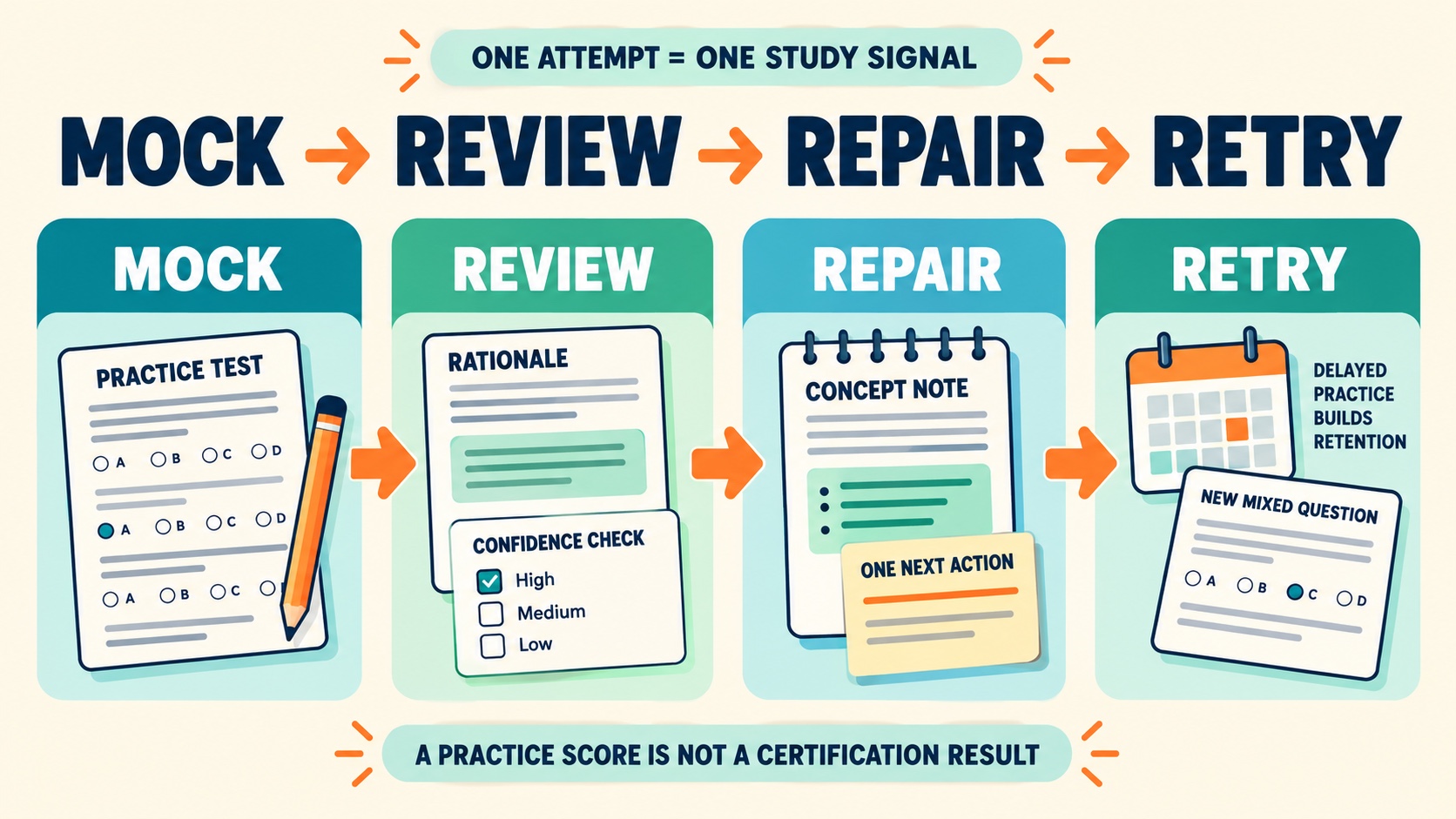
During the session: record more than correct or incorrect
Answer the item before reading a rationale or opening your notes. If you are practicing pacing, record a rough time signal rather than stopping for exact seconds. The goal is to learn whether time pressure changes your decisions, not to create a second administrative task.
Mark confidence immediately: high, medium, or low works well. Then note what happened:
- Knowledge gap: you did not know the definition, principle, or rule needed.
- Application gap: you knew the idea but could not recognize it in the scenario.
- Discrimination gap: two answer choices seemed plausible and you missed the feature that separates them.
- Reading gap: you overlooked a qualifier, sequence, exception, or scope boundary.
- Timing or attention gap: rushing, fatigue, or switching tasks changed the quality of the decision.
- Confidence mismatch: you were certain and wrong, or uncertain and correct.
These labels are study categories, not BACB classifications. They help you choose a repair action. Five missed items from one concept may call for a short lesson and a few new examples. Five high-confidence reading errors may call for deliberate practice with qualifiers and answer-choice comparisons. The same percentage can therefore lead to very different next steps.
After the session: review and repair
Read the rationale before looking for another question
For every missed or low-confidence item, explain the decision in your own words. What feature made the best answer fit? Why did the tempting alternative fail? Which term, measurement detail, ethical boundary, assessment step, or behavior-change condition mattered? If the practice resource does not provide a rationale, write a question for your handbook or current outline review instead of pretending that the answer letter is enough.
Review correct answers too when confidence was low. A lucky answer should not be filed as mastery. Conversely, do not spend equal time on every item. Prioritize errors that are repeated, high-confidence, connected to a foundational concept, or likely to affect several later decisions.
Turn each pattern into one repair task
A repair task is smaller than “study ABA again.” It might be: define three measurement terms from memory and create one neutral example for each; compare two assessment decisions and write the discriminating feature; rewrite an ethical boundary in plain language; or complete a short set of new items on the same concept without copying the original question.
Keep the task tied to the error. If the problem was reading a qualifier, rereading a whole textbook chapter may feel productive but may not test the real weakness. Write the next action in a verb-first form: “label,” “compare,” “apply,” “explain,” “retrieve,” or “check.”
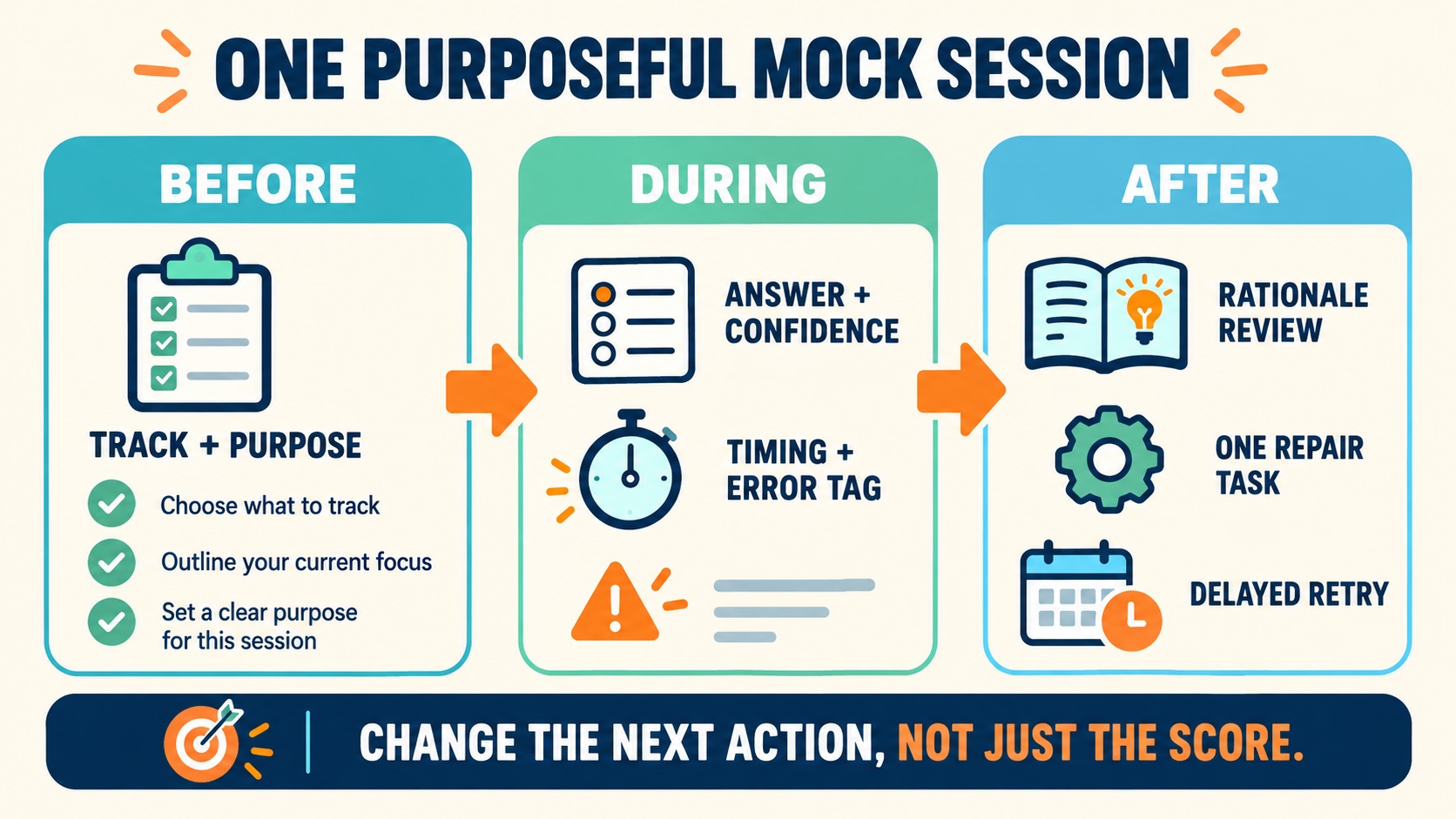
Use delayed retry and mixed review
Do not immediately repeat the same item until the answer feels familiar. That can measure memory for the wording rather than flexible understanding. Put the repaired concept aside, then return after a delay with a new example or a different question. When you can explain the decision without the original choices in front of you, the repair is stronger.
After a focused repair, mix the concept with earlier topics. A learner may understand one measurement question in isolation but still confuse measurement, assessment, and intervention when the cues are less obvious. Mixed review recreates the decision of choosing what matters first. Keep the mix track-appropriate and use the current TCO as the scope map.
One practical rhythm is: baseline, one repair block, delayed retry, then a mixed session. If the same error returns, change the explanation or example rather than simply increasing the number of questions. If performance improves but confidence remains low, add brief retrieval prompts and explanations. If confidence is high but accuracy is unstable, slow down and make the discriminating feature explicit.
Common mistakes
- Taking a mixed mock before checking the track: a generic label makes the result hard to interpret.
- Using the score as a prediction: an independent percentage is a study signal, not a BACB result or guarantee.
- Reviewing only wrong answers: low-confidence correct answers and high-confidence misses also reveal weak learning.
- Repeating the same items immediately: familiarity can hide an application gap.
- Writing “study more” as the next action: a repair task should name the concept and the behavior you will perform.
- Changing several variables at once: if you change the resource, timing, track, and question type together, you cannot tell what helped.
FAQ
Should I take a mock exam before studying?
A short or full baseline can be useful if the set matches your track and current outline. Treat it as a diagnostic, not as a judgment. If a timed full mock would overwhelm you, start with a smaller mixed set and build up.
What should I do after a low mock score?
Do not respond only by doing more random questions. Sort the errors by content, application, reading, timing, and confidence. Choose one repeated or foundational pattern, complete a specific repair task, and retry after a delay.
How many mock exams should I take?
There is no universal number that fits every learner. Take enough attempts to establish a baseline, test a repair, practice mixed decisions, and rehearse pacing when appropriate. Each attempt should have a different job.
Can a mock exam replace the BACB materials?
No. Use the current BACB handbook, examination information, and track-specific Test Content Outline as the source boundary. Independent mocks can provide practice and feedback, but they are not official exam content.
For the broad track-selection explanation, see the ABA mock exam guide. For shorter practice and repeatable review, use the relevant question practice and app study loop. These are learning resources, not certification guarantees.