
Single-Case Experimental Design in ABA: A Practical Guide
A single-case experimental design in ABA is a research design that repeatedly measures behavior while systematically changing an independent variable. The person, setting, behavior, or small group of cases provides the comparison across phases. Instead of asking only whether a group average changed, the analyst examines whether the same case changes when the intervention is introduced, withdrawn, staggered, or compared with another condition.
The phrase single-case does not mean “one observation,” and it does not automatically mean a case report. A single-case experiment uses repeated measurement and design logic to support prediction, verification, and replication. The design must also fit the behavior, the intervention, the setting, and the ethical limits of the question.
Quick answer: what is a single-case experimental design?
A single-case experimental design repeatedly measures behavior within one or more cases and systematically manipulates an independent variable so the analyst can evaluate whether the change in behavior is related to that manipulation. The case serves as its own comparison rather than being compared only with a separate control group.
Current BACB test-content outlines identify repeated measures, prediction, verification, replication, and the ability to distinguish common single-case designs as study content. For exam questions, look for planned phase changes, repeated data, and a design that demonstrates the intervention’s effect more than once or in more than one tier.
A graph showing improvement after treatment may be encouraging, but improvement alone is not the same as experimental control. The analyst needs to ask what the behavior was doing before the change, whether the intervention was introduced systematically, whether alternative explanations were addressed, and whether the effect was replicated.
Defining features and baseline logic
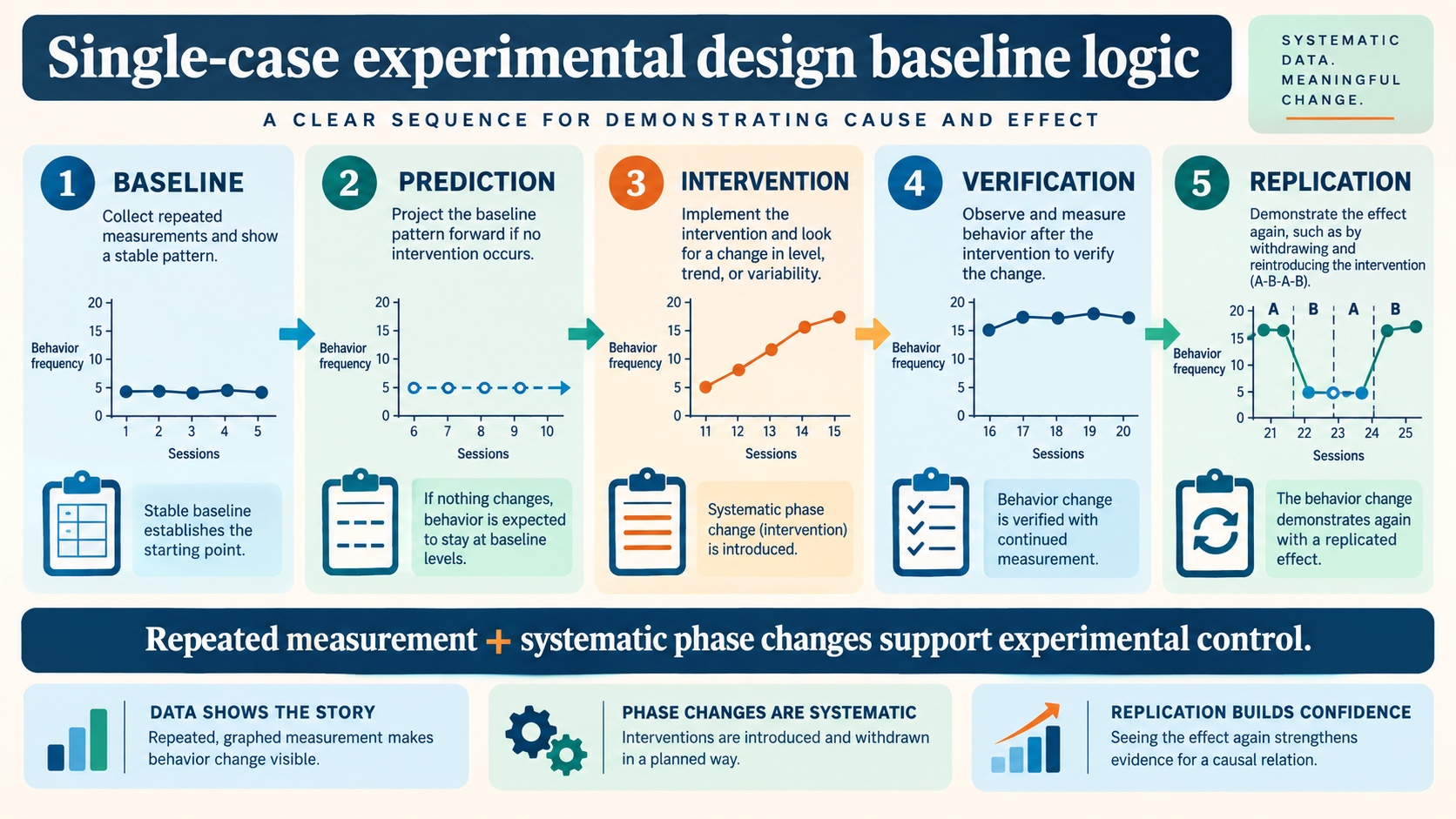
Repeated measurement means the target behavior is measured often enough to show a pattern rather than a single before-and-after snapshot. The measurement should match the behavior dimension—such as frequency, rate, duration, latency, percentage, or a product measure—and the definition should remain stable unless a documented change is planned.
Systematic manipulation means the independent variable is introduced, removed, compared, or shifted according to the design. The analyst records when the phase changes and monitors whether the procedure was implemented as intended. Without a clear manipulation, the study may describe behavior change without testing a functional relation.
Prediction asks what behavior is likely to look like if the current condition continues. A stable or interpretable baseline helps the analyst project a reasonable pattern into the next phase. Verification asks whether the behavior changes when the independent variable changes. Replication asks whether the relation appears again across a later phase, another behavior, setting, participant, or tier.
These ideas form baseline logic. A simple A-B sequence can show that behavior changed after an intervention was introduced, but history, maturation, changes in measurement, or another event could explain the change. Repeated demonstrations across planned comparisons strengthen the inference that the independent variable mattered.
Single-case does not mean that the analyst ignores context. The setting, people, materials, task demands, and social significance of the outcome remain important. A strong design asks a focused question while preserving enough detail to understand where the effect occurred and whether it generalizes.
Four common single-case designs
The design should be selected for the behavior and the question, not memorized as a list without conditions.
Reversal or withdrawal design
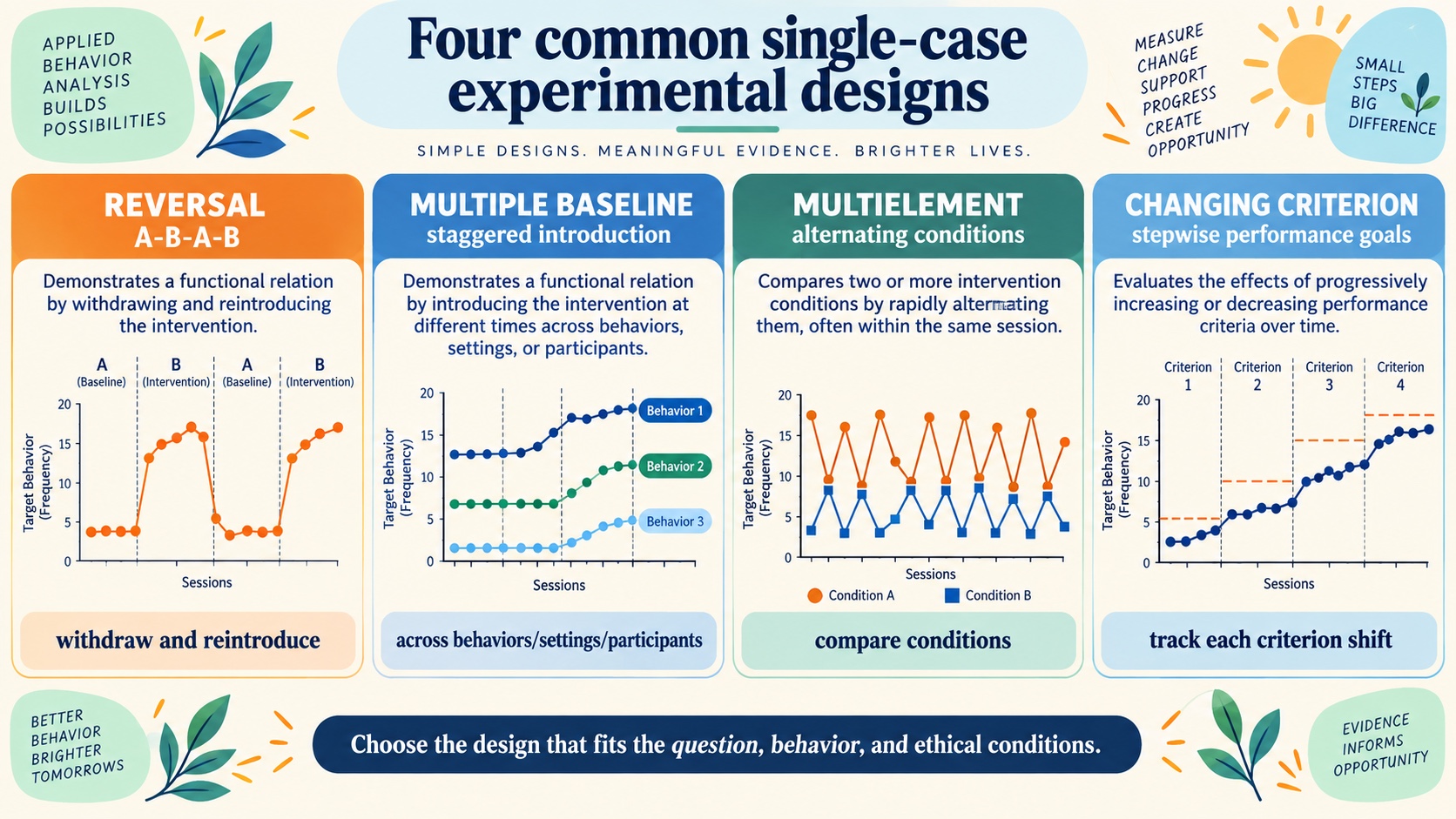
A reversal design repeatedly changes between baseline and intervention, often written as A-B-A-B. If behavior changes when the intervention begins, returns toward baseline when it is withdrawn, and changes again when it is reintroduced, the repeated pattern can provide strong evidence of a functional relation.
Withdrawal is not always ethical or practical. If an intervention teaches an irreversible skill, if removing it creates risk, or if the behavior does not reasonably return to baseline, a reversal may be a poor fit. The design’s strength comes from repeated comparisons, but that strength must be balanced with safety and social validity.
Multiple-baseline design
A multiple-baseline design introduces the intervention at different times across behaviors, settings, or participants. If each tier changes only after the intervention is introduced there, while untreated tiers remain relatively stable, the staggered pattern supplies replication without withdrawing the intervention from a tier after it begins.
Imagine teaching independent task starts across three classroom routines. The team measures all three routines, introduces the support in the first routine, then the second, then the third. A change that follows each staggered introduction is more informative than a simultaneous change across every routine, though the analyst still needs to examine measurement, implementation, and possible events affecting several tiers at once.
Multielement or alternating-treatments design
An alternating-treatments design rapidly alternates two or more conditions so their effects can be compared. This can be useful when the analyst wants to compare instructional procedures or reinforcement arrangements and the behavior can be measured under each condition. Counterbalancing or careful ordering may be needed to reduce sequence and carryover effects.
The conditions must be distinguishable enough for the learner and implementer, and the analyst must consider whether one treatment changes responding in the next condition. A graph with two lines is not automatically a valid alternating-treatments experiment; the conditions, timing, measurement, and comparison logic matter.
Changing-criterion design
A changing-criterion design evaluates behavior as the performance criterion shifts in planned steps. The intervention remains in place while the criterion for reinforcement or success changes. Evidence is stronger when behavior tracks each new criterion and changes again when the criterion changes.
This design may fit gradual increases or decreases, such as increasing the number of independent task steps completed before a break. The criterion must be meaningful, measurable, and changed according to a plan. Simply raising expectations whenever behavior improves is not the same as a planned changing-criterion design.
A useful selection question is not “Which design is strongest in every situation?” but “Which design can answer this question while protecting the learner and preserving interpretable measurement?” If a new skill should not be removed once learned, a multiple baseline may be more appropriate than a reversal. If two teaching arrangements can be alternated without carryover, a multielement comparison may be informative. If the goal is a gradual performance change, changing criterion may make the phase logic visible. The design is strongest when its structure matches the behavior and the decision the team needs to make.
Validity, visual analysis, and design fit
Internal validity concerns how confidently the design supports the conclusion that the independent variable produced the behavior change. Repeated measurement, stable procedures, treatment integrity, phase logic, and replication can reduce alternative explanations. A single-case design does not automatically guarantee high internal validity; the details of the study matter.
External validity concerns the extent to which findings transfer across people, settings, behaviors, materials, or time. Replication across tiers can help show that the relation is not limited to one narrow arrangement. Generalization should still be measured and planned rather than assumed from one successful phase.
Visual analysis examines level, trend, variability, immediacy of change, overlap, and consistency across phases. Visual analysis is not a casual look at whether a line went up. It is a structured interpretation of the graph alongside the design, measurement quality, procedural integrity, and social importance of the outcome.
Design selection is a decision about both science and feasibility. Ask whether withdrawal is safe, whether the behavior is reversible, whether tiers can be staggered, whether conditions can be alternated without carryover, and whether the criterion can change gradually. A design that is technically familiar but ethically unsuitable is not the best design for the question.
Common mistakes and an exam checklist
- Calling a one-person case report experimental: look for repeated measurement and systematic manipulation.
- Treating A-B as proof of causation: improvement after introduction may have alternative explanations.
- Choosing reversal automatically: check whether withdrawal is ethical, safe, and likely to show a return toward baseline.
- Calling simultaneous treatment across tiers multiple baseline: multiple baseline depends on staggered introduction.
- Confusing alternating treatment with changing criterion: one compares conditions; the other shifts a planned performance criterion.
- Assuming generalization: measure behavior across the people, settings, or routines where it matters.
For an exam scenario, ask:
- What is repeatedly measured, and what is the independent variable?
- Where is the baseline, and what prediction does it support?
- How is the intervention change verified?
- Where is replication demonstrated?
- Which design logic fits the ethical and practical conditions?
- What do the data show about internal validity and what remains uncertain about generalization?
For more ABA research and measurement review, visit ABA Theory Blocks, practice design distinctions with free ABA questions, or search related terms in the ABA Definition Search. These are natural study links; this informational page does not promise certification or exam performance.
Keep the central logic in view: repeated measurement makes the pattern visible, phase changes make the comparison interpretable, and replication makes the conclusion stronger.
FAQ and sources
What is the main purpose of a single-case experimental design? It is used to evaluate behavior change within a case through repeated measurement and systematic manipulation, with design logic that supports prediction, verification, and replication.
Does single-case mean only one participant? Not necessarily. A study may include one case or several cases, but each case is measured repeatedly and contributes within-case evidence.
Which design avoids withdrawing an intervention? A multiple-baseline design can avoid withdrawal by staggering the introduction across behaviors, settings, or participants, when its assumptions and practical conditions fit.
What is the difference between reversal and multiple baseline? Reversal repeatedly withdraws and reintroduces a condition. Multiple baseline staggers intervention introduction across tiers and does not require withdrawing the intervention from a tier after it begins.
Sources
- BACB Test Content Outlines for BACB Certifications
- BACB BCBA Test Content Outline (6th ed.)
- Optimizing Behavioral Health Interventions with Single-Case Designs
- Single-Case Design, Analysis, and Quality Assessment for Intervention Research
- Institute of Education Sciences: Key Criteria Used in Reviews of Single-Case Design Research