Single-Case Design in ABA: Baseline Logic, Common Types, and Key Limits
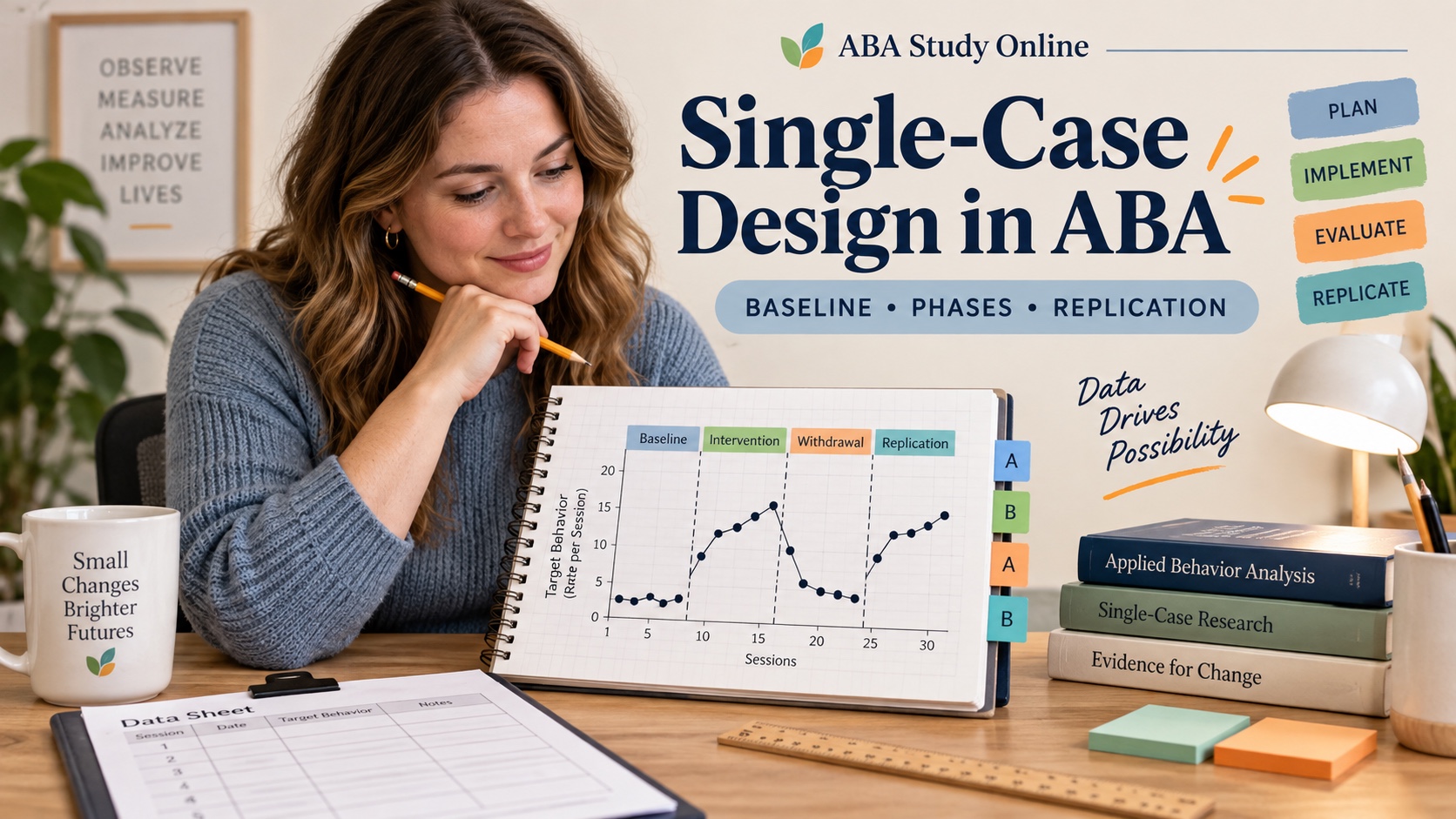
A single-case design in ABA follows one person, setting, behavior, or small unit over repeated observations. The learner is not simply described once. The behavior is measured across planned phases so the analyst can compare what happened before, during, and sometimes after an intervention or condition changed.
The phrase is often used loosely, so one distinction matters immediately: a single case study is not automatically a single-case experimental design. Experimental design requires logic for comparison and control. Repeated measurement, phase changes, prediction, verification, and replication help an analyst ask whether the intervention is plausibly related to the change rather than merely occurring before it.
Quick answer: a single-case experimental design repeatedly measures a defined dependent variable while systematically changing an independent variable across planned phases. The person or unit can serve as their own comparison. Common families include reversal, multiple baseline, multielement, and changing-criterion designs. The design type determines how prediction, verification, and replication are created.
The building blocks of the design
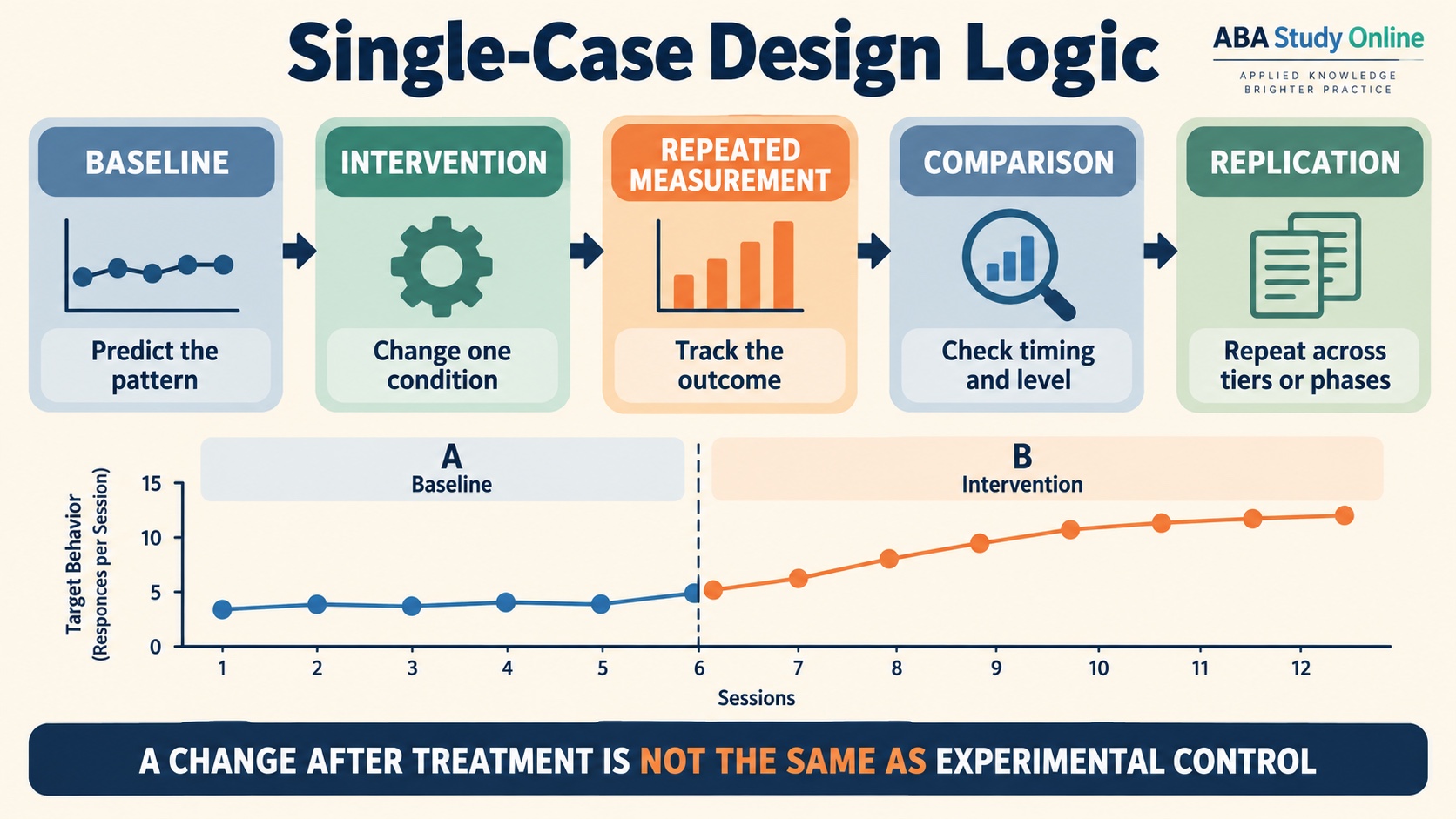
Independent variable: the intervention, condition, or feature that is systematically changed. In a study question, ask what the analyst introduced, withdrew, or varied.
Dependent variable: the observable behavior or outcome that is measured. It should have a clear operational definition and a measurement system that can show meaningful change.
Phases: sections of the graph that represent different conditions, such as baseline and intervention. Phase lines show when the condition changed; they do not automatically show why the data changed.
Repeated measurement: observations collected often enough to show a pattern, level, trend, variability, and the timing of changes. A single score before and a single score after an intervention cannot show the same pattern.
Experimental control: evidence that the planned change in the independent variable is responsible for the change in the dependent variable, supported by the design’s comparison and replication logic. The strength of the conclusion depends on the design and data, not on the label alone.
Why baseline logic matters
Baseline provides a prediction: if the intervention had not been introduced, what might the behavior have looked like? The prediction becomes more credible when baseline data show a reasonably interpretable pattern and the measurement system is stable enough for the question. Baseline is not a demand for perfect flatness. It is a reasoned reference point.
Verification asks whether the change is consistent with the intervention being responsible. Replication asks whether the relation appears again, such as when the intervention is introduced in another behavior, setting, or participant, or when the sequence is repeated in a reversal. These ideas are why a design with several planned comparisons can support a stronger inference than one before-and-after change.
An AB sequence contains a baseline followed by an intervention. It may be useful descriptively and may show a promising change. But without additional replication or control logic, it does not automatically rule out history, maturation, measurement changes, or other explanations. The correct study answer is often “the data are suggestive, but the design has limits,” not “the intervention is proven.”
Common single-case design types
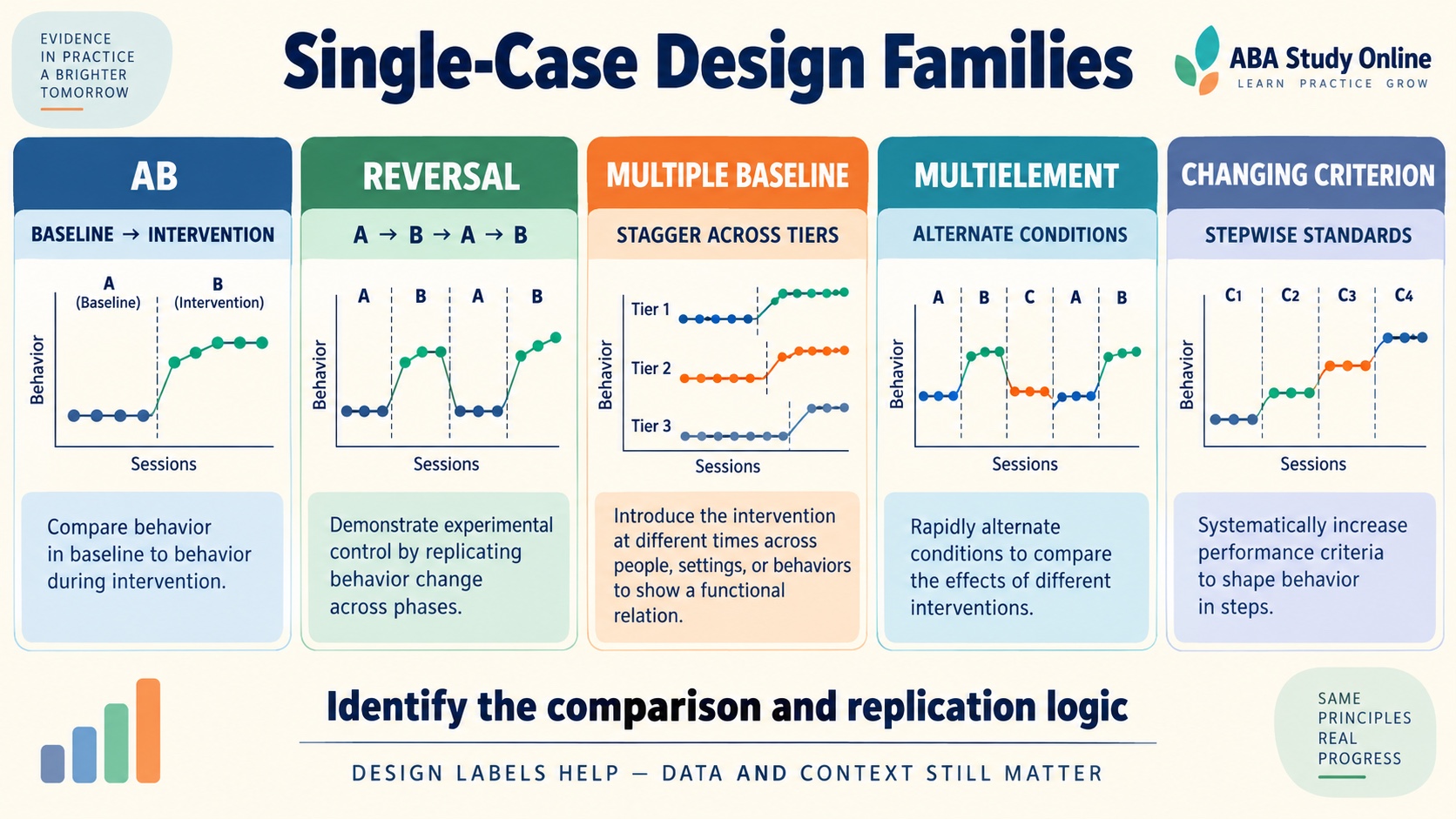
Reversal or withdrawal design: conditions are introduced and withdrawn or changed across phases, often in an A-B-A-B sequence. Repeated changes that follow the condition changes can provide a strong demonstration when withdrawal is ethical, safe, and meaningful. Not every behavior or intervention should be withdrawn.
Multiple-baseline design: the intervention is introduced at different times across behaviors, settings, or participants. If each outcome changes when the intervention reaches its baseline, the staggered pattern supplies replication without requiring the intervention to be withdrawn.
Multielement or alternating-treatments design: two or more conditions are alternated relatively rapidly so their effects can be compared. The conditions need to be distinguishable, and the interpretation depends on the measurement, sequencing, and control of carryover or order effects.
Changing-criterion design: the performance criterion changes in steps. The data should track those planned criterion shifts, showing whether behavior changes in the direction and amount expected as the standard moves.
These categories are study tools, not automatic prescriptions. The ethical and practical fit of a design depends on the behavior, intervention, environment, risk, reversibility, and people affected by the decision.
An original study scenario
Imagine a researcher studying independent task initiation. During baseline, the learner’s first-response latency is measured across several sessions. The intervention teaches the learner to check a visual start card and reinforces beginning within a defined window.
If the graph shows a lower latency immediately after the intervention, that is useful information. The next question is how the design supports the conclusion. Was the baseline pattern interpretable? Did the measurement stay the same? Did the change replicate across other tasks or settings? Was there a reason that the intervention should not be withdrawn? A multiple-baseline arrangement across tasks might provide replication while keeping the learned skill in place.
In an exam scenario, match the design to the logic described. If the intervention is staggered across several behaviors, think multiple baseline. If conditions alternate rapidly, think multielement. If the criterion moves step by step, think changing criterion. If a condition is removed and reintroduced, think reversal. Then check whether the question asks for a design label, a limitation, or an interpretation of the graph.
How to interpret a graph carefully
Start with the data, not the hoped-for story. Describe level, trend, variability, overlap, immediacy of effect, consistency across replications, and any changes in measurement or context. A large visual difference may be less convincing if the data are highly variable or the definition changed between phases.
Then examine internal validity. History, maturation, testing effects, instrumentation, and other events can create alternative explanations. Single-case designs reduce some threats through planned comparisons and replication, but they do not make every alternative explanation disappear. External validity is also a separate question: a strong demonstration in one case does not automatically generalize to every person, setting, or goal.
Also check whether the graph answers the question that was actually asked. A design may show that an intervention changed one target in one setting while leaving open whether the effect will maintain, generalize, or matter to the people involved. Interpretation is strongest when the operational definition, measurement system, phase changes, and decision rule were planned before the data were reviewed.
Common single-case design mistakes
- Calling every single participant study experimental: the design needs planned comparison and control logic.
- Calling ABAB “proof” without checking context: the sequence, data quality, replication, and ethical fit still matter.
- Confusing multiple baseline with multiple treatment: one staggers introduction across tiers; the other compares alternating conditions.
- Ignoring measurement changes: a new observer, definition, schedule, or data system can alter the graph.
- Treating a trend as a functional relation: interpretation must connect the timing and pattern to the design’s logic.
- Forgetting generalization: internal control and broad usefulness are related but different questions.
How to study the concept
Draw five tiny graphs and label only the phase sequence: AB, ABAB, multiple baseline, alternating conditions, and changing criterion. Under each, write how the design creates comparison and what kind of replication it provides. Then write one limitation or ethical reason that could affect the choice.
Use the ABA Theory Blocks to review independent variables, dependent variables, internal validity, and visual analysis. Use free ABA questions to classify short scenarios, and the ABA Definition Search to separate terms such as prediction, verification, replication, reversal, and experimental control. The ABA Study Online app can support flashcards, section practice, audio review, progress, and tools.
Single-case design FAQ
What is a single-case design in ABA?
It is a repeated-measures design that follows a defined behavior or outcome across planned conditions, often using the person or unit as their own comparison.
Is an AB design experimental?
An AB sequence can show a change after an intervention, but it generally provides weaker experimental control than designs with added replication or comparison logic. Do not treat the label alone as proof.
What is the difference between reversal and multiple baseline?
A reversal changes and often withdraws a condition across phases. A multiple-baseline design staggers the introduction of an intervention across behaviors, settings, or participants.
Why is repeated measurement important?
Repeated measurement helps show the pattern and timing of behavior across phases. It gives the analyst more information than one score before and one score after an intervention.