Sample RBT Exam: How to Practice Under the Current 2026 Format
A sample RBT exam should do more than give you a percentage at the end. It should help you practice the kind of decisions an entry-level behavior technician is expected to make, reveal which content area needs attention, and give you an explanation you can use to improve. Before choosing a practice test, check its edition, question design, domain coverage, answer explanations, and boundaries.
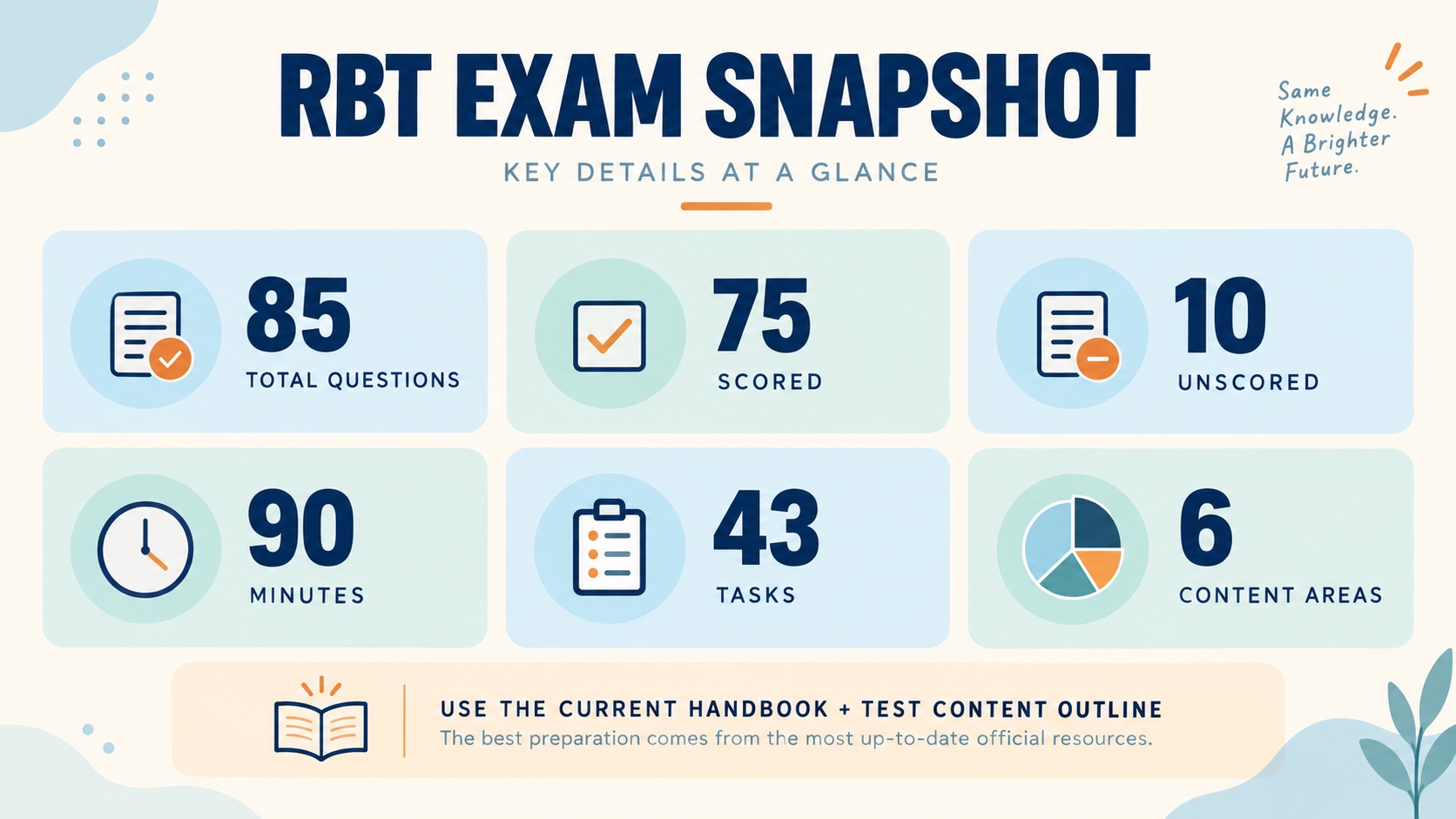
The current RBT examination is based on the RBT Test Content Outline (3rd ed.). The RBT Handbook describes 75 scored questions and 10 unscored questions, four answer choices with one correct answer, and 90 minutes to complete the exam. The outline contains 43 tasks across six content areas. A practice set can be shorter or longer for learning, but a full-length rehearsal should make its relationship to the current 85-question format clear.
This guide shows you how to evaluate and use a sample test. It does not reproduce official or retired BACB questions, claim access to live exam content, or promise a certification result. ABA Study Online practice questions and mock-exam products should be understood as original, unofficial study resources that support learning alongside the current BACB handbook, outline, training, and competency-assessment materials.
Table of Contents
What a sample RBT exam should help you do
The word “sample” can describe very different experiences. A five-question quiz may be a useful warm-up. A topic set may help you review measurement or prompting. An 85-question timed form may help you rehearse pacing. None of those formats is automatically better; the right choice depends on the job you need to complete.
Use a sample exam to practice four things:
- Recognize the task. Can you tell whether the question is asking about data, assessment, acquisition, reduction, documentation, or ethics and scope?
- Use the evidence. Can you choose an answer from the observable details instead of filling in facts that the scenario did not give you?
- Compare options. Can you explain why the best answer fits better than a plausible distractor?
- Recover from an error. Can you turn an uncertain answer into a specific next study action?
This is why a practice score should be treated as a diagnostic signal, not a label. A lower score may mean that you need content review, but it may also show that you are rushing, confusing similar measurement procedures, or choosing an intervention before identifying the relevant function or plan boundary.
Current 2026 RBT exam snapshot
Before you compare sample tests, anchor your expectations to the current official materials:
- 85 total questions: 75 scored and 10 unscored pilot questions.
- 90 minutes: the stated examination time.
- Four options: each question has four possible answers and one correct answer.
- 43 tasks: organized across six content areas.
- Overall performance: the handbook does not describe separate pass/fail results for each content area.
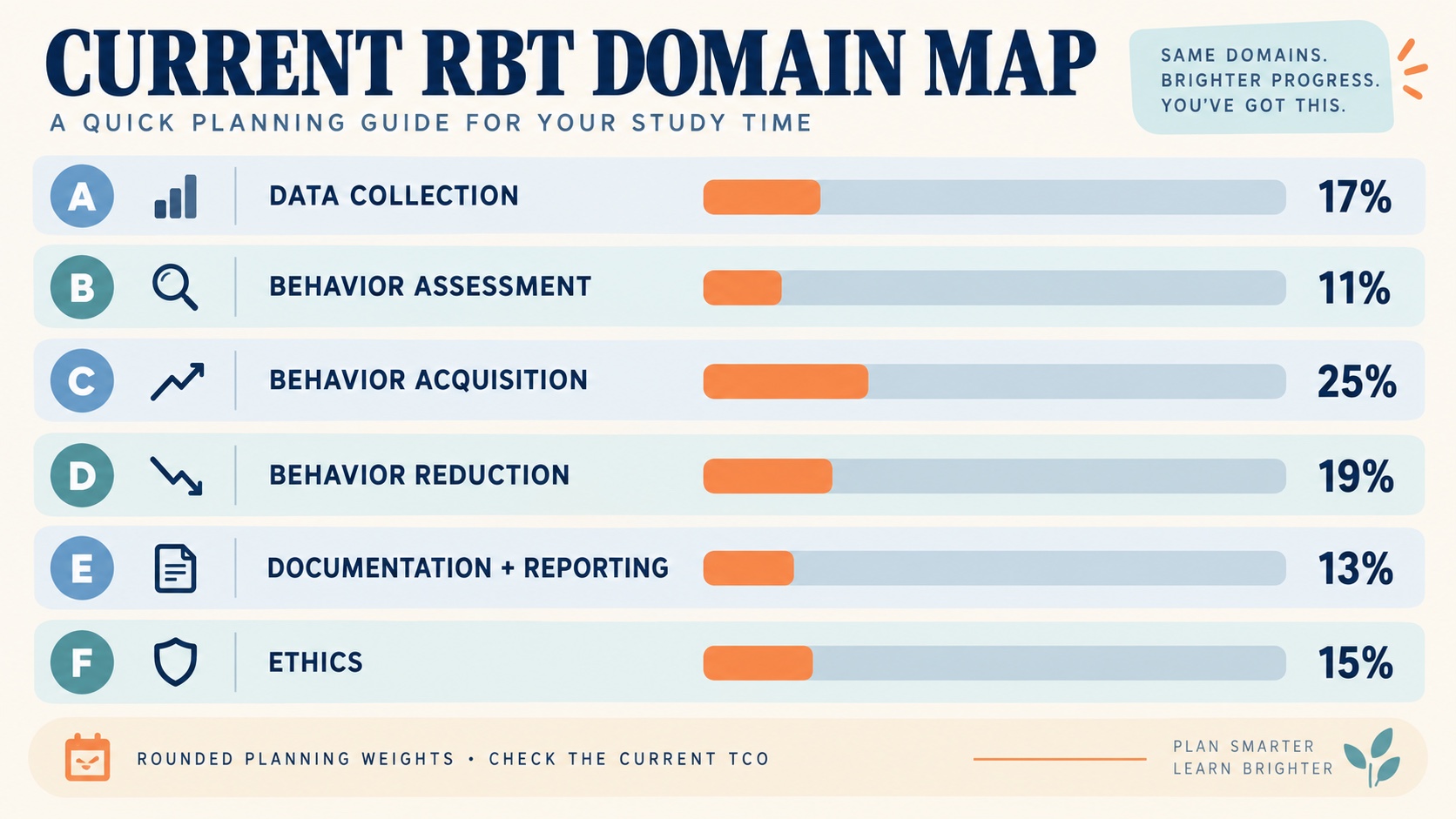
The current rounded domain weights are:
- A. Data Collection and Graphing — 17%.
- B. Behavior Assessment — 11%.
- C. Behavior Acquisition — 25%.
- D. Behavior Reduction — 19%.
- E. Documentation and Reporting — 13%.
- F. Ethics — 15%.
These values are rounded planning weights, not a promise about the order or exact wording of your exam. A strong sample exam should make its domain coverage visible so you know what your score represents. If a page still labels its sections only with an older task-list structure, check whether it has been updated for the current 3rd edition.
What to look for in a quality sample exam
Commercial practice pages often emphasize question count or a “pass first try” headline. Those details may attract attention, but they do not tell you whether the practice will teach you anything. Before starting, look for these signals.
Current edition and clear scope
The page should identify the RBT Test Content Outline (3rd ed.) and the time boundary it is designed for. “Updated” is not enough if the page never says what changed. The official RBT Handbook and current TCO should be easy to find, and the practice site should say that its questions are original and unofficial.
Four-option questions with concrete scenarios
Good practice includes decisions that reflect the RBT role: recording observable behavior, following a supervisor’s plan, implementing teaching procedures, responding to behavior-reduction procedures within scope, documenting objectively, and protecting confidentiality and client dignity. A question can be short, but it should give enough context to justify one best answer.
Rationales that explain the distractors
An answer key that says only “B” is not a teaching tool. Look for a rationale that explains the correct concept and identifies why the other options miss the evidence, use the wrong measurement, exceed the RBT role, or confuse related procedures. If the explanation makes a claim that matters, it should be consistent with the current training and ethics boundaries.
Domain visibility and error review
You should be able to tell which content area a question supports and revisit the item after submitting. A practice tool that hides every answer behind one final score may be useful for pacing, but it is less useful for targeted learning. Ideally, you can flag an item, record uncertainty, and see what to review next.
Accessible practice modes
A topic quiz, mixed untimed set, and timed full-length form serve different purposes. A learner who starts with a four-hour-style experience before understanding the concepts may only discover that they are tired. A learner who never practices under time may be surprised by pacing. A good sequence lets you use both.
Use a sample exam in three passes
Rather than taking the longest test first, use a three-pass sequence. You can repeat the sequence as your exam date approaches.
- Pass one: topic warm-up. Choose a small set from one content area. Read each rationale carefully and mark terms or procedures that need a Theory Block review. The goal is orientation, not endurance.
- Pass two: mixed untimed reasoning. Mix domains so you must identify the task from the scenario. Give yourself enough time to explain uncertain options. Mark answers that were correct but based on a guess.
- Pass three: timed rehearsal. Use an 85-question form or the closest available full-length structure under 90 minutes. Practice pacing, flagging, and moving forward. Review the complete form after a break instead of treating the final percentage as the end of the session.
During timed practice, a simple pace check can help. Ninety minutes for 85 questions is a little over one minute per question on average, but the average is not a rule that every question deserves exactly the same time. Read carefully, choose the best answer supported by the stem, flag genuine uncertainty, and return when the remaining time allows.
If a practice platform offers both instant feedback and a test mode, use them at different points. Instant explanations are helpful while learning a new distinction; delayed feedback is more useful when you are testing retrieval and pacing.
Do not use a sample exam to decide that you are “ready” from one number alone. Readiness is a broader judgment involving content understanding, application, pacing, and the official eligibility process. An unofficial site cannot make the certification decision for you.
Review by domain and error type
After a sample, sort your review into both a content area and an error type. The combination tells you what to do next:
- Data Collection and Graphing + knowledge gap: revisit the definition and calculate a new example.
- Behavior Assessment + discrimination gap: compare preference assessment types or descriptive versus functional information.
- Behavior Acquisition + application gap: explain how the procedure would look in a real teaching opportunity while following the written plan.
- Behavior Reduction + scope gap: identify what the RBT implements and when to seek supervisor direction instead of improvising.
- Documentation and Reporting + process gap: rewrite a vague note using observable, measurable language and the relevant reporting path.
- Ethics + discrimination gap: compare confidentiality, boundaries, supervision, and professional conduct decisions without reducing the code to a keyword.
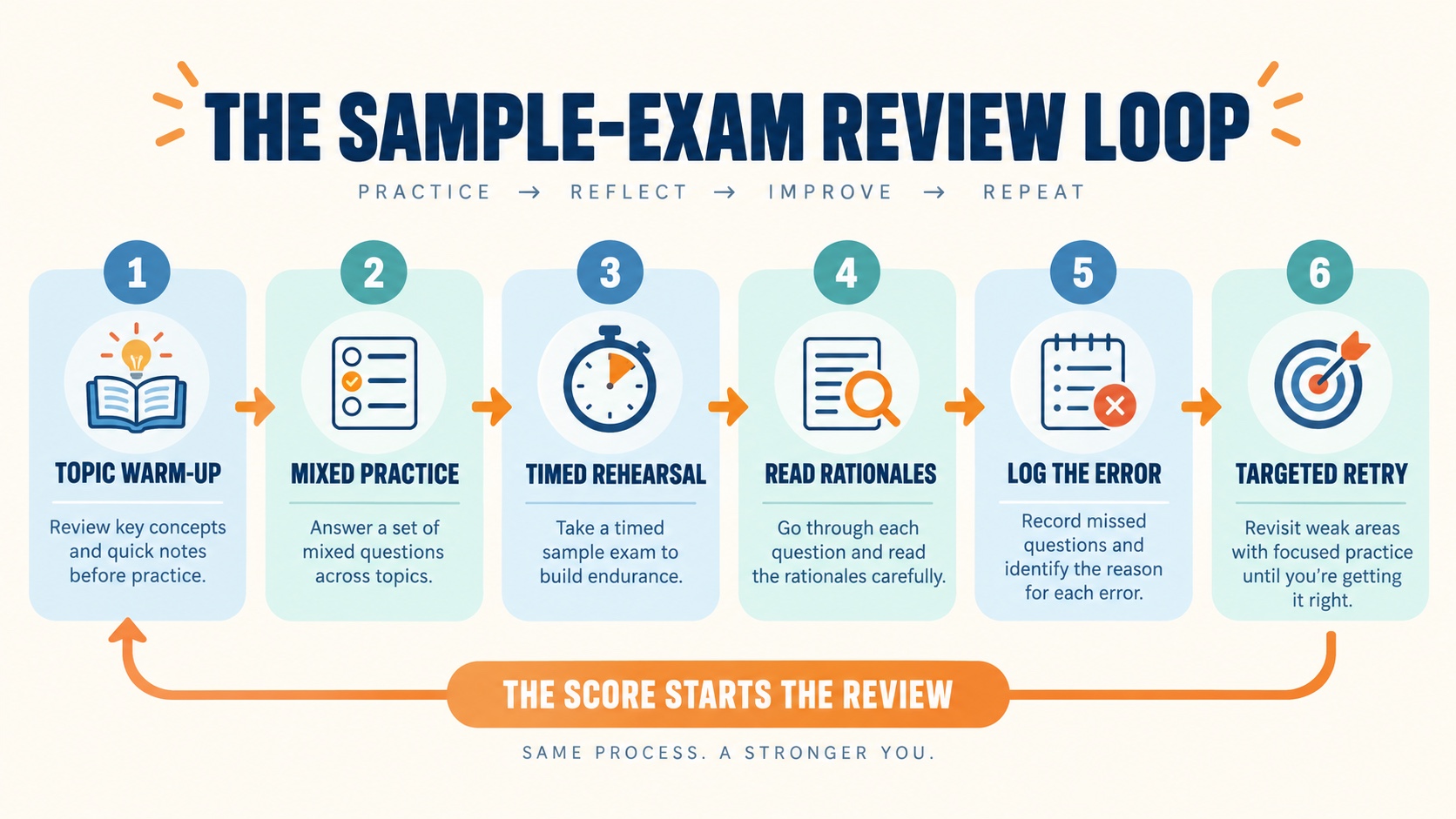
Then use a short review loop:
- Write what the question was really asking.
- State the evidence that supports the best answer.
- Explain why the most tempting distractor fails.
- Read or create a targeted explanation.
- Answer a new question about the same distinction after a delay.
A practical practice scenario
Imagine that Elena takes a 20-question sample and scores 70%. Her first reaction is to search for a more difficult test. Instead, she opens the review and notices that five misses came from Behavior Acquisition: she confused prompt fading with changing the target response, and two more came from Data Collection and Graphing because she reported a session count when the question asked for a rate.
Elena creates two small study blocks. In the first, she writes a comparison of prompt fading, stimulus control, and error correction, then practices two original scenarios. In the second, she calculates frequency, rate, duration, and percentage from short examples and explains which measure fits each question. Three days later, she takes a mixed set without domain labels.
Her next score may move up or down; the important change is that the result now tells her what to practice. A sample exam is doing its job when it makes the next step more specific. Repeating the same form immediately until the percentage rises can create familiarity without showing whether the underlying skill transferred.
For a free starting point, use ABA Study Online’s RBT practice questions to work through short original scenarios, then use the ABA Study Online app for repeatable review sessions. The free mock-exam preview and separate mock-exam area are clearly labeled website practice destinations. All ABA Study Online practice is original and unofficial; it is not BACB-endorsed and does not guarantee an examination result.
Common mistakes and FAQ
How many questions should a full sample RBT exam have?
The current examination has 85 total questions: 75 scored and 10 unscored. A shorter sample can be useful for learning, while a full-length rehearsal should explain how it relates to the 85-question format.
How long should I time a sample exam?
The current examination time is 90 minutes. Use untimed practice while learning a concept, then add timed sets as you build fluency.
Are free sample RBT exams useful?
They can be useful if the edition, original-question boundary, domain coverage, answer explanations, and review process are clear. Free access does not automatically mean current or accurate.
Does a sample-test score predict whether I will pass?
No unofficial sample score can make that guarantee. Use it to identify knowledge, discrimination, application, and process gaps. The BACB states that purchasing preparation materials does not guarantee passing.
Are these the real BACB questions?
A responsible practice site should say no. ABA Study Online sample questions should be original, unofficial practice written from public sources and reviewed for rationale quality. They should not be presented as live, recalled, or official BACB questions.
What comes after practice?
Return to the current RBT Handbook, RBT Test Content Outline (3rd ed.), 40-hour training materials, and competency-assessment materials. A sample exam does not replace the 40-hour training, Initial Competency Assessment, application, approved determination, examination, or ongoing supervision steps in the certification pathway.
Official sources and next study paths
Before relying on a sample exam, check the BACB RBT Handbook, the RBT Test Content Outline (3rd ed.), and the BACB’s RBT examination resources. For broader study, open the RBT Theory path, search the ABA glossary, browse free resources, or continue short sessions in the app. Keep current certification decisions anchored to the official BACB materials.