SAFMEDS for BCBA Study: How to Use One-Minute Fluency Practice
If you search for SAFMEDS BCBA, you are probably looking for a fast way to remember behavior-analysis terms, distinctions, and decision rules. SAFMEDS is commonly expanded as “Say All Fast, a Minute Every Day, Shuffled.” The method uses a focused set of cards or prompts, a short timed practice period, immediate checking, and repeated shuffled retrieval. That format can be useful when a large BCBA study outline feels scattered.
The key boundary is just as important as the acronym. SAFMEDS is an independent study or fluency method, not a BACB credential, required course, official exam format, or pass guarantee. The current BACB Test Content Outline and Handbook remain the controlling sources for official content, eligibility, and examination rules. Use SAFMEDS to strengthen quick retrieval, then add explanations, varied scenarios, mixed practice, and full-form rehearsal.
Table of Contents
What does SAFMEDS mean?
SAFMEDS describes a timed, shuffled practice routine. The familiar expansion is a memory aid for the sequence: say or produce the answers quickly, work for about a minute, practice regularly, and shuffle the items so recall does not depend on a fixed order. In behavior-analytic education, the approach is often discussed alongside precision teaching and charted performance. A peer-reviewed review describes SAFMEDS as an instructional and assessment strategy while also noting that additional research is needed to clarify how its benefits compare with traditional instruction.
For a BCBA candidate, the most useful starting point is not a universal “correct per minute” score. It is a well-defined response. Decide what is on the front of a card, what counts as a complete answer, how quickly you will score, and what you will do with an error. A card that asks for a one-sentence distinction is a different task from a card that asks you to select and justify an intervention in a new case.
That distinction prevents a common problem: treating every question as a speed drill. SAFMEDS is most naturally suited to compact, observable responses such as definitions, examples, nonexamples, sequences, abbreviations, or comparisons. It is less suited to replacing the reasoning required for a long scenario with ambiguous variables.
How does a SAFMEDS BCBA session work?
A basic session can be small enough to fit into a study break:
- Choose one narrow deck. Use a single content decision, such as measurement terms, prompting distinctions, or ethics vocabulary. Avoid putting an entire exam outline into one deck.
- Define the response. Write a prompt on the front and a concise answer key on the back. Include a source or note when a term has an important qualification.
- Set a short interval. One minute is the traditional cue in the acronym. Use a timer and record the number attempted, correct, incorrect, and skipped if those data help you plan.
- Respond and score consistently. Say or write the answer, then check it against the key. Do not quietly change the scoring rule because a session feels slow.
- Shuffle and repeat later. Mix the order before the next round and return after a delay. A rising score in a fixed order may show sequence memory rather than flexible retrieval.
Suppose a card asks, “What is the difference between continuous and discontinuous measurement?” A complete response might name the observation requirement and give one accurate example. If the answer is only “one is more precise,” mark the missing distinction, review it, and rewrite the card if the prompt is too vague. The purpose is not to reward a guess that sounds familiar; it is to make the target response clear enough to teach and measure.
The SAFMEDS fluency cycle
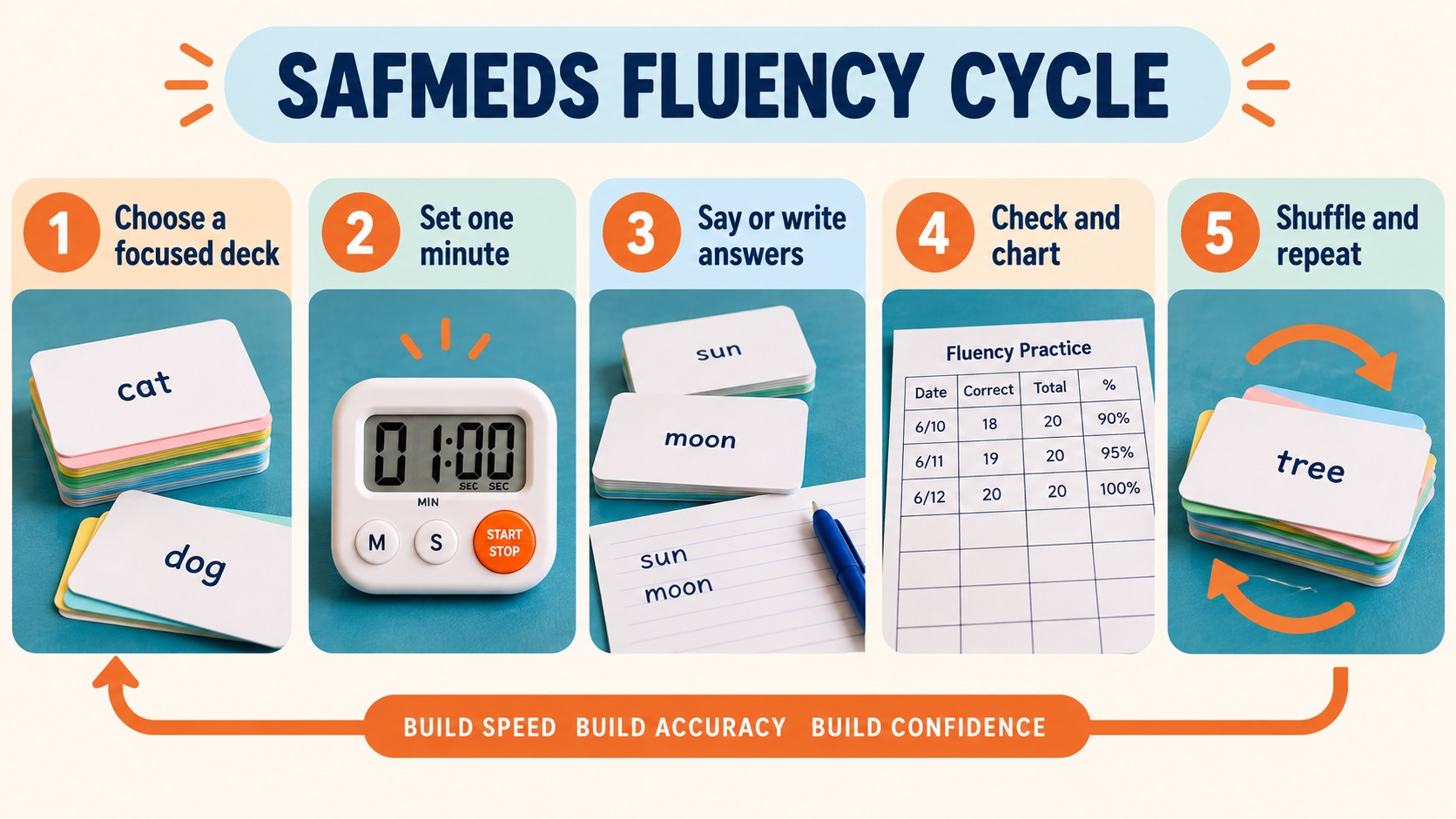
Charting can add a helpful feedback loop, but the chart is not the learning objective by itself. Use it to answer practical questions: Is accuracy improving? Is responding becoming less hesitant? Does performance drop when the order changes? Does the skill stay available after a day or a week? If speed increases while accuracy falls, the next step is not simply to push for a higher number.
Keep the data simple enough that you will actually use them. A dated record with total attempted, correct, errors, and a short note may be enough. If you use a commercial SAFMEDS or flashcard tool, check how it defines a correct response and whether its deck reflects the current BCBA content you intend to study. A polished timer does not verify the accuracy or currency of the cards.
What fluency practice can and cannot do
Fluency practice can help make high-use information easier to retrieve. Faster access may reduce the working-memory load involved in a later problem, especially when the target is a definition or a well-bounded distinction. Repeated practice can also reveal which terms are genuinely stable and which ones feel familiar only because you have just seen them.
It cannot establish that you understand every application of a term. A candidate may quickly define reinforcement and still misread a scenario because the consequence does not actually increase the future frequency of the behavior described. A candidate may recall a measurement label and still choose a poor measurement system for the observation question in front of them. Speed is a useful signal, not a complete mastery judgment.
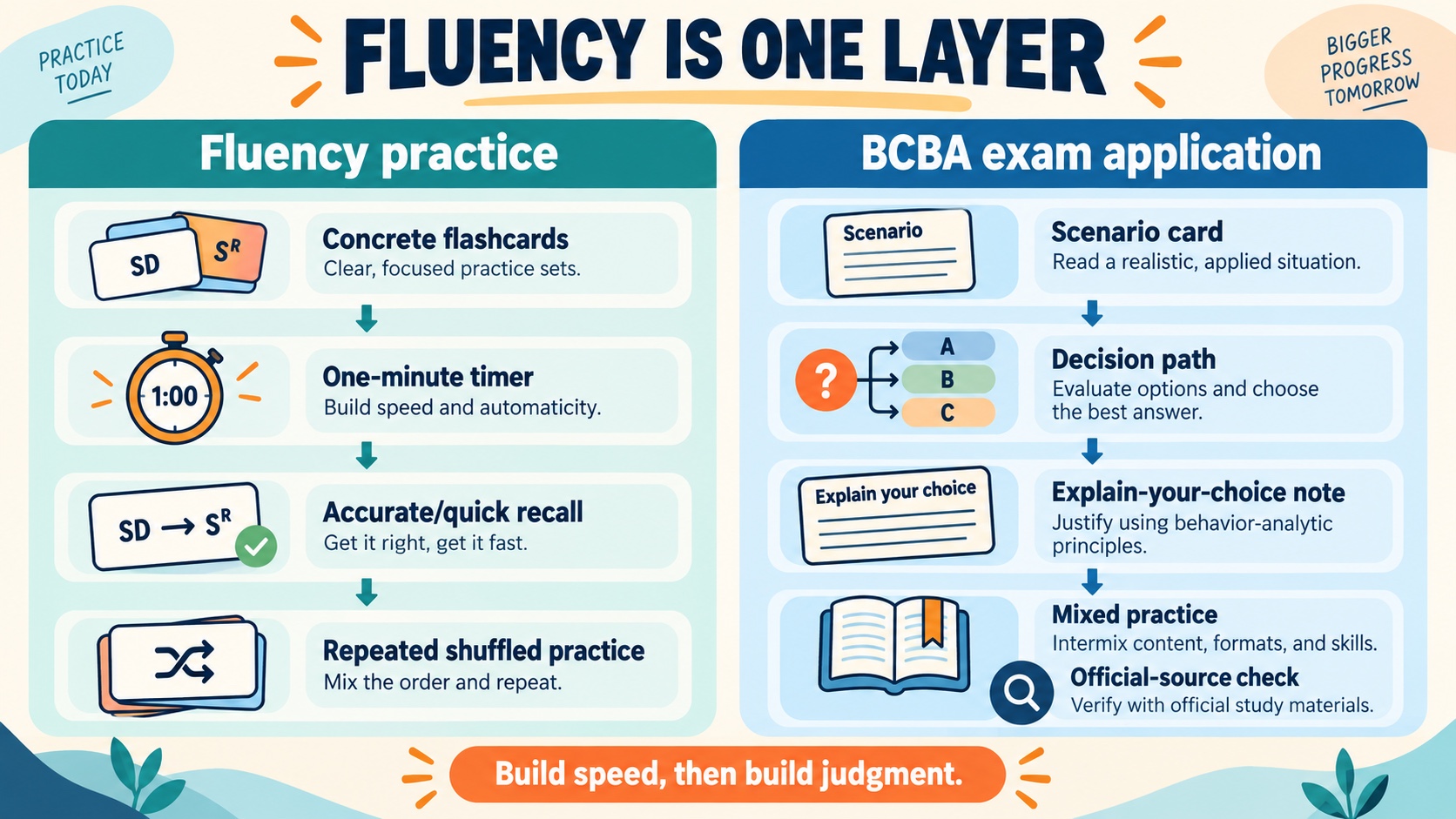
How to combine SAFMEDS with BCBA application practice
Use the current BACB Test Content Outline as the map, then assign each deck a job. For a concept that needs quick recall, make a small SAFMEDS deck. For the same concept, add a second set of original scenarios that changes the context, relevant variables, and answer choices. Finish with a brief explanation: what feature of the scenario controlled your decision, and why did the alternatives fail?
A balanced study loop might look like this:
- Retrieve: run a short shuffled fluency set for the target terms.
- Explain: say the rule in plain language and add a concrete example and nonexample.
- Apply: answer mixed scenarios without seeing the definition card first.
- Review: record the exact distinction missed, not just the question number.
- Delay: repeat the target after time has passed and check whether it transfers to a new format.
Short questions, flashcards, and a longer mock exam can therefore have different roles. ABA Study Online’s BCBA learning resources, free questions, app review tools, and mock-exam resources can sit in those different layers. Keep the official BACB sources beside them, especially when you are checking a current rule, content outline, eligibility detail, or exam policy.
A worked study example
Imagine that your target is the distinction between prompting and prompt fading. Start with six to twelve cards, not a hundred. One card might ask for a plain-language definition of a prompt. Another might ask what prompt fading changes over time. A third might require a brief example. During the one-minute round, score only the response rule you wrote before starting.
After the fluency round, close the cards and answer a scenario: a learner completes a task only after a verbal cue, and the teaching plan gradually reduces that cue. Explain what is changing, what behavior is being measured, and what evidence would show that the learner is responding more independently. If you can recite the definitions but cannot explain the scenario, the next study action is application and feedback, not a larger speed target.
Return to the same concept with changed wording. The goal is flexible responding: identify the relevant feature, choose the best answer, and justify it. That is a more useful interpretation of progress than a single high count on a familiar deck.
Common mistakes to avoid
- Using a fixed order: shuffle so you practice the concept, not the sequence.
- Chasing speed over accuracy: define what counts as correct and slow down when errors increase.
- Making cards too broad: split a vague prompt into observable, teachable responses.
- Studying definitions only: add examples, nonexamples, scenarios, and explanation prompts.
- Trusting an old deck: compare materials with the current TCO, Handbook, ethics code, and examination information.
- Treating a score as an exam prediction: a one-minute result is a practice measure, not a BACB outcome forecast.
- Confusing a product with an authority: a SAFMEDS deck or app is an independent learning aid, not the certification board.
A short weekly routine
For a modest routine, choose one content area at the beginning of the week and build a small deck from a current, trustworthy source. On several days, complete one or two timed rounds and note accuracy. Midweek, add a few scenarios that require explanation. At the end of the week, use mixed practice or a short quiz without the deck, then schedule the items that still fail after a delay.
Change the deck when it becomes too easy. Keep some mastered items for maintenance, but spend most of the session on targets that are accurate enough to practice yet still require effort. If the method starts to feel like a race, return to the learning question: what response should become more accurate, more available, or more flexible because of this practice?
FAQ and sources
What does SAFMEDS stand for?
SAFMEDS is commonly expanded as “Say All Fast, a Minute Every Day, Shuffled.” Different providers may describe the routine with slightly different instructions, so check the scoring rules and learning target rather than assuming every deck is identical.
Is SAFMEDS an official BCBA exam requirement?
No. SAFMEDS is an independent study or instructional method. The BACB’s current Test Content Outline, Handbook, requirements, and examination information define the official certification and testing boundaries.
How many cards should a BCBA SAFMEDS deck have?
There is no single required number. Start with a focused set small enough to score consistently. Add cards only when the prompt, answer, and source are clear, and split decks when one set mixes unrelated response types.
Can SAFMEDS replace BCBA practice exams?
No. It can support quick retrieval, but it does not replace explanation, varied scenarios, mixed practice, timing practice, or a full review of the current official sources.