Restricted vs. Unrestricted BCBA Hours: How to Classify Fieldwork Activities
If you are comparing restricted vs. unrestricted hours for BCBA fieldwork, start with the central rule: unrestricted activities must make up at least 60% of total supervised fieldwork, while restricted activities may make up no more than 40%. Restricted hours are optional; there is no minimum restricted percentage. The harder part is classification. An activity is not automatically unrestricted because it happens in a clinic, and it is not automatically restricted because it involves data.
This guide explains the current BACB distinction with examples and a practical classification process. Your supervisor and the applicable BACB Handbook control your personal record. The article is educational planning support, not an approval decision, fieldwork verification, or substitute for supervision.
Table of Contents
The short answer: 60% unrestricted, 40% maximum restricted
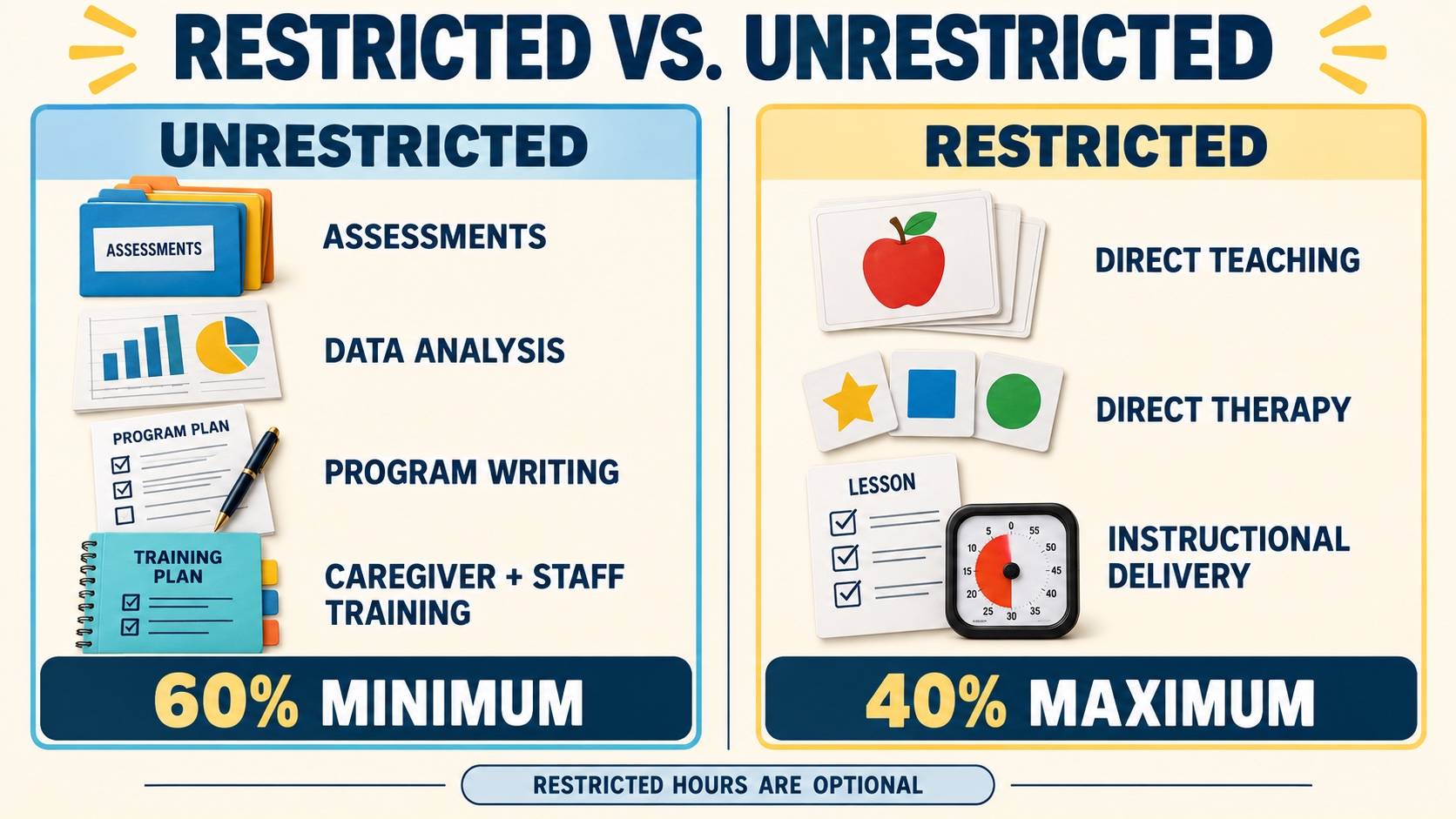
The current BCBA Handbook describes unrestricted activities as those most likely to be performed by a BCBA. They must comprise at least 60% of total supervised fieldwork hours. Restricted activities involve delivering therapeutic or instructional procedures directly to clients. They may comprise no more than 40% of the total fieldwork hours.
Think of the balance as a ceiling and a floor:
- Unrestricted: minimum 60% of total fieldwork hours.
- Restricted: maximum 40% of total fieldwork hours; no minimum is required.
- Unacceptable: non-behavior-analytic activities cannot be counted as either type.
The 60% calculation is based on total accumulated fieldwork, not necessarily a requirement to reach exactly 60% every calendar month. Still, monitoring each supervisory period is wise. A trainee who postpones the unrestricted work may discover too late that the final balance cannot be repaired easily.
What restricted and unrestricted activities mean
Restricted activities are the direct delivery of therapeutic or instructional procedures to a client. They can be valuable behavior-analytic work and can help a trainee build competence, but the fieldwork rules limit how much of the total experience can be made up of that delivery. Direct implementation of a client’s teaching procedure is a common example.
Unrestricted activities resemble the work a BCBA does when designing, evaluating, and overseeing behavior-analytic services. Examples in the current handbook include conducting behavior-analytic assessments, analyzing data, writing or revising programs, training caregivers or staff, meeting with clients about behavior-analytic programming, researching literature for current client programming, and observing or collecting data for an assessment or future programming decision.
Unacceptable activities are not a third kind of fieldwork to be balanced. General coursework assignments, readings, quizzes, unrelated administrative work, billing, non-behavior-analytic training, non-behavior-analytic assessments, and other activities that are not behavior analytic or client specific cannot be counted just because they happen at an ABA employer.
Examples that make the distinction clearer
| Activity | Likely classification | Reason to discuss with the supervisor |
|---|---|---|
| Implementing a teaching procedure directly with a client | Restricted | Direct therapeutic or instructional delivery. |
| Graphing and interpreting a client’s data to guide a program | Usually unrestricted | The focus is analysis and programming, not only implementation. |
| Training a caregiver or staff member on a behavior-analytic program | Usually unrestricted | The trainee is building the implementation system and evaluating performance. |
| Collecting data during an existing treatment session | Context-dependent | Purpose and relation to a future assessment or programming decision matter. |
| Completing a general workplace billing task | Unacceptable | It is administrative rather than behavior analytic. |
These labels are study examples, not automatic approvals. The same words—especially “data collection,” “observation,” and “training”—can describe different activities. The activity description should make the behavior-analytic purpose visible.
How to calculate the fieldwork balance
Use the total fieldwork target and the applicable fieldwork type to create a planning ceiling. If a trainee completes 2,000 hours of Supervised Fieldwork, at least 1,200 hours should be unrestricted and no more than 800 may be restricted. If a trainee completes 1,500 hours of Concentrated Supervised Fieldwork, at least 900 should be unrestricted and no more than 600 may be restricted.
For a monthly check, divide the running unrestricted hours by total qualifying fieldwork hours, then compare the result with the long-term target. Suppose a trainee has 400 qualifying hours logged, including 230 unrestricted hours. That is 57.5% unrestricted, so the trainee is below the 60% target at that point and should discuss the mix with the supervisor. The calculation does not decide whether any individual entry qualifies; it only shows where a review is needed.
There is no reason to fill a tracker with borderline entries just to reach a percentage. A smaller accurate record is more useful than a larger record that labels every client-facing task unrestricted. Keep the activity, purpose, client connection, and supervisor feedback together.
Why context changes the classification
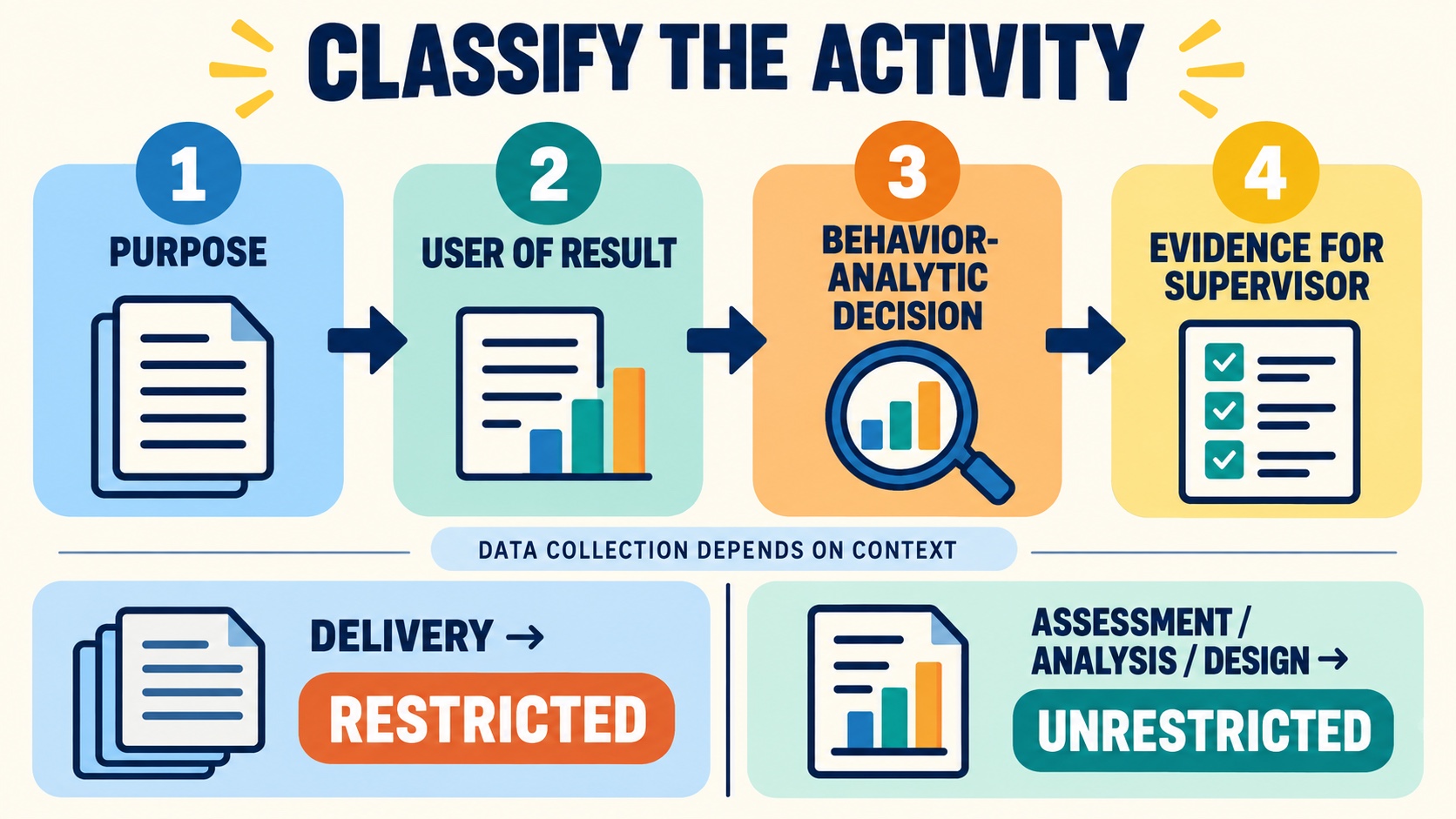
The BACB’s own explanation uses data collection to show why a keyword label is not enough. Data collection can be restricted if the trainee is simply collecting data as part of implementing an existing client treatment program. Data collection can be unrestricted if it is part of a functional assessment or another process used to identify future programming needs.
Ask four questions about a borderline activity:
- What is the purpose? Is the trainee delivering a procedure, assessing a need, analyzing a pattern, or designing a program?
- Who will use the result? Is it only part of today’s implementation, or will it inform a clinical decision, program revision, staff training, or caregiver support?
- What behavior-analytic decision is being practiced? Name the assessment, measurement, analysis, design, or evaluation skill rather than the setting.
- What evidence will the supervisor review? Save the data, draft, graph, training plan, meeting note, feedback, and final classification rationale.
What the 2027 BCBA changes do and do not change
The 2027 BCBA Requirements continue to require at least 60% unrestricted activities across total supervised fieldwork. That does not mean every other fieldwork number stays the same. The 2027 overview changes the concentrated supervision percentage to 7.5%, sets a 20–160-hour fieldwork-period range, specifies 60 or 90 cumulative minutes of client observation depending on fieldwork type, and introduces 2027 verification forms.
Do not call this a new “7th edition” of the exam. The activity balance belongs to fieldwork requirements; the BCBA Test Content Outline is a separate examination document. Label your tracker with the application framework, form version, and source date. If your application timing crosses January 1, 2027, read the BACB transition guidance before carrying forward a current tracker.
A practical classification and tracking workflow
Before the month begins, create a row for each planned activity. Use a plain-language description, the client or program connection, the intended behavior-analytic decision, and a tentative classification. During supervision, bring the borderline rows to the supervisor instead of waiting until the final form. At the end of the period, reconcile total hours, unrestricted hours, restricted hours, observation, supervision contacts, and signatures.
Keep restricted and unrestricted counts in separate columns. Track a running percentage, but do not let the spreadsheet silently recategorize an activity. If the supervisor changes a classification, preserve the original note, record the correction, and update the signed record using the current process. A tracker is an organizer; the supervisor and BACB forms remain the authority for the fieldwork record.
For learning support, use the BCBA learning blocks, BCBA practice questions, and ABA glossary to review measurement, assessment, data analysis, programming, and ethics concepts. They can help you explain the work more clearly, but they cannot approve an hour.
Turn classification questions into practice
Use the ABA Study Online app to practice BCBA concepts and review reasoning errors in short sessions. The app is an independent study tool; it does not determine whether your fieldwork activity qualifies, replace your supervisor, or guarantee certification.
Common mistakes and study support
Treating restricted as “bad.” Restricted work can be valuable training. The rule limits the proportion so the trainee also learns assessment, analysis, design, training, and oversight skills.
Calling everything at an ABA company unrestricted. The employer and setting do not decide the classification. The activity’s purpose and behavior-analytic function matter.
Calling everything with a client restricted. Client-facing assessment, programming meetings, caregiver training, and data analysis can be unrestricted when they match the current definition.
Counting non-behavior-analytic work. Billing, general paperwork, unrelated training, and course homework do not become fieldwork because a behavior-analytic employer assigned them.
Letting an app or tracker make the decision. Use digital tools for study and organization. Ask the qualified supervisor to review the activity and the current BACB requirements.
FAQ and official sources
Are restricted hours required? No. Restricted activities may make up no more than 40% of total BCBA fieldwork; the current framework does not set a minimum restricted percentage.
How many unrestricted hours do I need? At least 60% of total supervised fieldwork. For 2,000 hours, that is at least 1,200 unrestricted hours. For 1,500 hours, it is at least 900. Confirm the fieldwork type and current rules with your supervisor.
Can RBT hours count toward BCBA fieldwork? Sometimes, if the activities and supervision satisfy the applicable BCBA fieldwork requirements. RBT work is often restricted, so do not assume that an RBT job automatically supplies enough unrestricted experience.
Where should I verify the final classification? Start with the current BCBA Handbook, the 2027 BCBA Requirements, and the BACB fieldwork resources. Bring uncertain activities to your qualified supervisor; a general article cannot approve them.
The most reliable restricted-versus-unrestricted decision is a documented conversation about purpose, behavior-analytic function, evidence, and the current rule version. Use the percentages to monitor the balance, but use supervision to improve the work itself.