Response Maintenance in ABA: What It Means and How to Plan for It
Response maintenance in ABA means that a learned behavior continues to occur over time after the intensive teaching arrangement, prompts, or reinforcement schedule has changed. The response is not merely correct during a lesson. It remains available under the conditions that matter in everyday life or in a later maintenance check.
Maintenance is easy to confuse with generalization. Generalization asks whether behavior occurs with new people, materials, settings, or response forms. Maintenance asks whether the behavior continues across time. A skill may maintain with one teacher but fail to generalize to a new classroom, or generalize to a new setting but fade several weeks later. The questions overlap, but they are not identical.
Quick answer: response maintenance is the continued performance of a learned behavior across time after teaching intensity or support changes. It is demonstrated by planned probes or ongoing measurement, not assumed because a learner reached mastery once. A maintenance plan may include natural reinforcement, varied practice, fading prompts or schedules, and checking the response again later.
Maintenance compared with related terms
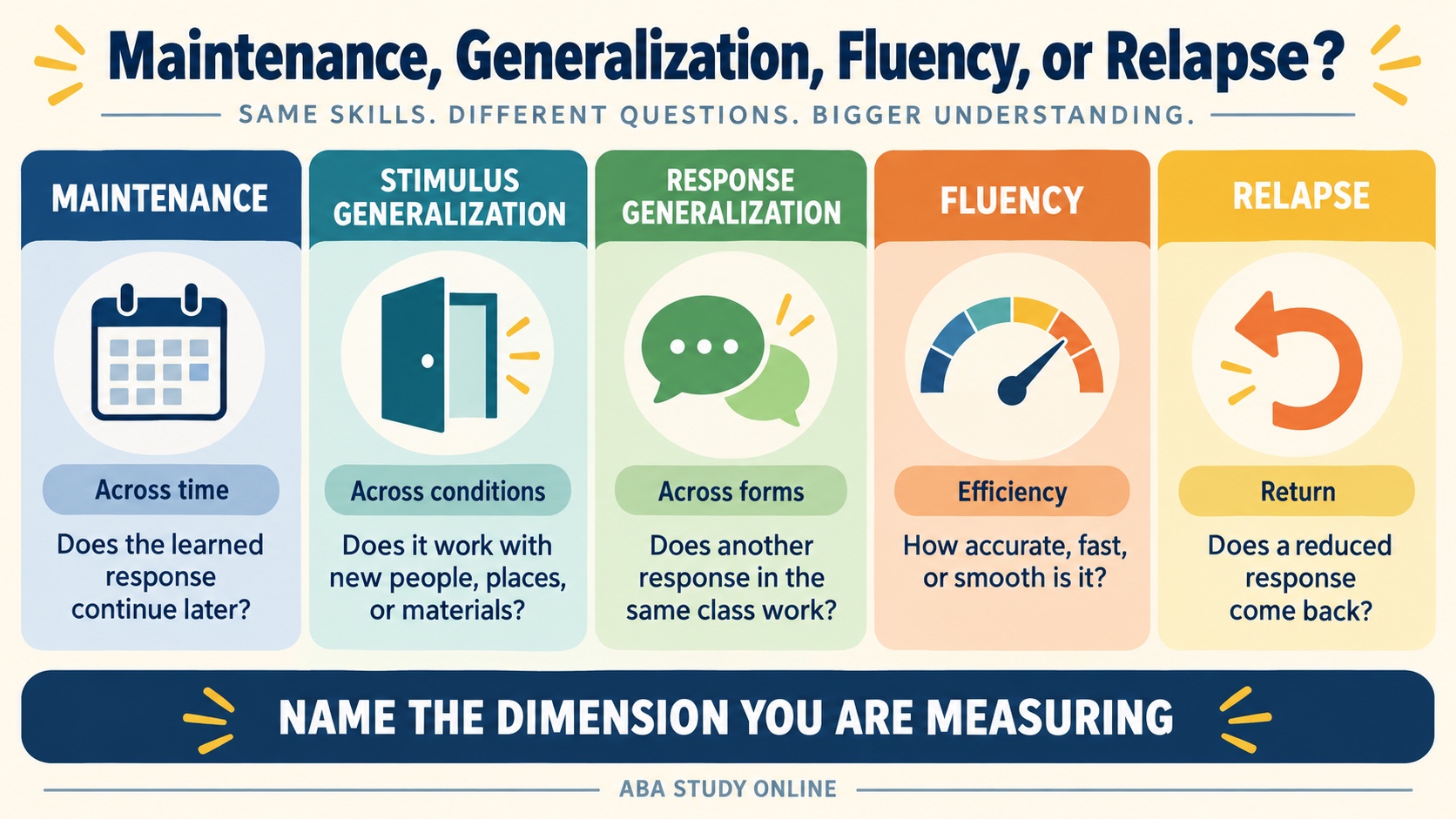
Response maintenance is persistence across time. A learner continues to use a communication response two weeks after direct teaching is reduced, or still completes a routine during later probes.
Stimulus generalization is responding in the presence of new or changed stimuli. A skill learned with one instructor may occur with another instructor, in another room, or with different materials.
Response generalization is a change in the form or topography of a response within the same functional response class. A learner may appropriately request a break with a word, gesture, or communication device rather than only the exact form taught.
Fluency concerns how accurately, quickly, or efficiently a response occurs. A response can be fluent during instruction and still fail to maintain weeks later. Fluency may support use, but it is not the same measurement question.
Relapse describes the return of a previously reduced or changed behavior under some conditions. Terms such as resurgence, renewal, and reinstatement refer to different relapse processes. Maintenance is about the continued desired response; relapse is about a return of behavior that had decreased or disappeared. The study context determines which process is being tested.
How maintenance is measured
Measurement begins with a precise response definition and a time plan. “The skill lasted” is too vague. A maintenance question might ask whether the learner independently completes four routine steps during a probe every Friday for four weeks, or whether the response remains above a defined accuracy criterion after teaching sessions become less frequent.
Maintenance probes should be scheduled rather than collected only when someone remembers. The probe may use the same measurement system as teaching or a clearly described variation. Record the setting, materials, cueing, reinforcement available, response, and time since the last intensive teaching opportunity. These details help the team interpret whether a change reflects maintenance, generalization, measurement drift, or a different task.
Mastery is a decision rule for moving forward; maintenance is evidence after that decision. Reaching 80% across three sessions may meet a teaching criterion, but it does not automatically demonstrate that the response will occur next month, with a different person, or when prompts and reinforcers are less frequent. The later probe answers a different question.
How maintenance can be planned
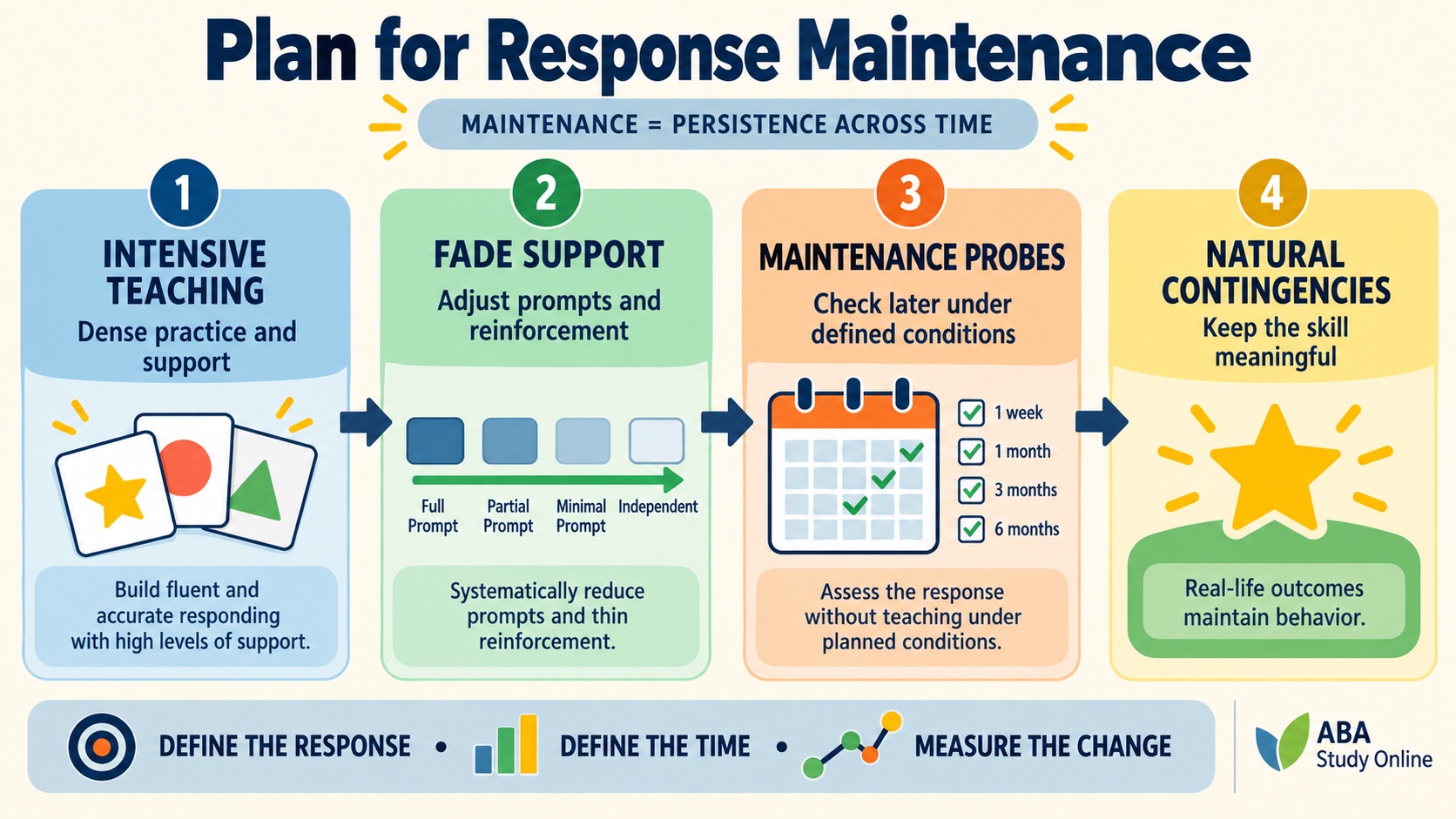
Connect the skill to natural contingencies. If a response produces a meaningful outcome in everyday life, that natural consequence can help support continued use. The relevant outcome should be socially meaningful, not simply convenient for the program.
Fade support carefully. Prompts, dense reinforcement, and adult assistance may be reduced according to data. Fading is not the same as removing support abruptly, and the correct schedule depends on the learner, the response, the setting, and the plan.
Practice across useful examples. Varied materials, people, tasks, and examples can help a learner contact the relevant features of the skill. This is primarily a generalization strategy, but it can also make the response more durable when real-life conditions vary.
Schedule maintenance checks. A later probe can show whether the response continues, whether more teaching is needed, or whether the measurement system needs review. A maintenance check should be planned with dignity, feasibility, and the learner’s priorities in mind.
The practical decision is not always to remove support completely. Some learners may use an accommodation, visual cue, communication device, or periodic reminder as part of a stable and meaningful routine. Maintenance planning asks whether the response remains useful under the intended conditions, not whether every support disappears. The target should be independence as defined by the person’s goals and context, rather than independence as a fixed visual ideal. A planned support is not evidence of failure.
An original study scenario
Imagine a learner who has been taught to request help with a short phrase or communication device during independent work. During teaching, an adult is nearby, prompts are available, and the request contacts quick assistance. After the learner meets the teaching criterion, the team plans a maintenance probe two weeks later during the ordinary work routine.
At the probe, the team records whether the request occurs independently, what task was present, how much time passed before the request, and whether help was available. If the response occurs with the usual teacher but not with a substitute teacher, that suggests a generalization question. If it occurs with both teachers during the first week but drops later, that suggests a maintenance question. The labels guide the next measurement; they do not by themselves explain why the pattern changed.
What maintenance data can and cannot show
Maintenance data can show whether a defined response continues under specified conditions and time intervals. They can also show that performance changes after prompts, reinforcement density, materials, or setting changes. They cannot prove that one maintenance strategy will work for every learner or that a response will persist in every future context.
Interpret the result with the measurement and context in view. A low maintenance probe may reflect a true loss of skill, a changed instruction, a new task, a missing reinforcer, illness, schedule disruption, or an observation system that no longer matches the response. A high probe does not prove that the skill will maintain forever. It is evidence from the conditions that were checked.
Common response-maintenance mistakes
- Assuming mastery equals maintenance: mastery ends one decision; later probes answer the maintenance question.
- Calling every new setting maintenance: a new person or setting raises a generalization question too.
- Fading everything at once: changing prompts, reinforcement, materials, and task demands together makes interpretation harder.
- Measuring only when performance looks good: planned checks reduce selective reporting.
- Ignoring natural value: a skill is more likely to matter when it produces a meaningful outcome for the learner.
- Treating a study framework as a clinical prescription: real decisions require qualified professional judgment, consent, context, and data.
How to study the concept
Make a five-row table with the headings time, person or setting, response form, efficiency, and return of behavior. Put maintenance, stimulus generalization, response generalization, fluency, and relapse into the row that best describes the question. Then create one example where two dimensions change at the same time and explain why the data would be harder to interpret.
Use the ABA Theory Blocks to review generalization and behavior-change procedures, free ABA questions to classify scenarios, and the ABA Definition Search for terms such as schedule thinning, natural reinforcement, resurgence, and maintenance probes. The ABA Study Online app can support flashcards, section practice, audio review, progress, and tools.
Response maintenance FAQ
What is response maintenance in ABA?
It is the continued occurrence of a learned response across time after intensive teaching or support conditions change.
What is the difference between maintenance and generalization?
Maintenance focuses on persistence over time. Generalization focuses on behavior occurring with new stimuli, settings, people, or response forms. A plan may need to evaluate both.
Does reaching mastery prove maintenance?
No. Mastery is a criterion for a teaching decision. Maintenance requires later measurement under defined conditions.
How can reinforcement fading support maintenance?
Fading can gradually shift a response from intensive teaching conditions toward naturally available consequences, but the schedule and decision rules must be based on the current plan and data.