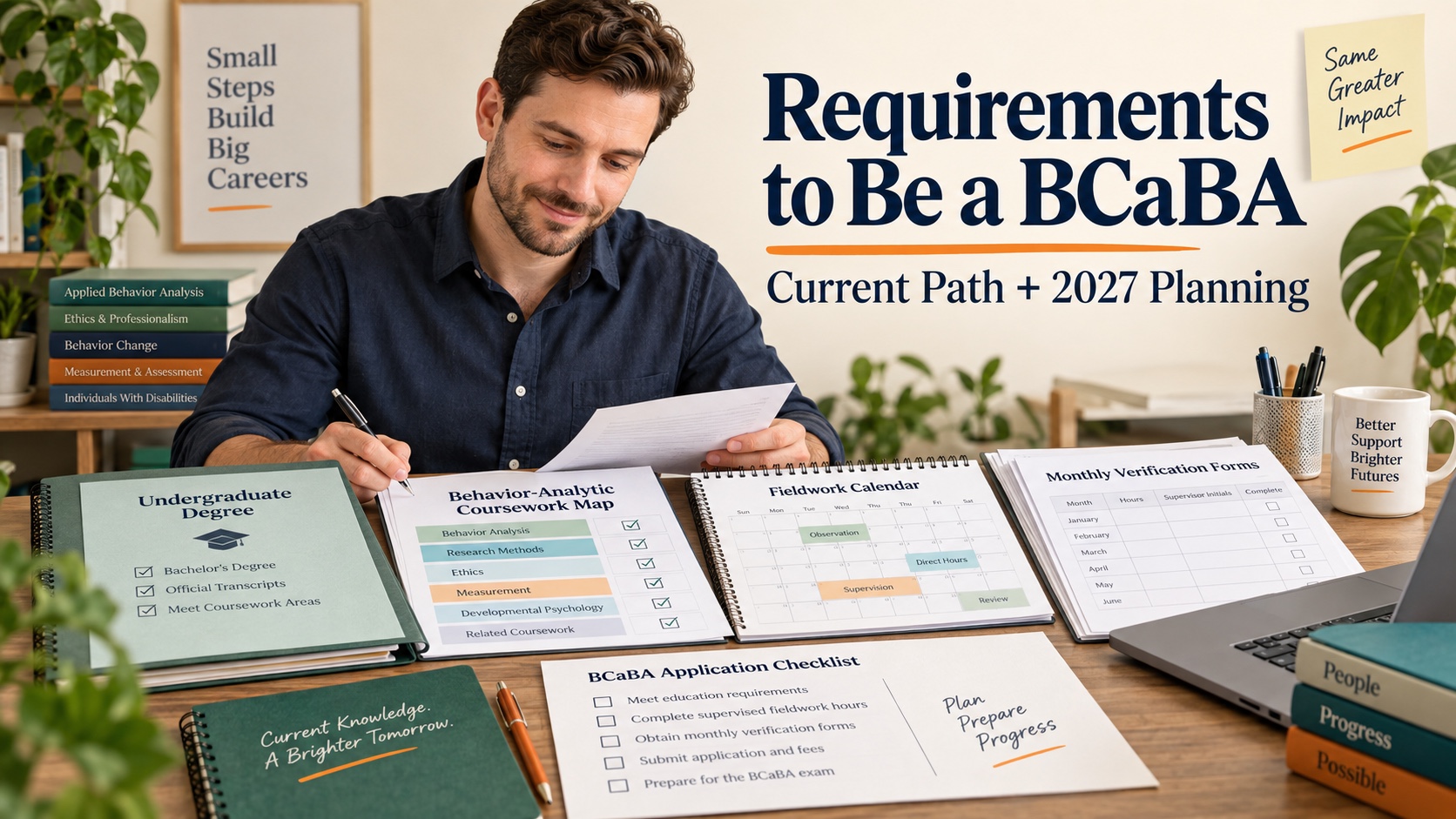
Requirements to Be a BCaBA: A Current Pathway and 2027 Planning Guide
If you are searching for the requirements to be a BCaBA, you need more than a short list of classes. The certification path combines a degree, behavior-analytic content, supervised fieldwork, an application, and the BCaBA examination. Your application date also matters because significant requirement changes begin January 1, 2027.
This guide gives you a dated planning framework. It explains the current Pathway 1 and Pathway 2 routes, shows where fieldwork fits, and separates the 2022 requirements from the published 2027 transition. Use the current BACB handbook and formal application review as the authority for your individual situation.
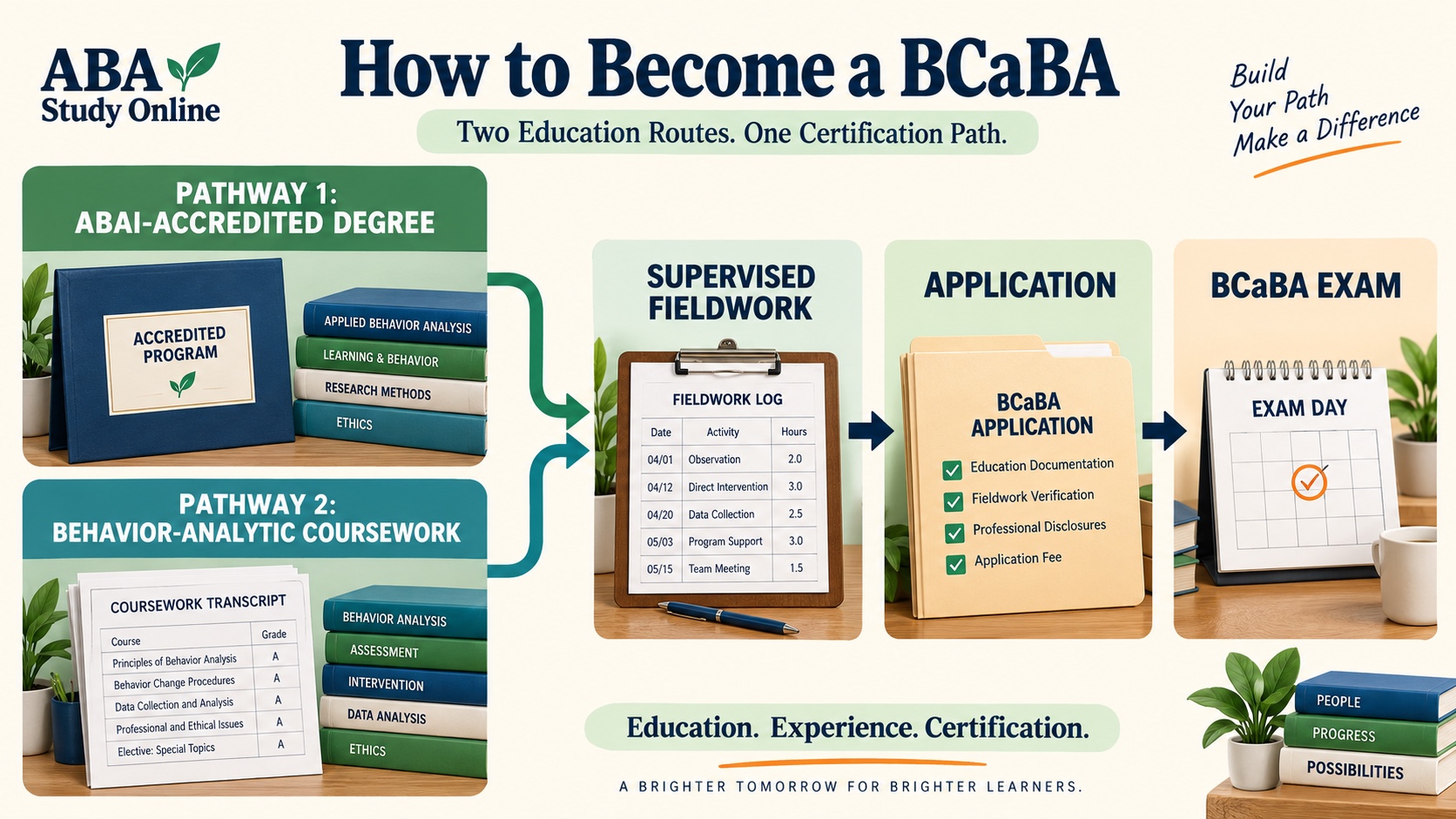
Quick answer: the current BCaBA route requires an undergraduate degree, behavior-analytic content through the applicable pathway, supervised fieldwork, and a passing BCaBA examination. Pathway 1 is tied to an ABAI-accredited degree program. Pathway 2 uses behavior-analytic coursework with an undergraduate degree. You must also meet the application and documentation requirements that apply when you submit your complete application.
Pathway 1 versus Pathway 2
Pathway 1: an ABAI-accredited degree
Pathway 1 is the degree route. The current BCaBA Handbook describes it as a bachelor’s degree or higher from an ABAI-accredited behavior-analysis program, with the degree earned while the program was accredited under the applicable rules. The degree supplies the behavior-analytic content evidence through the accredited program. Keep the institution and degree records available rather than relying only on a school webpage.
Pathway 2: behavior-analytic coursework
Pathway 2 is for an undergraduate degree paired with behavior-analytic coursework. Coursework is not verified by the course title alone. The institution, course level, content hours, dates, grades, and the applicable coursework attestation all matter. If your coursework comes from more than one place or does not fit a simple transcript, create a course map and discuss it with the program contact, advisor, or supervisor.
Both pathways still require supervised fieldwork and the BCaBA examination. A degree or course certificate does not by itself create the BCaBA credential. The BACB also states that it cannot decide whether an individual degree, coursework set, or training experience meets requirements outside a formal review.
Supervised fieldwork requirements
Fieldwork is a separate evidence track for both BCaBA pathways. Before counting hours, identify the supervisor, agree on the supervision arrangement, use the correct forms, and decide how you will record activities and observations. Keep monthly records as you go. Reconstructing a year of fieldwork from memory creates avoidable gaps.
When comparing a job or training opportunity, ask who is responsible for supervision, who observes your work, how often records are reviewed, and whether your activities expose you to both direct implementation and broader behavior-analytic work. A convenient setting is not automatically a qualifying setting. The useful question is whether the arrangement creates the documentation and supervision evidence required for your pathway.
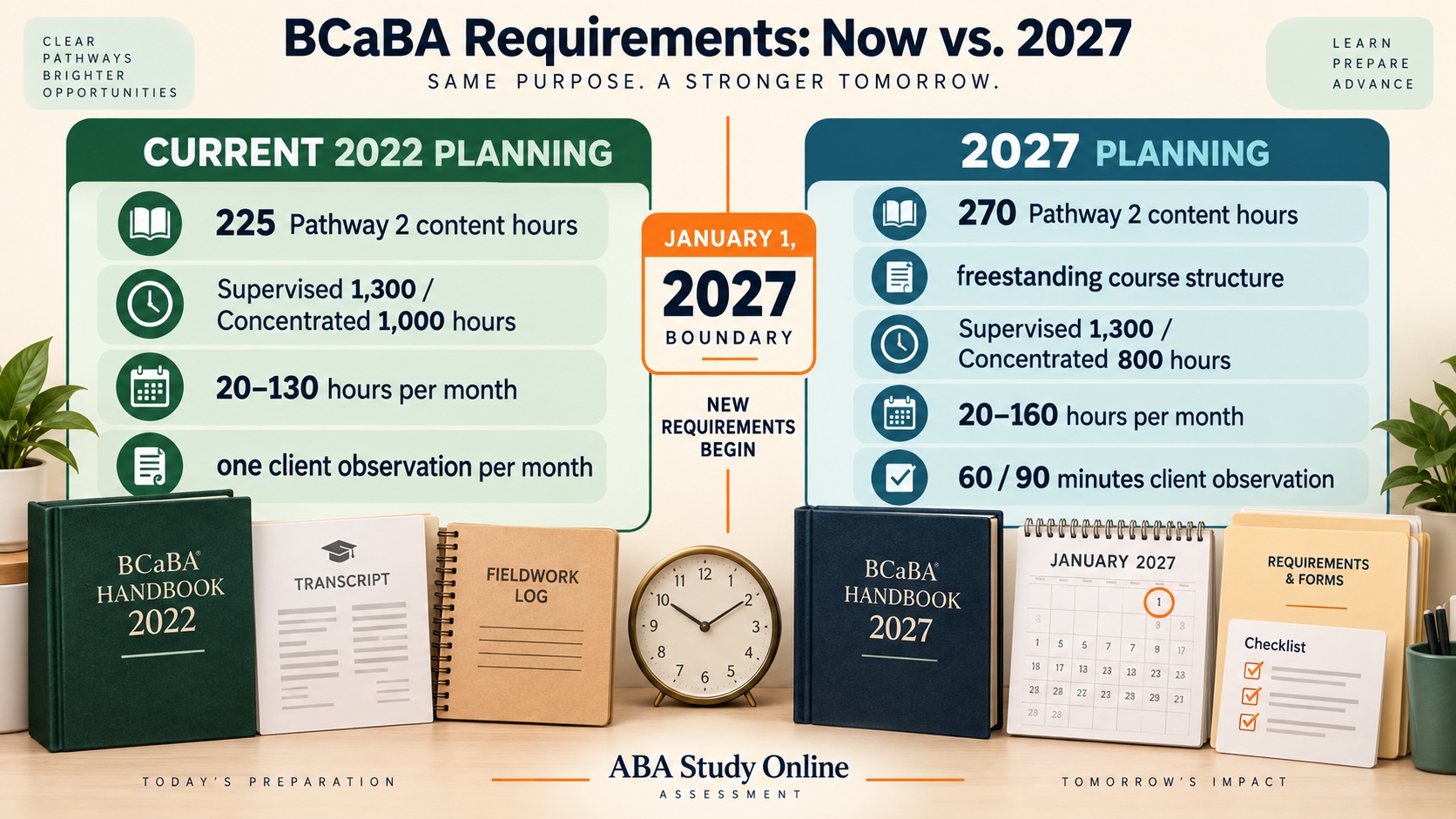
Under the current 2022 requirements, the supervised option uses 1,300 hours with 5% supervision and the concentrated option uses 1,000 hours with 10% supervision. The current monthly range is 20–130 hours, with one client observation per month. These figures sit inside additional documentation and supervision rules, so treat them as a planning summary rather than the complete handbook.
Keep a fieldwork folder with the supervision contract, monthly forms, observation evidence, activity records, supervisor signatures, and final verification. If you change supervisors or settings, mark the transition clearly. A strong folder lets you answer three questions: what did you do, when did you do it, and who verified it?
Set a monthly review appointment with yourself or your supervisor. Reconcile the hours against the permitted monthly range, check that observation information is present, and correct small documentation problems while the details are still easy to verify. This simple rhythm protects both your learning time and your future application record for BCaBA applicants.
What changes on January 1, 2027?
The BACB’s published transition guidance says the new requirements begin January 1, 2027. If you do not submit a complete application under the current requirements by the stated deadline, plan for the new rules. Do not blend current and future numbers into one checklist; label every record with the application period it supports.
For Pathway 2 coursework, the 2027 transition changes the content structure and increases the total from 225 to 270 content hours. The published guide describes:
- Foundations of Behavior Analysis: 45 hours in one freestanding course.
- Methods of Behavior Analysis: 45 hours in one freestanding course.
- Behavior Assessment and Intervention: 90 hours across two freestanding courses.
- Organizational Behavior Management: 45 hours in one freestanding course.
- Ethics in Behavior Analysis: 45 hours, with at least 15 hours in a freestanding course.
The fieldwork figures also change. The 2027 document describes 1,300 supervised or 800 concentrated hours, 5% or 10% supervision, a 20–160 monthly range, and client observations of 60 or 90 minutes per month depending on the option. The transition guidance recommends reviewing coursework with an advisor and maintaining documentation that matches the requirement set for the application date.
The 2027 changes are eligibility and maintenance changes, not proof that the exam has become a “7th edition.” Verify the current BCaBA Test Content Outline separately when you build your study plan. Requirements, forms, and exam-outline terminology should never be assumed from a provider’s old page.
A simple habit helps: keep one folder for eligibility evidence and another for study notes. The first answers whether your records support an application; the second helps you learn the concepts. Keeping those jobs separate prevents a practice quiz, course completion badge, or unofficial checklist from being mistaken for an application document.
Your BCaBA planning checklist
- Choose a target application period: current requirements or the January 1, 2027 rules.
- Confirm your undergraduate degree, institution, award date, and transcript access.
- Choose Pathway 1 or Pathway 2 based on the evidence you can document.
- For Pathway 2, map each course to content, hours, dates, grades, institution, and the current attestation.
- Set up your fieldwork agreement and monthly record before counting hours.
- Track supervision, observation time, activities, signatures, and forms in a single evidence folder.
- Check the current application documents and submit a complete application under the rules that apply.
- Study the current BCaBA Test Content Outline and schedule the exam only after following the application instructions.
Use the right document version
Document version is part of the planning task. The BACB application-processing updates identify the current BCaBA Pathway 2 Coursework Attestation version and distinguish fieldwork forms tied to the 2022 requirements. Before submitting, open the live document page, confirm the version, and save the form with the rest of your evidence. A downloaded form from an old course folder may be useful for learning, but it should not silently become your application form.
If your application will cross January 1, 2027, make a two-column audit: one column for the requirements that support a current application and one for the new requirements. Compare coursework structure, content hours, fieldwork option, monthly range, observation evidence, and forms. If one activity can satisfy both sets of requirements, keep records that make both parts visible. This gives your supervisor or advisor something concrete to review.
Common mistakes
- Confusing an ABA-related degree with Pathway 1: accreditation and degree timing matter.
- Counting course titles without a course map: document hours, grades, level, dates, and institution.
- Starting fieldwork without a record system: monthly evidence is easier to maintain than rebuild.
- Mixing 2022 and 2027 figures: use a dated checklist and the matching forms.
- Calling practice material official: study resources support learning but do not make an eligibility decision.
- Assuming the BACB will pre-approve a transcript informally: use the handbook, advisor, supervisor, and formal review process.
FAQ
Do I need a master’s degree to become a BCaBA?
No. BCaBA is an undergraduate-level certification. The current pathway overview uses an undergraduate degree for Pathway 2 and a bachelor’s degree or higher from an ABAI-accredited program for Pathway 1. Check the current handbook for the route that fits your records.
Can I choose between Pathway 1 and Pathway 2?
They are separate eligibility routes. Your choice should follow the education and coursework evidence you can document, not only the wording on a school’s marketing page.
Will the 2027 BCaBA requirements change the number of coursework hours?
Yes. The published transition guide describes a change from 225 to 270 content hours for Pathway 2, with new freestanding-course and content-area requirements. Review your transcript with an advisor if your application will cross the transition.
Can ABA Study Online tell me whether I qualify?
No. ABA Study Online can explain concepts and provide study resources, but the BACB’s current handbook and formal application review control an individual eligibility decision.
For study support, see the BCaBA learning path, BCaBA practice questions, and ABA glossary. These are educational links, not a certification guarantee.