Requirements for BCaBA: A Quick Self-Check for 2026 and 2027
If you are searching for the requirements for BCaBA, begin with two questions: which eligibility pathway fits your education, and when do you expect to submit a complete application? The BACB’s current BCaBA Handbook and the 2027 requirements use the same broad sequence—degree, behavior-analytic content, supervised fieldwork, application, and examination—but several details change on January 1, 2027.
This is a planning guide, not an eligibility decision. Use it to find the next document or conversation you need, then verify the complete rule set in the current BCaBA Handbook. The fastest way to get lost is to combine current coursework numbers, future fieldwork rules, and an old form into one personal checklist.
Table of Contents
The five BCaBA requirements checkpoints
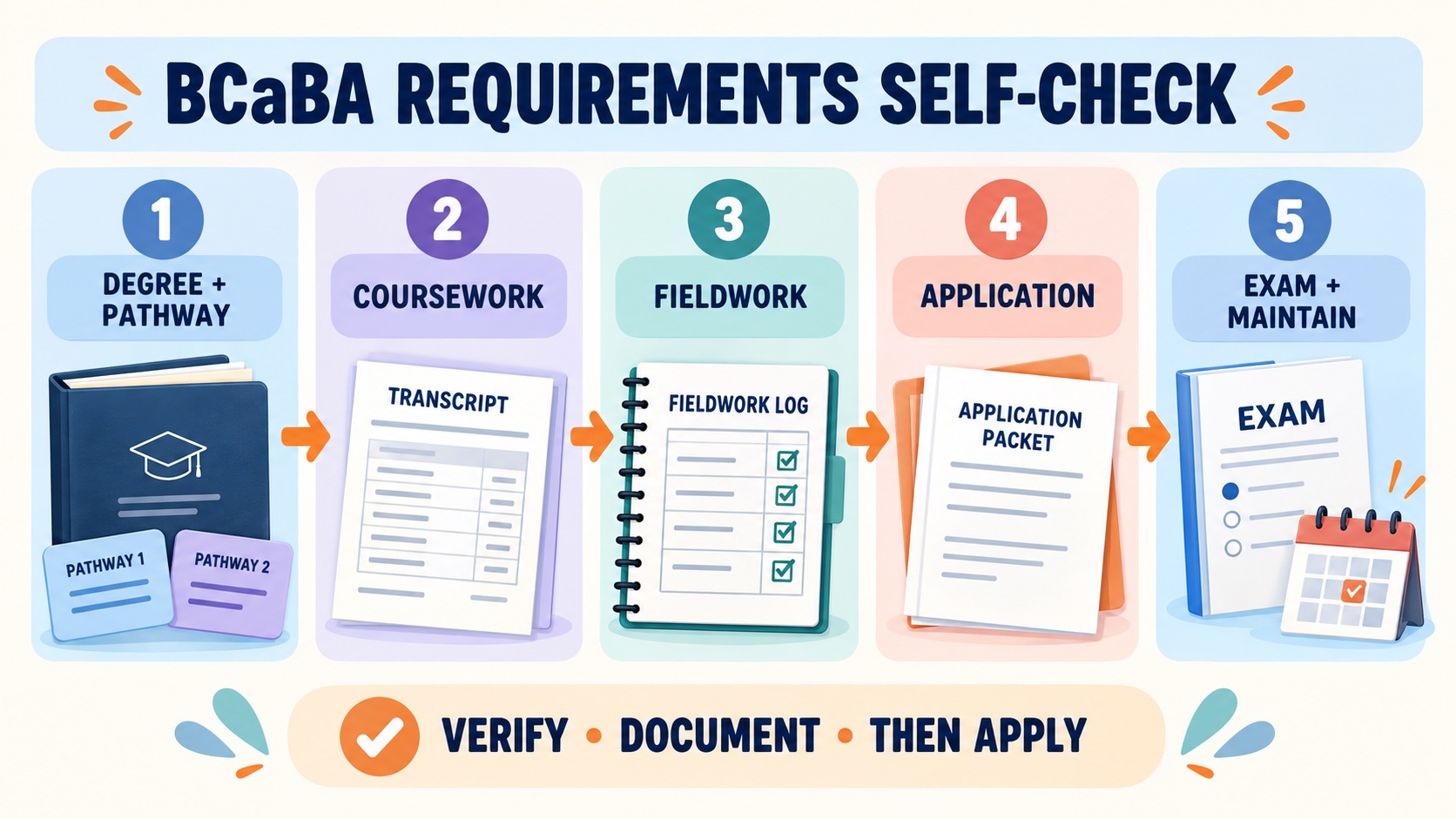
A useful BCaBA requirements check is a chain, not a single box. You need to verify:
- Degree and pathway: whether you are using an ABAI-accredited program route or a coursework route.
- Behavior-analytic content: whether your courses meet the applicable content, hour, institution, and documentation rules.
- Supervised fieldwork: whether your hours, supervisor, contacts, observations, and activity records meet the applicable version.
- Application evidence: whether your portal information, transcripts, attestations, payment, and forms are complete and consistent.
- Examination and maintenance: whether you are studying for the current BCaBA examination and understand the ongoing certification responsibilities.
These steps are connected, but they are not interchangeable. A BCaBA practice test can help you study for an examination; it cannot replace an official transcript. A workplace may offer useful experience; that does not automatically make every hour qualifying fieldwork.
1. Degree and eligibility pathway
The BACB describes BCaBA as an undergraduate-level certification. BCaBAs provide behavior-analytic services under BCBA supervision, and BCaBAs may supervise RBT work when the applicable requirements are met. That supervision boundary is part of understanding the credential: BCaBA certification is not the same as BCBA certification and does not mean independent BCBA practice.
The current Handbook presents two eligibility pathways. Pathway 1 uses a bachelor’s degree or higher from an ABAI-accredited program. Check the specific program and degree, not only the university name, in the ABAI accredited-program directory. Accreditation is program-specific, and the timing rules in the Handbook also matter.
Pathway 2 uses a qualifying bachelor’s degree or higher in any field together with behavior-analytic coursework that meets the BACB requirements through an institution with a Pathway 2 Program Contact. The institution and its designated contact are important evidence points. A list of course titles copied from a website is not the same as the official transcript and attestation process required for an application.
For your first self-check, write down the exact institution, degree, graduation date, possible pathway, and contact person who can confirm the records. If you cannot identify those items, your next step is education-record verification—not more practice questions.
2. Behavior-analytic coursework
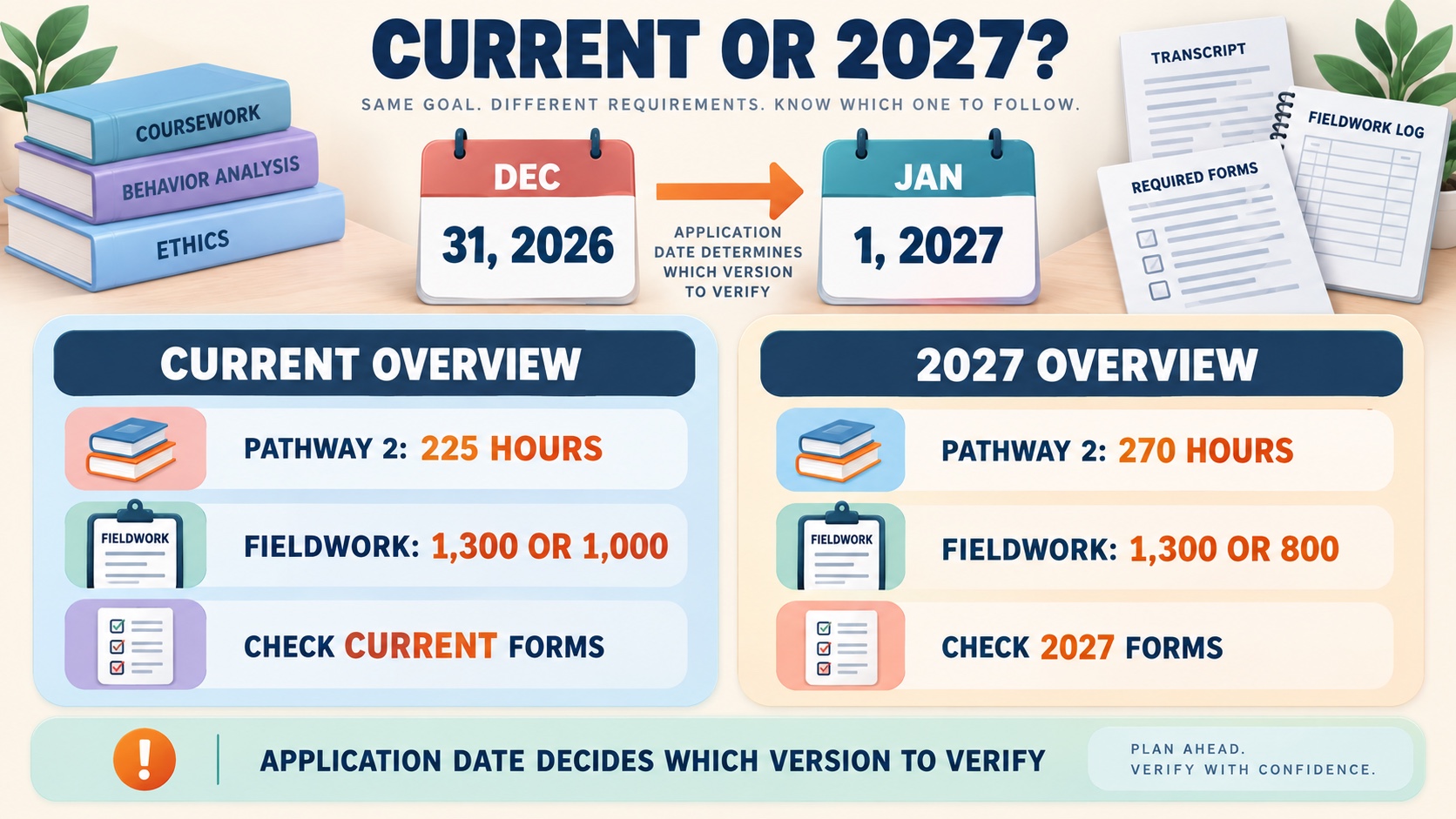
If you are using Pathway 2 under the current requirements, the Handbook’s overview lists 225 instructional hours across six content groups:
- Ethics, the code-enforcement system, and professionalism: 30 hours.
- Philosophical underpinnings, concepts, and principles: 45 hours.
- Measurement, data display, interpretation, and experimental design: 30 hours.
- Behavior assessment: 45 hours.
- Behavior-change procedures and selecting and implementing interventions: 60 hours.
- Personnel supervision and management: 15 hours.
The total is only the starting point. Check the institution, academic level, credit, grade, date, content match, and documentation rules in the Handbook. The current overview also includes a freestanding-course condition for part of the ethics content. If you transferred between schools, keep records from each relevant institution instead of assuming one transcript tells the entire story.
For a 2027 application, do not assume that a current 225-hour spreadsheet transfers unchanged. The 2027 Pathway 2 structure totals 270 hours: Foundations of Behavior Analysis 45, Methods of Behavior Analysis 45, Behavior Assessment and Intervention 90 across two freestanding courses, Organizational Behavior Management 45, and Ethics in Behavior Analysis 45 with at least 15 hours in a freestanding course. The course architecture and freestanding-course requirements matter, not only the total.
A practical document check is to place your transcript beside the applicable content table and mark each requirement as “documented,” “needs institution confirmation,” or “not yet met.” That creates a useful conversation with a program contact or mentor without claiming that a personal spreadsheet is an official BACB review.
3. Supervised fieldwork
Fieldwork is another area where a simple total can mislead. Under the current overview, the BCaBA route lists either 1,300 hours of Supervised Fieldwork or 1,000 hours of Concentrated Supervised Fieldwork. The 2027 overview lists 1,300 Supervised Fieldwork hours or 800 Concentrated Supervised Fieldwork hours.
The hours must fit a supervision system. Depending on the applicable rule version, that includes qualified supervision, the required supervision percentage, individual-versus-group supervision limits, client observations, monthly documentation, and the distinction between unrestricted and restricted activities. The 2027 overview specifies 5% supervision for Supervised Fieldwork and 10% for Concentrated Supervised Fieldwork, 20–160 fieldwork hours per supervisory period, 60 or 90 cumulative minutes of client observation, at least 50% individual supervision, and at least 40% unrestricted activities.
Do not start by asking only, “How many hours do I need?” Ask instead: Who is my qualified supervisor? What activities will be counted? How will each supervisory period be documented? Which version of the forms matches my application date? A fieldwork log with a large number but missing contacts, observations, signatures, or activity classifications may not solve the eligibility problem.
4. Application and examination
After degree, content, and fieldwork evidence are ready, the application stage still has its own checklist. Use the pathway that matches your records, request official transcripts in the manner the BACB specifies, complete any required attestation, and make sure your portal information and documents use consistent identifying information. Keep copies of submissions and note the document version and date.
The examination comes after the application and authorization process. Study the current BCaBA Test Content Outline and official handbook materials, but do not treat a practice score as an eligibility determination. Study tools can organize concepts, question review, and error correction; they cannot create a qualifying degree, coursework attestation, or supervised fieldwork record. The BCaBA learning path and free BCaBA practice questions can support independent study, while the BACB remains the source for application rules.
5. The 2027 requirements date gate
The most important planning variable for many candidates is the application date. BACB transition guidance states that a complete application—including payment and required documents—received by December 31, 2026 is reviewed under the current requirements. The new requirements take effect January 1, 2027. Because “complete” is meaningful here, do not confuse starting an application, creating a portal account, or paying for one document with submitting a complete package.
Use this simple branch:
- Current-rule planning: verify the current pathway, 225-hour Pathway 2 map, current fieldwork option, forms, and complete-application requirements.
- 2027 planning: verify the 270-hour Pathway 2 structure, new freestanding-course details, 1,300-or-800 fieldwork overview, 2027 forms, and the applicable supervisor/documentation rules.
- Uncertain date: keep both versions separate in your planning file and ask a qualified mentor or institution to help you interpret your records before you submit.
The 2027 change is not a reason to invent a “7th-edition BCaBA exam.” The official materials describe eligibility, coursework, fieldwork, and maintenance changes. The examination edition should be verified from the current BACB examination resources and test content outline, not inferred from the year of the requirements update.
Common mistakes and a self-checklist
Before you call your plan complete, check these failure points:
- You verified the specific ABAI-accredited program or identified the Pathway 2 Program Contact.
- You mapped courses to the applicable content table instead of counting only course titles.
- You separated current and 2027 coursework and fieldwork records.
- You have a supervision and documentation system before counting fieldwork hours.
- You know which forms, transcripts, attestations, payment, and supporting documents make the application complete.
- You are studying from the current BCaBA outline and handbook, with no claim to live, recalled, or official examination questions.
- You understand that certification includes ongoing ethics, supervision, continuing-education, and recertification responsibilities.
For free supporting study, use the resources library, the ABA glossary, and the ABC Data Sheet tool for learning and practice. Those resources can make concepts easier to review, but the BACB Handbook and transition materials control the application requirements.
BCaBA requirements FAQ
Can I use any bachelor’s degree for BCaBA certification?
Pathway 2 may allow a bachelor’s degree or higher in any field from a qualifying institution, together with required behavior-analytic coursework and fieldwork. Pathway 1 uses a degree from an ABAI-accredited program. Verify the details in the Handbook rather than treating “any bachelor’s degree” as the complete requirement.
Do I need 225 or 270 coursework hours?
That depends on the applicable requirements and application timing. The current Pathway 2 overview lists 225 hours; the 2027 Pathway 2 structure lists 270 hours with different content blocks and freestanding-course details. Keep the two maps separate until your application-date plan is clear.
Does the 2027 change mean a 7th-edition BCaBA exam?
Not automatically. The 2027 materials address eligibility and maintenance changes. Verify the active examination outline separately through the BACB’s official examination resources.
Can ABA Study Online tell me whether I qualify?
No. ABA Study Online can support independent learning, practice, and document organization, but it cannot determine your certification eligibility or replace the BACB’s application review. Use the official handbook and discuss your record with an appropriate mentor or program contact.
The best BCaBA requirements plan is version-aware and evidence-based: identify the pathway, map the records, establish supervised fieldwork, and then verify the application package. That sequence gives your study time a clear purpose without confusing practice resources with certification rules.