How to Read About Fieldwork and Supervision for Behavior Analysts Online Free
If you want to read about fieldwork and supervision for behavior analysts online free, begin with official BACB resources. You can access the BACB fieldwork pages, handbooks, FAQs, and documentation guidance without treating a copied textbook, an old PDF, or a social-media summary as the current rule. Free reading is useful when it helps you ask better questions of your supervisor and track the requirements that apply to your pathway.
This guide shows where to start, how to separate the BCBA and BCaBA pathways, and how to use free materials responsibly. It does not reproduce the handbook or decide whether a particular activity counts for your fieldwork. Your current handbook and qualified supervisor remain the decision points.
Table of Contents
Start with the official BACB pages
The BACB BCBA fieldwork page is a useful hub because it links to the current BCBA Handbook, fieldwork checklist, documentation resource, sample supervision contract, and fieldwork FAQs. The BACB supervision page adds a role-based view of who supervises fieldwork and what training supervisors need. Open these pages directly rather than searching only for a downloadable file; live pages can point to a newer handbook or transition notice.
Choose the correct certification track before taking notes. BCBA and BCaBA fieldwork are not the same pathway, and an RBT’s ongoing supervision is a different process again. Write “BCBA,” “BCaBA,” or “RBT” at the top of your notes, followed by the handbook version you are reading.
A free reading path
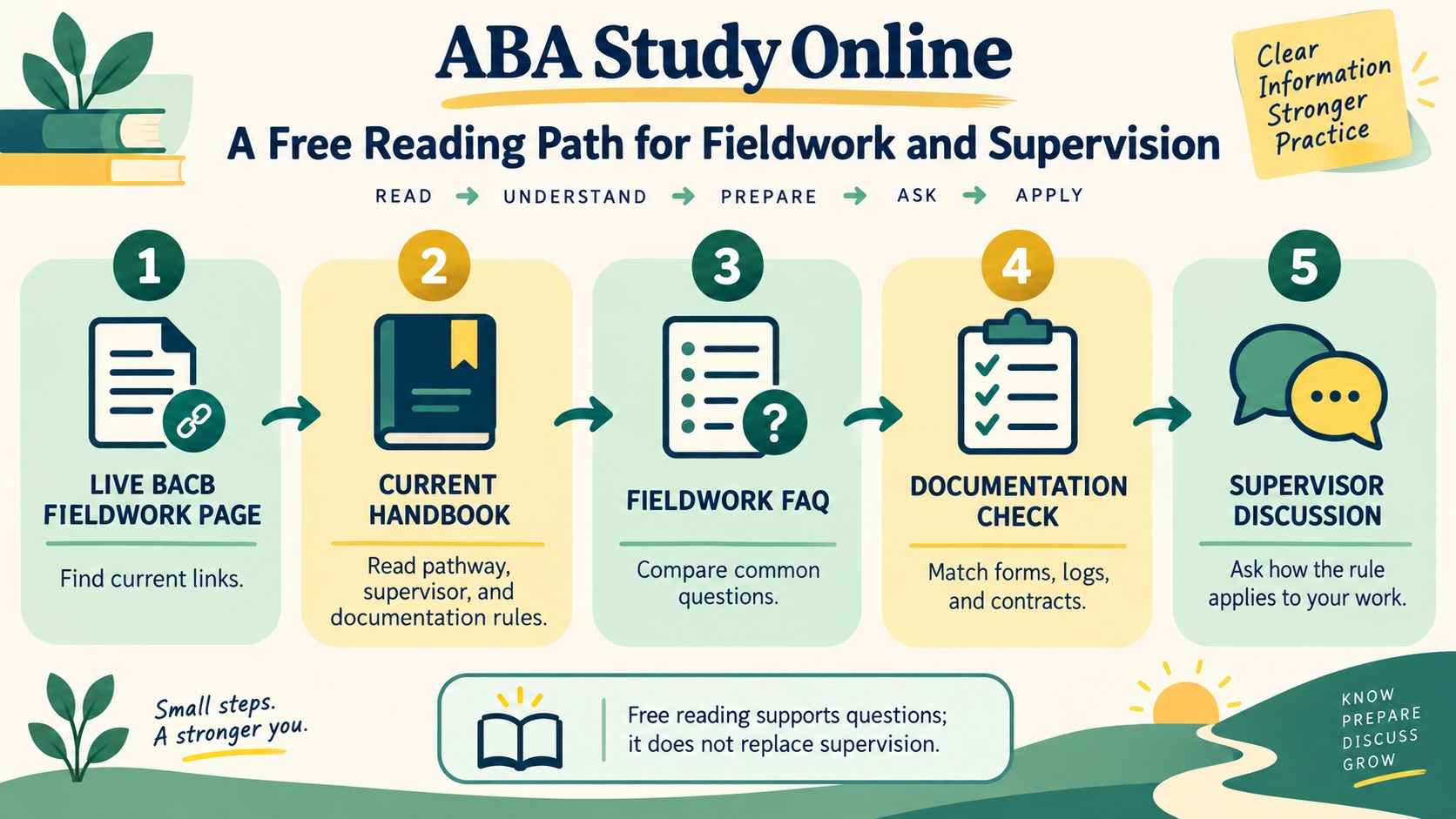
- Open the live track page: use the BCBA or BCaBA fieldwork topic page to see current resources.
- Read the handbook section: locate eligibility, supervisor qualifications, fieldwork activities, documentation, and transition notes.
- Read the FAQ: use it to understand why some answers depend on context and supervisor judgment.
- Review documentation guidance: compare it with the forms and system your organization uses.
- Bring questions to supervision: ask how the rule applies to your clients, contract, organization, and pathway.
What to learn about fieldwork
At a high level, BCBA fieldwork includes a required amount of supervised experience and a mix of client-related activities. The current handbook reviewed for this article describes Supervised Fieldwork and Concentrated Supervised Fieldwork, with different hour totals and supervision intensity. The BACB’s 2027 requirements page signals changes to core eligibility requirements, so do not carry a 2026 number into a 2027 plan without checking the current handbook.
When reading, look for five questions:
- What fieldwork type and pathway am I using?
- Who is qualified to supervise me?
- What contacts and observations are required in each supervisory period?
- Which activities are acceptable, unrestricted, or restricted under the applicable rules?
- Which forms, logs, contracts, and attestations preserve evidence of the work?
Do not assume that every task performed in an ABA workplace counts automatically. Read the acceptable-activities section and ask your supervisor before counting an hour. A free article can explain the decision process, but it cannot validate your particular hour.
Pay attention to the difference between a broad hour total and the rules that make a supervisory period valid. The handbook describes limits on hours in a period, required contacts, observations, the proportion of supervision, and the share of individual supervision. It also describes unrestricted activities that more closely represent the work of a future behavior analyst. These pieces work together. A spreadsheet showing a large number of hours does not prove that the hours meet every requirement.
Read the forms as well as the prose. A monthly verification form, final verification form, supervision contract, and audit log each preserve a different part of the record. If your organization uses software instead of a paper form, ask how its fields correspond to the official documentation. Keep a copy of the agreement and learn who can correct an entry before it becomes difficult to reconstruct.
What to learn about supervision
Supervision is more than a signature at the end of a month. BACB materials describe supervision as guidance that develops behavior-analytic, professional, and ethical skills while protecting client service quality. Your reading should cover supervisor qualifications, supervision contacts, client observations, individual versus group supervision, feedback, and documentation.
Use a short meeting agenda:
- Bring one activity you want to count and the handbook section that appears relevant.
- Explain what you did, what client information you used, and what product or decision resulted.
- Ask whether the activity fits the current pathway and how it should be documented.
- Record the guidance and next action without copying confidential client details.
Good supervision is also an opportunity to practice professional reasoning. Ask for feedback on how you describe behavior, interpret data, select an assessment or intervention step, communicate with caregivers, and protect client dignity. If you only discuss whether a form has a signature, you may miss the skill-development purpose of the relationship.
Use free reading to prepare a specific question, not to avoid the conversation. The most valuable answer is often tied to your actual setting, client service, and professional goals. That is where general guidance becomes meaningful practice.
Keep this distinction visible whenever you compare resources: an explanation teaches, a handbook governs, and supervision applies the rule to your work in context.
It is also a useful way to detect outdated advice: if a page has no track, edition, date, or source link, treat it as a prompt for research rather than evidence.
How to document your questions and hours
Create a private study log with the handbook version, page or section, question, supervisor answer, and follow-up date. Keep official fieldwork forms and organizational records in the system your supervisor approves. Personal notes should not contain unnecessary identifiers, clinical details, or screenshots of protected records.
ABA Study Online’s BCBA resources, free question previews, and app review tools can help you review terminology and organize study sessions. They do not replace the BACB handbook, supervision contract, fieldwork verification form, or supervisor judgment.
Free-resource mistakes to avoid
- Using a pirated or incomplete copy: start with official BACB pages and current handbooks.
- Reading the wrong track: BCBA, BCaBA, and RBT supervision rules have different purposes.
- Copying an old number: transition-year requirements can change.
- Counting hours before asking: an activity must fit the applicable rule and documentation system.
- Confusing a study guide with supervision: reading supports preparation; it does not create a supervisory relationship.
FAQ and official sources
Where can I read the fieldwork rules for free?
Start with the BACB BCBA or BCaBA fieldwork page, the current handbook, fieldwork FAQs, and the supervision-and-training resource page. Confirm that the document is current for your pathway.
Can a free article tell me whether my hours count?
No. Use the handbook’s acceptable-activity guidance, then ask your qualified supervisor about your specific work and documentation.